How AI is Helping Finance to Reduce Costs and Improve Efficiency

In the finance sector, achieving efficiency and reducing costs are more necessary than ever. ViitorCloud’s AI solutions are designed to help your business unlock new levels of productivity and profitability. With our cutting-edge AI development services, we help finance organizations streamline operations, optimize costs, and make data-driven decisions with excellent accuracy.

AI finance cost optimization is not just about automating repetitive tasks. We use advanced AI techniques like Generative AI to transform your financial processes. These solutions delve deep into your data, uncovering valuable insights, forecasting trends, and making intelligent recommendations that enhance decision-making. Whether it’s identifying patterns in large datasets or predicting future market behaviors, our AI solutions work tirelessly to maximize your financial outcomes.

With finance cost optimization with AI solutions from us, businesses can reduce operational costs, increase efficiency, and stay ahead of the competition. Our AI experts team developed AI tools that are designed to evolve with your needs, ensuring that as your business grows, so do the benefits of your AI infrastructure. We take pride in offering customizable AI finance solutions that can adapt to your unique challenges and goals.

With ViitorCloud, you’re not just adopting AI; you’re investing in the future of your financial success. Our finance cost optimization with AI services is tailored to ensure you see tangible results, from cost reduction to improved strategic decision-making. Let us help you turn AI potential into real-world performance.

Revolutionize your finance operations! In the following blog, discover how our AI development services can drive your business forward with AI solutions specifically crafted for the finance sector. Let’s unlock the future of finance together!

The Role of Artificial Intelligence in Finance

ViitorCloud provides innovative AI solutions that can greatly improve the operational capabilities of financial institutions, helping them better serve their clients. We offer tailored AI development services designed specifically for the finance sector, leveraging advanced technologies. Effective finance cost optimization with AI solutions is essential for staying ahead. Our expertise in AI finance cost optimization enables financial organizations to streamline their processes, reduce operational costs, and enhance overall efficiency.

Let’s have a look at how finance cost optimization with AI works and the role of AI in finance:
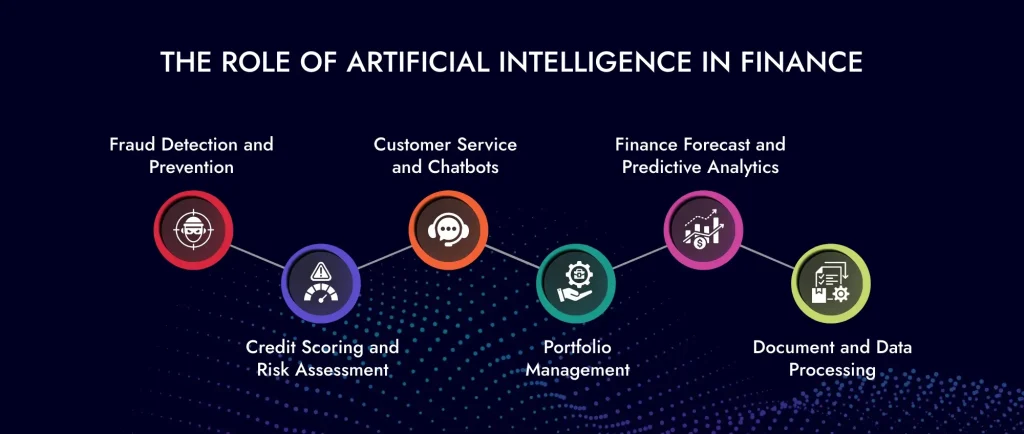
The Role of Artificial Intelligence in Finance

1. Fraud Detection and Prevention

The banking and investment sectors continually deal with fraud on a daily basis, one of them being money laundering. Financial institutions have traditionally used expert-written rules coded into software. Though efficient, criminals often avoid these rules. By creating an artificial intelligence system that “learns” to identify suspicious behavior without fixed rules, we have AI.

Machine learning is used by about 70% of financial organizations for fraud detection. Besides detecting fraud, AI-powered chatbots act as a first line of defense during digital transactions, verifying identities with advanced techniques like biometric analysis or multi-factor authentication (2FA).

These virtual assistants handle tasks usually done by human agents, such as identity verification, and answer queries 24/7 without fatigue or bias. It also leads to improved customer service quality and reduced operational costs.

2. Credit Scoring and Risk Assessment

Fintech firms are already leveraging machine learning’s abilities to exploit information not usually tapped into by traditional financial companies. Rather than sticking with basic credit data, they access alternative sources such as online activities, social media content, or smartphone usage patterns. This advanced analysis paints a more detailed picture of an individual’s financial habits, helping lenders manage risks more effectively and possibly offering borrowers lower interest rates.

A Wells Fargo study highlighted that AI implementation resulted in fewer loan defaults than conventional methods used by major financial corporations. Besides aiding decisions on asset allocation, AI plays a crucial role in efficiently managing investment risks. It does this by analyzing complex datasets from different sources like economic indicators and social media sentiments, identifying possible threats before they cause significant impacts on portfolio performance.

Fintech organizations utilize advanced ML algorithms to forecast future trends based on past behavior patterns and anomalies uncovered during analysis. Thus, proactive risk mitigation strategies can be employed instead of reactive measures taken after incurred losses.

3. Customer Service and Chatbots

AI-powered chatbots are now indispensable when it comes to automating customer service processes. These virtual assistants use machine learning algorithms to improve continuously based on user interactions. Beyond handling queries 24/7, these chatbots provide tailored financial advice by analyzing an individual’s financial data and patterns and suggesting better-saving strategies or suitable investment opportunities.

Another strong application of AI in fintech is that predictive analytics helps predict future behaviors based on past trends and customer feedback, thus allowing companies to anticipate solutions even before clients express needs. Major corporations like Wells Fargo use this technology to predict possible issues affecting their customers’ accounts or transactions, thus enabling them to act promptly and fostering trust between the institution and its clientele within the finance and banking industry.

4. Portfolio Management

AI and machine learning algorithms are now critical for improving decision-making processes and optimizing investment portfolios towards maximum returns with minimum risk.

It is also vital in assessing the performance of an investment portfolio and asset allocation. Today’s Fintech companies use AI instead of traditional methods, which rely on financial advisors using past data and personal experience.

This innovative method allows for a flexible asset allocation, which changes investments depending on market conditions instead of sticking to a particular strategy. This way, it enhances returns while effectively reducing risks.

5. Finance Forecast and Predictive Analytics

Predictive analytics is a crucial tool in the fintech world. It applies statistical techniques such as modeling and machine learning to analyze facts plus historical information. Therefore, this kind of deep analysis makes it possible to forecast future events or behaviors within the finance sector accurately. These technologies enable financial institutions to have factual insights rather than relying on speculation or gut feelings, leading to better outcomes.

Many advantages accrue to fintech firms that integrate AI into their systems. One is improved operational efficiencies; automated systems can perform complex calculations much faster than humans, driving traditional financial services to such technological advancements.

Also, AI is essential in predicting future happenings based on previous and current data. This attribute is vital to financial achievement, such as saving for personal assets or increasing a company’s profitability while cutting expenditures.

6. Document and Data Processing

Artificial intelligence in document and data processing has transformed the finance industry. In the past, dealing with large amounts of financial information and paperwork used to take time and was usually prone to mistakes. Conversely, AI automates this operation by automating it, avoiding errors due to human involvement.

AI-powered tools can quickly extract, categorize, and analyze data from different documents, such as invoices, contracts, and financial statements, to aid in faster processing time, lower error risk, and higher data accuracy. To this end, machine learning algorithms improve their performance over time by gaining knowledge of new data, consequently boosting their ability to identify trends and abnormalities.

For instance, AI can automate extracting relevant information from a large volume of unstructured data that converts into structured formats that are easier to analyze and report. For compliance purposes in particular, where accurate and timely reporting is important the capability is helpful.

READ: AI in Finance – Transforming Banking with AI Solutions

Optimize Your Financial Operations with AI!

Discover how our AI solutions drive finance cost optimization and boost efficiency in the BFSI sector. Let’s transform your business now!

Finance Cost Optimization with AI Solutions

AI plays an important role in driving finance cost optimization with AI solutions. These advancements not only lead to reduced costs but also significantly enhance the efficiency of financial activities.

By implementing AI finance cost optimization, organizations can streamline their processes, allowing finance teams to focus on strategic initiatives rather than routine tasks. This shift fosters a more agile and responsive financial environment, ultimately resulting in better decision-making and improved overall performance. Embracing these innovations is a confident step toward a more efficient future in finance.

Let’s discuss how finance cost optimization with AI solutions works:
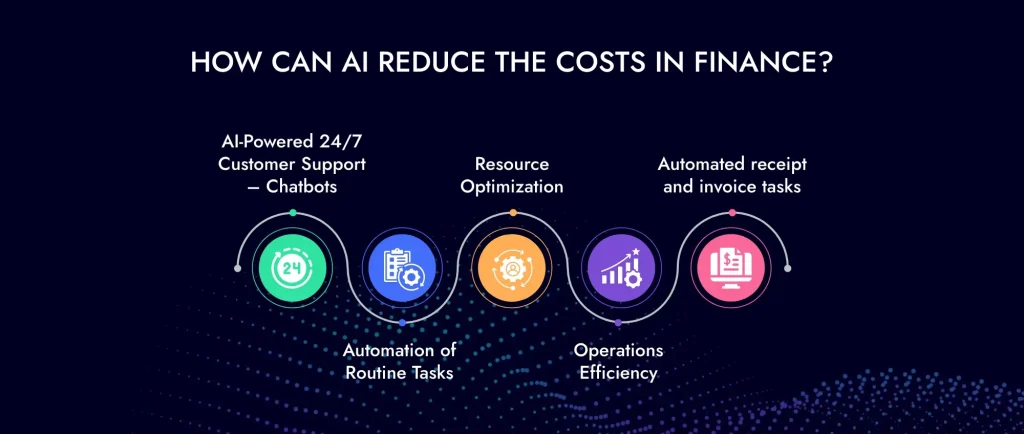
Finance Cost Optimization with AI Solutions

The majority of consumers believe that customer service is crucial for brand loyalty. Time and resource constraints can frustrate customers and mar their experience. Many customers expect banks to provide 24/7 customer service, regardless of time zones. However, difficulties associated with 24-hour service include hiring, training, and scheduling staff. These challenges require significant financial investment, thus consuming much of banks’ budgets.

This is where AI chatbots come in handy, helping with any task at any given time. One of the major benefits of finance cost optimization with AI is an expansion of access to self-service for customers; however, they must be able to understand instructions delivered via texts or sound prompts generated by an interactive voice response (IVR) system. Chatbots can interpret context, detect emotion in text messages, and respond appropriately.

Chatbots are best suited for determining account balances or knowing fixed deposit rates. Millions are saved by these artificial intelligence bots, freeing up resources and saving time for the banking industry. Additionally, chatbots overcome language barriers since training them involves teaching them how to answer queries and converse using any language.

Finance cost reduction may be achieved by automating routine tasks as part of an artificial intelligence integration strategy, with machines taking over such tasks as entering information into databases, making transactions go through, or verifying whether regulations have been complied with, which used to be done manually, taking much time.

Thanks to powerful AI systems that can do these operations with high precision and speed, human involvement may be minimized. This, in turn, will save labor costs and minimize the chances of making costly mistakes.

For example, AI can do account reconciliation automatically, while payroll management, invoice processing, etc., become much simpler. These developments, therefore, mean that finance cost optimization with AI is a reality all over the world.

By providing actionable insights through advanced data analytics, AI helps financial institutions to optimize resources within their reach. For instance, using artificial intelligence makes it possible to detect inefficiencies from huge amounts of information available to understand market trends and make better decisions about investing for the future. Financial institutions must use their assets efficiently by allocating them properly among capital equipment, employees, and technology.

For instance, predictive analytics based on AI can anticipate customer behaviors hence helping financial companies know where they should put more money into or remove such services – this approach is known as strategic resource allocation. Through this method, desired results are achieved at the minimum costs possible.

AI simplifies processes and reduces time taken in executing complex tasks thus enhancing operational efficiency for an organization. Such measures can be implemented by using artificial intelligence in workflow management hence optimizing customer service especially when it comes down to decision-making processes for financial-related issues.

The AI integration strategy of chatbots into an organization’s operations ensures that customers have access to support every day of the week including weekends even during odd hours of the night. Therefore this results in improved satisfaction levels among clients who no longer have to wait in long queues at any banking hall looking for someone capable enough answering even simple queries made by text messages or through pressing buttons on their phones; thus saving millions each year on maintaining large call center teams only ready assist you 24/7.

Additionally, real-time fraud detection is more efficient than conventional techniques because it allows monitoring and analysis of actual transactions carried out by AI-powered cost reduction in finance. To prevent further damage from fraud and protect the institution’s reputation, this proactive approach to fighting fraud saves money by reducing losses associated with fraudulent activities.

According to a study conducted by Harvard Business Review Analytic Services, 67% of C-suite executives agree that their teams’ major activities include chasing receipts and invoices. Again, 64% think that financial departments should concentrate on examining financial information to guide business decisions. This gap shows how vital strategic obligations differ from regular operational roles.

With built-in automation, AI provides real-time data and simplifies the month-end close process. AI solution automates chasing missing receipts and invoice information, saving you time, improving accuracy, and speeding up spend visibility without constantly asking colleagues for information.

ALSO READ: Benefits of AI in Finance: Transforming Financial Services

Cut Costs and Enhance Efficiency with AI Solutions

Leverage the power of AI for finance cost optimization and unlock unparalleled operational efficiency. Partner with ViitorCloud today!

Examples of Successful Enterprises in the Finance Industry

AI applications in finance, ranging from credit scoring to fraud detection, have maintained efficiency and accuracy. Industry reports reveal that nearly 70% of financial institutions use machine learning for essential functions like risk management and customer service automation. This adoption improves decision-making processes and optimizes operational costs, paving the way for significant financial gains.

Moreover, AI’s impact extends beyond operational efficiency to economic contribution. Forecasts indicate that AI could inject $15.7 trillion into the global economy by 2030, exceeding the combined current outputs of China and India. This economic windfall highlights AI’s pivotal role in driving global growth and competitiveness across financial enterprises. In parallel, regional insights highlight India’s burgeoning AI market, projected to reach $3.9 billion by 2028, fueled by rapid digitization and AI’s transformative capabilities in the banking, healthcare, and telecommunications sectors.

Innovative AI tools like ChatGPT exemplify AI technologies’ rapid adoption and scale within financial enterprises. With ChatGPT collecting over 100 million active users within months of its launch, the application highlights AI’s potential to improve customer interaction and operational productivity. Enterprises are using ChatGPT to enhance customer service, generate multilingual content, and improve workforce productivity. As financial institutions continue to use AI’s capabilities, they are on the way to unlock new opportunities for growth, efficiency, and customer satisfaction.

SEE: Top Applications of AI in Finance Transforming the Industry

Transform Finance with Smart AI Solutions

Our AI expertise helps you achieve finance cost optimization while improving performance in the financial sector. Get started with us!

How Can ViitorCloud Help Finance Companies with AI Solutions?

In the finance industry, staying ahead of the competition means adopting innovation—and AI is at the forefront of that transformation. From finance cost optimization with AI solutions to streamlining routine tasks, AI is revolutionizing how financial institutions operate. It’s not just about reducing costs; it’s about creating new efficiencies, optimizing investment decisions, and delivering superior customer service. For companies that are serious about AI finance cost optimization, now is the time to adopt AI solutions that can future-proof your operations and drive business growth.

AI development companies like us understand the unique challenges faced by financial institutions. That’s why our AI development services are designed specifically to meet your needs. Whether you’re aiming to cut costs, enhance operational efficiency, or explore AI-driven insights for better decision-making, we offer AI solutions that will empower your business to succeed in this growing market. Our team of AI experts works closely with you to deliver customized solutions that align with your goals, ensuring a seamless integration of AI into your financial operations.

Why wait? The future of finance is AI-driven, and ViitorCloud is here to help you harness that potential. From automating back-office tasks to implementing refined algorithms for financial analysis, our AI finance cost optimization solutions are built to deliver results. Contact us today and let us lead the way in transforming your finance operations with innovative AI technologies.

Don’t miss the opportunity to stay competitive! Partner with ViitorCloud and unlock the true power of AI for your business.


Frequently Asked Questions

AI automates routine tasks, enhances operational efficiency, and minimizes errors, reducing overhead costs significantly.

AI optimizes finance by enhancing decision-making with predictive analytics, improving risk management, and automating processes for faster transactions.

AI simplifies workflows, speeds up data processing, and enables faster customer service through automation and predictive insights.

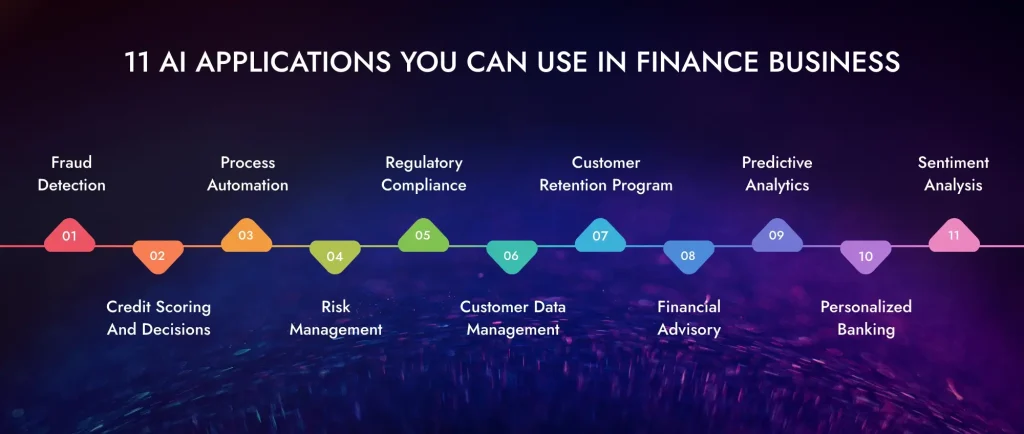
Top AI Applications Transforming Finance

Artificial Intelligence is already transforming industries, and finance is no exception. While blockchain, cryptocurrencies, and Robo-advisors often make headlines, AI is the true game-changer in the finance sector. The future of finance lies in smart, AI-powered solutions that drive efficiency, enhance customer experiences, and reduce operational costs.

The financial services are vast and complex, from retail banking and investment management to insurance and accounting. This is where our AI development services step in. Our AI solutions streamline processes, improve decision-making, and cut costs, empowering your business to stay ahead in a competitive market.

The applications of AI in finance are extensive, whether it’s fraud detection, personalized banking experiences, or automated investment strategies. AI simplifies operations and enables your team to focus on growth, not just maintenance.

If you want to elevate your business with AI, ViitorCloud is here to help. Our expertise in AI development ensures that your finance operations will not only be more efficient but also future-proof. We provide tailored AI solutions that can transform your financial services!

Top 11 Applications of AI in Finance Business

By integrating AI into finance, companies can significantly reduce operational costs and increase profit margins. This technological advancement also grants customers the convenience of accessing their accounts on their smartphones, allowing for seamless mobile banking experiences.

Top 11 Applications of AI in Finance Business

1. Fraud Detection

AI has become an integral tool for detecting and preventing frauds, especially within Fintech due to its ability to analyze large amounts of data quickly and accurately.

Machine learning algorithms are crucial for improving how financial institutions detect fraud. AI applications in finance algorithms learn from past financial transactions to spot patterns that may indicate fraudulent behavior. This predictive analytics approach helps companies proactively identify threats before they cause damage, offering extra protection for customers’ private data.

Also, Artificial Intelligence-powered chatbots serve as gatekeepers during digital transactions. Scammers use these as their first defense through methods like biometric analysis or multi-factor authentication (2FA) that verify the identity of individuals who could be thieves. Such technology keeps malicious people away from innocent customers.

2. Credit Scoring and Decisions

Credit scoring has been transformed by Artificial Intelligence (AI) in financial services where traditional models have been replaced with more accurate and sophisticated ones. For instance today, fintech firms use AI-driven machine learning algorithms that consider more variables than traditional financial institutions do.

These algorithms make use of both standard credit data along non-traditional sources such as online behavior, social media interactions, or even phone usage patterns. This is because AI in finance applications gives lenders a better view concerning borrowers’ reliability in terms of finances other than just relying on regular credit data only which means they can assess risk better leading to lower interest rates.

According to a Wells Fargo study based on fewer loan defaults following the adoption of artificial intelligence than conventional methods applicable among major financial institutions, it is evident that AI effectively enhances risk management within the finance industry.

3. Process Automation

Machine learning solutions enable financial services companies to automate repetitive tasks thus increasing productivity through intelligent process automation. Examples of such innovations include chatbots, automated paperwork handling, and gamified employee training. The result – enhanced customer experience, reduced costs, and improved service scalability.

Furthermore, machine learning technology is also effective in accessing and interpreting data to identify patterns and trends. In this regard, AI in finance application chatbots are used by customer support systems to deal with a wide range of issues as if they were real people.

For example, Wells Fargo has a chatbot on Facebook Messenger driven by machine learning that interacts with users seamlessly helping them find account information or recover passwords; this illustrates how artificial intelligence can improve customer service in the banking sector.

4. Risk Management

Banks and other financial institutions can use machine learning techniques that analyze huge amounts of data to reduce risk factors greatly. Thus, unlike traditional methods, which only consider limited details like credit scores, ML appraisals better understand an individual’s personal information, which is widely available for assessing their real risk capacity.

Machine learning-based insights into banking and financial services simplify informed decision-making. For instance, ML programs may draw from multiple data sources while assessing loan applications before giving them risk scores. This way, the algorithms will give possible defaulters, prompting companies to adjust terms or rethink their approach towards each client individually.

READ: Benefits of AI in Finance: Transforming Financial Services

5. Regulatory Compliance

Keeping pace with regulatory changes across different locations constitutes a challenge to Fintech companies. This is made easier with constant monitoring and interpretation of new rules by Artificial intelligence in finance application. It updates the system’s rules on time for compliance purposes, reducing the chances of penalties and improving trust between customers and regulators alike.

6. Customer Data Management

Regarding banks and financial institutions, data is crucial for their operations and success. Efficiently managing volumes of diverse financial data—from mobile communications and social media activity to transaction details and market data—is a significant challenge even for financial experts.

By using machine learning approaches, organizations can increase processes’ efficiency and capacity to get valuable information from data. Among these AI and ML tools are analytics, data mining, and natural language processing that help derive actionable Intelligence from this huge number of records, which essentially enhances business profit.

For example, customer financial data can be evaluated by machine learning algorithms to assess the influence of market changes and specific financial trends. This enables institutions to make informed decisions and offer customized services that cater to customer requirements in a better way.

7. Customer Retention Program

ML technology used by credit card companies determines which customers are in danger of becoming dormant and works on retaining them proactively. Their system helps them accurately forecast the behavior of their customers based on user demographics and transaction history and adaptively create custom-made offers.

During this operation, predictive models are used to spot at-risk customers using binary classification. In turn, the recommender model provides personalized card offers for effective customer retention from dropping off.

8. Financial Advisory

Machine learning-driven budget management apps provide customers with specialized financial advice and guidance. These apps enable users to track daily spending and analyze data to pinpoint spending patterns and areas for potential savings.

Another emerging trend is the rise of Robo-advisors. These AI-powered tools work like human advisors but target individuals and small and medium-sized enterprises with limited resources. Robo-advisors use machine-learning algorithms to build investment portfolios advising on trading, investments, or retirement issues among other needs.

9. Predictive Analytics

In Fintech companies predictive analytics is an important thing to consider. It uses methodologies like modeling, and machine learning to enable deep analysis of both present and historical datasets. This kind of analysis makes it easier to predict events happening in the future or behaviors taking place in the finance sector more precisely.

Factual insights rather than speculation or intuition are obtained by financial institutions using these beneficial technologies. Hence, more informed decision-making is possible leading to better overall outcomes. Various advantages come with Fintech firms integrating AI capabilities within their systems.

One such benefit is increased operational efficiency; traditional financial service providers prefer this technology since automated systems perform complex calculations much faster than humans. Moreover, AI enhances risk management strategies particularly in hedge funds and asset management firms by enabling more sophisticated risk assessment mechanisms and mitigation measures.

10. Personalized Banking

Financial advice does not fit all because its unique circumstances differ from each client’s. In this way, AI helps financial institutions provide personalized guidance and “advice engines” that use machine learning to suggest customized investment decisions, taxation, insurance, etc.

Similarly, AI adaptive capabilities go beyond simple automation providing highly targeted advice on the other hand.

11. Sentiment Analysis

Through using advanced AI systems Fintech companies are now able to handle amounts of data from social media posts and news articles. By using machine learning algorithms, these systems can understand an investor’s sentiment towards a specific security or the entire market and differentiate between positive, negative, and neutral sentiments.

AI uses NLP for interpreting human language. It mainly focuses on identifying emotional words in text data and assigning scores based on positivity or negativity. NLP analyzes sentiment in text data for personalized financial services provided by Fintech platforms.

For example, when algorithmic trading approaches discover similar investors demonstrating increased optimism around certain stocks algorithmic trading methods like this sentiment analysis can be used as a signal toward investing some of your money into them.

Enhance Financial Performance with AI

Use AI applications in finance to drive efficiency and innovation. Our expert AI development services deliver customized solutions to meet your unique needs.

What is the Potential of AI to Reduce Finance Costs

AI, especially Generative AI powered by Large Language Models (LLMs), is transforming the finance industry by automating tasks, increasing efficiency, and significantly reducing manual work. Financial companies can stay updated and enhance customer experiences by using these disruptive technologies with tailored AI solutions from ViitorCloud.

By investing in AI development services, businesses can implement AI applications quickly and see immediate benefits. For example, AI can streamline coding processes, helping developers launch new financial products and services faster and with greater accuracy. Imagine reducing your operational costs while boosting performance—AI makes this possible.

A recent global survey revealed that 36% of financial professionals reported cost reductions of over 10% after integrating AI. According to the study, several hundred Nvidia’s financial customers have been found implementing them. Nearly half saw noticeable improvements in customer service. At ViitorCloud, we offer AI-driven solutions that not only enhance customer interactions with multilingual support but also streamline compliance, risk management, and security efforts—drastically lowering costs in these areas.

ViitorCloud has already helped numerous businesses harness the applications of AI in finance, such as contract translations and seamless communication between diverse teams and customers. Our AI development services are designed to reduce costs, improve service, and transform financial operations.

Transform Your Financial Strategy with AI

Stay ahead in the finance sector by incorporating advanced AI applications. Our top-notch AI development services provide comprehensive solutions to enhance your financial processes.

How ViitorCloud Empowers Finance to Become Future-Ready

The finance industry is undergoing a rapid transformation with the integration of AI. Applications of AI in finance are driving efficiency, enhancing customer experiences, and improving decision-making. AI processes large volumes of data with remarkable speed and precision, enabling financial institutions to operate more efficiently while offering personalized services tailored to each customer’s needs.

At ViitorCloud, we empower financial institutions to become future-ready with our cutting-edge AI solutions. Our AI development services are designed to help your organization adapt to the evolving finance sector, improving compliance, optimizing financial strategies, and elevating customer service.

Hire AI developers and transform your finance operations with AI! Partner with ViitorCloud today and lead the way to a smarter, more efficient future. Contact us now to explore how our AI solutions can revolutionize your business.


Frequently Asked Questions

Applications of AI in finance offer enhanced decision-making, risk management, and personalized services. It improves efficiency by automating routine tasks, analyzing many data sets for insights, and providing predictive analytics for better financial planning.

AI in finance examples include AI-driven chatbots for customer support, fraud detection systems, robot advisors for investment advice, credit scoring models, and automated compliance monitoring that streamline operations and improve service delivery.

AI in finance application solutions includes predictive analytics; machine learning algorithms used in spotting fraudulent activities; financial advisor personalization technologies; automatic compliance systems as well and customer interaction tools powered by artificial intelligence that boost efficiency and customer experience.

How Can AI be Beneficial to The Finance Sector?

The finance industry has always been at the forefront of adopting cutting-edge technologies, and Artificial Intelligence is no exception. While AI is gaining traction across various sectors, its impact on finance is particularly transformative. From enabling banks and lenders to streamline operations, to making data-driven decisions, and delivering highly personalized customer experiences, the benefits of AI in finance are undeniable.

Recent innovations in AI are pushing the boundaries even further, helping financial institutions boost efficiency, improve decision-making, and optimize service delivery. But to truly capitalize on AI’s potential, businesses must look beyond the hype. Leveraging AI development services and tailored AI solutions can unlock new levels of productivity while significantly reducing costs.

At ViitorCloud, we provide comprehensive AI solutions designed specifically for the finance industry. Our expertise can help your business harness the full power of AI to not only stay ahead of the curve but also achieve tangible results that drive success. Let’s explore how our AI services can elevate your financial operations.

READ: AI in Finance – Transforming Banking with AI Solutions

Why Does AI Matter in the Finance Sector?

Imagine being able to predict market trends or make rapid financial decisions with ease—thanks to AI, that’s exactly what financial institutions can achieve today. With the benefits of AI in finance, massive amounts of data are processed at lightning speed, enabling quicker insights and more informed decisions. At ViitorCloud, our AI solutions are designed to help finance businesses optimize their processes, from risk management to market forecasting.

One of the biggest impacts of AI in finance is its ability to detect fraud in real-time. Our AI development services provide startups and established finance companies with advanced systems that continuously learn from data patterns, identifying suspicious activities as they occur. This proactive approach not only protects your institution from threats but also fosters trust with your customers.

With AI-powered chatbots, your business can offer seamless customer service, addressing queries instantly without human intervention. But don’t worry—AI solutions don’t replace human expertise. They enhance it. While AI handles data processing and automation, your team can focus on strategic decisions that require human insight. Our AI development services offer the perfect blend of cutting-edge technology and human expertise to help your business thrive in this competitive sector.

Unlock the Benefits of AI in Finance Today

Streamline your financial operations with cutting-edge AI solutions designed to enhance efficiency and accuracy. Partner with us for tailored AI development services that empower your business to stay ahead.

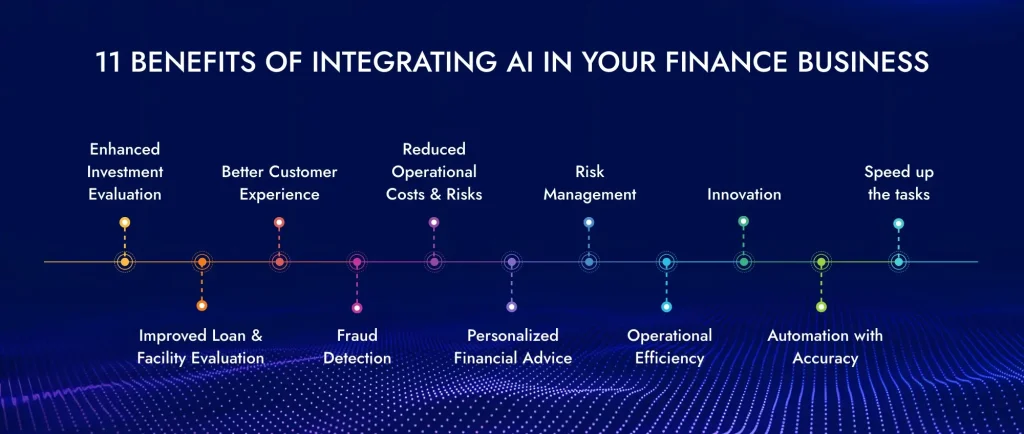
Benefits of AI in Finance Business: Integrating AI in Your Finance Business

Integration of Artificial Intelligence is an absolute game changer with many privileges.

Let us examine how the field of finance benefits from AI:

Benefits of AI in Finance Business - Integrating AI in Your Finance Business

1. Enhanced Investment Evaluation

Bank profitability isn’t only about earning interest. Banks are always looking for profitable investment opportunities that maximize returns.

The role played by sophisticated investment software must be considered since it offers custom-made financial institutions risk appetite-driven advice regarding investments. Further, AI tools can accurately evaluate customer proposals that involve complex industry-specific information.

Though human analysts have the final say on investment decisions, investing analysis software makes this process easier by juggling multiple variables and scenarios. Gathering and analyzing relevant data may be time-consuming and challenging, especially for organizations entering foreign markets. In such scenarios, AI-powered software provides a quick way to assess new markets and opportunities.

2. Improved Loan and Facility Evaluation

Often, financing eligibility based solely on credit scores relies on obsolete data, mistakes or misclassifications. However, today, abundant online information can lead to more accurate assessments of individuals or businesses.

AI-driven systems can now provide endorsements or refusals based on a wider range of factors, even if there are minimal documents available from applicants. The problem still needs to be solved in understanding why the system recommended it. While approved applications usually move forward with little questioning, rejections require clear explanations on why they could not lend from institutions to clients.

According to Accenture, “banks can increase the volume of interactions or transactions by 2-5 times without needing to increase staff” by utilizing AI-based tools. Although artificial intelligence systems may feature biases incorporated in their designs, developers eventually decide on them so that they can provide some form of objectivity. Nevertheless, with growing awareness of institutional prejudices and the heterogeneous nature of funding applications, software developers are now better placed to improve applications and updates by incorporating more pertinent variables.

3. Better Customer Experience

Customers today are all about convenience. The ATM improves the banking system by enabling access to critical services even when banks are closed, which, in turn, fuels innovation in finance startups through AI. Clients can now open smartphone bank accounts and complete verification while sitting on their couches.

This can be done using Decision Management Systems (DMS) to streamline the capture of Know Your Customer (KYC) information, significantly reducing errors and turnaround times. And because the business rules software is robust enough, the banks can quickly effectuate and deploy business decisions without long-established processes.

This ensures that new products and specials are available at the right time and changes made on business decisions or tariffs are incorporated seamlessly into the system. Automated eligibility checks mean clients aren’t frustrated by lengthy processes only to be rejected. This gives personalized service while serving a large number of customers.

4. Fraud Detection

An Enterprise Decision Management System enhances early fraud detection and ensures full audit documentation. Regular third-party audits can interrupt business operations when employees leave their workplace to explain or validate transactions. Software based on advanced technology often recognizes errors through precision data captured by the system itself.

Fraud tactics change as banks tighten controls. Today’s criminals do transactions under detection thresholds so as not to raise suspicion. Without deep-rooted analysis, such activities may slip past checks into compliance even though they satisfy basic requirements. This is where artificial intelligence outperforms humans.

AI scans huge amounts of records to identify suspicious deals accurately, while human attention may go astray in such volumes. Money laundering or funding illegal activities can thus continue undetected if there are no AI-driven mechanisms to detect fraudsters taking advantage of loopholes.

5. Reduced Operational Costs and Risks

Although banking mostly runs electronically, many people-centered practices necessitate lots of paperwork; hence, these processes become major cost centers and risks that lead to errors.

Robotic process automation (RPA) is software miming rule-based digital tasks that humans usually perform. With advancements in handwriting recognition, natural language processing, and other AI technologies, RPA bots can transform into intelligent automation tools capable of handling a wide range of banking workflows once done exclusively by humans.

This implies hyper-automation which combines AI alongside RPA thereby changing effective and reliable banking systems.

6. Personalized Financial Advice

Consider receiving instant financial advice customized to your personal needs and objectives. For instance, AI algorithms can analyze various factors to provide you with customized recommendations such as your financial background, spending habits, or even investment preferences.

AI-powered robo-advisors can recommend portfolios depending on an individual’s risk tolerance levels and financial goals, thus optimizing asset allocation for enhanced returns. Such customization leads to increased client satisfaction and better financial outcomes since investments are aligned with people’s likes and aspirations.

Furthermore, AI-driven financial advice is available around the clock, providing prompt responses to financial planning, budgeting, and investment strategy queries. Thus, clients are empowered by this accessibility to make informed decisions quickly outside of the limitations of traditional banks’ hours.

7. Risk Management

It is important in finance to employ effective risk management systems to ensure financial stability and minimize potential losses. AI is very helpful in managing risks using sophisticated algorithms that can process massive volumes of data concurrently.

By processing this information, AI systems can uncover patterns indicating future risks like fraud or unusual market movements. The early identification of risks enables banks to mitigate them to safeguard assets and preserve operational continuity.

8. Operational Efficiency

Individuals can redirect their attention to strategic initiatives by using AI to handle repetitive tasks. AI excels at automating tasks such as document verification, summarization, transcription of phone conversations, and responding to common customer queries such as operational hours.

This technology allows AI bots to take over mundane or low-engagement tasks previously done by humans thus increasing efficiency and productivity across various areas. It optimizes operations while freeing up human personnel for value-added jobs that drive innovation at the organizational level.

9. Innovation

AI drives innovation in finance, leading to radical changes in different industries. This ranges from improved customer experiences to optimized operational efficiencies; traditional banking is being redefined through the application of AI technologies that are also opening up new growth and development opportunities.

AI has enabled predictive analytics and forecasting models as another area where innovation occurs. Market behavior, asset performance as well as demands from consumers can all be accurately predicted using AI programs based on historical data together with real-time market trends.

In addition, startups spearheading Blockchain technology and smart contract applications have transformed finance Startups with AI which has made finance more transparent, secure, and efficient among others

10. Automation with Accuracy

Repetitive and time-consuming tasks have been transformed in financial institutions by AI-driven automation through increased precision. Document verification, compliance checks, and transaction processing are some of the complex processes that can be done swiftly and without any mistakes by AI-based automated systems.

Using machine learning algorithms, these systems can learn from past interactions and improve performance, ensuring consistent data handling and decision-making accuracy.

For instance, AI-based robotic process automation (RPA) bots can automate back-office operations like data entry and reconciliation, significantly reducing the manual effort required and minimizing the risk of human error.

11. Speed Up the Tasks

Speed is a critical advantage AI brings to finance, where timely decision-making and quick responses can make a significant difference. AI for finance startups accelerates tasks across various domains, from customer service to data analysis, enabling financial institutions to meet the growing demands for faster service delivery and operational responsiveness.

In customer service, AI-powered chatbots and virtual assistants respond instantly to customer inquiries 24/7. These bots can understand natural language, interpret queries, and promptly deliver accurate information or resolve issues.

Transform Your Finance Strategy with AI

Discover the full potential of the benefits of AI in finance. Our expert AI development services deliver innovative AI solutions that elevate performance and drive growth.

How does ViitorCloud Overcome Finance Challenges With an AI Solution?

AI solutions for finance present a game-changing opportunity for businesses in the financial sector. By streamlining operations, enhancing decision-making, and delivering personalized customer experiences, the benefits of AI in finance are undeniable.

With ViitorCloud’s AI development services, your financial institution can automate routine tasks like data entry and fraud detection, optimize investment strategies, and strengthen risk management. Our AI solutions not only help you stay ahead of the competition but also empower you to overcome complex industry challenges with ease.

Partner with ViitorCloud today to harness the full potential of AI and unlock new opportunities for growth in your financial operations. Let’s take your business to the next level!

Benefits of AI in Finance


Frequently Asked Questions

An example of AI in finance is AI-powered chatbots that handle customer inquiries and transactions, providing 24/7 service without human intervention.

AI is used in finance for fraud detection, risk assessment, automated trading, and customer service, enhancing efficiency and accuracy.

AI helps finance companies by improving decision-making with data-driven insights, automating repetitive tasks, and enhancing customer experiences through personalized services.

AI in Finance – How Artificial Intelligence is Used in Finance

Have you ever asked a chatbot about opening a savings account or received a call from your bank to verify credit card activity? This is just a glimpse of how Artificial Intelligence is revolutionizing the finance industry.

AI in finance has transformed operations by automating routine tasks, enhancing customer service, and driving business efficiency. With most banks (80%) recognizing the value of AI, the COVID-19 pandemic has accelerated its adoption, pushing more people to embrace digital solutions.

ViitorCloud’s AI development services are designed to help financial institutions harness the power of AI. From fraud detection and personalized banking to risk management and regulatory compliance, our AI solutions can streamline your operations, improve customer experiences, and enhance decision-making.

This article will explore how AI in finance is used, its benefits to financial companies, and the future of the finance sector.

What is AI in Finance?

Artificial intelligence in finance involves using advanced technologies, mainly machine learning algorithms, to improve various aspects of the finance industry.

AI finance helps generate insights for data analytics, performance measurement, predictions, real-time calculations, customer service, and smart data retrieval. It allows financial companies to understand markets and customers better.

According to Forbes, 70% of financial firms utilize machine learning to predict cash flow, adjust credit scores, & detect fraud.

Transform Your Financial Operations with AI Solutions

Discover how our tailored AI Development Services can drive efficiency in your finance strategy.

AI’s Impact On the Finance Industry

Have you ever wondered how artificial intelligence changes how we manage money and interact with financial institutions? AI in finance impact is nothing short of revolutionary and a topic worth diving into.

Let’s start with something we’re all familiar with—customer service. Remember the last time you interacted with a chatbot regarding your banking needs? That’s AI at work. These intelligent bots are available 24/7, quickly responding to your queries. They can assist with everything from opening a savings account to verifying suspicious activity on your credit card.

Financial institutions generate a lot of data every second, and AI-powered finance tools can analyze this data in real-time. This ability helps banks and other financial firms make more informed decisions. Have you noticed how financial advice is becoming more personalized? AI enables banks to offer customized services based on individual customer profiles. AI can provide personalized recommendations that suit your needs by analyzing your spending habits, investment preferences, and financial goals.

How is AI Driving Continuous Innovation in Finance?

AI has transformed the way financial firms interact with their customers. Chatbots and virtual assistants powered by AI provide instant responses to queries, helping you with everything from balance inquiries to loan applications.

This not only saves time but also improves the overall customer experience. Have you ever felt the convenience of resolving a banking issue at midnight? That’s AI at work, making financial services accessible round the clock.

AI enables banks and financial advisors to offer customized services to your unique financial situation. AI can recommend customized solutions by analyzing your spending habits, investment history, and financial goals. Whether suggesting the best investment opportunities or creating a personalized savings plan, AI ensures that the advice you receive is relevant and beneficial.

Boost Financial Performance with AI Development Services

Implement advanced AI technologies in your finance systems for optimized results.

Why Are Finance Companies Opting for AI?

Finance companies are opting for artificial intelligence (AI) to find more opportunities in the financial sector.

Let’s see why:

1. Personalized Financial Services

AI is changing how financial institutions serve customers by offering highly personalized services catering to individual needs and preferences. AI algorithms can provide recommendations, product offerings, and financial advice by analyzing customer data such as transaction history, spending habits, and investment choices.

For example, AI-powered finance robot advisors can create customized investment portfolios based on a person’s risk tolerance, financial goals, and investment timelines. AI-driven banking apps can also deliver personalized financial management tools, budgeting assistance, and product recommendations, enhancing customer experience.

2. Fraud Detection & Prevention

One of the most used applications of the AI finance industry is fraud detection and prevention. Have you ever wondered how banks avoid fraud activities? Traditional methods often struggle to keep up, but AI is changing the industry. AI in finance algorithms can analyze a lot of data in real-time, identifying patterns that may indicate fraudulent activities.

AI-powered fraud detection systems continuously learn and adapt. Isn’t it amazing how these systems can catch fraud attempts? By using machine learning techniques, AI can analyze relationships and correlations that humans might miss. This approach safeguards financial institutions and their customers and helps maintain trust and confidence in the financial system.

3. Smart Process Automation

AI is transforming the finance industry by automating various processes, streamlining operations, and minimizing the risk of human error. Have you noticed how quickly things get done these days? That’s thanks to intelligent process automation (IPA), which combines AI with robotic process automation (RPA) to handle complex and knowledge-intensive tasks.

For instance, AI can automate document processing, accurately extracting relevant information from financial statements, contracts, and other documents. Can you imagine how much faster and error-free these processes become? This speeds up operations and reduces the chances of errors and inconsistencies.

Furthermore, AI-powered chatbots and virtual assistants now handle routine customer inquiries and transactions, allowing human resources to focus on more complex tasks.

4. Credit Risk Assessment

AI is transforming how financial institutions assess credit risk and make lending decisions. Have you ever wondered why traditional credit scoring sometimes seems so limited? Traditional models often rely on a narrow set of data sources, missing the broader picture of an individual’s or business’s creditworthiness.

In contrast, AI algorithms can analyze diverse data, including social media activity, online footprints, and transactional data. How do you feel about your social media activity being part of a credit assessment? This comprehensive approach leads to more accurate and unbiased credit risk assessments, resulting in better lending decisions and lower default rates.

5. Trading & Portfolio Management

AI is also transforming portfolio management and trading in the finance industry. Imagine analyzing amounts of real-time data, such as market trends, news, & social media sentiment, to identify profitable trading opportunities. AI-powered trading algorithms do just that, executing trades with lightning speed.

Moreover, AI-driven portfolio optimization techniques are helping investors build and manage diversified portfolios that match their risk tolerance and investment goals.

These AI finance solutions continuously monitor and rebalance portfolios, ensuring optimal asset allocation and maximizing returns. Would you trust an AI to manage your investments? The efficiency and precision offered by AI in this domain are hard to overlook.

6. Loan Processing

AI technology has revolutionized loan processing by automating critical tasks such as risk assessment, credit scoring, and document verification. By analyzing extensive datasets, AI algorithms can swiftly evaluate borrower creditworthiness with a high degree of accuracy.

Artificial intelligence in finance has simplified the loan approval process in finance systems by reducing the time it takes for evaluation and decision-making. Banks can handle many loan applications efficiently, ensuring that borrowers receive timely responses through automated workflows.

7. Risk management

AI helps financial institutions examine complex data to find risk faster and more accurately than traditional methods. AI models can spot market trends, monitor what seems off, or warn about future risks using historical data and current market conditions.

Institutions using this approach have been able to mitigate risks promptly, enforce regulatory compliance, and maintain a stable financial environment.

8. Enabling 24/7 Customer Interactions

Using artificial intelligence, customers can now be attended to at any time without waiting for service from human being representatives.

Have you ever asked a virtual assistant a question at an odd hour? “It’s always about making the human interaction more efficient because, in many of these cases, there’s still a customer service rep,” says Rob Thomas, senior vice president of IBM’s Cloud and Data Platform, in a recent Yahoo! Finance video. “But AI is making them more productive and better at solving the problem.”

According to AI News, virtual assistants can respond to customer needs with minimal employee input. This straightforward approach increases productivity by reducing the time and effort spent on generic customer queries, allowing teams to focus on longer-term projects that drive innovation across the business. How do you feel about AI taking on these routine tasks? It is not just how efficient AI is but also how it enhances human interaction in customer service.

9. Innovation and New Business Models

Artificial intelligence in finance improved predictive analytics in insurance by enhancing customer experiences while maintaining a human touch, thus creating innovative products and services within the finance industry that outpace competitors.

10. Enhanced Data Analytics and Decision Making

Artificial Intelligence (AI) leverages advanced algorithms with computing power to handle huge datasets, surpassing human ability in terms of speed and scale.

This capability allows organizations to make data-driven decisions with more accuracy and foresight as AI systems analyze massive amounts of structured and unstructured data that human analysts may miss completely or take much longer to identify subtle patterns and correlations or trends.

Revolutionize Your Finance Strategy with AI

Partner with ViitorCloud’s AI experts to integrate customized AI Solutions in your finance workflows.

How to Implement AI Solutions in Finance?

Implementing AI solutions in finance requires careful planning and execution to ensure effectiveness and compliance.

Here’s a structured approach to implementing AI solutions in the financial sector:

  • Assessment and Planning: Determine areas where AI can add value, such as customer service, risk management, or operational efficiency. Set goals for implementing AI, such as improving customer experience, cost reduction, or decision-making enhancement.
  • Data Collection and Preparation: Ensure data quality and accessibility. Cleanse and preprocess data to enhance its suitability for AI algorithms. Implement robust security measures to safeguard sensitive financial data throughout its lifecycle.
  • Choose AI Technologies: Choose AI technologies such as machine learning, robotic process automation, or natural language processing based on their applicability to identified use cases. Evaluate AI solution providers or consider in-house development based on capabilities, scalability, and compliance with regulatory requirements.

Future of AI in the Finance Industry

AI has become part of every industry, even in finance, and has been pushed further by the changes brought about by COVID-19. The impact of AI on task simplification, fast analysis of data, and human-like ability to predict outcomes must be considered.

According to scholars, about $1 trillion could be saved by banks globally by adopting artificial intelligence by 2030. McKinsey & Company highlights how critical it is for banks to implement AI technologies extensively today, as failure will lead to a loss of competitiveness.

Achieving success requires a complete transformation at all levels within organizations. Moreover, rising digital expectations have increased financial institutions’ investments in IT and AI as millennials and Gen Z take over the largest customer segments within the US banking sector. Banks are, therefore, faced with an imperative need for change due to evolving preferences, as 78% of millennials prefer digital banking options over traditional ones.

Enhance Your Finance Systems with AI Solutions

See how our AI Development Services can transform financial processes and deliver smarter outcomes.

How is ViitorCloud Automate Finance Through AI?

Integrating AI in finance marks a transformative step toward enhancing operational efficiency, accuracy, and customer satisfaction. AI solutions like fraud detection, process automation, and predictive analytics are reshaping the way financial institutions operate, offering personalized services that elevate performance and strategic decision-making.

At ViitorCloud, we lead this transformation with cutting-edge AI development services tailored for the finance sector. Our AI solutions are designed to automate financial processes, optimize operations, and drive innovation. By partnering with us, you ensure your business stays ahead in a competitive landscape, leveraging AI to boost efficiency and scalability.

Ready to unlock the potential of AI in finance? Contact ViitorCloud today to explore customized AI development services that will revolutionize your financial operations.


Frequently Asked Questions

In finance, AI is used for fraud detection, customer service automation, personalized recommendations, and risk assessment.

AI can improve finance by automating processes, reducing errors, enhancing decision-making with data insights, and optimizing customer experiences.

AI for finance industry solutions benefits users by offering personalized services, faster transactions, improved security through fraud detection, and enhanced financial advice based on data analysis.

Build Advanced Recommendation Systems using Generative AI

Generative AI solutions can transform the way your business engages with customers. Our advanced image recommendation systems utilize Generative AI to deliver high-quality, personalized image suggestions, enhancing the customer experience while gathering valuable data to refine machine learning models. By leveraging these AI solutions, your business can achieve deeper customer insights and more accurate predictions, leading to next-level personalization and engagement.

At ViitorCloud, we offer customized AI development services designed to help businesses in the public sector unlock the full potential of AI and drive impactful results. Let us help you elevate your customer interactions and achieve your business goals.

Impact of Generative AI on Customer Experience

Businesses increasingly use advanced technologies like generative AI to enhance customer interactions. With 71% of customers expecting personalized experiences, traditional recommendation systems often fall short, causing frustration. Generative AI overcomes these limitations by analyzing complex user data to provide real-time, tailored suggestions. This approach boosts conversion rates by up to 915% and increases customer engagement by 6%-10% compared to conventional methods.

Generative AI is transforming industries by delivering unique use cases across sectors like retail, SaaS, and finance. Yet, its role in specific applications remains underexplored. At ViitorCloud, we’ve collaborated with numerous clients to uncover how Generative AI can drive value, especially when paired with traditional AI and machine learning.

In this blog, we’ll share insights from a service developed for a confidential client, where we tested the use of Generative AI for image recommendations based on user text or image input. The results? The concept was unproven—and that turned out to be a valuable discovery.

We walk you through these outcomes and explore how Generative AI has the potential to redefine recommendation systems, setting new standards for personalized customer experiences. Let’s dive in.

BUSINESS OBJECTIVES

Drive deeper customer interaction by delivering highly personalized image recommendations based on user text or image input, resulting in increased customer satisfaction and loyalty.

Generate higher-quality data through Generative AI, augmenting traditional machine learning models and enabling more accurate customer insights and predictive analytics for better decision-making.

Establish the company as a leader in AI-powered personalization by pioneering advanced recommendation systems, setting new standards for tailored customer experiences and differentiation in the market.

CORE TECH

  1. Image Captioning Models (e.g., FLORENCE)
  2. Image Embedding Models (e.g., CLIP)
  3. Vector Databases (e.g., Pinecone, Milvus, LanceDB)
  4. AI Frameworks (e.g., PyTorch, LlamaIndex)
  5. Data Preprocessing Tools (e.g., OpenCV, PIL)
  6. API Integration (e.g., FastAPI, Flask)
  7. Cloud Services for Model Deployment (e.g., AWS, GCP, Azure)
  8. Recommendation Algorithms (e.g., Cosine Similarity)

Generative AI to Build Advanced Recommendation Systems

Explore how our AI Development Services can transform your customer experience with cutting-edge recommendation systems.

ARCHITECTURE

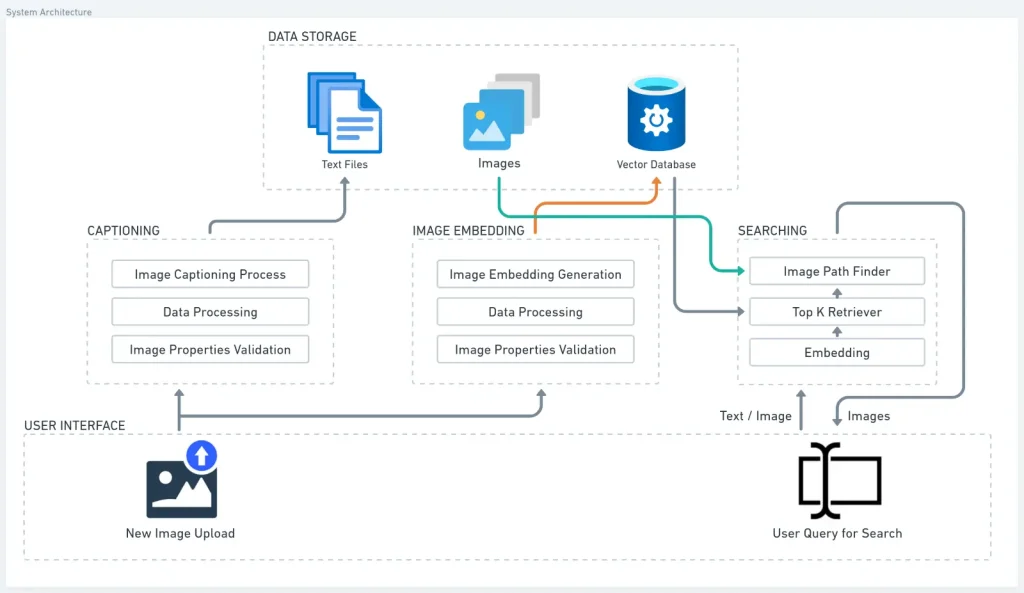
Generative AI Architecture
  1. Collect Image Datasets

The process begins by gathering relevant image datasets, which serve as the foundation for training and generating recommendations.

  1. Set Up Image Captioning Model

Implement an advanced image captioning model to generate descriptive captions for each image. These captions enrich the dataset by adding contextual metadata, improving recommendation quality.

Image Captioning Model
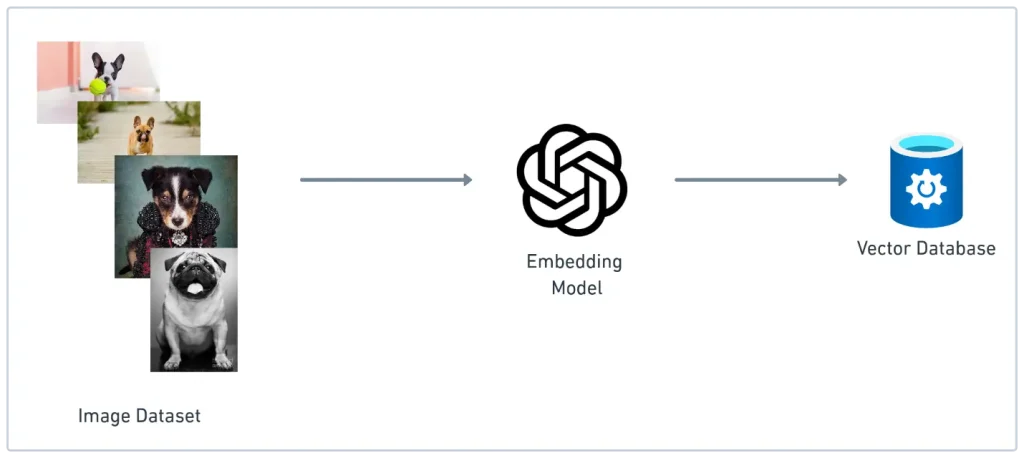
  1. Set Up Image Embedding Model

Integrate an image embedding model to convert images into vector representations. These embeddings allow the system to calculate the similarity between images for more precise recommendations.

Image Embedding Model
  1. Prepare Image Datasets with Captions

Combine the images and their generated captions into a structured dataset, making it easier to process for downstream tasks.

  1. Build a Vector Store

Develop a vector store that holds the embeddings of images. This enables efficient similarity searches, which are crucial for generating recommendations based on user input.

  1. Index Dataset into Vector Database

Index the image embeddings and captions into a high-performance vector database (VectorDB), optimizing the search and retrieval of similar images.

  1. Generate Recommendations

Using the indexed dataset, the system can now generate personalized image recommendations based on user-provided text or image input.

  1. Evaluation and Refinement

Continuously evaluate the performance of the recommendation system, refining the models and dataset to improve accuracy and relevance in recommendations over time.

Use Cases

  • E-Commerce: Recommending product images based on textual descriptions & visual queries.
  • Content Creation: Helping bloggers, marketers, or designers find images that match the theme of their content.
  • Social Media: Suggesting relevant images or memes based on user-generated text.
  • Educational Platforms: Offering illustrative images to accompany educational content based on the topic or subject being discussed.

Challenges

  • Ambiguity in Text: Text can often be vague or contain multiple meanings, which makes precise image matching difficult.
  • Image Diversity: A wide variety of images can fit a single description, so the system needs to balance accuracy and diversity in its recommendations.
  • Contextual Understanding: Understanding the deeper context of the text (e.g., cultural or situational references) can be difficult for purely algorithmic systems.

Future Directions

  • Personalization: Enhancing the system by incorporating user preferences and browsing history to make more personalized recommendations.
  • Real-Time Recommendations: Increasing efficiency to provide instant recommendations as users type or search.

Build Advanced Recommendation Systems with Generative AI Expertise

Partner with us to leverage tailored AI Solutions that drive personalized experiences and business growth.

Conclusion

Generative AI is revolutionizing image recommendation systems, bringing a new level of personalization and accuracy to improve customer engagement and decision-making. As businesses, especially in the public sector, strive to deliver more tailored services, ViitorCloud’s AI development services provide the expertise you need to leverage this cutting-edge technology.

With solutions designed to address challenges like handling ambiguous inputs, our AI solutions ensure you stay ahead of the curve, enhancing customer experience and driving growth. Ready to transform your business? Partner with ViitorCloud today and unlock the full potential of Generative AI.


Frequently Asked Questions!

A Generative AI recommendation system utilizes advanced machine learning models to offer personalized suggestions, such as image recommendations, based on user data and behavior patterns. It customizes its suggestions by analyzing user inputs and preferences.

Yes, ViitorCloud can enhance existing recommendation systems by integrating sophisticated AI technologies that refine accuracy and personalization. We optimize these systems to better understand user behavior and improve the relevance of suggestions.

Absolutely! ViitorCloud specializes in developing tailored AI solutions that align with your unique business objectives. Our team works closely with clients to understand their requirements and create customized applications that drive results.

Yes, ViitorCloud supports cloud-based AI deployments by utilizing platforms like AWS and Azure. This ensures scalable, flexible, and efficient AI solutions that integrate seamlessly with your cloud infrastructure.

ViitorCloud offers customized AI integration services to enhance your existing systems. We provide custom solutions that ensure seamless implementation and optimization of AI technologies to meet your specific needs.

Innovative AI Use Cases in the Public Sector Industries

In the public sector, businesses encounter many challenges that can hinder their growth and operational efficiency. These issues can significantly impact performance, from operational inefficiencies to complex decision-making processes. At ViitorCloud, we understand these pain points and are here to provide tailored AI solutions that drive improved performance and sustainable growth.

Our expertise in AI development services equips your organization with innovative tools to tackle these challenges head-on. By using AI Use Cases in the Public Sector, such as predictive analytics and automation, we streamline your operational processes, optimize resource utilization, and deliver valuable insights into market trends and citizen behavior. This proactive approach addresses existing problems and paves the way for sustainable advancement within your organization.

As the public sector increasingly turns to Artificial Intelligence initiatives, we stand ready to guide you through this transformation. Our solutions are designed to empower your business, ensuring you stay ahead of the curve while effectively addressing the unique challenges you face.

Let us partner with you to unlock the full potential of AI. Together, we can navigate the complexities of the public sector and achieve your business goals with confidence. Choose ViitorCloud for your AI development services and experience the difference that expert-driven solutions can make for your organization.

Unlock the Potential of AI in Public Sector Industries

Explore how AI use cases in the public sector drive innovation. Partner with ViitorCloud to implement tailored AI solutions that transform your operations.

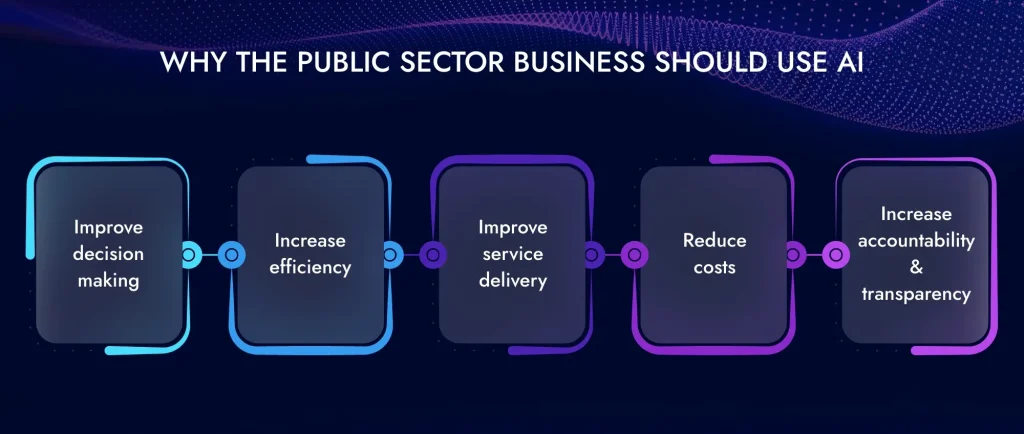
Why the Public Sector Businesses Should Use AI

Public Sector Businesses Should Use AI to harness the power of technology for transformative change. At ViitorCloud, we specialize in providing tailored AI solutions that enhance efficiency, boost productivity, and improve decision-making processes within the public sector. According to the Grand View Research report, the AI market will reach $1,811.8 billion by 2030, up from $136.6 billion in 2022, with a 38.1% CAGR and now this is the perfect time to embrace this technological revolution.

Why the Public Sector Businesses Should Use AI

Our AI solutions empower public sector organizations to analyze vast amounts of data, including legal considerations, socioeconomic factors, and public sentiment. This comprehensive analysis leads to informed policy formulation and budget-making, fostering transparency and accountability. By partnering with us, you can ensure your decisions are backed by data-driven insights.

Manual tasks can bog down your workforce. Our AI technologies automate routine administrative functions—like document processing and data entry—freeing up your staff to focus on more complex and impactful responsibilities. Let us help you streamline operations and maximize productivity.

With our advanced AI chatbots, we enhance service delivery by addressing citizen inquiries swiftly and effectively. Improved response times lead to higher citizen satisfaction and reduce the burden on your staff. Choose our AI solutions to elevate your service standards and foster a positive relationship with your community.

Adopting AI in the public sector can significantly reduce operational costs by automating time-consuming tasks. Our solutions not only increase efficiency but also provide significant savings that can be redirected toward critical initiatives.

Our AI tools enable real-time data analysis, providing valuable insights that build public trust and confidence in your organization. With us, you can ensure that your actions are transparent and accountable, reinforcing your commitment to serving the public effectively.

By integrating AI in the Public Sector with ViitorCloud’s expert services, you position your organization to meet contemporary challenges head-on while achieving your business goals. Let us guide you on this transformative journey towards innovation and excellence. Together, we can redefine what’s possible in the public sector!

READ: Benefits of AI in the Public Sector: Transforms Enterprises

Empower Your Public Sector Strategy with AI

Take advantage of cutting-edge AI use cases in the public sector to boost efficiency and decision-making. Let ViitorCloud design AI solutions that meet your unique needs.

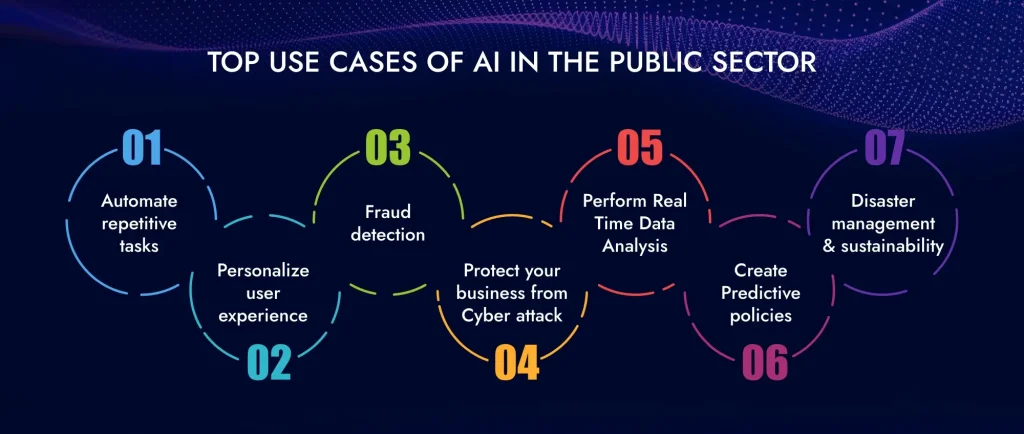
AI in the Public Sector: Top 7 Use Cases

According to the Deloitte report, 70% of business leaders support AI government projects. Also, using AI in the public sector improves efficiency and productivity.

Let’s detail the 7 AI use cases in the public sector.

AI Use Cases in the Public Sector

1. Automate Repetitive Tasks

AI assists the public sector in streamlining the operations process by automating repetitive tasks such as data entry and document processing. When a generative AI is implemented in the public sector, it manually reduces the time and waste of resources. Additionally, workers can focus on important tasks that require human judgment and expertise. AI automates the report generation process so that quick decisions can be made. AI in the public sector automates repetitive tasks to work smoothly through its application.

2. Personalize User Experience

AI chatbots provide personalized experiences to citizens in the area of public services. The chatbot is designed to respond quickly to citizen inquiries so public sector employees can focus on complex tasks. Additionally, chatbots are citizen-centric and provide seamless integration into public sector platforms such as communication channels or web portals. As a result, service delivery is efficient, and citizens are happy. It is one of the important AI public sector use cases.

3. Fraud Detection

In the public sector, fraud detection is reduced through AI and machine learning. Machine learning is used to identify irregularities and minimize false claims. AI is useful to analyze large datasets to find fraudulent activities and improve revenue collection. Additionally, AI helps detect real-time anomalies, prevent corruption, and ensure fair practices. This AI solution helps public sectors allocate resources, boost transparency, protect public funds, and create an equitable society.

4. Protect Your Business from Cyber Attack

In the public sector, AI solutions monitor network traffic, and machine learning algorithms help detect anomalies and threats. Also, AI is useful for analyzing behavior and patterns that identify cyber risks, mitigate them, and protect sensitive data in the public sector. This approach provides citizens privacy and integrates public service. Furthermore, AI public sector use cases in cybersecurity evolve the threats in the digital landscape to defend against cyberattacks in modern urban environments.

5. Perform Real-Time Data Analysis

AI in the public sector is useful for analyzing data for urban planning. It analyzes data such as demographics, environmental factors, and traffic patterns. This approach helps public sectors optimize resource allocation, formulate policies, and enhance infrastructure development. Additionally, it helps predict future trends, which helps make informed decisions and improves the quality of life for citizens. Furthermore, the public sector uses case data analytics to solve complex urban problems and foster development.

6. Create Predictive Policies

AI public sector solutions help in predicting policy. Advanced AI algorithms analyze crime data, demographic information, and social media trends to predict crime hotspots. Machine learning algorithms help law enforcement strategically allocate resources and prevent crimes before they occur. Additionally, AI technology anticipates crime activities and protects the communities from crime happening in their life.

7. Disaster Management and Sustainability

AI helps predict disasters, optimize rescue operations, and manage resources smoothly. AI helps analyze satellite images and environmental data to forecast natural disasters and resource deployment. This approach minimizes disasters and streamlines recovery. Additionally, AI analyzes data from various sources to detect pollution levels, illegal deforestation, and wildlife threats, which aid in conserving biodiversity and natural resources.

These AI use cases in the public sector help in operating smoothly and efficiently and increase productivity.

ALSO READ: AI Public Sector Cost Optimization | Reduce Costs & Boost Efficiency

Drive Innovation with AI in the Public Sector

Learn how AI use cases in the public sector can revolutionize your organization’s processes. Collaborate with ViitorCloud for customized AI development services.

Transform Your Public Sector Operations with ViitorCloud’s AI Solutions

At ViitorCloud, we understand the transformative power of AI in the public sector. Our AI development services are designed to enhance your operations and drive efficiency through innovative AI Use Cases in the Public Sector.

Imagine automating administrative tasks, analyzing data for informed policy formulation, strengthening cybersecurity measures, and providing personalized support to citizens through intelligent AI chatbots. These advancements not only streamline processes but also foster deeper engagement with citizens and facilitate better decision-making in the public sector.

With our extensive experience in advanced AI technology, we are your trusted partner in integrating AI initiatives. Our expert consultants are dedicated to helping you navigate the challenges faced by public sector enterprises, ensuring that you use AI solutions effectively to meet your business objectives.

Don’t let your organization fall behind in this digital age. Reach out to ViitorCloud today and discover how our tailored AI solutions can propel your public sector operations into the future. Let us help you harness the power of AI to achieve your goals and create lasting impact!


Frequently Asked Questions

Artificial intelligence impacts the public sector by automating manual tasks and improving efficiency and data decision-making. Also, it helps solve the challenges of data privacy, ethical risks, and security.

AI analyzes complex data to find the public transit routes and predict how demographic changes will impact demand for public services. As a result, resources can be optimized.

The National Oceanic and Atmospheric Administration uses AI to analyze heat islands, where a community experiences warmer temperatures than other areas. With the help of analysis, NOAA can protect the public from heat.

Advantages of Using Microsoft Power Platform for Your Business

Microsoft Power Platform is a suite of low-code tools designed to help users build custom business applications, automate workflows, and analyze data with minimal coding. Launched in 2018, it seamlessly integrates with Microsoft services like Azure, Dynamics 365, and Microsoft Teams, making it a key enabler of digital transformation within organizations.

What is Microsoft Power Platform?

Microsoft Power Platform is a low-code suite that helps organizations build custom applications, automate workflows, and analyze data efficiently. It has empowered users—regardless of technical skills—to create solutions that meet specific business needs, driving digital transformation across industries.

  • Power BI: Provides interactive data visualization and analytics, enabling real-time, data-driven decision-making.
  • Power Apps: Allows users to quickly build custom applications using a simple drag-and-drop interface, addressing unique business challenges without needing extensive coding knowledge.
  • Power Automate: Automates workflows between apps and services, reducing manual tasks and improving overall productivity.
  • Power Virtual Agents: Enables businesses to create intelligent chatbots to automate customer interactions, enhancing service efficiency.

Power Platform integrates seamlessly with Microsoft 365, Dynamics 365, Azure, and third-party apps, offering:

  • Unified Experience: Access Power Platform tools within Microsoft 365 for a smooth, familiar user experience.
  • Collaborative Workflows: Leverage integration with Teams and SharePoint for effortless collaboration and data sharing.
  • Embedded Insights: Power BI dashboards can be embedded into Microsoft 365 apps, enabling real-time insights directly in your workflow.

In short, Microsoft Power Platform accelerates business innovation by leveraging an organization’s existing Microsoft ecosystem, fostering growth and efficiency.

Unlock the Power of Microsoft Power Platform Today

Transform your business processes with our customized Microsoft Power Platform solutions. Let’s build smarter workflows and drive innovation.

Why Choose Microsoft Power Platform?

Microsoft Power Platform offers a comprehensive, user-friendly solution for businesses aiming to optimize operations and drive digital transformation. Its cost-effective and scalable design enables organizations to adapt quickly to changing demands, empowering both technical and non-technical users.

  • Cost-Effective: With low-code tools, businesses can develop custom applications and automate workflows without heavy IT investments or high development costs.
  • Scalable: The platform grows with your business, allowing you to use its components independently or together as your needs evolve.
  • User-Friendly: Power Apps and Power Automate are designed for users of all skill levels, enabling non-developers to build apps and automate processes with ease.
  • Seamless Integration: Power Platform works effortlessly with Microsoft 365, Dynamics 365, Azure, and third-party applications, helping businesses create efficient, end-to-end solutions.
  • Fast Deployment: Pre-built templates and a drag-and-drop interface allow for rapid development and deployment, reducing time-to-market for solutions.
  • Low-Code Development: Easily create apps and workflows without extensive coding, making the platform accessible to a wide range of users.
  • Enhanced Automation: Power Automate streamlines repetitive tasks, boosting productivity by freeing up employees for higher-value work.
  • Data-Driven Insights: Power BI provides robust analytics, offering real-time insights to support better decision-making.

Microsoft Power Platform is ideal for businesses seeking to improve efficiency, boost productivity, and foster innovation through a scalable and integrated toolset.

Who Can Use Microsoft Power Platform?

Microsoft Power Platform is designed for a broad audience, making it accessible to business users, IT professionals, and developers across various industries and business sizes. Its low-code nature and integration with Microsoft 365 allow users to create custom solutions customized to their specific business needs.

Power Platform empowers business users to develop applications, automate workflows, and analyze data without requiring coding expertise.

Key benefits include:

  • Quick App Development: With drag-and-drop features and templates, users can quickly create custom apps using Power Apps to streamline processes.
  • Automated Workflows: Power Automate simplifies repetitive tasks, reducing manual efforts and improving accuracy—especially valuable for HR, Finance, and Operations.
  • Data Insights: Power BI helps users visualize data through interactive dashboards, enabling informed, data-driven decisions.

Power Platform enhances efficiency for IT professionals and developers by providing tools to build scalable, robust solutions while ensuring governance.

Key advantages include:

  • Faster Development: The low-code environment speeds up solution development, helping IT teams deploy applications more quickly.
  • Seamless Integration: It integrates smoothly with Microsoft 365, Dynamics 365, Azure, and third-party apps, creating cohesive, end-to-end solutions.
  • Governance and Control: IT teams can maintain control over data security and compliance through role-based access and data protection policies.

Power Platform is applicable across various departments, helping them tackle specific challenges:

  • HR: Automate employee onboarding and streamline performance reviews.
  • Finance: Simplify invoice processing, create custom financial reports, and manage expenses.
  • Sales: Automate lead tracking, quote generation, and gain insights into sales pipelines.
  • Operations: Manage inventory, automate work orders, and monitor real-time metrics.

Power Platform’s versatility makes it an ideal solution for users across different roles and industries, supporting businesses in driving digital transformation and operational efficiency.

Maximize Efficiency with Microsoft Power Platform

Streamline operations and boost productivity with our tailored Microsoft Power Platform solutions. Discover how we can help your business thrive.

Where Can Microsoft Power Platform Be Implemented?

Microsoft Power Platform can be deployed across various industries, enabling businesses to automate workflows, enhance customer service, and build custom applications. Its flexibility makes it ideal for addressing specific operational needs in diverse sectors.

Power Platform’s adaptability allows it to serve a wide range of industries, including:

  • Healthcare: Improving patient management and operational efficiency.
  • Retail: Enhancing inventory management and customer engagement.
  • Manufacturing: Automating production workflows and boosting supply chain transparency.
  • Education: Streamlining student data management and improving digital learning experiences.
  • Finance: Automating compliance processes and improving financial reporting.
  • Government: Enhancing public services and citizen engagement through streamlined workflows.

Organizations use Power Platform in multiple scenarios, such as:

  • Automating Workflows: Power Automate simplifies repetitive tasks, improving efficiency across departments.
  • Improving Customer Service: Power Virtual Agents enables businesses to deploy chatbots that enhance customer interaction and response time.
  • Developing Custom Apps: Power Apps helps businesses build applications tailored to their specific operational challenges, enabling better data management and process improvements.

Several organizations have successfully used Microsoft Power Platform, including:

  • Accenture: Empowered over 700,000 employees to make data-driven decisions with Power BI.
  • Seattle Visiting Nurses Association: Optimized their vaccine delivery process during the pandemic using Power Apps and Power Automate.
  • Balfour Beatty: Streamlined project management processes by integrating Power Platform with Azure services.
  • Shell: Enabled 4,000+ citizen developers to build applications that saved costs and increased business value.
  • SNCF: Created hundreds of Power Apps to foster innovation and efficiency within their organization.

These examples show how Power Platform transforms businesses by automating tasks, enhancing customer experiences, and building customized solutions that drive operational improvements.

Leverage the Microsoft Power Platform for Your Growth

Accelerate your digital transformation with expert Microsoft Power Platform services. Start optimizing your business with innovative solutions.

How Does Microsoft Power Platform Work?

Microsoft Power Platform is a suite of tools designed to simplify data analysis, app development, and workflow automation. Its components—Power BI, Power Apps, Power Automate, and Power Virtual Agents—operate individually while integrating with Microsoft services like Dynamics 365 and Azure.

  • Power BI: A business intelligence tool that helps users create interactive dashboards and reports. It turns raw data into actionable insights, allowing organizations to make data-driven decisions.
  • Power Apps: A low-code platform that enables users to build custom applications. Users can create two types of apps: canvas apps, which offer full design control, and model-driven apps, which focus on data relationships and processes.
  • Power Automate: This tool automates workflows between different applications and services. It helps streamline repetitive tasks, such as data transfers, notifications, and approvals.
  • Power Virtual Agents: A no-code tool for creating intelligent chatbots. These chatbots handle customer inquiries and automate routine tasks without requiring advanced coding skills.

Power Platform integrates seamlessly with:

  • Dynamics 365: Enhances CRM and ERP solutions by enabling real-time data synchronization and automated workflows.
  • Azure: Leverages advanced services like machine learning and analytics for more robust applications.
  • Microsoft 365: Embeds Power BI reports into tools like Teams and SharePoint, promoting collaboration and easy access to data insights.

Power Platform’s low-code/no-code features enable users of all skill levels to create custom solutions:

  • Drag-and-Drop Interfaces: Simplifies app and workflow creation, making it accessible to non-developers.
  • Pre-Built Templates: Speeds up deployment with ready-to-use solutions for common business scenarios.
  • Connectors: Hundreds of connectors facilitate integration with various systems, allowing for streamlined automation and data flow.

With its powerful tools, seamless integration, and user-friendly features, Microsoft Power Platform enables businesses to enhance processes, boost productivity, and drive innovation.

Empower Your Business with Microsoft Power Platform

Simplify, automate, and scale your processes with our Microsoft Power Platform services. Let’s take your business to the next level.

Advantages of Microsoft Power Platform

Microsoft Power Platform brings numerous benefits to organizations, driving efficiency, innovation, and cost-effectiveness. Its key advantages center on empowering users, automating processes, and providing actionable insights, all while integrating seamlessly with existing systems.

  1. Empowering Non-Developers: With a low-code/no-code interface, Power Platform enables non-developers, also known as “citizen developers,” to build custom apps and workflows, significantly reducing reliance on IT departments.
  2. Automating Routine Tasks: Power Automate streamlines manual processes like data entry, approvals, and notifications, saving time and increasing productivity across departments.
  3. Data-Driven Decision Making: Power BI’s advanced analytics and visualizations provide businesses with real-time insights, allowing for better decision-making based on current data trends.
  4. Seamless Integration: The platform integrates effortlessly with Microsoft 365, Dynamics 365, and Azure, alongside other third-party apps, fostering an interconnected digital ecosystem.
  5. Cost Efficiency: By enabling users to create their own applications, the platform reduces the need for costly development projects, lowering IT expenditure.

Microsoft Power Platform Benefits for Enterprises

  1. Accelerating Digital Transformation: Power Platform enables businesses to quickly adapt to evolving market demands and customer needs by allowing rapid development and deployment of custom applications.
  2. Enhancing Team Collaboration: Integrated with Microsoft 365 tools like Teams and SharePoint, Power Platform fosters real-time collaboration, data sharing, and workflow management, enhancing cross-departmental teamwork.
  3. Scalability: The platform is highly scalable, allowing organizations to expand their solutions as they grow, ensuring it can adapt to future business challenges.
  4. Maximizing Technology Investments: By integrating with existing Microsoft ecosystems, businesses can fully leverage their technology investments, streamlining operations without needing new infrastructure.
  5. Fostering Innovation: Power Platform encourages innovation by allowing employees across departments to create custom solutions for their unique business challenges, driving innovation from within.

Microsoft Power Platform helps organizations accelerate innovation, streamline workflows, and make data-driven decisions. Its flexibility, user-friendliness, and cost-effectiveness make it an ideal choice for businesses looking to enhance productivity and drive digital transformation.

Partner with ViitorCloud to Integrate Microsoft Power Platform

Partner with ViitorCloud to integrate Microsoft Power Platform and enhance your digital capabilities. We specialize in Microsoft development, offering tailored solutions that automate workflows, improve data insights, and boost productivity. Their certified experts implement Power BI, Power Apps, Power Automate, and Power Virtual Agents for seamless integration and optimal performance. Whether streamlining operations or driving digital transformation, we have the expertise to help you achieve your business goals.

Transform with Microsoft Power Platform Solutions

Harness the full potential of the Microsoft Power Platform for your business with ViitorCloud’s expert services.

Conclusion

Transform your processes with ViitorCloud’s Microsoft Development Solutions. Adopting Microsoft Power Platform provides organizations with numerous advantages, including improved agility, collaboration, and scalability—key factors for thriving in today’s dynamic business environment. By empowering non-developers to build custom applications, automating routine tasks, and delivering actionable data insights, the platform helps streamline operations and enhance productivity. For enterprises seeking to accelerate their digital transformation, Microsoft Power Platform offers innovative solutions tailored to specific business challenges, fostering sustainable growth. Want to integrate the Microsoft Power Platform? Contact our experts now.


Frequently Asked Questions

Power Platform includes Power BI, Power Apps, Power Automate, and Power Virtual Agents for data analysis, app creation, automation, and chatbot development.

Power Platform integrates seamlessly with Microsoft 365, Dynamics 365, Azure, and many third-party applications to enhance productivity.

It enables custom app creation, workflow automation, enhanced data insights, and faster, cost-effective development.

ViitorCloud designs tailored Power Platform solutions, integrates them with existing systems and offers ongoing support and training.

How AI is Helping the Public Sector to Reduce Costs and Improve Efficiency

Artificial Intelligence is transforming the public sector, bringing cutting-edge innovations that directly address the needs of modern governance. At ViitorCloud, we offer tailored AI solutions to help public sector institutions streamline operations, make smarter decisions, and deliver superior services to citizens—all while achieving AI Public Sector Cost Optimization.

Our AI development services harnesses technologies like machine learning, natural language processing, and robotic process automation to enhance resource allocation, minimize inefficiencies, and ensure that public sector organizations operate more effectively. This results in significant cost savings and promotes a more agile, responsive government that better serves its citizens.

At ViitorCloud, we understand the unique challenges the public sector faces and are here to deliver AI solutions that align with your goals. Whether you’re looking to reduce operational costs or improve service delivery, our AI in Public Sector expertise can guide you toward success.

Let us help you drive change with our AI Development Services and custom AI Solutions, designed to future-proof your organization.

Unlock Cost Optimization with AI in the Public Sector!

Streamline operations and cut costs effortlessly with ViitorCloud’s tailored AI Development Services.

7 Responsibility of Artificial Intelligence in the Public Sector

In what ways does AI change government operations and service delivery to its people? Therefore, from automating administrative tasks to optimizing healthcare diagnostics, predicting crime, managing urban infrastructures, etc. AI transforms the landscape of public administration for AI public sector cost optimization.

7 Responsibility of Artificial Intelligence in the Public Sector

1. Public Services and Citizen Engagement

Have you ever thought about long queues when you go for government services? Imagine chatbots instantly handling routine queries, reducing your wait time, and freeing human resources for more complex issues.

Artificial Intelligence (AI) transforms public services and citizen engagement by automating routine tasks and enhancing interaction efficiency. AI-powered chatbots and virtual assistants handle common queries, reducing wait times and allowing government employees to focus on more complex issues. The World Health Organization (WHO) estimates that 1.3 million people die in road crashes annually. Governments can significantly improve road safety and reduce these fatalities by effectively integrating AI into transportation systems.

Also, AI in public sector systems helps increase access to support systems since these types of AIs provide 24/7 support, eventually leading to higher satisfaction rates among citizens. Additionally, AI public sector cost optimization solutions can use these tools to analyze citizen feedback from various channels and help them understand community expectations.

2. Data Analysis and Decision-Making

Are you confident that every step officials make is based on accurate data? This means using computers over people gives users correct decisions even if not so safe.

Being able to do this makes it easier than relying on human beings, hence aiding in making informed choices on many things such as what one must buy or invest his money in according to his/her needs.

AI is more capable of analytical tooling than humans, thus making better decisions in the public sector. Governments collect much data from various sources, such as public records, surveys, and even social media.

Patterns, trends, and exceptions can rapidly be identified by AI public sector cost optimization algorithms that influence policy-making and resource allocation.

3. Surveillance & Monitor

Regarding public safety, AI improves surveillance and monitoring capabilities thus preventing crimes and ensuring security. AI cameras can detect strange activity or movements humans can see, but they raise an alarm for further investigation.

Therefore, these systems are used to quickly scan through hours of CCTV footage to identify potential threats and make it possible for immediate responses if emergencies arise. However, compliance with ethical guidelines will ensure public safety while maintaining privacy.

4. Healthcare Diagnostics & Treatment

In this sector, AI changes healthcare diagnostics and treatment by increasing the proficiency of medical personnel. Medical images including X-rays or MRIs are examined by artificial intelligence, and they detect or diagnose diseases quickly.

These models are trained with actionable health information from individual patients to predict patient outcomes and provide personalized care plans. They help in AI-driven cost reduction in the public sector associated with disease prevention and intervention programs delivered through the channel of local governments while ensuring better quality care.

AI-based telemedicine platforms also promote access since patients can receive medical consultations remotely. It is projected that by 2030 healthcare AI market will reach $187.95 bn. In addition, by 2026, the robot-assisted surgery market may amount to up to $40bn.

5. Smart Cities and Infrastructure Maintenance

Do you think your city could be more efficient and environmentally friendly? Can smart cities featuring AI optimize traffic flows, manage energy usage, and predict infrastructure maintenance needs?

Artificial intelligence solutions enabling urban optimization have become vital for smart city initiatives. Sensor-based AI systems monitor real-time data that reduces congestion and improves travel times.

6. Education & Administrative Automation

The education sector has been simplified by automating administrative processes, making teachers focus on teaching rather than paperwork due to artificial intelligence systems. For instance, teacher workloads have been reduced significantly by providing automated enrolment facilities and scheduling and grading functionality for schools handled through Artificial Intelligence technology.

Personalized learning platforms bring in an aspect of AI that allows educational content to be adapted for individual students’ needs, thereby improving learning outcomes. Moreover, it is possible to evaluate academic data with the help of artificial intelligence to identify challenges that affect different areas, thus making it easy to deal with them.

7. Climate Analysis

Are you worried about climate change and what it will do to us? Using AI technologies, we can analyze climate data to predict trends and develop strategies to mitigate the effects of climate change.

AI plays a crucial role in addressing climate change by analyzing environmental data and projecting future trends. Machine learning models based on massive datasets collected through satellites and weather stations, among others, can predict climate patterns while evaluating human activity’s impacts. This information helps policymakers develop ways to mitigate climate change, such as opting for resource use, planning for extreme weather events, or reducing greenhouse gas emissions.

Environmental conservation and sustainability become more effective due to insights driven by artificial intelligence (AI). Public sector AI integration strategy significantly enhances efficiency, service delivery, and decision-making.

Cut Costs and Enhance Efficiency with AI!

Let ViitorCloud’s AI Development Services help you optimize resources and improve performance.

How can AI Save Costs in the Public Sector?

Artificial Intelligence (AI) possesses transformative potentialities in public services, which optimize operations, enable better provision of services, and save significant costs.

Here’s how AI is making a difference in various areas:

AI Save Costs in the Public Sector

AI-enabled chatbots and virtual assistants can handle various administrative tasks, including answering citizens’ questions, managing appointments, and processing applications. This automation reduces the need for human intervention in routine tasks, resulting in significant AI-driven cost reduction in the public sector.

Assistance is available all day long via chatbots so people don’t have to wait for working hours. The use of AI to automate repetitive tasks lets employees spend more time on complex problems thereby increasing their overall productivity.

AI ensures that healthcare emergency services improve through predictive analytics and response times. These algorithms analyze data to predict potential health crises and allocate resources more efficiently. AI can forecast emergency service demands based on historical data, allowing better resource allocation and reducing unnecessary expenditures.

Faster diagnosis with higher accuracy through AI quickens treatment, thus resulting in fewer hospital stays and reduced costs. Regarding “Chatbots for businesses”, organizations achieve a 64% redirection of efforts by agents toward complex issues as opposed to 50% without AI.

Streamlined by AI, welfare programs include detecting fraud, automating eligibility checks, and optimizing resource distribution, to mention but a few. It is fostered that this will enable allocating funds where they are most needed to minimize waste.

Fraud prevention can also be enhanced by detecting irregular claims using AI systems, reducing costs. By analyzing huge amounts of data, AI ensures that resources are efficiently distributed so that appropriate benefits of AI in the public sector reach their rightful owners.

AI technology can boost public safety by predicting crime hotspots and enabling more effective surveillance. A proactive approach like this may help reduce crime rates and associated policing expenditures.

Furthermore, when analyzing criminal data, AI models can determine areas likely to experience crimes; hence, police resources can be distributed accordingly, and preventative measures can be implemented regarding such hotspots.

Additionally, AI-operated cameras and monitoring systems detect odd activities in real time, reducing the need for human surveillance extensively.

Another crucial area where AI could play a major role is in developing smart cities through optimal infrastructure management and effective use of resources. This helps save money while increasing the quality of urban life.

AI can study traffic patterns concerning optimizing traffic lights’ timing, thereby cutting congestion-related costs. In smart grids, AI systems take care of energy distribution, ensuring efficient resource utilization and reduced utility bills.

Achieve Cost Efficiency in the Public Sector with AI!

Empower your organization with advanced AI Solutions for unmatched cost optimization.

Examples of Successful Enterprises in the Public Sector Industry

This global trend represents a final great effort for governments towards more efficient, effective, and ethical designs involving various stakeholders.

These cases show different ways governments have used technologies in public administration. This includes some specific pilot projects and general strategies that might be adopted by government agencies working on AI implementation.

Modern governments insist on policies driven by people and services based on citizens’ inputs, thus necessitating large-scale civic engagement. The process usually takes too long because digital participation platforms generate huge amounts of citizen input that is difficult to analyze. As such, it becomes a complex and time-consuming process that may deter valuable citizen input from being effectively utilized.

Response: It uses machine learning augmented tools to efficiently analyze citizen input for civil servants at CitizenLab, a Belgian civic technology company. The public participation platform of the company utilizes Natural Language Processing (NLP) and Machine Learning algorithms to address thousands of contributions from citizens by summarizing trends, clustering ideas, and classifying them based on themes, demographics, or locations.

This system provides civil servants with real-time data-driven insights through user-friendly dashboards. CitizenLab facilitated a project called Youth4Climate early in 2019, in which young Belgians gave suggestions regarding climate change.

The AI-powered platform analyzed 1,700 ideas, 2,600 comments, and 32,000 votes, which resulted in a report containing 16 policy recommendations for elected officials. It demonstrates how AI facilitates citizen engagement and results in more informed government decisions.

Results and Impact: The platform has been successful for several municipalities, including Kortrijk City, whereby the administration interacts directly with its constituency through the platform that processes inputs from over 1,300 users.

Similarly, the city of Temse employs this tool for resource allocation based on crowdsourced ideas about mobility in the town. By automating data analysis, meaningful citizen participation is encouraged, and there is also an enhanced understanding of public requirements, thus leading to improved decision-making capacity.

Issue: Despite its small population of approximately five million, Finland aims to become an international leader in artificial intelligence applications. The technology-intensity economy of the country, together with digitized public services and highly educated people, creates a basis for such an ambition.

Research suggests accelerating AI and automation development could significantly boost Finland’s GDP and net employment. The challenge lies in determining the specific actions needed to achieve this potential.

Response: In May 2017, Finland’s Ministry of Economic Affairs and Employment launched an Artificial Intelligence Programme guided by a Steering Group comprising a network of experts. The group produced two key reports: “Finland’s Age of Artificial Intelligence” (December 2017) and “Leading the Way into the Age of Artificial Intelligence” (June 2019).

These reports outline 11 key actions to improve business competitiveness, effectively utilize data, ensure rapid AI adoption, attract top talent, make bold investments, and build world-class public services, among other goals. Unique to Finland’s approach is the emphasis on public sector efficiency and service effectiveness alongside economic growth.

Objectives include:

  • Developing new operating models.
  • Ensuring citizen data privacy.
  • Improving government data interoperability.
  • Creating AI-focused educational programs.
  • Fostering public-private partnerships.
  • Engaging in public discussions on AI ethics.

Transform Public Sector Operations with AI!

Boost efficiency and reduce costs using ViitorCloud’s proven AI Development Services.

How does ViitorCloud Help Public Sector Enterprises With AI Solutions?

Artificial Intelligence is revolutionizing the public sector, driving cost optimization and boosting efficiency across various operations. From administrative automation and healthcare to welfare programs and crime prediction, the integration of AI enables public sector organizations to operate more intelligently and cost-effectively. By leveraging AI Solutions, these institutions are not only improving service delivery but also staying ahead with cutting-edge technologies.

At ViitorCloud, we provide tailored AI Development Services to help public sector organizations streamline their processes, reduce costs, and enhance operational efficiency. Our expertise in AI in the Public Sector ensures that your organization can harness the power of AI for smarter governance and impactful outcomes.

Partner with ViitorCloud for AI Public Sector Cost Optimization and lead the way in modernizing public services with our AI Solutions. Let’s collaborate to achieve your goals for a more efficient, tech-driven future.

Ready to elevate your operations? Contact ViitorCloud today for customized AI Services that drive results.


Frequently Asked Questions

AI reduces costs in the public sector by automating routine tasks, improving resource allocation, and enhancing operational efficiency. This leads to significant labor, administrative expenses, and infrastructure maintenance savings.

AI optimizes public sector industries by providing data-driven insights for better decision-making, streamlining processes through automation, and improving service delivery. This results in enhanced productivity, reduced waste, and more effective use of resources.

AI improves efficiency in the public sector by automating repetitive tasks, enabling faster data processing, and offering predictive analytics. These advancements led to quicker response times, improved accuracy, and simplified operations.

How Can AI Be Beneficial to Public Sector Enterprises?

Challenges like inefficient resource allocation, limited citizen engagement, and bureaucratic red tape in the public sector often hold organizations back. These obstacles lead to a lack of public trust, delayed service delivery, and wasted resources. However, these issues can be addressed effectively with AI in the public sector.

At ViitorCloud, we provide tailored AI development services designed to automate administrative processes, optimize resources, and streamline operations. Our AI solutions boost productivity and offer personalized citizen services that enhance engagement and satisfaction, building a more transparent and responsive public sector.

With our expertise, ViitorCloud transforms public-sector organizations, making them agile and efficient. We understand the benefits of AI in the public sector, and we’re here to help you implement them successfully. If you’re looking to overcome public sector challenges and achieve meaningful digital transformation, let ViitorCloud be your partner in building the future.

Why Do AI Solutions for the Public Sector Matter?

Because they’re revolutionizing the way governments operate, and at ViitorCloud, we’re here to help your organization harness the benefits of AI in the public sector.

AI isn’t just about automation—it’s about making work smarter, cutting operational costs, and allowing governments to allocate resources with precision. With ViitorCloud’s AI expertise, you can drive efficiency, streamline decision-making, and create policies that truly make an impact.

Our AI solutions for the public sector empower you to make data-driven decisions, improve transparency, and ensure accountability through automated monitoring and compliance systems. Whether you’re looking to optimize resource allocation or enhance public service delivery, we provide the advanced tools your organization needs to stay ahead.

READ: AI in the Public Sector – Innovative AI Solutions for Governments

Transform Public Sector Operations with AI

Partner with us for tailored AI Solutions that enhance efficiency and decision-making.

Top 7 Benefits of AI in the Public Sector for Startup Business

AI Solutions for Public Sector Startups offer benefits that automate labor tasks and minimize human errors, and AI empowers the public sector to work more intelligently. AI helps in decision-making and enhances public safety, among other benefits it offers.

Let’s understand in detail the Benefits of AI in the Public Sector:

Top 7 Benefits of AI for Startup Business in the Public Sector

1. Make Data-Driven Decisions

AI can collect and analyze data such as qualitative and quantitative data for the decision-making process. It analyzes historical data and uses surveys to understand the public needs and preferences. This approach to analyzing data ensures that the public sector provides things to citizens as per their desire, which satisfies the citizens. AI data-driven changes the way decisions take place in the public sector. It combined natural language processes and machine learning to analyze large datasets to provide meaningful insights, detect patterns, and make predictions related to the data. Also, this capability helps in policy formulation, allocation of resources, government procurements, and regulatory compliance.

2. Predictive Analytics

AI can collect and analyze large amounts of data to identify patterns, trends, and insights. The increased pattern identification helps public services to make informed decisions to serve the best public and avoid the wastage of resources. Advanced public service algorithms can predict service demand, manage risk, and prevent fraud. This approach helps budget planning, fosters citizen governance, and improves service delivery. AI benefits in the public sector include predictive analytics, anticipating needs, mitigating challenges, and enhancing effectiveness.

3. Manage All the Business Information Properly

Sensitive data has to be stored for essential purposes such as taxation, census, and public archives. In the public sector, physical documents are stored instead of digital copies. As a result, employees are required to store documents, maintain, secure the documents, and retrieve the information. AI is useful in the public sector for storing information effectively. Additionally, AI is effective with daily tasks that are too big and time-consuming for workers.

4. Improve Communication

One of the Benefits of AI in the Public Sector is improving communication. Good communication is important to keep a healthy relationship anywhere in the world. It is important in the public sector to maintain foreign and national relationships so that public workers cannot bear to take communication lightly. As a result, it become important for public workers to adopt AI for communication. AI tools help public workers communicate smartly and effectively with every individual. Also, a positive reputation is built in the eyes of the citizens and other people. Furthermore, AI helps detect misleading information, hate speeches, and propaganda.

5. Improve Security

Public workers must create a safe and secure community so people can live peacefully and happily. Security is required in the military, as well as surveillance, entry or exit of people in airports, public institutes, and internal communication. AI technology can help provide security in this place. It helps manage citizens’ identities, including birth information, thumbprints, education, resident and health records, and criminal or terrorist information. AI integration into government administration smooths the process, and the duties of public workers for security are automated. It is one of the essential Benefits of AI in the Public Sector.

6. Improve Efficiency

The benefit of AI in the public sector is that it improves efficiency. When the public sector uses AI technology, they will get updated technology in the system and become forward-thinking. Also, hiring skilled professionals in the department brings positive results in the public sector. Additionally, when AI solutions support departments and functions, they get insights into the problems, and problems can be solved easily. However, AI provides data-driven information to the public sector to help them make decisions for education, police work, political campaigning, and real estate to improve efficiency.

7. Automate Customer Support

AI virtual assistants and chatbots handle routine inquiries, provide information, and guide citizens through public services. This guides the public during the complicated process, improves efficiency, and reduces waste time. Also, it responds to the public in a personalized way. Additionally, it allows human staff to focus on complicated issues rather than normal queries. For instance, it solves citizen inquiries related to online tax filing, government benefits, etc. It is one of the AI solutions for public sector startups that satisfies customers with automation.

READ MORE: Artificial Intelligence in Business: An Intelligent Approach

Lead Public Sector Innovation through AI

Integrate cutting-edge AI Solutions to optimize your workflows and public services.

3 Challenges You Will Face While Choosing AI for Your Public Sector Business

The Challenges Faced when choosing AI in the Public Sector Startups are ethical considerations, regulatory complexities, and operations integration.

Let’s understand in detail the challenges the public sector faces:

3 Challenges You Will Face While Choosing AI for Your Public Sector Business

AI algorithms work on the data trained; if the data contains biased and discriminatory data, then it will not provide an equal outcome. It provides unequal hiring processes, law enforcement, and social services outcomes. Ensures the representative training data and audits the data to mitigate the risks. Also, the transparent development and monitoring of AI processes are essential to working under ethical standards. Additionally, ensuring equitable treatment for citizens and not repeating discrimination is possible through AI systems.

AI in the public sector faces challenges related to accessibility and equity gaps, where communities lack access to AI services due to socio-economic disparities. Data biases can worsen disparities and affect service delivery and decision-making fairness. AI systems are adopted to address this issue and meet different requirements and capacities in public sectors. It is the way AI benefits in the public sector.

AI systems are complex and opaque, which makes the decision-making process challenging. Also, it generates a lack of trust among the public in accessing public services. The government has to be liable for explaining and accountable for everything done by AI systems.

ALSO READ: 7 Steps to Implementing AI in Business Effectively

Enhance Public Sector Services with AI

Let ViitorCloud’s AI Development Services elevate your operational capabilities and impact.

How Does Viitorcloud Overcome Public Sector Challenges with AI Solutions for the Public Sector?

Innovation in public sector startups through AI is revolutionizing the way government services operate, driving efficiency and enhancing decision-making. From automating administrative tasks to predicting crime and aiding in policy formulation, AI’s potential is vast. Machine learning and natural language processing are the key drivers behind these transformative changes.

At ViitorCloud, we specialize in AI Solutions for the Public Sector, helping your organization harness the Benefits of AI in the Public Sector to streamline operations, ensure regulatory compliance, and improve service delivery. As a leading provider of AI Development Services, our skilled professionals are experts in creating tailored AI strategies that fit your unique needs.

Looking to integrate AI into your public sector systems? ViitorCloud has the solutions to make it happen. Contact us today to explore how our cutting-edge AI Solutions can drive success for your business.

Let’s take your public sector initiatives to the next level with AI innovation!


Frequently Asked Questions!

An example of AI in the public sector is using predictive analytics in law enforcement. Police use AI to analyze historical crime data, socioeconomic factors, weather conditions, and other factors to predict crime. As a result, resources are effectively allocated in the police department.

The leading AI Solutions for Public Sector Startups are NIRMAI, Rephrase.ai, Karya AI, Machinehack AI, and Yellow.ai.

AI benefits the Public Sector by handling customer queries in customer service and providing public safety. Also predicts fraud trends and helps in policy formulation and administrative efficiency.

AI helps the public sector by automating routine tasks like customer inquiries and data entry to improve efficiency and reduce costs. Also, it helps in the decision-making process, optimizes the allocation of resources, and enhances citizen’s services with personalized interactions.

Dependency Injection Patterns in Angular

Angular Dependency Injection (DI) is a fundamental feature of the Angular framework, enabling developers to create scalable, maintainable, and testable applications. As a design pattern, DI promotes the separation of concerns by decoupling components from their dependencies, allowing for greater flexibility and modularity in application architecture.

According to the 2023 Stack Overflow Developer Survey, Angular is one of the most popular frameworks, with approximately 20% of developers reporting using it. This widespread adoption highlights the importance of understanding its core features, including Dependency Injection. Let’s explore the article in detail.

What is Dependency Injection

Dependency Injection (DI) is a design pattern in software engineering that allows a class to receive its dependencies from an external source rather than creating them. This facilitates loose coupling and improves the modularity of the codebase, allowing for better maintainability and scalability.

Definition and Overview

Dependency injection (DI) is a way to give a class what it needs (a dependency) instead of the class creating it by itself. For example, if class A relies on class B, class B becomes class A’s dependency. DI supplies class B via an external injector, decoupling both classes.

  • Common dependency injection patterns include:
  • Constructor Injection: Dependencies are provided through a constructor.
  • Setter Injection: Dependencies are injected via setter methods.
  • Interface Injection: The dependency injects itself into any client that implements a specific interface.

Importance in Modern Development

Dependency injection plays a vital role in modern applications by:

  • Loose Coupling: Reduces interdependencies, simplifying component replacement or modification.
  • Testability: Enhances unit testing by allowing mock dependencies, improving test efficiency.
  • Maintainability: DI aligns with dependency injection principles like the SOLID framework, making code easier to maintain and update.
  • Flexibility: Enables runtime swapping of dependencies, useful in scenarios like angular dependency injection where different configurations may be needed.
  • Centralized Configuration: Frameworks like Angular provide centralized management, streamlining code, and applying changes consistently.

In Angular, DI is implemented using injectable Angular services, which can be easily configured through angular injection. This makes Angular’s dependency injection easier and improves how the app is built, making it more organized, easier to test, and maintain.

Optimize Your Angular Projects with Expert Dependency Injection Solutions

Unlock the full potential of Angular Dependency Injection with ViitorCloud’s tailored development services.

Core Principles of Dependency Injection

Dependency Injection (DI) is based on key principles that enhance software design and maintainability.

Dependency Injection Principles

  1. Inversion of Control (IoC): Shifts the responsibility of managing dependencies to an external dependency injection container. This leads to a design that’s easy to change and adjust.
  2. Separation of Concerns: Allows classes to focus solely on their responsibilities, while dependencies are handled externally, improving code clarity.
  3. Single Responsibility Principle (SRP): By injecting dependencies, classes adhere better to SRP, avoiding direct management of external components.

Relevance of Basic Principles

  • Loose Coupling: DI decouples classes, enabling easy updates without altering dependencies—key for frameworks like Angular dependency injection.
  • Interface-Based Design: Encourages interfaces, allowing multiple implementations without changing dependent classes.
  • Configurability: Supports different environments (development, testing, production) by externally configuring dependencies.

Benefits of Application Design

  • Testability: Easier to test classes in isolation by mocking dependencies, and aligning with core dependency injection patterns.
  • Flexibility: Applications can adapt quickly by swapping dependencies, as seen in Angular dependency injection.
  • Maintainability: Code remains focused on primary tasks, simplifying debugging and future updates.
  • Readability: Using DI improves code readability, as seen in dependency injection principles for clean and modular design.

Integrating these principles makes applications built on DI more flexible, maintainable, and easier to test, particularly in frameworks like Angular, where concepts like injectable Angular services are vital.

Understanding Angular Dependency Injection

Angular Dependency Injection (DI) is a core feature of Angular that manages dependencies efficiently, promoting modularity and enhancing testability.

What is Angular Dependency Injection

Angular dependency injection lets components and services get what they need from outside instead of creating it themselves. This design pattern supports modular, reusable, and maintainable applications. Dependencies in Angular are often services, but they can also include values like strings or functions.

Angular’s DI System Overview

Key components of Angular’s DI system include:

  • Injector: Manages the creation and lifecycle of dependencies.
  • Providers: Define how to create and supply dependencies, either at the component, module, or application level.
  • @Injectable Decorator: Marks a class as injectable Angular so that dependencies can be injected.

Benefits of Angular Dependency Injection

  1. Modularity: Encapsulates functionality, making components and services reusable and independently testable.
  2. Testability: Facilitates unit testing by allowing mock services to be injected in place of real ones.
  3. Maintainability: Promotes loose coupling, simplifying updates and modifications.
  4. Reusability: Decouples components and services, making them reusable across different projects.

How Does Angular Dependency Injection Work

  1. Registration: Dependencies are registered using providers, ensuring the injector can resolve them.
  2. Injection Tokens: Unique tokens help the injector identify and provide the right dependency.
  3. Constructor Injection: Dependencies are declared in constructors, like with angular inject, and provided by the injector.
  4. Singleton Instances: Services typically follow a singleton pattern unless otherwise configured.
  5. Hierarchical Injectors: Dependencies are managed through hierarchical injectors, allowing for scoped or shared services.

Simplify Complex Angular Applications with Custom Dependency Injection

Leverage our Angular expertise to streamline your development process and enhance performance.

Patterns in Angular Dependency Injection

Angular offers various dependency injection patterns to manage dependencies efficiently, promoting modularity and testability.

Common Dependency Injection Patterns in Angular

  1. Constructor Injection: The most common pattern where dependencies are provided via the constructor. It’s ideal for services needed during instantiation.
  2. Setter Injection: Dependencies are injected via setter methods after object creation, useful for optional or changeable dependencies.
  3. Interface Injection: Involves defining an interface to inject dependencies. Although less common in Angular dependency injection, it’s useful for enforcing contracts between classes.

Examples of Dependency Injection Patterns

1. Constructor Injection

@Injectable({ 
  providedIn: 'root', 
}) 
export class MyService { 
  constructor(private dependency: DependencyService) {} 
}

2. Setter Injection

@Injectable({ 
  providedIn: 'root', 
}) 
export class MyService { 
  setDependency(dependency: DependencyService) { 
    this.dependency = dependency; 
  } 
}

3. Interface Injection

export interface DependencyInjector { 
  injectDependency(dependency: DependencyService): void; 
} 
 
@Injectable({ 
  providedIn: 'root', 
}) 
export class MyService implements DependencyInjector { 
  injectDependency(dependency: DependencyService): void { 
    this.dependency = dependency; 
  } 
}

Best Practices for Angular Dependency Injection

  1. Use providedIn: ‘root’ for singleton services.
  2. Prefer constructor injection for required dependencies.
  3. Use setter injection for optional or changeable dependencies.
  4. Keep services focused on a single responsibility to ensure maintainability.

Implementing these dependency injection patterns in Angular helps developers build scalable, modular, and testable applications.

Angular Dependency Injection: Key Features

Angular’s dependency injection (DI) system simplifies the management of dependencies and enhances modularity. Here’s a concise overview of how it works and what sets it apart from general DI frameworks.

How Angular Injects Dependencies

In Angular, dependencies are injected via constructor injection using the @Injectable decorator. This marks a class as injectable, allowing Angular to create and manage instances, while resolving dependencies automatically.

@Injectable({ 
  providedIn: 'root', 
}) 
export class MyService { 
  constructor(private dependency: DependencyService) {} 
}

Angular’s hierarchical injector system manages dependencies at various levels (root, module, component) for better control.

How Angular DI Differs from General DI

  1. Hierarchical Injector System: Angular’s DI is hierarchical, offering more granular control over the injection scope.
  2. Automatic Dependency Resolution: Dependencies are resolved automatically based on the constructor, streamlining setup.
  3. Decorator-Based Configuration: Angular uses decorators like @Injectable for easy dependency configuration.
  4. Lazy Loading and Tree Shaking: Optimizations like lazy loading and tree shaking help reduce bundle size by excluding unused dependencies.
  5. Angular Ecosystem Integration: Angular DI is tightly integrated with modules, components, and services for seamless dependency management.

Specific Features of Angular DI

  1. Injection Tokens: Allows flexibility by using tokens like classes, strings, or symbols to identify dependencies.
  2. Optional Dependencies: The @Optional() decorator makes certain dependencies optional, providing defaults when unavailable.
  3. Multi-Providers: Multiple instances can be registered under the same token for more complex dependency needs.
  4. Aliasing: Dependencies can be injected under alternative tokens with the @Inject() decorator.
  5. Lifecycle Hooks Integration: Angular DI integrates with component lifecycle hooks, injecting dependencies at specific stages.

Understanding Angular-specific features and patterns, such as Angular inject, Angular injectable, and dependency injection Angular, significantly improves application structure and maintainability.

Boost Your Angular Development with Advanced Dependency Injection Patterns

Partner with ViitorCloud to implement scalable and efficient Angular Dependency Injection solutions.

Practical Examples of Angular Dependency Injection

Angular’s Dependency Injection (DI) system improves app design by making it easier to maintain, organize, and test. Here are some practical scenarios where Angular DI is effectively used:

When to Use Angular Dependency Injection

  1. Service Sharing Across Components: DI allows components to share a singleton service, ensuring a consistent state across the application.
  2. Configuration and Environment Variables: Inject configuration or environment-specific dependencies for easy switching between environments (e.g., development, production).
  3. Optional Dependencies: Use setter injection or optional dependencies when certain services might not always be required.
  4. Testing and Mocking: DI simplifies unit testing by allowing real services to be replaced with mock services, focusing tests on isolated components.

Example: Managing Product Data with Angular DI

Step 1: Create a Product Service

@Injectable({ 
  providedIn: 'root', 
}) 
export class ProductService { 
  private products = [ 
    { id: 1, name: 'Product A', price: 100 }, 
    { id: 2, name: 'Product B', price: 150 }, 
  ]; 
 
  getProducts() { 
    return this.products; 
  } 
 
  addProduct(product: { id: number; name: string; price: number }) { 
    this.products.push(product); 
  } 
}

Step 2: Use the Product Service in a Component

@Component({ 
  selector: 'app-product-list', 
  template: ` 
    <h2>Product List</h2> 
    <ul> 
      <li *ngFor="let product of products"> 
        {{ product.name }} - ${{ product.price }} 
      </li> 
    </ul> 
    <button (click)="addNewProduct()">Add New Product</button> 
  `, 
}) 
export class ProductListComponent { 
  products: Array<{ id: number; name: string; price: number }> = []; 
 
  constructor(private productService: ProductService) { 
    this.products = this.productService.getProducts(); 
  } 
 
  addNewProduct() { 
    const newProduct = { id: 3, name: 'Product C', price: 200 }; 
    this.productService.addProduct(newProduct); 
    this.products = this.productService.getProducts(); // Refresh product list 
  } 
}

Extending Example: Adding Authentication

Step 1: Create an AuthService

@Injectable({ 
  providedIn: 'root', 
}) 
export class AuthService { 
  private isAuthenticated = false; 
 
  login() { 
    this.isAuthenticated = true; 
  } 
 
  logout() { 
    this.isAuthenticated = false; 
  } 
 
  isLoggedIn() { 
    return this.isAuthenticated; 
  } 
}

Step 2: Use Both Services in a Component

@Component({ 
  selector: 'app-admin', 
  template: ` 
    <h2>Admin Panel</h2> 
    <div *ngIf="authService.isLoggedIn(); else loginTemplate"> 
      <app-product-list></app-product-list> 
      <button (click)="authService.logout()">Logout</button> 
    </div> 
    <ng-template #loginTemplate> 
      <button (click)="authService.login()">Login</button> 
    </ng-template> 
  `, 
}) 
export class AdminComponent { 
  constructor(public authService: AuthService, private productService: ProductService) {} 
}

This example demonstrates how dependency injection in Angular improves code reusability and testability by managing shared services like product management and authentication across different components.

Drive Efficiency with Angular Dependency Injection Best Practices

Work with our experienced developers to ensure your Angular projects are built for long-term success.

Conclusion

Understanding Dependency Injection (DI) in Angular is crucial for building scalable and maintainable applications. DI promotes loose coupling, enhances testability through mock dependencies, and increases component reusability. It also provides flexibility by allowing dynamic dependency management while centralizing configuration to minimize boilerplate code. As Angular’s DI system continues to evolve, it will bring performance improvements and expanded features, solidifying DI as a key aspect of efficient development.

Looking for expert Angular Development Services?

Our Angular development services encompass a wide range of capabilities, including Angular web development, application development, migration, as well as maintenance, and support. At ViitorCloud, our team of Angular developers specializes in creating compelling and adaptive websites that effectively boost traffic and drive sales. Elevate your Angular development endeavors by engaging a dedicated Angular programmer from our accomplished team.

Contact ViitorCloud today for scalable and high-performance Angular solutions.


Frequently Asked Questions

Angular uses Constructor Injection, Setter Injection, and Interface Injection to manage dependencies in different scenarios.

Angular’s hierarchical injector system allows for global and scoped dependency management through a root injector and child injectors.

Use Constructor Injection for required dependencies, Setter Injection for optional ones, and register services at the appropriate levels for better performance.

ViitorCloud offers expert Angular development services, optimizing dependency management and application performance. Contact us to enhance your Angular projects.