What are the top trends in AI for businesses?

Artificial intelligence is no longer a luxury in the current dynamically changing digital environment but is a requirement. AI brings new momentum to growth and innovation and is transforming industries, reshaping the lives and work of businesses. Businesses across multiple industries have been recognizing the vast potential of Artificial Intelligence in driving innovation, improving efficiency, and building a competitive advantage.

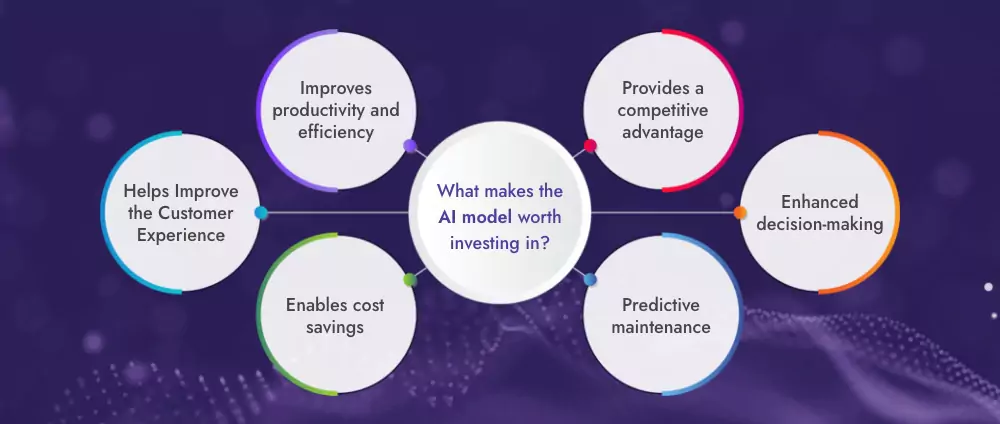
About investing in artificial intelligence will help your businesses with cost-cutting, better resource management, scalability, improved decision-making, and staying ahead of the competition.

However, choosing the right AI services company is most important to gain access to these benefits. At ViitorCloud, be it in setting trends in business with AI or in the only following, here is why our partnership becomes the best choice for AI development.

Top 5 AI business trends in 2024

Artificial intelligence is exponentially growing and, in its growth, is already impacting world societies and economies. Trends that come out ahead in business are a by-product of this transformative technology.

The global market for artificial intelligence was valued at 538.13 billion dollars as of 2023 and is likely to reach around 2,575.16 billion dollars by 2033, expanding at a CAGR of 19% for the years 2023 to 2033.

Now, top of mind, consider the top five artificial intelligence business trends we are likely to see happening by 2024.
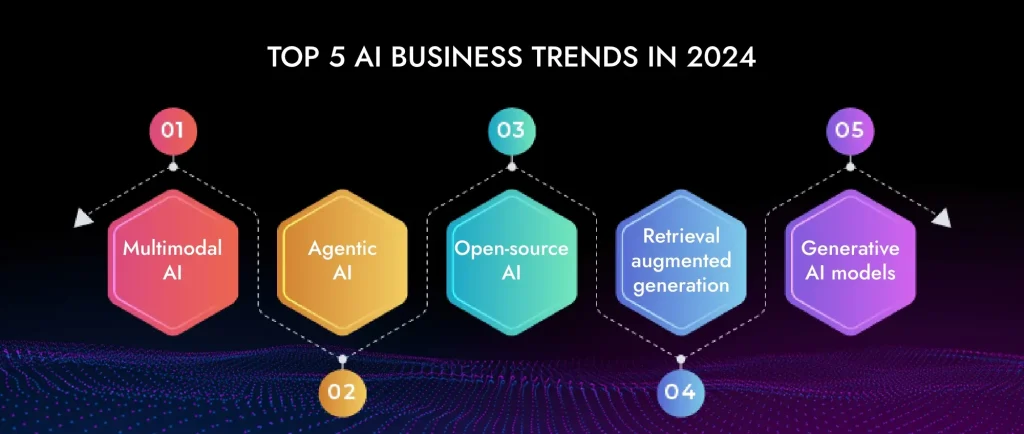
1. Multimodal AI

Our multimodal AI with rapid edge technology performs on different data types — text, image, audio, or video — all under one roof, projecting imperative predictive outcomes.

Multimodal AI is next game-changer for interpreting data and putting it at your disposal to utilize it properly for business. Accessing an artificially intelligent system connecting channels of information, such as the human body, by assimilating various sensory inputs, our system can provide an accuracy unparalleled in insights and predictions in a way that has hitherto not been possible. This technology can change the game for an organization and help it tap complex data optimally and effectively.

Imagine chatbots in customer service going beyond the basic norms. Backed by our multimodal AI, these chatbots not only understand the text but also the tone and context of the speech, making the experience personalized for the customers. Our prowess in multimodal AI will also ensure that your company stays ahead of the competition by adopting the latest and most highly developed techniques for processing data.

2. Agentic AI

An agentic AI will, using automated, complex workflows, revolutionize the processes in achieving your business’s goals. We leverage agentic AI to optimize business processes to deliver accuracy and top-notch efficiency without human intervention. Below is how our Agentic AI solutions drive business growth for you:

  • Decision-making excellence: we let you marshal your strategic decision-making through agentic AI systems to permit contextual judgments and the framing of settings consistent with your purposes.
  • Goal Adjustment: Human adaptability is the key to surviving in today’s fast-changing world. Our agentic AI solutions ensure goal and plan adjustment, offering you an agile, competitive business.
  • Natural Language Understanding: Compounded on the quality of being able to understand and interpret natural language on its own, our Agentic AI just follows detailed lists of instructions that, in turn, lead to operational optimization for enhanced productivity.
  • Workflow Optimization: Enables your business goals to be met with unparalleled efficiency—our Agentic AI tailors workflows to have every process just right in experiencing maximum output and success.

3. Open-source AI

We offer custom-made solutions to facilitate open-source AI traction for your business to reach the next level. We ensure the control of open-source AI technologies for tailored and scalable solutions that match the exact needs of your business.

Integrating the power of open-source AI, we bring modern capabilities to critical areas like medical image analysis, recommendation personalization, fraud detection in real-time settings, and highly tailored learning experiences and we make these solutions readily accessible to organizations, developers, and researchers for easy integration and impactful results.

Partnering with us is all about adopting a way in which collaboration becomes an enabler for transparency in continuous improvement. Trust us to expertly engineer your AI journey with innovative technology and unmatched support to deliver beautifully designed solutions.

4. Retrieval-augmented generation

With the support of Retrieval-augmented generation, we improve the performance of generative AI models and using external facts upgrade the accuracy and dependability of these models.

This innovative way empowers businesses to consistently implement advanced chatbots and virtual assistants to use their unstructured data without complex model adjustments.

5. Generative AI models

Our AI solutions redefine content creation for text, images, audio, animation, video, and multimedia. We accept projects involving the latest tools such as GPT-4, Copilot, and Gemini in business enterprises to create text forms of the highest quality and receive projects using Stable Diffusion for creating images. Our custom generative AI solutions yield tremendous benefits for businesses:

  • Improve the efficiency and accuracy of AI, particularly with respect to computer vision and natural language processing. Create original content seamlessly between images, videos, and text.
  • Automate tasks effectively to improve business operations and save valuable time and resources.
  • Uncover insights from the mass of complex data sets to enable enterprises and researchers to identify new patterns of emerging trends.

Our AI innovations pave the way forward with unrivaled advancements designed for your tailor-made needs.

Stay ahead in the AI revolution with ViitorCloud’s top-tier solutions. Trust our expertise to optimize your operations and achieve your business goals. Contact us today to discover how we can help!

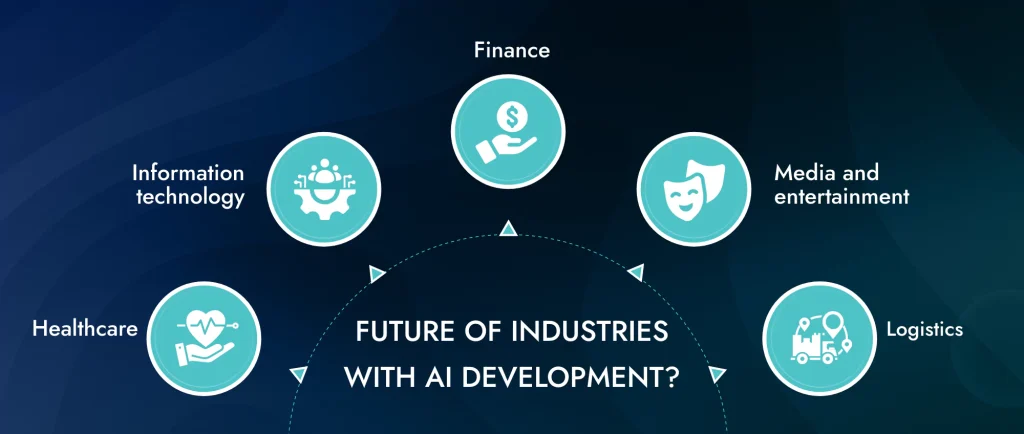
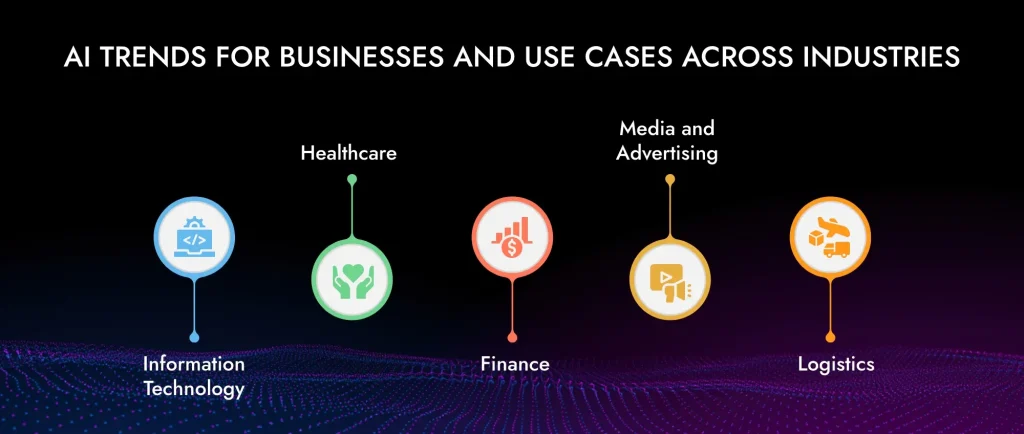
AI trends for businesses and use cases across industries

Business intelligence trends with AI are fundamentally transforming and redesigning businesses across many diverse industries by allowing automation, efficiency, and innovation. Let us understand the applications of AI across different industry sectors.
AI trends for businesses and use cases across industries

Information Technology

Make the AI-powered transformation of your business. This is how we are going to up your productivity, efficiency, and decision-making with information technology solutions:

  • Helpdesk Operations Automation: Self-service AI-driven portals and chatbots automate the way of sorting, mainly resolving common problems that cause little downtime and releasing the organization’s resources.
  • Sophisticated Data Analytics: Our AI solutions discover hidden trends and patterns in data and customer behavior for making more intelligent business decisions. Automate Code Generation: AI development automatically generates code snippets and reduces development processes by analyzing existing code bases.
  • Predictive maintenance for hardware: The predictive maintenance solutions are delivered through the analysis of vast amounts of data, coming from sensors and historical performance data sources, to predict and prevent hardware problems, assuring that your IT infrastructure is solid and reliable.

Healthcare

AI business strategies are altering the healthcare industry, and we are on the futuristic edge of this transformation. Our AI solutions, created by the world’s first generalized AI platform, empower precise analysis of images to provide diagnostics and evidence-based personal treatment plans. Our AI-based discovery tools predict molecular interactions to allow fast drug discovery, and advanced neural networks power innovative diagnostic techniques with retinal scans and analysis of skin color changes.

Finance

Our AI solutions are differentiated in the finance industry by better security and optimization in decision-making. Here is how our AI capabilities will help you take your business forward:

  • Credit Risk Assessment: Our advanced AI solutions maintain very detailed records of customers, therefore allowing for practical and accurate credit risk assessment to avoid financial risks.
  • Fraud Detection: Our AI detects any unusual patterns and behaviors with up-to-date machine learning algorithms to prevent fraudulent transactions; this will safeguard your business for both you and your customers.
  • Safer Trading: Our AI technology uses real-time market data, allowing individuals and organizations to trade in a timely and efficient manner. We will help you to reduce unpredictable risks and be able to maximize your investment strategies for the highest returns.
  • AI-Driven Auto Claims Processing: Our AI technology will make it easier for insurance companies to process claims virtually. Be it an estimation of the score of riskiness of a person to his vehicle, analysis of accident images, or observations of driving behavior, we confirm to be able to offer you the fastest and most accurate approvals on claims in a proposal that guarantees satisfaction for your customer and that you stay super-efficient.

Media and Advertising

Innovate and power your business in the fast-moving world of Media and Advertising with our state-of-the-art AI solutions. Decades of experience in changing music, film, publishing, advertising, and content creation industries. Learn how our AI services can redefine media and advertising in the following ways:

  • Audience Targeting and Segmentation: A way forward with the AI analysis of datasets running into thousands to predict consumer behavior to make campaigns personalized. Specialization We excel in user behavior, segmentation, A/B testing, and campaign optimization for superior results.
  • Predictive Analytics: Drawing on what AI truly excels at – predicting consumer trends using historical data – we place timely ads and drive strategic insights.
  • Custom Content Creation: This AI enables us to generate custom content matched to individual tastes and preferences for increased engagement and conversions.
  • Social Media Insights: Our AI does in-depth brand monitoring and will identify trends in this regard and assess campaigns that have ensured the building of robust social media strategy as key needs.

Logistics

Advanced AI solutions for logistics operations: The global AI market in logistics is suddenly expected to reach 15,010.88 million dollars by 2028. We provide customized AI innovations that drive efficiency and reliability.

  • Optimize routes easily by using AI-based analysis across traffic data, GPS tracking, and weather forecasting—avoiding delays and ensuring better safety.
  • Simplify warehouse operations by integrating augmented reality and robotic technologies to enable the rapid and error-free management of items.
  • Get exceptional quality control through state-of-the-art computer vision technologies that tie down superior standards and operational excellence.

Partner with ViitorCloud for the latest AI trends and tailored solutions to achieve unparalleled business success. Schedule a consultation now!

Achieve digital breakthroughs with ViitorCloud AI services

With the rapidly changing technological environment today, it is tough to stay updated and harness AI trends as a digital transformation weapon. To successfully implement AI, professional advice is indeed required by organizations to untangle the intricacies and bring out transformational values. ViitorCloud excels at AI consulting services and helps businesses back this technology to automate operations, enhance productivity, and develop competitive advantages.

By choosing ViitorCloud, it’s a collaboration with seasoned professionals who bring easier integration of AI. Be it strategic planning or efficient execution, our consultancy offers solutions that are tailored to the need. Make your business grow exponentially with respect to Business Growth as well as Operational Efficiency with ViitorCloud. Experience the power of Artificial Intelligence Where Innovation Meets Precision to drive your business toward success.

Frequently asked questions

The latest AI business trends are Multimodal AI, Agentic AI, neural networks, open-source AI,retrieval-augmented generation, and generative AI.

The AI trends for businesses must prepare themselves to adapt to ethical AI, explainable AI, Intelligence amplification, digital twins, AutoMl, metaverse, etc.

Artificial intelligence transforms industries with automated operations, acquiring data for customer insights and developing new values that help companies grow. Also, AI is beneficial for quality assurance and software testing.

How to implement AI in your business: 7 easy steps

In the last few years, AI has become a synonym for the future and revolution. But here at ViitorCloud, we think AI is not the future but the present. It’s because several businesses are already embracing the latest AI techs in their operations. For instance, AI-powered chatbots have significantly improved customer service, machine learning algorithms have enhanced productivity, and data analytics tools have increased efficiency. So, the right time to invest in AI is today!

After the advent of chatbots like ChatGPT, the market is flooded with lots of new AI technologies, but AI is not just limited to chatbots. As stated, there are lots of new AI technologies that businesses, regardless of their type, can use according to their preferences and goals, making AI a versatile and adaptable tool.

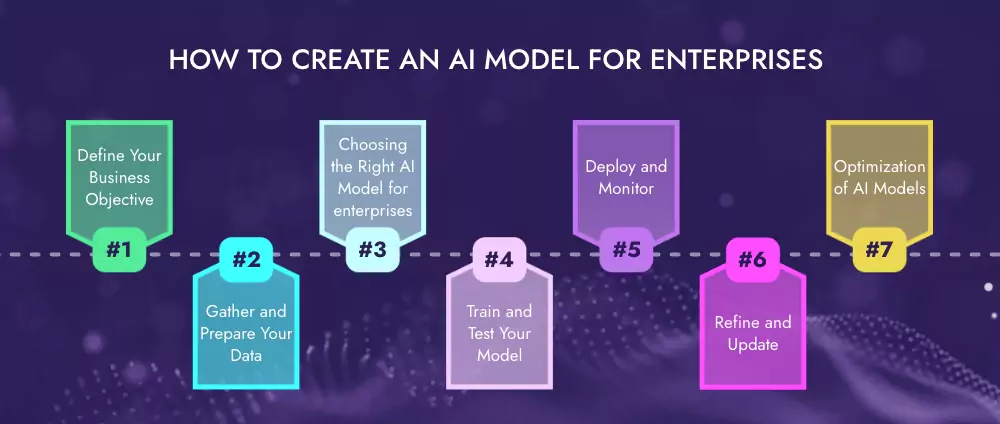
ViitorCloud helps businesses implement a wide range of the latest AI solutions, including chatbots, machine learning, and data analytics so that they thrive in the competitive, dynamic market. Here, we have explained how you can implement AI in your business in seven steps and how ViitorCloud can help you at each step.

How Implementing AI in Your Business Is Beneficial

Before we go into the key steps of implementing AI in your business, it is important to know how advantageous it is. AI for businesses is about more than automating tasks; it is about data analysis. It is about making operations easy and making you stand out from competitors. Let’s learn how to incorporate AI into your business to uncover the company’s true potential.

Improves Efficiency

AI solves multiple business problems, such as automating repetitive tasks, data entry, and customer service. As a result, your employees can focus on essential functions of innovation, strategies, and creation.

For instance, chatbots answer customers’ queries 24/7, and customer support focuses on critical tasks. It increases productivity and reduces business costs.

Data-driven decision

AI can analyze data of customers, markets, and operations and translate it into actionable insights. Predictive analytics helps you anticipate trends, optimize resource allocation, and make profitable decisions.

Growth beyond borders

When you provide personalized product recommendations to customers, you expand your reach. Also, as per individual preference, marketing campaigns expand your market reach and allow you to work for new market segments.

Customer experience

AI analyzes the preferences and behaviors of the customer and provides recommendations to customers that satisfy them. For instance, virtual assistants solve queries and recommend products or services as needed. It is not just a business providing you service but building relationships and loyalty.

Innovation

AI analyzes the data to identify new product ideas, predict the failure of the product or services, and streamline R&D processes. The analysis of failure helps businesses in improving their business product or service. Also, it helps in innovating your businesses to stay ahead of the competition.

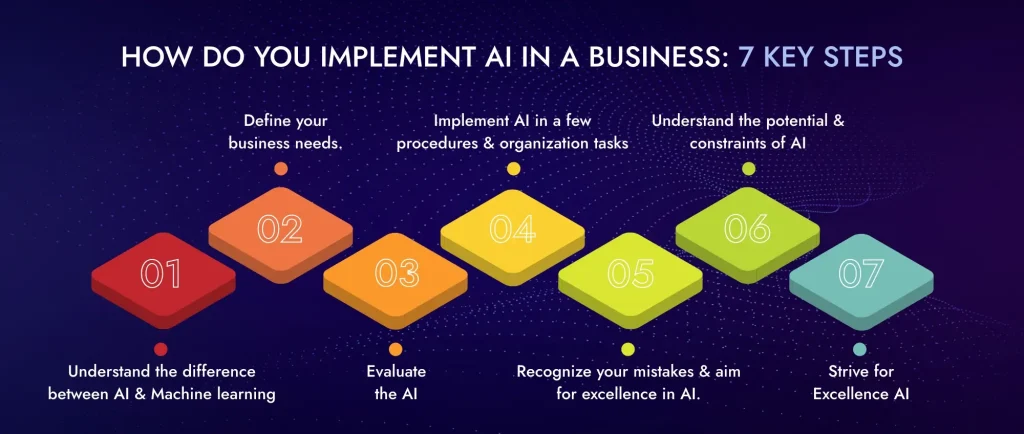
How do you implement AI in a business: 7 key steps

It is an unsaid fact that AI is changing businesses across industries. It could contribute up to USD 15.7 trillion to the global economy in 2023, says a PWC report. So, it is essential for you to embrace it before it is too late. So, here’s how to adopt this latest technology in your business.

7 Steps to Implementing AI in Business Effectively

1. Understand the difference between AI and Machine learning

Firstly, when implementing AI in a business, you must understand what AI and machine learning are.

Artificial intelligence – AI is a machine that thinks like humans and imitates human behavior. It can process large amounts of data like human beings. AI can analyze, recognize patterns, and make decisions just like humans.

Machine learning – ML refers to the branch of artificial intelligence that focuses on data and algorithms to make decisions as humans and provide accuracy in the decision.

So, in this step, we help you understand what you really need i.e., AI or ML.

2. Define your needs

Defining business needs is the second step of the AI implementation strategy. Businesses must define the problems they want AI to solve to know their business needs. For that, we ask you these five questions such as follows:

  • What outcome do you want to see?
  • What are the obstacles to achieving your goals?
  • How do you measure success?
  • How can AI help you succeed?
  • What data do you have today and need in the future?

The answers to these questions help you to understand your business needs. Once business needs are known, you can search for a solution.

3. Evaluate the AI

Implementing AI in business analysis of the company’s readiness is important. Also, evaluate current infrastructure, data accessibility, and personnel capabilities. In addition, you must check how easily businesses can adopt new ideas and developments.

This seems daunting task, right? Don’t worry, we will help you evaluate the current tech and find the right AI solutions for you.

4. Implement AI in a few procedures and organization tasks

Businesses can begin integrating AI into selected processes and jobs. This allows the company to experiment, gain insights, and demonstrate the value of AI to stakeholders. Additionally, it helps understand the challenges involved in AI.

With this, we can address the challenges before they become bigger issues in the future.

5. Recognize your mistakes and aim for excellence in AI

When new technology is implemented in business, mistakes can’t be avoided. In business, you must consider it a lesson rather than getting demotivated. You need to continuously use new tactics to check which is working to achieve your aim for excellence.

6. Understand the potential and constraints of AI

It is essential to keep realistic expectations with AI, what it can do or not. AI can’t solve all business issues. You need to understand its potential and constraints as businesses you can use correctly.

7. Strive for Excellence AI

The last step is an AI implementation strategy, which strives for excellence in AI. In business, striving is achieved by learning, developing, and adapting AI. Also, in your business work environment, encourage staff to test fresh AI technology and strategies.

Thus, this is how artificial intelligence implantation takes place in business. ViitorCloud helps you in the whole process and makes your journey even smoother while you focus on your goals and progress.

Don’t just implement AI—master it with ViitorCloud. Our customized AI solutions are crafted to enhance your business efficiency and growth. Get in touch with us today to create a tailored AI implementation strategy.

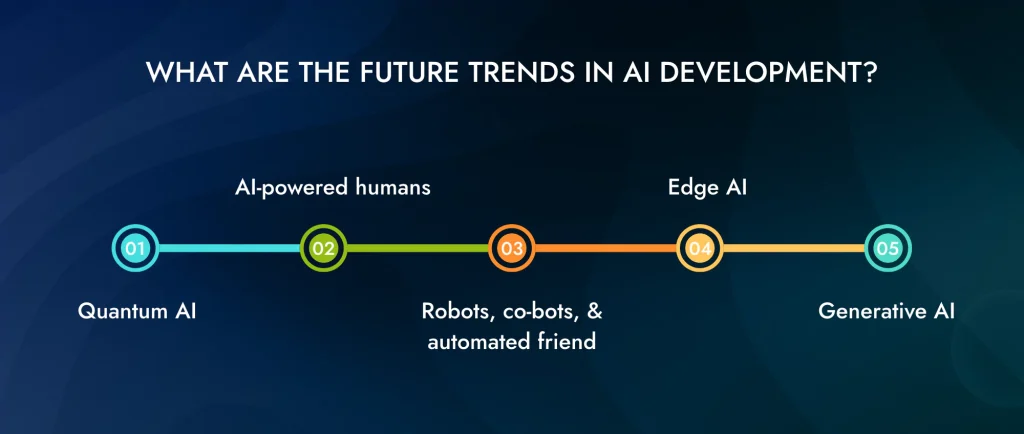
Future trends in AI for businesses

Several trends promise to transform how businesses operate, make strategic decisions, and interact with customers. Let’s understand how future trends in AI are transforming business.

Generative AI

Implementing AI in business with generative AI helps automate aspects of web development, from front-end design to back-end functionality. Also, AI is integrated into content management systems to streamline workflows, improve security, and optimize site appearance and functionality. AI helps automate code generation, layout optimization, bug detection, and improving efficiency. It creates website templates and themes. AI helps in content management systems for text and image generation, language translation, and SEO optimization, saving time and improving user experience.

Cybersecurity solutions

AI provides cybersecurity solutions by analyzing large amounts of data to identify anomalies and security threats. Also, the system uses machine learning to detect unusual behavior and patterns that indicate cyberattacks, such as malware infections. Cybersecurity issues are arising in emails and devices that can be protected with AI technology. AI uses machine learning to detect spam, phishing attempts, and malicious attachments by analyzing email headers, content, and sender behavior. Popular email service providers like Yahoo and Gmail use artificial intelligence to protect users from spam or hackers. It is the way artificial intelligence implementation takes place in cybersecurity.

Automation

Automation helps in business transformation by automating repetitive and time-consuming tasks so that businesses can focus on more critical tasks. Also, the use of AI reduces human error and improves productivity and efficiency. There are three types of automation Robotic Process Automation, cognitive, and predictive analytics automation. Robotic Process Automation automates repetitive tasks such as form filling, data entry, and extraction. Cognitive Automation helps systems understand, interpret, and make decisions based on data. Predictive Analytics Automation combines AI and machine learning to analyze history patterns and data for business prediction. This automation creates a customer base, improves profit, and optimizes operations.

Quantum AI

Quantum AI is a combination of quantum computing and artificial intelligence. It is helpful in image and speech recognition with accuracy and speed process. Quantum AI is useful in other areas of finance. Analyzing large volumes of financial data quickly and accurately helps manage effective risk and provides better investment decisions.

Conversational AI

Conversational AI is a technology that recognizes and responds to text and speech inputs. This is possible through the combination of natural language processing and machine learning. The one common application of conversational AI is chatbots, which interpret user inputs and carry on a conversation with national language processing. Other applications are virtual assistants, voice assistants, and customer service chatbots. It is the way conversational AI is useful in business.

So, these represent the future of AI development, and this is how Artificial Intelligence is modernizing your business.

Harness the power of AI technologies to supercharge your business processes. Partner with ViitorCloud for cutting-edge AI services that drive real results.

How ViitorCloud helps to implement AI in your business processes

Implementing AI in business processes is no longer a future approach, it is a present-day concept that allows organizations to stay competitive. Also, using AI with a defined objective and strategy will take the business to the next level. The business will run smoothly and efficiently with the right AI technology and good-quality data.    

ViitorCloud, an AI consultancy service company, has a professional AI team that integrates AI into business processes, enhances efficiency, and helps with decision-making. We understand clients’ unique needs and then design and implement AI solutions according to client requirements. 

To help you get started, Viitorcloud helps in implementing AI in business; you gain a trusted partner that empowers your business to stay ahead of competitors in the competitive digital world.

Frequently asked questions

Artificial intelligence implementation for businesses involves identifying business needs, choosing the right AI technology, data preparation, Developing AI models, integrating AI into the system, and monitoring and maintaining things.

AI implementation is essential for business as it improves productivity, personalized experience, data-driven decisions, and enhanced security, stability, and accuracy.

The applications practical in AI are hiring and recruitment, cybersecurity, market prediction, customer analysis, billing and invoice, and virtual assistant.

AI enhances business intelligence by automating tasks, analyzing data, identifying trends, and helping decision-making.

Why is AI-powered process automation necessary for your business?

AI business process automation is necessary for businesses because of market competition. A business requires a quick solution to its problem where artificial intelligence is helpful.

Artificial intelligence technology helps reduce costs, streamline operations, and improve productivity. Also, it allows people to focus on critical tasks.

Here is a detailed overview of why AI-powered process automation is necessary for your business. Also, know the application of AI automation and learn how to use AI process automation.

What is AI-powered automation?

AI-powered automation integrates AI technology and algorithms into various processes and systems to operate, automate tasks, and make decisions. Also, it helps in handling complex and cognitive tasks.

The capability of machine learning, predictive analytics, etc., is used in AI. It is where data is analyzed to identify patterns, provide business insights, and automate the business process to improve efficiency and productivity.

Applications of AI automation in business

AI technology, such as natural language processing, machine learning, and computer vision, is helpful in business by streamlining the process. These tools help make data-based decisions, improving customer experience and overall performance. Let’s understand in detail the applications of AI automation in business.

ClickUp

ClickUp is the AI assistant which assists you in various tasks such as follows:

  • Text generation – ClickUp AI is useful for different purposes, such as writing content for blog posts, marketing content, or condensing extensive documents.
  • Translation – It helps translate text in multiple languages.
  • Answering queries – ClickUp AI is good at solving inquiries for different topics. The topics include project management, productivity, or any complexity of business.
  • Idea Generation – It is a companion for brainstorming innovative concepts, such as product development or strategic marketing campaigns.
  • Document Summarization – ClickUp AI helps convert lengthy documents into short document and concise formats.

Chatgpt

OpenAI developed the ChatGPT, an AI power language that produces text resembling human beings. Let’s understand in detail how ChatGPT is useful.

  • Conversation with humans: Chatgpt helps engage with people. As it responds to inquiries, creates narratives, and follows instructions.
  • Text generating: It helps generate text in different formats. The format, such as blogs, articles, and marketing content, helps summarise the document.
  • Translation: Chatgpt helps translate text into multiple languages.
  • Answering questions: It can solve queries on science, history, or current events.
  • Dall-E: OpenAI developed Dall-E, which helps with text-to-image creation. It can generate images based on text descriptions. For instance, using the prompt “ create a dog riding bicycle,” the image will be created using Dall-E.
  • Artistic creation: DALL-E 2 is a tool for producing original artwork, drawings, sculptures, and spanning paintings.
  • Product design: DALL-E 2 produces novel products such as furniture, clothing, and toys.
  • Education: DALL-E 2 helps create illustrative materials, such as diagrams and visuals for educational material.
  • Marketing collateral: You can generate marketing materials, custom posters, flyers, and advertisements with Dall-E 2.

These are the tools that are useful in business process automation with AI.

Elevate your business with AI

Maximize efficiency and innovation with AI-driven process automation from ViitorCloud. Our expertise ensures seamless integration and exceptional results for your business.

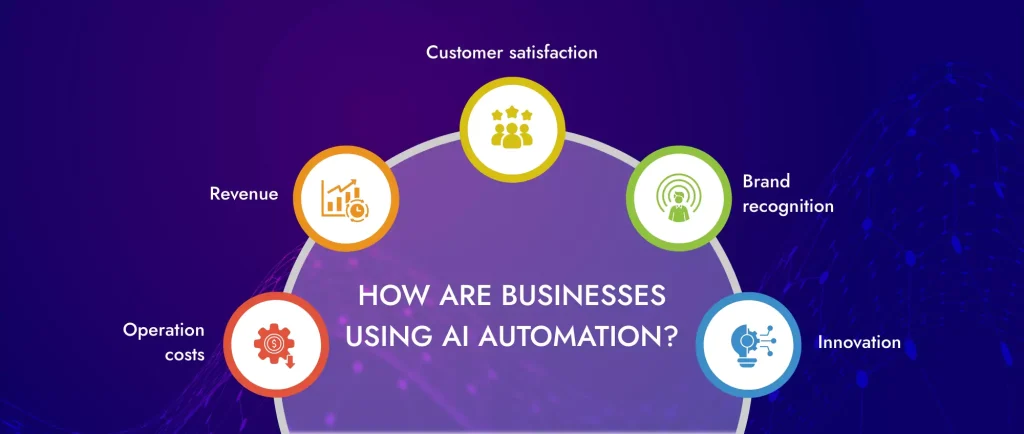
How are businesses using AI automation?

AI automation in business helps improve efficiency, reduce costs, and improve productivity. Also, it is helpful in various areas to achieve business goals. Some of these areas are:

how are businesses using ai automation

Operation costs

AI will automate routine tasks in the operation department, such as data entry, inventory management, and invoicing. With business process automation AI, operations costs will be reduced and profits will increase.

The tools used for automating operation tasks are Ontraport or Zapier; when these tools are used, it saves costs that are investing in labour.

Revenue

The main objective of any business is to generate revenue and increase with time. Businesses generate revenue commonly through sales, customer base, launching new products or services, or price increases. In this place, AI tools are helpful.

For instance, CRM software like HubSpot helps automate lead generation and lead nurturing. The chatbots help personalize product recommendations and solve customer inquiries. You can automate the invoice process using FreshBooks or QuickBooks.

Customer satisfaction

Customers are an essential part of any business; their satisfaction is a priority of the company. When satisfying the customer, businesses must provide high-quality products or services, good customer support, and listen to customer feedback. It is challenging to provide 24/7 with the help of humans. But AI has made it possible with chatbots. The chatbots can assist 24/7, resolving real-time issues and providing personalized product recommendations. As a result, customers are satisfied and loyal to the business.

Brand recognition

Businesses need to invest in marketing and advertisement to build an online presence and create a positive brand image. AI helps build an online presence for brand building. For instance, Hootsuite automates social media posting and engagement, Moz helps improve SEO ranking and optimize website content. Additionally, AI understands your audience and creates an effective marketing campaign.

Innovation

Things are changing in the world fast with the help of technology, so innovation in your product or service is essential. You can innovate products or services by analyzing customer feedback from surveys, social media, and reviews. Also, you can understand customer pain points and needs and make new products according to them. AI helps provide insights into customer needs and pain, which helps businesses innovate their products or services.

Why does your business need AI-powered process automation?

Automating half of the processes in today’s fast process environment is easy. Automation enhances productivity, reduces costs and

helps you stay out of the competitors. Let’s understand in detail why your business needs AI powered process automation.

why does your business need ai-powered process automation

Big data management

In the digital world, a lot of data is generated from every corner of the world, which is considered big data. The data is helping businesses with innovations, better decision-making, improve productivity, and help in planning customer satisfaction. Moreover, big data is helpful for business success, but managing is a big hurdle for business.

The hurdle of managing data is solved with business process automation AI, as it helps process the data, discover the data patterns, convert the unstructured data into structured data, and give insights to draw better conclusions.

Improved business productivity

There are two ways AI business automation Improves Productivity.

Automate repetitive tasks

AI-powered process automation performs repetitive tasks so human beings can focus on critical tasks. As a result, productivity increases.

The software is programmed with high configurational logic, which provides accuracy and no human error, which provides a massive benefit from automation.

Data-driven process

According to the latest information, around 48% of businesses are utilizing AI to process, observe, and monitor significant data patterns to get knowledge to improve the process. Data is the biggest asset for the company.

Process mining and optimizing current business processes are used to make business decisions. It is the way data is useful in AI business process automation.

Revenue with product recommendations

eCommerce is a convenience store for digital users as it allows shopping at benefits and discounts. Also, e-commerce stores are becoming intelligent with AI process automation. AI analyzes customer behaviour related to buying, shopping carts, and wishlists. On the basis of that, they recommend the product to customers. For instance, if you are looking for a dress, add 2 to 3 dresses in the cart and do not buy now. After some days, you will see an advertisement of the same and similar dresses with discounts. On average, 2 to 3 visits and on the 4th and 5th visit, you will buy the product.

Price optimization

People prioritize prices and quality, but businesses must predict the right product price and optimize it according to market trends. Also, the company has a range of products. Manually deciding the cost is difficult, but powered software helps determine the price.

AI business process automation software considers all factors in product price prediction and optimizes prices. It is possible as software to scan the data from bulk, refer to different price scenarios, and suggest a reasonable product price for a profitable business.

Improved sales and marketing

In sales and marketing, the right strategy and appropriate solution should be executed at the right time so the business can generate sales. The human brain can do this work but with limits. However, AI business process automation can do this work efficiently in the following ways:

  • Know buyer journey
  • Tips to improve sales performance
  • Better schedule management
  • Customer value is boosted and retention is increased
  • Gain insights on business sales strategy
  • Help in creating a content strategy
  • Helps create content such as blogs, articles, podcasts, whitepapers, case studies, and email marketing.
  • AI helps in searching keywords.

Augment your business potential with AI-powered automation

Revolutionize your business operations with advanced AI technology from ViitorCloud. Our team of experts will collaborate with you to streamline processes, boost efficiency, and propel your company towards unprecedented growth.

Why is AI-powered data automation the future?

According to data capture solutions are going to hit $3.84 billion globally by 2024. The manual data entry work will end, and AI automated technology will take its place in the marketplace.

Here are some reasons AI-powered data automation is the future.

Data sorting

Businesses have to deal with thousands of data daily, and that data needs to be categorized so it is accessible easily. It is not possible manually; AI makes it easy. AI process automation technology classifies the data into different formats, such as documents, images, and PDFs. Additionally, AI solutions can identify the data type and know where to extract the data. Also, human errors are reduced as accuracy is provided during data entry.

Increase productivity

AI automation is helpful in the data entry process and increases productivity in business functions.

It ensures to:

  • Reduce paperwork and save money.
  • Reduce manual errors
  • Improve clarity
  • Fasten the process

The error decreases with manual data processing, so you can focus on strengthening relationships with the stakeholders and customers with AI automation solutions. AI Automation helps boost profit and improve productivity.

Validity and security

The manual data processing might cause data duplication, misidentification, and lateness. With the help of AI automation, data duplication or error can be identified and rectified.

Employees must match documents and confirm validity when manual data entry is processed. AI automation saves the time and energy wasted on matching documents manually and getting validity.

Automate your business with ViitorCloud AI services

AI business process automation is changing the way business functions. It automates the business’s operations, customer support, human resources, marketing, and sales functions. Automation is improving the productivity and efficiency of the company.

When you are looking for someone to integrate automation into your business functions, connect to Viitorcloud, an AI consultancy service with a global presence and technology that helps you grow the business, Viitorcloud is a team of professional experts who have experience in AI technology, work on AI projects and complete the project.

Partner with us to integrate AI power automation. Contact our team on the website and send your project requirements; we will contact you for further processing.

Frequently asked questions

AI business automation refers to automating tasks and processes. The technology used is machine learning, natural language processing, and computer vision to enhance efficiency, accuracy, and productivity across various businesses.

AI impacts business process automation by improving productivity, decision-making, personalized recommendations, data management, and customer service. Also, it provides accuracy and reduces human errors.

The cost to implement AI for business automation depends on several factors, such as the scope of the project, the complexity of the tasks, the type of AI technology, and the industry requirements.

Innovate your businesses through AI development services

Artificial Intelligence helps innovate the business, transforming the business in unprecedented ways. Generative AI is powerful in reshaping the boundaries of creativity and innovation in various industries.

AI technology, such as machine learning, computer vision, natural language processes, AI product development, and chatbots, improves business work and helps bring innovation.

Let’s get a detailed overview of AI development services, how AI development services foster business innovation, and the benefits of using AI services.

What are AI development services?

AI development services are a professional offering specializing in creating, implementing, and maintaining artificial intelligence. These services help transform raw data into actionable insights and make the business work more efficiently. Let’s understand five types of AI services in detail.

Smart assistants and AI chatbots

AI chatbots are computer programs that work as human conversations in written or spoken language. Chatbots are integrated with natural language processing to understand questions and responses.

There are two types of chatbots.

Declarative chatbots

These chatbots combine NLP and machine learning to generate automated responses when questions are asked. Declarative chatbots are most commonly useful in customer support services.

Predictive chatbots

Predictive chatbots are a type of chatbot designed to predict user needs and questions with the help of predictive analytics, NLP and machine learning. These chatbots help recommend products or services to customers, generating sales for the business.

Machine learning

Machine learning is an artificial intelligence that allows machines to learn things from data and experience. Past experience helps identify patterns related to sales and risk in business. As a result, companies can increase sales and make the right decision to prevent risk. In addition, machine learning identifies repetitive tasks such as data entry, document analysis, screening, and customer inquiries. These repetitive tasks are automated with machine learning.

Natural language processing

Natural language processing allows a computer to interpret, manipulate, and comprehend human language. The business has large volumes of data in text format from emails, social media platforms, news channels, videos, audio, and more. Additionally, the NLP helps automate and analyze the data.

In businesses like insurance, legal, and healthcare, the large volume of documents like medical records and financial and private data is sorted and protected with the NLP. Additionally, NLP is useful in customer service businesses like Amazon, where customers’ moods, preferences, habits, and behaviors are predicated, and the product or service is recommended to customers.

AI security

Artificial intelligence security is a key component in cybersecurity that defends cyberattacks. Using machine learning algorithms and deep learning techniques, AI can analyze unusual patterns and behavior in the system, which detects threats. Also, real-time monitoring helps identify security incidents quickly.

Additionally, AI helps detect phishing and malicious emails. Also, AI automates vulnerability scanning and assessment. It is the way AI in business is helpful.

Generative AI

Generative artificial intelligence can generate text, images, videos, or other data in seconds. It can generate text through blogs, articles, social media posts, and code development. Generative AI helps create music, voiceovers or realistic sound effects for video games.

It helps create video content such as deepfakes, animations or realistic video game environments. Additionally, it helps create images of people who don’t exist, creating artwork and modifying pictures in real time. It is a way generative AI is helpful.

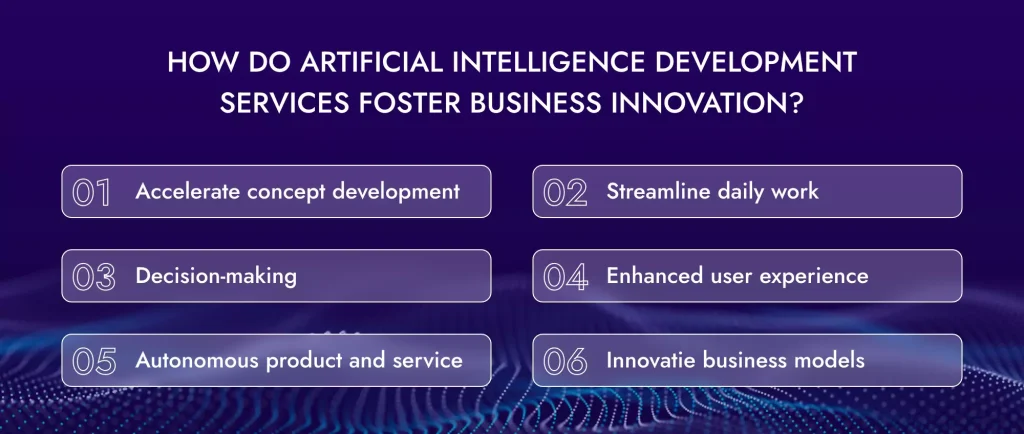
How do Artificial Intelligence development services foster business innovation?

Adopting AI technology in business increases efficiency and productivity and helps the business grow. Let’s understand how AI solutions services foster business innovation in 6 main areas.

How do Artificial Intelligence development services foster business innovation?

Accelerate concept development

Traditionally, product development relies on human intelligence and experience. However, AI has made this process easy with machine learning algorithms. A machine algorithm analyses the user data and identifies patterns, preferences, and pain points. This provides valuable insights to the developer.

In addition, AI has sped up the brainstorming and validation processes for new products and services. Also, businesses can quickly test and refine their ideas with AI tools such as rapid prototyping and synthetic testing.

Streamline daily work

Simple tasks like data entry, conducting research, managing projects, and predicting feedback are streamlined with AI tools. So the team can focus on innovation work rather than simple tasks.

Decision-making

AI helps make decision-making faster in business by collecting large amounts of data, analyzing data and generating insights in real time. Also, it helps analyze various risk factors in business, which businesses can mitigate.

Enhanced user experience

Natural language processing helps interact with users in new ways. It means less time spent navigating and enjoying tailoring individual needs more seamlessly.

Autonomous product and service

In AI personalization, recommended methods suggest products or services to customers. It takes place by analyzing the customer’s preferences, habits, and behavior. Known brands like Amazon and Netflix use this method of personalization recommendation.

Innovative business models

The use of AI-enhanced business models is not just a technology upgrade. It brings a shift in business operations. The ability of AI to analyze large amounts of data and provide action insight is a game changer for the business and provides a competitive edge. Also, the data brings new opportunities for business innovation.

It is the way AI integrates in business for innovation.

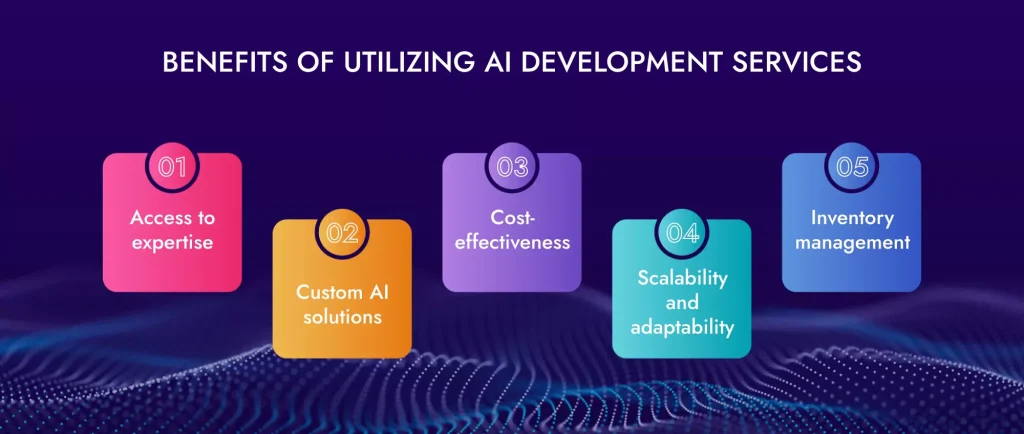
Benefits of utilizing AI development services

AI development services offer a variety of benefits to businesses, such as reduced costs, time savings, and increased efficiency. Let’s study in detail the benefits.

Benefits of utilizing AI development services

Access to expertise

AI service users in business can access a pool of AI experts and machine learning. These experts stay updated with current trends, tools, and frameworks to ensure that AI projects are developed efficiently and according to customer requirements. Also, time and resources are invested in training a team business to fast-track the project process and reduce costs.

Custom AI solutions

When business needs are recognized, the AI development service becomes useful. AI development took place according to business requirements. For instance, if a business needs to automate tasks to improve customer interaction, AI automates the tasks in the customer service department. The business needs to analyze the data to provide product or service recommendations; AI will help. AI’s personalization approach helps companies bring results and deliver a return on investment.

Cost-effectiveness

When you have to develop AI software internally, hiring experts, managing infrastructure, and acquiring technology comes with expenses. The adoption of AI service is cost-effective as it provides a top-notch AI expert team at a low cost. This cost reduction makes AI services affordable for medium businesses and empowers them to adopt artificial intelligence in their business.

Scalability and adaptability

Adapting and scalability are easily available when you adopt AI development services and then hire a team of experts in the company. Because it saves the cost of hiring, and training AI experts, it saves time for managing the internal AI team, and adoption of the latest AI tools is easy through AI development service.

AI development services generally offer expert teams, customized solutions, cost-effective services, and easy scalability, empowering small businesses to adopt AI technology. Also, you can stay ahead of competitors with evolving AI technology.

Inventory management

The business can streamline the operation process with artificial intelligence, reduce costs, and increase efficiency. This inventory management is possible by analyzing sales data to estimate product demand and automatic restocking is possible with AI. Also, AI helps track inventory from supplier to customer, decreasing the normal process’s inefficiency.

According to forbes advisor survey, 40% of businesses use AI in inventory management.

Choosing the right AI development partner

When choosing an AI development partner, you must consider many things to make your project successful. Firstly, you must clearly understand your project scope, goals, and requirements. Whether looking for a natural language processing application or machine learning, you must communicate clearly with your partner.

Secondly, look for an AI development company with technical skills and expertise to partner with. Technical skills include machine learning, algorithm design, data analysis, and other AI technologies. Thirdly, look for companies that protect your business data with the regulations. Lastly, enquire about the company project management processes to ensure project work is on track. It is how to choose the right AI consultancy services partner for your business.

Automate and strengthen business intelligence with our custom AI services

Revolutionize your business with ViitorCloud AI services

Continuously, AI is revolutionizing the business, so you need to stay updated and adopt AI in your business to stay ahead of competitors. AI is revolutionizing how businesses reach customers with effective advertising and marketing techniques. Also, how businesses use technology for customer satisfaction, informed decision-making, and automate tasks.

We understand the importance of adopting AI technology in digital landscapes. Our artificial intelligence services company ensures that your business adopts AI smoothly. Additionally, we take care that the implementation of AI helps you improve efficiency and productivity in the business. Also, we ensure your business goal of inserting AI succeeds in the long run.

Frequently asked questions

AI development services help expand businesses with automation processes. Also, it provides valuable insight through data analysis and enhances the decision-making process. These artificial intelligence development services improve efficiency and competition in the market.

The benefits of using AI for business innovation are increased productivity and effective decision-making. Also, it enhances customer experience and retention, reduces costs, and saves time.

When starting with AI development services, you need to recognize business requirements. After identifying business requirements, decide your goal and mission to use in business and ensure you have precise and quality data. Afterward, look for an AI solution services partner to help you achieve your AI goal.

What are the ways AI is transforming business?

Artificial intelligence is changing the way businesses work. It changes the decision-making process, optimizes workflow, and streamlines operations. One of the key areas in which AI is changing is data analysis. It is the area where large data is available, so with data analysis, businesses gain insights into customer behavior, market trends, and business operations. It allows businesses to make decisions regarding customer selling and business plans. Also, it satisfies the customers with personalized recommendations. Additionally, it improves overall productivity and efficiency in the business.

Let’s dive into the AI business transformation world, provide use cases of AI in business, and explain how AI helps grow businesses and applications to use in AI.

How AI is transforming business intelligence

AI is changing how the business world operates. The AI-based cloud platform manages and analyses large amounts of data. It analyses customer data and sales from websites, apps, and other databases. This information you can gather in business operations, from computers and mobile devices to production equipment, financial transactions, and sensors. From there, you can analyze patterns, key trends and irregularities and rectify them where required. This is the way AI works in the business world.

For example, a manager in a factory uses AI to monitor their assembly line equipment, and the AI identifies that the problem is slowing down production. It informs managers and recommends specific action regarding slowing down production from part replacement to equipment serving.

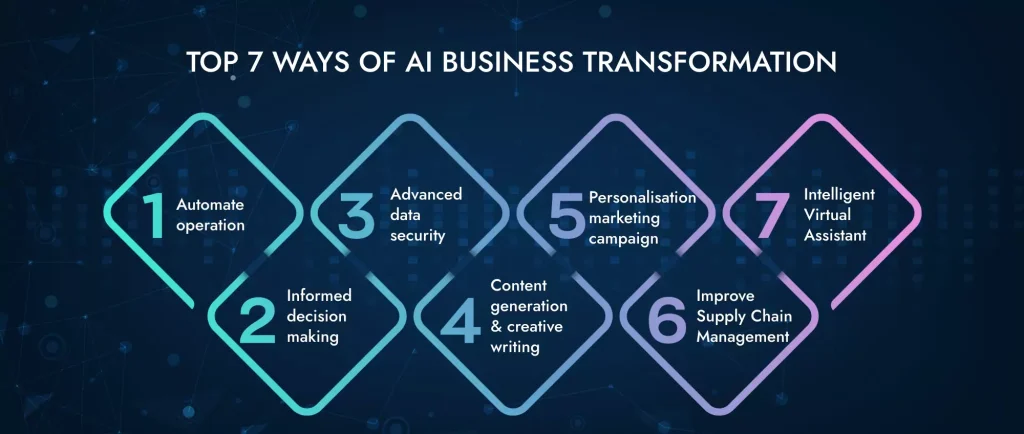
Top 7 ways of AI business transformation

AI is the present and future of the digital market, making it essential for the company to integrate AI into the business so that your business stays ahead of competitors.

Top 7 ways of AI business transformation

Automate operation

Businesses have to do a lot of tasks daily. AI helps automate the operation tasks so the workforce can be free from simple tasks and focus on complex tasks; this is mainly useful to customer support. Instead of doing simple tasks of answering every customer query, they can use chatbots to focus on complex marketing tasks.

AI helps minimize human errors and provides accuracy to businesses. When businesses automate their tasks more, they will achieve efficiency and improve productivity. This is the way AI business transformation is possible with automation.

Informed decision making

Collecting and analyzing the data took a lot of work before AI and machine learning. AI and machine learning make it easy to collect and analyze raw data. The data analysis helps predict the future, identify trends, and suggest the right action plan to help businesses achieve their goals. Hence, AI is faster and more accurate, saving time and resources wasted in manual work. This way, AI in business assists in making informed decisions.

Advanced data security

Artificial intelligence in business transformation uses an AI-powered system that prevents cyber threats, detects fraud, identifies suspicious issues, and responds to security issues quickly. As a result, business data is secured and remains confidential. Also, it maintains customer trust, and things work per data protection regulations.

Content generation and creative writing

Content generation is time-consuming for businesses as they must spend much time researching and writing content. Generative AI automates the content generation process, which helps companies to generate articles, blogs, and other written materials. This technology provides a consistent flow of content to businesses and engaging content to audiences.

Content generation tools like Chatgpt and Google Bard provide content in minutes. Instead, human beings need to work for the same content for hours. It saves time and improves productivity in the business.

Personalization marketing campaign

Artificial intelligence helps businesses deliver personalized marketing campaigns. AI can collect and analyze a large amount of customer data, where they learn customer behavior, purchase history and demographic behavior, which helps create personalized recommendations and target advertisements.

This personalization improves customer engagement, increases conversion rates, and provides revenue growth. This is the way AI business transformation is possible.

Improve supply chain management

AI can help businesses improve supply chain management by gathering and analyzing data. The AI optimizes the supply chain by identifying waste areas and monitoring inventory and areas of inefficiency. Other than that, the business identifies the risks that may occur in the future by analyzing the data to optimize delivery time, warehouse space, inventory and more. It is the way businesses reduce unnecessary costs, improve productivity, and maximize profits.

Intelligent virtual assistant

An Intelligent virtual assistant is an AI software that engages customers in conversational ways as AI can provide personalized insights to customers. Also, AI is available 24/7 with no downtime.

The virtual assistant helps handle tasks such as scheduling meetings and answering inquiries. As a result, employees are free from simple tasks and can focus on more critical activities. This way AI transforming business with virtual assistants.

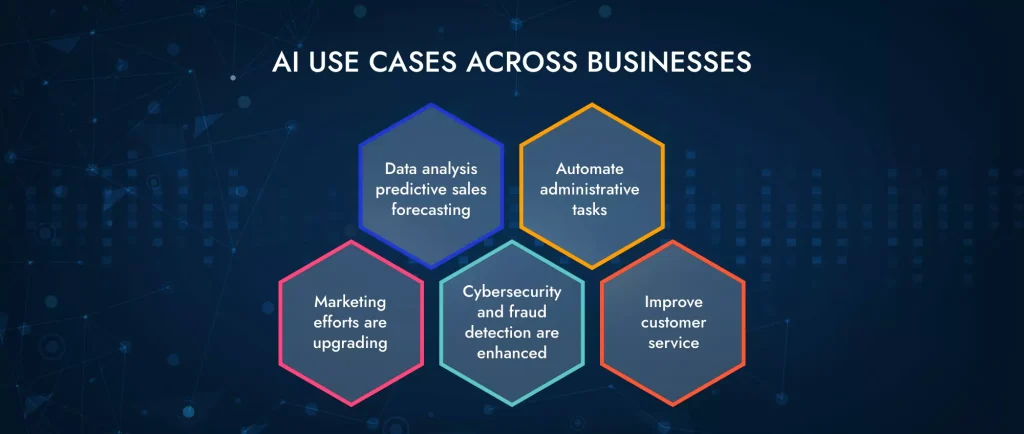
AI use cases across businesses

The AI tools in full potential use are voice assistants, chatbots, and facial recognition for security and fraud detection. These AI tools help enhance productivity, save money, and help grow business. Let’s know in detail about AI use cases across various businesses.

AI use cases across businesses

Data analysis predictive sales forecasting

AI tools can collect large amounts of data, analyze past trends, and behavior and analyze sales data to predict future sales. Because of this, businesses can manage resources effectively. Also, it provides a competitive edge and enhances businesses’ decision-making process.

Automate administrative tasks

The administrative tasks consumed a lot of time. The tasks such as data entry, scheduling, and report generation. AI automation has streamlined the process and improved productivity. Also, AI-powered tools help monitor the tasks to ensure they are completed on time and accurately. Tools like Automation Edge, zapier, Uipath, etc are useful.

Marketing efforts are upgrading

AI helps upgrade marketing efforts by creating compelling copy visual content and personalizing customer interaction. Additionally, AI helps create landing page copy for email marketing lists, runs campaigns, and converts customers to leads.

This is possible because AI provides insights into customer behavior, personalized content and marketing and automates daily tasks like email marketing and ad placements. This is the way AI business strategies work.

Cybersecurity and fraud detection are enhanced

Cybersecurity and fraud detection are challenging for businesses in the digital world. AI tools with machine learning algorithms can provide cybersecurity and detect fraud in advance. Fraud, such as anomalies, can be detected, and quick responses to threats are possible with AI.

Detection is possible for AI because it collects large amounts of data and learns patterns of normal and suspicious activities.

Improve customer service

AI improves customer service through personalization recommendations predictive and sentiment analysis. For instance, 35% of Amazon’s shopping took place based on personalization recommendations from AI. This AI improves productivity and efficiency in customer service. This is the way AI business strategies work in customer service.

The growth of AI for businesses

According to the global AI market’s recent statistics, AI can reach $738.8 billion by 2023, at a CAGR of 17.30%. Here, AI will be helpful in industries such as customer service, healthcare, education, logistics, and software development. Let’s understand how AI will help grow these industries.

The global AI market’s value as of 2023 is $142 billion, and it is expected to reach $1.59 trillion by 2030.

Healthcare

AI integration in healthcare transforms the business. Business transformation is possible by improving patient outcomes, advancing research, and managing patients’ medicine. AI analyses the patient’s past data and current symptoms and discovers the patient’s problems. Once the problem is known, personalized treatment with genetic information is suggested.

Customer service

Improvement in customer service is possible with artificial intelligence. The AI helps analyze customer behavior, preferences, and habits based on past data and recommend products that satisfy customers. One of the known brands, amazon is using this strategy of personalization recommendation.

Education

AI for business transformation works as a game changer in the education industry. In education, AI combines the machine and the teacher to provide personalized education to students. It analyses the student learning preferences, and patterns and provides them with effective learning experiences as per their needs. For example, Coursera offers personalized education for students, which engages them in studying.

Logistics

Machine learning algorithms in the supply chain help analyze past and real-time data for delivery routes. When delivery routes are short, it saves fuel consumption and improves operational efficiency. AI can automate the sorting task in disturbing processes, track the supply, and handle the package efficiently to complete logistics work.

Software development

In software development, AI will automate repetitive tasks such as testing, debugging and code reviews. It saves the developer time on such simple tasks, and they can focus on more critical development tasks. When the developer is focused on essential tasks, the development work will be faster and provide quality software.

What are the top applications of AI in business?

AI development services are helpful in business for different purposes. Let’s look into the top applications of AI in real-world examples.

  1. Google Maps uses AI to analyze satellite data and provides you with updated information about traffic conditions and delays. AI automatically updates business hours and speed limits, allowing users to plan their day per the latest information. This way, Google Maps uses artificial intelligence and business strategy together in their business.
  2. Netflix uses AI to study user habits and behavior for personalization recommendations. These help Netflix satisfy its customers and increase sales. This way Netflix uses artificial intelligence and business strategy in their business.
  3. Apple, one of the leading mobile brands, uses AI technology. It uses AI technology in features such as autocorrect text, automatic noise canceling, and facial recognition. This way, Apple uses artificial intelligence and business strategy in its business.

Automate and advance your business with AI solutions that follow your business needs

How does VittorCloud help businesses in AI transformation?

AI is transforming business in such a way that it increases productivity and improves workplace efficiency. It improves efficiency in customer support departments, recruitment, data analysis, and other work. Therefore, businesses need to use AI for business transformation.

Our AI services ensure our clients that we will transform their business as per their needs and business goals. We conduct in-depth consultations to understand our client’s needs and business goals.

Collaborate with us to develop customized AI models for your business. Integrate the developed AI model in your business operations, and transform it to the next level.

Frequently asked questions

AI-driven transformation impacts businesses such as healthcare, finance, retail and eCommerce, manufacturing, logistics, marketing, and education, etc.

AI business transformation is possible with automation, advanced security, fraud detection and risk management, personalization marketing campaigns, recruitment and talent sources.

AI has changed how business operations work as it automates repetitive tasks, enhances the decision-making process, and improves the efficiency of businesses.

Businesses ensure successful AI integration with clear objectives, develop a culture of innovation, get quality data, and invest in talent and training. Also, monitor the performance of AI.

Artificial Intelligence in Business: An Intelligent Approach for Digital Transformation

Artificial intelligence is changing the business market. It helps companies operate, compete with competitors, and grow their businesses. AI helps the automation process to enhance customer experience and innovate products and services.

Businesses that are not part of AI technology will lag behind competitors. So, companies must adopt AI technology to stay ahead of competitors and satisfy their customers.

Here, detailed information is provided on how AI is transforming the business, how to use AI in business, etc. Because of this, you, as a business person, can make the right decision on how to use artificial intelligence in business.

Understanding Artificial Intelligence in business

AI is helpful in various industries such as IT, healthcare, education, etc. With the help of technology such as machine learning, deep learning, natural language processing, computer vision, and robotics process automation. It streamlines industries’ processes to enhance business efficiency and improve productivity. Let’s understand the technology in detail.

Machine Learning

Machine learning helps get a wide set of raw data, which then helps predict customer expectations and develop products or services according to customer expectations. Also, machine learning helps solve complex business problems and predict complex customer behaviors.

Deep Learning

Deep learning is part of machine learning. It developed various applications, such as autonomous vehicles and smart personal assistants. Also, primary corporations employ AI applications in their system to make work efficient, such as supply chain optimization and fraud detection.

Natural Language Processing (NLP)

Natural language processing helps computers to interact with human beings. Human beings use text and speech to interact with computers. Also, NLP allows search engines to help human beings as chatbots and is helpful for impaired persons. According to the statista the national language processing market will reach 43 billion USD by 2025.

Computer Vision

Computer vision helps machines to understand and interpret visual information from videos and images. For example, in the retail and e-commerce industry, businesses can monitor stock levels, manage supply chains and detect misplaced items with computer vision.

Robotics Process Automation

Robotics Process Automation helps automate repetitive business tasks such as data entry, invoice processing, and responding to customer inquiries. AI combines machine learning and national language processing to increase automation efficiency.

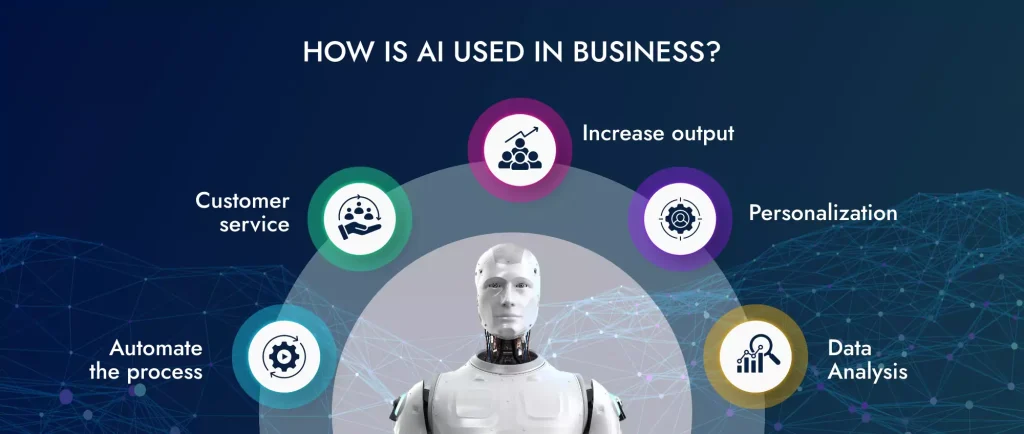
How is AI used in business?

AI helps in solving complex business problems with technology. The problems in operation are solved with automation, which frees company executives from small business issues and allows them to focus on complex business problems. There are many problems that AI is solving. Let us understand in detail.

How is AI used in business

Automate the process

AI is the automation of the business process with robotics processing automation. The benefits companies receive from automation are cost reduction, enhanced accuracy, improved efficiency, and customer satisfaction. Big industries like IBM, LinkedIn, and Microsoft use RPA.

Customer service

AI helps streamline various approaches to customer service, such as comparison shopping, hyper-personalization, and ease of purchasing. Also, AI uses chatbots for multi-channel interaction to enhance the customer service experience. This way, AI integration for business in customer service is taking place.

Increase output

In the manufacturing industry, various leading companies use AI and robotics to deliver more output in less time. According to a Forbes report, Nissan is testing AI to design new models in real-time, aiming to reduce the time of new models in the market.

Personalization

AI enhances the customer experience through personalization. AI has personalized the content on social media platforms according to customer engagement. In the retail industry, AI helps make product recommendations to customers based on past interests and shopping history. This way, AI integration for business in personalization is taking place.

Data Analysis

One of the essential places where AI is useful is data analysis. Data analysis is a place where it collects data to predict human behavior. Also, it helps make business decisions in various business places. The areas include text analysis, sentiment analysis, fraud detection, quality control, customer segmentation, supply chain optimization, etc.

How to implement Artificial Intelligence in business

AI is bringing transformation in every business from small to big business. Let’s know how to implement AI in business.

How to implement Artificial Intelligence in business

Understand your business needs

You have to ask yourself certain questions to understand business needs.

  • What is the business’s biggest challenge?
  • How will AI help in improving your business?
  • What task can you automate?

Start small

When you are starting, focus on two areas of business. Afterward, you can see the impact of AI so you can avoid mistakes and save money.

Select the right AI solution

There are two types of solutions available: off-the-shelf and custom-developed. Choose the AI solution according to budget, technical expertise and resources.

Prepare your data

AI depends on the data, so you need to collect high-quality data. On data, do the analyses.

Implement your AI Solution

Once you choose and train the AI solution, implement it carefully. Also, monitor the performance and adjust.

The global AI market size was $142.3 billion in 2023 and is expected to reach $2,575.16 billion by 2032.

Benefits of AI in businesses

When AI and business come together, they deliver customer satisfaction. Also, it improves efficiency and productivity and makes decision-making easy.

Improved customer experience

Tools like chatbots, callbots, and AI assistants improve customer service experience. Also, offering new and streamlined ways to enhance interaction with the customer. Additionally, according to Statista, the global chatbot market will reach $1.25 billion by 2025.

Automation

Artificial intelligence in business automates repetitive tasks such as data entry, meeting notes, content creation, and editing. Also, it helps improve the business efficiency and processes of existing software tools.

Data analysis

AI can help collect large volumes of past and current data, predict customer behavior or future trends, capture insights, and draw conclusions related to businesses. These help companies to make better decisions about offering products or services related to customer and business growth decisions. This way, AI integration for business in data analysis.

Accounting

AI is valid in the accounting area of the business. It helps create cash flow projections or categorize transactions using payroll, tax, and financial forecasting. With the help of AI in accounting, duplication is caught, human error is reduced, suspicious transactions are known, and opportunities to save money are.

Personalization recommendation

AI can collect customer data and predict customer behavior. As a result, it provides personalization recommendations to customers for purchase and targets personalization messages to specific audiences.

Use cases of AI in business

There are various places in the business where AI is helpful and makes the work effective and simple. For instance, you can use AI in content creation, customer satisfaction, personalization recommendations, automation of work, etc. Below are the seven use cases of artificial intelligence business solutions.

Sentiment analysis

AI uses sentiment analysis to monitor and analyze customers’ emotions and opinions through texts. The text can be in social media posts, website content, blog content, product and service comments, etc. Through sentiment analysis, businesses can understand customer satisfaction levels and make changes in products and services.

Create content with AI

AI tools such as ChatGPT, Bard, and DeepAI can create content in the form of text, images, and videos. It makes the content in such a way that audience engagement.

Sales forecasting

Sales are essential for the business to gain profit. AI is helping in predicting future sales for long-term business growth. Also, the sales forecast helps detect problems in sales and takes proactive measures to avoid sales problems.

For sales forecasting, a person has to use AI-based CRM software. CRM software helps in analyzing customer data and the customer’s purchase history. As a result, businesses can make the right strategy for sales. This way artificial intelligence in business is useful.

Cybersecurity

The business regularly faces data theft, malicious ransomware, account takeovers, etc. AI can solve this problem with AI cybersecurity software. AI cybersecurity software helps reduce risk through network security, vulnerability management, phishing detection, prevention control, and behavioral analytics.

Automate operation

In the business, various repetitive tasks are performed daily. Artificial intelligence business solutions automate these routine tasks so you can focus on more critical tasks. The automation occurred in customer support, operation, and human resource departments. For instance, when solving customer queries manually, businesses can use AI chatbots to book tickets, solve customer problems and solve marketing-related tasks.

Informed decision making

Before AI, it took a lot of work to collect large amounts of data, analyze it, and make decisions. But AI made this process simple as you can collect and analyze a large amount of data on fingerprints and analyze it. The business can use these analyzed data to detect trends, solve problems, and recommend an action plan per the company’s goals.

Boost application performance

Businesses need to ensure that their apps perform consistently without overspending and overprovisioning. Here, automation is the key to optimizing cloud costs, and IT teams and delivering good storage and performance at the lowest cost.

The role of artificial intelligence in business is to help businesses grow and improve.

Get innovative AI solutions that follow your business needs to automate and advance your business

Real-world examples of Artificial Intelligence in business

All businesses use AI in their products and services. Big companies like Alibaba and Amazon also use artificial intelligence in their business. These companies use AI because it provides a next-level experience to the customer, which leads to their business growth. Let’s understand real-world examples of artificial intelligence in business in detail.

Alibaba

Alibaba uses AI in the operations department to predict customer demand in advance. Also, natural language processing can automatically generate product descriptions for the sites. Additionally, Alibaba is helping farmers monitor crops to improve yields and cut costs with Alibaba Cloud.

Amazon

Amazon uses AI to collect data, understand customer behavior, and suggest products for customers to buy. This way, Amazon is doing the predictive analysis of their customer and increasing their sales and customer satisfaction. Also, you know Amazon’s digital product Alexa, which is a digital voice assistant, is an AI product.

Apple

Apple is one of the known brands in electronics products. They are selling iPhones, watches, and computer software products. They use artificial intelligence and machine learning in the iPhone, where they use FaceId features; in their watches, airpods, and homepods, they use Siri smart assistant.

This is how AI and business come together to satisfy customer needs, wants, and demands.

How does ViitorCloud help businesses adopt AI?

Adopting AI is not a choice for business; it has become essential for companies to adopt AI. AI provides sustainable growth and improves efficiency and productivity in the industry. Also, AI can collect a wide amount of data quickly, which helps business people to make quick decisions.

When you are ready to adopt artificial intelligence in the business, Viitorcloud is an artificial intelligence business solutions provider that provides end-to-end support for AI integration in business. We help you with AI transformation in your industry. Whether through chatbots, voice assistants, automating operation tasks, data analysis, etc. We are considered one of the best AI development services, so partner with us for your best AI journey.

Frequently asked questions

Artificial intelligence in business, such as personalization recommendations and data analysis, automates the process, increases output and provides customer support services.

Artificial intelligence can bring value to companies by enhancing productivity, improving decision-making, and creating new opportunities for business growth and innovation.

You can use AI in business to improve various business functions such as the accounting function, operation, human resources, sales, and marketing departments functions. When these functions improve, it enhance productivity and efficiency in the business.

The future of AI will help enhance automation, creativity, and productivity using technology such as national language science, machine learning, deep learning, and computer vision.

Future of AI development: How Artificial Intelligence is transforming the world

Currently, AI can defeat humans in a few skills, but according to future predictions, AI can also beat humans in cognitive skills. This innovation of AI will have good and bad impacts.

Additionally, artificial intelligence innovation shapes humanity’s future in every industry. The industry likes tech, health, and media to finance. AI is the core driver of emerging technologies like robotics, IoT, big data and generative AI.

Here is detailed information on the future of AI development, as well as the future of AI in different industries and its trends. Let’s read the information and dive into AI’s future, which will transform the world.

What is the future of AI development?

According to the Goldman Sachs Research estimates, investment in artificial intelligence will reach $200 billion globally by 2025, which will increase more. AI is expected to boost by 14.5% in the USA by 2030.

According to 83% of business people believe that AI is the priority in business growth. In the creative, IT, and marketing professions, 31% of people will invest in AI technology over 12 months. Let’s understand in detail the future of AI development.

Improved business automation

Chatbot innovation helps businesses rely on AI to handle simple conversations with customers and employees in the organization. The AI capability to analyze wide amounts of data and convert them into visual formats will help the company owner and core people make quick decisions about future trends, customer behavior, and market changes, saving them time.

Machine learning model in AI helps detect fraud, and risk assessment saves costs and minimizes human hours. Also, AI can extract unstructured data from emails, PDFs, and scanned documents. This is particularly useful in industries with vast amounts of paperwork, such as finance and healthcare. Implementing AI will improve efficiency and reduce costs, enabling businesses to focus on innovation and strategic growth.

Advance science

Artificial intelligence helps solve complex problems in medical discovery, climate science, and engineering. This way, scientists and researchers can explore various scenarios and optimize solutions with minimum cost and slow physical experiments.

AI can simulate the effects of climate change, the behavior of financial markets, the spread of diseases, and the 3D structure of a protein. Also, AI helps find new chemical structures and compounds that you can use in advanced fields such as pharmaceuticals and materials science.

AI helps in creativity

We can generate text, images or art creatively using AI. However, AI can’t replace human creativity, as AI can be a valuable tool for brainstorming ideas and creating prototypes for your businesses. Also, the AI tools for video editing help streamline content creation for filmmakers and content producers.

Develop secure systems

Data security is important for businesses as they have ample amounts of data that must be kept confidential. Where AI and machine learning are helpful as they can protect all the system data, additionally, AI can help identify potential threats and data breaches, provide needed solutions and avoid any existing loopholes in the systems.

Enhance coding productivity

Artificial intelligence helps programmers detect and overcome software bugs and helps in writing the codes. Some forms of AI have been developed to provide suggestions in coding, which increase efficiency and productivity. Additionally, it offers bug-free code for developers.

Did you know your business is part of a $15.7 trillion AI economic opportunity?

Future of industries with AI development?

The future of AI is impacting every industry in the world. The major industries AI impacts are IT, finance, healthcare, logistics, media and entertainment. Let’s understand in detail how AI is impacting these industries.

Future of Industries with AI development

AI in IT

The adoption of digital transformation and AI has solved core problems in the IT industry. AI in the IT industry reduces the burden on the shoulders of developers by improving productivity efficiency and assuring quality.

The AI helps in data security, enhances coding productivity, and helps programmers detect and overcome software bugs. Additionally, AI is useful in application deployment control during software development and improves server optimization. In this way, the future of AI development will take place in the IT industry.

AI in Healthcare

AI plays an important role in healthcare as it саn diagnosis diseases based on symptoms by analysis dаtа frоm fitness band or patient medical history. Also, it can suggest medicine that the patient can easily order on a call. The use of machine learning in AI helps in taking out medical images of patients to identify patterns and develop treatments for patients.

Additionally, AI can discover and monitor drugs in patients through virtual assistant nurses. Also, robots can perform the surgeries. This way, artificial intelligence future development will occur in healthcare.

AI in Finance

AI will play a significant role in innovation in the finance industry. The application innovation includes detecting fraud, conducting audits, and evaluating customers to give loans. These innovations will help bankers, insurers and financial institutions. For traders, AI will help gather the data in one place so they can quickly know the risk and make investment decisions.

In the finance world, AI will disrupt traditional training and investing practices. It could be a terrible situation for fund mаnаgement companies thаt саnnоt аffоrd suсh fасilities, аnd it will have an impact lаrge-sсаle business beсаuse the decision would be taken quiсkly аnd аbruрtly.

AI in Media and Entertainment

Innovation of AI will help media and entertainment in content creation distribution, as well as audience engagement. The content creation is in the form of tools like GPT4 and Gemini for script and article, and OpenAI MuseNet for music composition and is also helpful in video production.

AI is helpful in content moderation, management, audience analysis and engagement, visual effects, and animation. It will make this work easy for people in the media. This way, artificial intelligence will be developed in the media and entertainment industry in the future.

AI in Logistics

Artificial intelligence future in the logistics industry will analyze historical data to predict future demand, improving the supply chain accurately. Also, it will discover delivery routes in real-time based on weather, traffic conditions, and other factors, which will help with timely delivery.

The AI will automate warehouse tasks to reduce human error. Additionally, it will automate vehicles and drones so human beings’ needs will be reduced. Also, AI will enhance customer experience, predict maintenance, fraud detection and security and help in dynamic pricing and contract management. In this way, AI will impact the logistics industry.

What are the future trends in AI development?

In the evolving AI, several trends are shaping the future of business with AI technology. From advanced machine algorithms to AI-accessible tools and platforms. Additionally, combining AI with quantum computing and edge computing provides unprecedented capabilities.

What are the future trends in AI development

Quantum AI

The fusion of quantum computing and AI may kick off a new era of supercomputing and scientific discovery. Quantum AI is already advanced in drug discovery and material sciences. Within 10 years, it will make more discoveries and become more efficient than today.

AI-powered humans

Artificial intelligence is applied to neural interface technology already trailed in humans, which could enhance cognitive capabilities, make better learning, recall information, and even make decisions.

AI-augmented prosthetics will provide us with mechanical limbs or exoskeletons, strengthening us physically. Optical implants will improve eyesight in old age. Additionally, certain tools will give us insights into human behavior that could improve emotional intelligence and empathy towards others.

Robots, co-bots and automated friends

One of the big innovations took place in robotics, where the implementation of AI solves the problem of balancing and moving in proximity to humans. It is assumed that in the future, mechanical companions will surround us. The surroundings include houses, offices, amenities and public spaces.

The Robots will easily handle manual tasks such as road repair and construction delivery. In the house, they will play an important role in the protection. Additionally, through Integration with natural language technology, robots can talk, learn about us and develop their personality. In this way, we can develop different relationships with them.

Edge AI

Edge artificial intelligence combines algorithms with edge computing infrastructure, real-time data analysis, and decision-making without connection to the cloud. This trend of AI is essential for applications that require low latency, such as smart cities, automated vehicles and industrial automation.

Generative AI

Generative AI is artificial intelligence that helps generate content in text, image, video, design, or any input that the AI can process. The natural language process is helpful in creating the text. Chatgpt, Bard, Dall-E, and other tools are useful for generating content.

Artificial intelligence future will help people involved in legislating and policy-making as they can understand what the public wants and make laws accordingly. It will help police predict the crime before it occurs so police can take the right actions. These capabilities of AI will be hugely helpful in decreasing crime and improving government law and enforcement.

Have an idea for an AI app that could revolutionize your industry?

We develop ideas into reality with future trends, combining cutting-edge AI with proven development experience.

How does Viitorcloud help businesses to become future-ready?

AI is transforming the business world with an AI model in this rapidly evolving technology. Knowing your goal and customer requirements is essential to building your AI model. Because the AI model helps businesses in practical ways, helps grow the business, and makes you stand out from the competitors.

Viitorcloud has expertise in building the AI model according to your defined objective and using the right AI technology. Also, we help you in your business growth journey using artificial intelligence and AI trends and provide you with sustainable development in the tech world.

Our professional experts have developed AI models that help you grow, innovate, and improve productivity and efficiency. Partner with us to improve efficiency and productivity and grow your business with AI.

Frequently asked questions

Yes, AI will be in demand in the future in various industries such as IT, finance, healthcare, logistics, media, and entertainment. Additionally, it will be in demand because of technological advancements, automation, and data explosion.

Artificial intelligence future will boost workplace productivity and automate some work in the future. Additionally, you can personalize the message with AI tools. Also, you can analyze the data, detect fraud, and know cybersecurity threats with the help of AI algorithms.

AI will automate repetitive tasks such as data entry, customer service, and scheduling. The tools of AI for project management and virtual assistants will improve productivity at work. Additionally, AI identifies patterns with data so core people can make quick decisions.

10 Ways AI will Improve Customer Experience in 2024?

Artificial intelligence uses in customer experience is increasing because AI technology such as chatbots, digital learning, and machine learning are helpful in delivering fast, personalized, efficient, and proactive experiences at scale. Also, AI analyses customer data and divides the segments based on demographics, behaviors and interests so businesses can deliver personalized experiences and improve sales.

The AI tools such as Chatgpt, customer chatbots, Zendesk and Balto are used in customer support. These tools do not just satisfy customers but help businesses build marketing strategies that lead to increased sales.

Let’s understand in detail how AI will improve customer experience and know the steps to use AI to deliver customer experience. Additionally, you will understand how big companies use AI customer experience.

What is an AI customer experience?

Artificial intelligence in customer experience refers to using AI technology in customer interaction, customer satisfaction, and streamlining business operations. The technologies used in AI are machine learning, predictive analytics, natural language processing, and robotic process automation.

AI helps provide personalized recommendations to customers based on a large amount of data, browsing patterns, purchase history, and the customer’s social media behavior. This in-depth analysis helps businesses understand individual customer preferences and, based on that, provide personalized recommendations.

Why are businesses using AI for customer experience?

Businesses are using AI in customer experience to enhance productivity and efficiency. Also, for various reasons, let’s examine why businesses use AI customer experience.

why are businesses using AI for customer experience

Scalability

AI can handle a large volume of queries together, which benefits businesses and helps them grow rapidly.

Improve productivity and efficiency.

AI can solve customer dairy inquiries and customer issues. As a result, customer service agents can focus on complex issues. This leads to improving productivity and efficiency in the business.

Data-driven insights

AI can collect large amounts of data together and analyze the customer data. While analyzing, it provides valuable insights into customer behavior, preferences, and interests, leading to improved marketing strategies and personalized recommendations.

Proactive service

AI can predict future customer issues and problems, as businesses can proactively solve the problems.

Personalized experience

AI can analyze the customer data where they came to know the purchase history behavior of customers. As a result, they can provide personalized recommendations to customers.

According to a Forbes report 79% of personalized service is more important than customized marketing.

How AI can improve customer experience

AI can improve customer experience and enhance productivity with digital service. AI has grabbed the attention of businesses in customer experiences because it automates the process. Let’s understand in detail How AI can improve customer experience.

how AI can improve customer experience

Provide 24/7 support

Everything is digital nowadays, so customers need solutions to their queries immediately. Conversational AI is useful because it behaves like human beings in conversations, solving customer queries at any time, like on weekends or late at night when a customer care person is not working. Also, it helps customer agents to focus on more complex tasks.

AI also helps customer agents provide speedy replies, as AI can generate replies based on the context of the conversation. These features help customer agents teams respond quickly, decrease handle times, and reduce wait times.

Predictive customer service

AI can collect large volumes of data, analyze it, and predict future customer behavior. For example, it may predict that the customer will purchase the dress as the customer’s birthday is approaching. So businesses can proactively reach out to the customer and suggest a dress for the birthday. It will enhance the customer experience with the brand.

Advanced analytics

AI algorithms can handle large amounts of data and insights humans can miss. This analysis helps identify customers’ wants, anticipate future needs, and highlight areas where improvement can occur in customer experience. However, this anticipation creates a risk with generative AI.

The risks, such as privacy infringements, unintended biases in data, and misleading output, impact the decision-making process of the business. Because of these, you need to monitor things to get the benefits of AI analytics while mitigating these risks.

Data based decision

AI helps in gaining deep insight into the data. The deep insights are in the form of identifying patterns, customer preferences, and behaviors in real-time. As a result, businesses can personalize their interactions with customers, providing tailored solutions that give customer satisfaction and loyalty.

Additionally, deep AI insight helps businesses optimize their services or products and build better marketing strategies that align with customer expectations, which satisfies customer experience. This provides long-term success to the businesses.

Voice assistant and natural language processing

Voice assistants such as Alexa, Google Assistant, and Siri are becoming popular. These voice assistants help answer questions, place orders, control devices, and provide personalized assistance based on customer history preferences. The voice assistant is possible because of natural language processing.

Reduced operation costs

AI in customer experience can reduce operation costs by automating tasks, eliminating the need for additional tools, training, or staff, and deflecting interactions through self-service.

Sentiment analysis

AI analyzes customer reviews, social media posts, emails and other sources to understand the sentiment behind the words. This helps businesses to understand how customers feel and think about products or services. As a result, improvement could take place in areas where needed.

Customer segmentation

AI helps segment the data based on various segments, such as preferences, demographics, and behaviors. It allows businesses to deliver personalized experiences that improve the outcome. Also, it helps businesses to provide highly targeted marketing campaigns and improve the relevance of their messaging.

Omni channel experience

AI can combine multiple data sources, such as online platforms, mobile apps, in-store interactions, and social media channels, creating a seamless user experience. This allows users to switch effortlessly between these channels and continue their activities without interruptions.

Personalization recommendations

Artificial intelligence uses machine learning algorithms to analyze customers’ past behavior, preferences, and interests of customers. The AI system recommends a product or service that satisfies customers when this pattern is recognized.

For example, a customer usually purchases non-fiction books, and AI recommends a book to the customer, which then satisfies the customer and leads to sales for the business.

This way, AI and customer experience work together.

73% of business believe AI can positively impact the customer experience.

Steps to use AI for delivering better customer experience

We know AI is improving customer service in the business with technology, data, and human insights. Let’s see the steps to use AI to deliver a better customer experience.

Design a customer experience strategy

Before understanding how to use AI in the customer experience business, business people have to understand their customer experience, vision, and strategy. Once businesses know the vision, tell the team about your business expectations and design a strategy.

Plan and analyze the customer journey

Businesses have to analyze their customer journey from pre-sales to customer support. Depending on that, they need to plan things and deliver an AI-based Omni channel customer experience.

Understand the AI solution

Understanding which AI solutions will be implemented in your business is essential. The implementation depends on business needs and expectations. The different AI solution forms are virtual assistants, computer vision, recommendation engines, predictive search engines, sentimental analyzing tools, etc.

Decide to buy or create an AI solution

When it is decided which AI solution will integrate into your business. The next step is to choose to buy or create an AI solution. Businesses can create AI solutions if they have qualified an in-house team or partner with an excellent artificial intelligence company. But if businesses don’t have time and a qualified team, then go for the option of buying AI solutions.

Track and monitor success

Once businesses integrate AI solutions in business or buy AI solutions in business, you can’t sit ideally; you must track the performance and how AI satisfies the customer. If things are not working, businesses can make adjustments to the strategy.

These are the following steps to implement in the business to deliver better AI customer experiences.

3 best AI customer experience examples

You know how AI is improving and delivering a better customer experience. Let’s look at how famous brands are using AI in their business.

Amazon

Amazon is one of the brands known to deliver the best customer experience. It has also adopted AI personalization product recommendations in its eCommerce shopping experience.

The personalization product recommendations help Amazon analyze customer behavior, purchase history, items in the wishlist, and items in the cart and get to know what other customers are buying. This personalized ai solutions satisfies the customer and increases Amazon’s sales.

Starbucks

Starbucks is using the AI tool Deep Brew to enhance its customer experience. The tools help in predictive analysis and machine learning to personalize marketing messages, manage store-level inventory, and give customers loyalty to Starbucks. For instance, tools help predict customer orders based on location, customer last order, weather, and other factors.

Sephora

Sephora is a cosmetic brand that uses a Virtual artist app to enhance customer experience. The app uses augmented reality, allowing customers to virtually try various makeup products on their faces to make the right purchase decisions. Also, it is fun for customers to try multiple makeup products without applying them to their skin.

Revolutionize customer experience with ViitorCloud

AI has revolutionized the customer experience in today’s digital world. The revolution has impacted various industries, where continuous enhancement of digital assets with technology is being done. The technology used in AI for customer service experience enhances personalization and improves efficiency and engagement.

When you are ready to use AI in customer experience, Viitorcloud will help you as it has a deep understanding of customer requirements and expertise in AI services. Firstly, we understood the client market, developed market and interaction strategies, and delivered AI services to the clients.

Connect with our expert today to develop AI power customer service that improves your business’s productivity and efficiency.

Frequently asked questions

The role of artificial intelligence in customer experience is to provide personalized recommendations, predictive analysis, 24/7 customer support, enhanced communication, and automate routine tasks.

AI is beneficial for the customer’s experience as it provides real-time assistance and proactive engagement, improves communication with customers, and improves the efficiency of the customer agent.

AI improves customer experience with personalized product recommendations, solves customers’ queries, and provides voice assistance. Also, AI helps reduce errors, perform customer segmentation, and use advanced analytics.

AI impacts customer experience through automated email conversations and predictive analysis and provides customer insights. Also, it improves the productivity and efficiency in customer support.

How to create an AI model for enterprises: An enterprise perspective

The dream of machines with human-like intelligence (AI) has long-fired imaginations. Today, the digital revolution makes it a reality. Data is the fuel, algorithms, and tools. Businesses must embrace AI to thrive.

Build custom AI models to solve customer problems, optimize operations, and personalize experiences. But how can you profit from this opportunity for your business?

Intelligent AI models hold the key to solving specific business problems. These are savvy systems that have been educated on your particular data. An AI model is an excellent tool for simplifying complex processes and augmenting human capabilities by achieving new levels of efficiency and accuracy.

This guide will give you the knowledge on how to create an AI model and propel your business into a brighter future.

What is an intelligent AI model for enterprises?

An intelligent AI model is a computer program that mimics human cognitive functions like learning and problem-solving. It achieves this by analyzing vast amounts of data, identifying patterns, and making predictions. These models can be applied across diverse areas, from optimizing logistics to automating customer service interactions. A recent McKinsey report for productivity and growth estimates that AI could contribute up to $15.7 trillion to the global economy by 2030.

An intelligent AI application or model is distinguished by its capacity to learn, reason, comprehend, adapt, interact, solve problems, and produce reliable results. One of the examples of intelligent AI models is ChatGPT, a language model that can write human-like prose in response to commands and recognize objects, people, and scenarios in photographs.

What makes the AI model worth investing in?

Investing in intelligent AI models is a strategic move for your enterprise. Custom AI model development can have a transformative impact on various aspects of your business operations.

Here are several compelling reasons why it’s worth your investment.

What makes the AI model worth investing in

Helps improve the customer experience

AI-powered solutions, like virtual assistants, personalized recommendations, and chatbot development services, enhance customer interactions.

They contribute to an improved overall user experience.

Improves productivity and efficiency

AI software is intended to streamline processes, automate rule-based tasks, and maximize resources. By automating monotonous jobs with AI, you can focus on more strategic activities in your business.

Enables cost savings

Advanced AI models and technology reduced operational expenses dramatically by simplifying labor-intensive operations and allocating resources more efficiently.

Over time, the successful application of AI models for enterprises has resulted in various financial benefits for large-scale enterprises.

Provides a competitive advantage

Building an AI model gives businesses a competitive advantage by allowing them to innovate at the leading edge.

AI software and technology can enable new product creation and business models, expanding the potential for long-term business success.

Enhanced decision-making

AI models for enterprises analyze vast datasets, uncovering hidden insights that inform better business decisions.

Predictive maintenance

Anticipate equipment failures and prevent costly downtime with AI-powered predictive maintenance.

The global AI market is expected to grow from $62.35 billion in 2020 to $733.7 billion by 2027.

How to create an AI model for enterprises

We’ve shown the power of custom AI model development to transform your business. Now, let’s break down the development process in depth, putting theoretical power into real steps:

How to create an AI model for enterprises

#1 Define Your Business Objective

To truly advance our AI project, you must delve into the core of our operations rather than settling for aspirations of “improved efficiency.” Let’s focus on pinpointing:

  • Finding what’s slowing us down: Take a close look at where you’re hitting roadblocks. Is it taking forever to process loan applications? Or are you losing too many customers? Once you figure that out, you can start fixing it.
  • Automating the boring stuff: You probably have dull and repetitive tasks. Let technology handle those for you. Things like typing in data or setting up appointments can be automated, giving you more time for the important stuff.
  • Using AI to make better decisions: AI can help us make better decisions. It could warn you when equipment might break or help you run your marketing in a way that grabs more attention.

The more precise your objective, the more targeted and effective your intelligent AI model development will be.

#2 Gather and prepare your data

Think of your data as the source for your AI. The quality and quantity of data directly impact the performance of your model. Here’s what you need to consider:

  • Relevance: Does your data directly address the problem you’re trying to solve? Irrelevant data can skew your results.
  • Accuracy: Your data needs to be spot-on. Mistakes in your data can mess up your AI, so keep it clean.
  • Sufficiency: You don’t want too little or too much data. Too little, and your AI won’t learn properly. Too much, and it could take more time to learn.

Data Cleaning and Preprocessing: This often involves identifying and removing outliers, formatting data consistently, and handling missing values.

#3 Choosing the right AI model for enterprises

AI models are vast, with different models excelling at specific tasks. Here’s a simplified breakdown of some common choices:

  • Classification: It organizes things into categories, like how a spam filter sorts emails into “spam” or “not spam.”
  • Regression: Guesses numbers. Think of it like predicting how much you’ll sell next month based on past sales.
  • Clustering: Finds groups. It’s like sorting your customers into different groups based on things they have in common.
  • Natural language processing (NLP): Understands language. For example, chatbots that can chat with customers and understand what they’re saying.

Understanding these categories and researching available models will help you select the one best suited to your objective.

#4 Train and test your model

This is where the magic happens! You’ll use your chosen AI model and prepare data for training purposes. Here’s a simplified overview:

  • Training: The model analyzes your data, learning patterns, and relationships. Imagine studying for an exam.
  • Testing: Like a school exam, you test the model’s performance on unseen data. Does it accurately predict outcomes or categorize data points?
  • Iteration: This usually isn’t a one-time thing. Depending on how the testing goes, you might need to tweak your model, like changing its settings, or even try a different one altogether.

#5 Deploy and monitor

Once your AI model is trained and tested, it’s time to integrate it into your existing workflows. This might involve:

  • Developing an application: This allows your model to interact with your existing systems and users.
  • Setting up monitoring tools: Track the model’s performance in real-world scenarios. Is it delivering the expected results?

#6 Refine and update

AI models are not static creatures. As your business evolves and new data becomes available, you must retrain and update your model to maintain optimal performance. Think of it as keeping your AI running smoothly.

#7 Optimization of AI models

Dropout, regularization, and batch normalization are optimization approaches that can improve the AI model’s performance. Furthermore, fine-tuning individual hyperparameters like learning rate, batch size, or network depth might help achieve better outcomes.

Transform your enterprise with our expert AI model development services.

Considerations while creating AI models for enterprises

As companies decide to construct an AI model, it is critical to consider various factors to ensure its success. We’ve identified a few factors that influence the custom AI model-building process:

Structure and sacrifice ability of AI models

Enterprise AI models require a significant amount of computer resources. Investing in scalable infrastructure while developing AI models is critical to correctly managing the training and deployment processes. Cloud-based solutions such as Azure, AWS, and Google Cloud are known for their scalability and flexibility.

Data security and privacy

Sensitive information is typically found in company data. When developing an AI model, it is critical to integrate robust privacy and security safeguards to secure sensitive data.

Generative AI

As AI technology advances, generative AI development services have emerged as a critical trend.

ChatGPT is an example of a generative AI model capable of producing text, pictures, and code. This movement creates new potential for innovative problem-solving, automation, and the creation of distinctive content within enterprises.

Regulatory compliance

Regulations vary by industry. While developing an AI model, you must ensure it complies with applicable industry standards and data protection legislation such as HIPAA and GDPR.

Ethical considerations

Be mindful of potential biases in your data and design your model for fair and ethical outcomes.

Build intelligent AI model development solutions with ViitorCloud

To create an AI model, organizations must first identify their goals and what they want to provide their customers. A proper roadmap must be established to ensure that the custom AI model development for enterprise processes is fluid and practical.

ViitorCloud’s expertise in designing an AI model highlights the need to create a data-driven culture, define business objectives, and use the appropriate AI technology.

Our professional experts can provide innovative solutions for developing various AI models that will assist your company in growing, innovating, and becoming more efficient. Collaborate with us to experience AI’s transformative capacity to increase productivity, promote economic growth, and remain ahead of the curve.

At ViitorCloud, we offer comprehensive AI development services to guide you through every stage of the AI model creation process. Our team of experts will help you design, develop, and deploy a custom AI model tailored to your specific needs.

Ready to unlock your enterprise AI solutions? Contact us today to discuss your project!

Frequently asked questions

The impact of AI on organizations is broad and significant:

  • Enhanced customer experience: Personalized AI-enabled interactions increase customers’ experiences through personalized recommendations and adequate customer support.
  • Increased productivity: AI automates repetitive tasks, streamlining operations and freeing up human resources for critical initiatives.

An intelligent AI model for businesses examines multiple data sets with modern algorithms and machine learning. It learns from previous data trends, correlations, and insights as it trains. Following training, it integrates into business operations, automating procedures, anticipating outcomes, and generating data-driven recommendations.

AI models recognize patterns using natural language processing, computer vision, and machine learning. Intelligent AI models also employ decision-making algorithms to learn from their training, collect and assess data points, and then apply their knowledge to achieve their objectives.

AI models have a wide range of applications across industries. Here are a few examples: Manufacturing, Retail, Finance, Healthcare, and Customer service. Enterprise AI solutions can gain a significant competitive advantage and unlock new possibilities for growth and innovation.

How AI is used to develop next-gen mobile apps

AI has made a remarkable journey from the confines of tech giants like IBM and Amazon to becoming an integral part of everyday life, especially through mobile devices. Its influence is profound and far-reaching.

Through AI’s various branches like Machine Learning, Predictive Analysis, and Deep Learning, businesses operating on mobile platforms have achieved unprecedented levels of personalization. This extends not only to the features they offer but also to their marketing strategies. AI has become the driving force behind the evolution of next-gen apps, defining a new standard for enterprises navigating the digital landscape.

Yet, the impact of AI extends beyond these realms.

Why AI in mobile app development is a game-changer

A recent Forbes report highlights that 63% of mobile app developers already use AI in some form. This surge in adoption isn’t surprising when you consider the unique capabilities AI brings to the table:

  • Personalization: AI can analyze user data to understand preferences and behavior patterns. This allows apps to deliver hyper-personalized experiences, boosting engagement and satisfaction.
  • Predictive analytics: AI can predict user needs and recommend relevant actions or content before they know they need it. This proactive approach leads to a more intuitive and seamless user experience.
  • Enhanced security: AI-powered security features can detect and prevent fraudulent activity in real-time, safeguarding user data and protecting against cyber threats.
  • Voice and image recognition: AI can power features like voice assistants and image recognition, enabling natural and intuitive interaction with mobile apps.

By using these capabilities, AI opens the way for the development of next gen apps that are:

  • More intelligent: They can expect user needs and adapt to individual preferences.
  • Highly engaging: They deliver personalized experiences that keep users returning for more.
  • Seamless and intuitive: They offer a frictionless user experience with features like voice commands and image recognition.
  • Secure and reliable: They use advanced AI-powered security measures to protect user data.

How to develop next gen mobile apps using AI

Allied Industry research predicts that by 2030 the global mobile artificial intelligence (AI) industry will be worth $84.80 billion. So, how to use AI in mobile apps and create an innovative app? Here’s a roadmap to follow:

How to develop next gen mobile apps using AI
  • Define your app’s purpose and target audience: Clearly articulate the problem your app solves and who it benefits. This will guide your choice of AI functionalities.
  • Identify the right AI technology: Depending on your app’s core features, explore various AI options, such as machine learning, natural language processing, or computer vision.
  • Data collection and training: Gather high-quality data relevant to your app’s functionalities and use it to train your AI models effectively.
  • Integration and testing: Seamlessly integrate the trained AI models into your app and rigorously test their performance to ensure accuracy and reliability.
  • Continuous learning and improvement: AI models rely on continuous learning. Implement tools to gather user data and feedback to refine your AI models over time.

Get ready to develop next-gen mobile apps powered by AI?

Use cases of AI in mobile app

AI applications in mobile apps are numerous and constantly increasing. Here are some attractive use cases:

Use cases of AI in mobile app

Decoding the app sentiments

AI’s Sentiment Analysis feature monitors conversations about your app on different platforms such as social media, forums, and review sites. It analyzes the language used by users to determine their sentiments, whether positive, negative, or neutral. Tracking these discussions offers valuable insights into user interactions and preferences.

This analysis helps identify trends, patterns, and areas for improvement within the app. For instance, it can highlight frequently mentioned features users appreciate or complaints about certain functionalities. This information is crucial for understanding user satisfaction levels and guiding decisions for future updates and enhancements to the app.

Voice assistants and language translation

Mobile apps commonly use voice assistants like Siri, Google Assistant, and Amazon Alexa. They perform tasks, answer questions, and give recommendations. The voice recognition market is expected to reach $26.79 billion by 2025. Siri, for example, can set reminders, send messages, make calls, and provide info based on voice commands.

Language translation apps use AI to translate between languages in real-time. Google Translate, for instance, offers accurate translations in both written and spoken form.

Image recognition

AI algorithms in mobile apps analyze images from the camera for augmented reality, visual search, and object recognition.

Google Lens employs AI-powered image recognition to identify objects, landmarks, and products, delivering relevant information and search results.

Ability to personalize

AI enables taxi booking apps to send discount messages at the right time and restaurant apps to suggest preferred food items, enhancing user experience. This AI feature grants brands access to user location and device usage data, including active times, preferred apps, social interactions, and visited platforms.

With this information, companies can tailor discounts and cashback offers within the app based on individual preferences and behaviors. AI takes personalization to a new level, reshaping customer relationship management strategies.

Learning behavior patterns

Platforms often use AI to understand users’ buying habits for smoother interactions. For example, Snaptravel, a hotel booking service, uses NLP and machine learning to chat with users naturally. If the chatbots face issues, humans step in to teach them.

AI also helps detect fraud in online payments by analyzing credit card details and purchase history. If a purchase doesn’t match a user’s spending, AI flags it as potentially fraudulent.

Health and fitness monitoring

Mobile apps with AI capabilities collect and analyze user data on physical activities, sleep, nutrition, and vital signs for insights into health and fitness. These apps offer personalized workout routines, nutrition plans, and lifestyle adjustments based on individual data. They monitor health patterns, provide early warnings, and suggest preventive measures.

Tracking user behaviors like exercise consistency, sleep, and nutrition promotes healthy habits. Through reminders, goal tracking, and habit-forming techniques, AI helps users stay accountable and make positive lifestyle changes.

Personalized recommendation

Mobile apps use AI to offer personalized recommendations by analyzing user preferences and behaviors. AI algorithms and data analysis help apps understand individual interests and provide relevant content.

Amazon employs AI to tailor product suggestions based on browsing and purchase history, boosting sales. Spotify uses AI to generate personalized music recommendations by analyzing listening habits and user data. This customization enhances user experience and engagement with the app.

Real-time examples of how to use AI in mobile app

AI has been applied in various real-world circumstances, changing several industries. Some best AI examples are:

  • E-commerce apps use AI to provide personalized product suggestions and customer service chatbots. For example, Amazon’s app uses AI to make product recommendations based on user activity.
  • Healthcare apps use AI for patient monitoring, diagnosis, and personalized health recommendations. Apps such as Babylon Health use artificial intelligence to provide medical consultations based on a user’s medical history and general knowledge.
  • Google Maps and Waze employ artificial intelligence (AI) to analyze traffic data and make real-time travel suggestions.
  • Social media apps like Instagram and TikTok use AI to personalize content and increase user engagement through tailored feeds and suggestions.
  • Logistics companies leverage AI to optimize supply chain management, route planning, and inventory management. For instance, companies like FedEx employ artificial intelligence algorithms to streamline package delivery routes and reduce shipping costs.
  • In Information Technology, AI is used for network security, anomaly detection, and data analysis. Companies like Cisco utilize AI-powered solutions to identify and mitigate cybersecurity threats in real-time, enhancing overall network resilience.
  • Within the Public sector, AI is employed for various purposes, such as fraud detection, resource allocation, and citizen services. Government agencies utilize artificial intelligence technologies to detect fraudulent activities in welfare programs and optimize the allocation of public resources for maximum efficiency.
  • In Finance, AI is revolutionizing the industry with applications in fraud detection, risk assessment, and automated trading. Financial institutions like JP Morgan Chase utilize AI algorithms to analyze market trends and make data-driven investment decisions, leading to increased profitability and reduced risk exposure.

Next-gen business transformations start from ViitorCloud

The potential of AI in next gen app development is boundless. At ViitorCloud, we’re at the forefront of this transformation, helping businesses utilize AI to create intelligent, engaging, and future-proof mobile apps. Our team of experienced AI developers and mobile app specialists can guide you through every step of the development process, ensuring your AI-powered app is a resounding success.

Ready to use AI’s power and craft a next-generation mobile app? Partner with ViitorCloud and enjoy the transformative power of AI in app development. Contact ViitorCloud today and schedule a consultation to discuss your requirements for AI development services!

Frequently asked questions

The future of AI in app development is inspiring. We can expect even more refined AI models that can learn and adapt at an unexpected pace. This will lead to more personalized, intuitive, and intelligent mobile apps seamlessly integrating with our lives.

AI mobile app development is fundamentally changing the industry by shifting the focus from generic experiences to hyper-personalized ones. AI empowers apps to understand and anticipate user needs, increasing user engagement and satisfaction.

Artificial intelligence-based app development requires machine learning engineers, data scientists, software developers, and other technical experts, depending on the project requirements. Because of these, project costs may vary every time. You can contact our sales team to learn more.

When choosing an AI mobile app development company, consider its experience with AI development, the specific AI technologies it specializes in, and its portfolio of successful AI-powered apps. Finding a company that understands your app’s vision and can guide you through the entire development process.