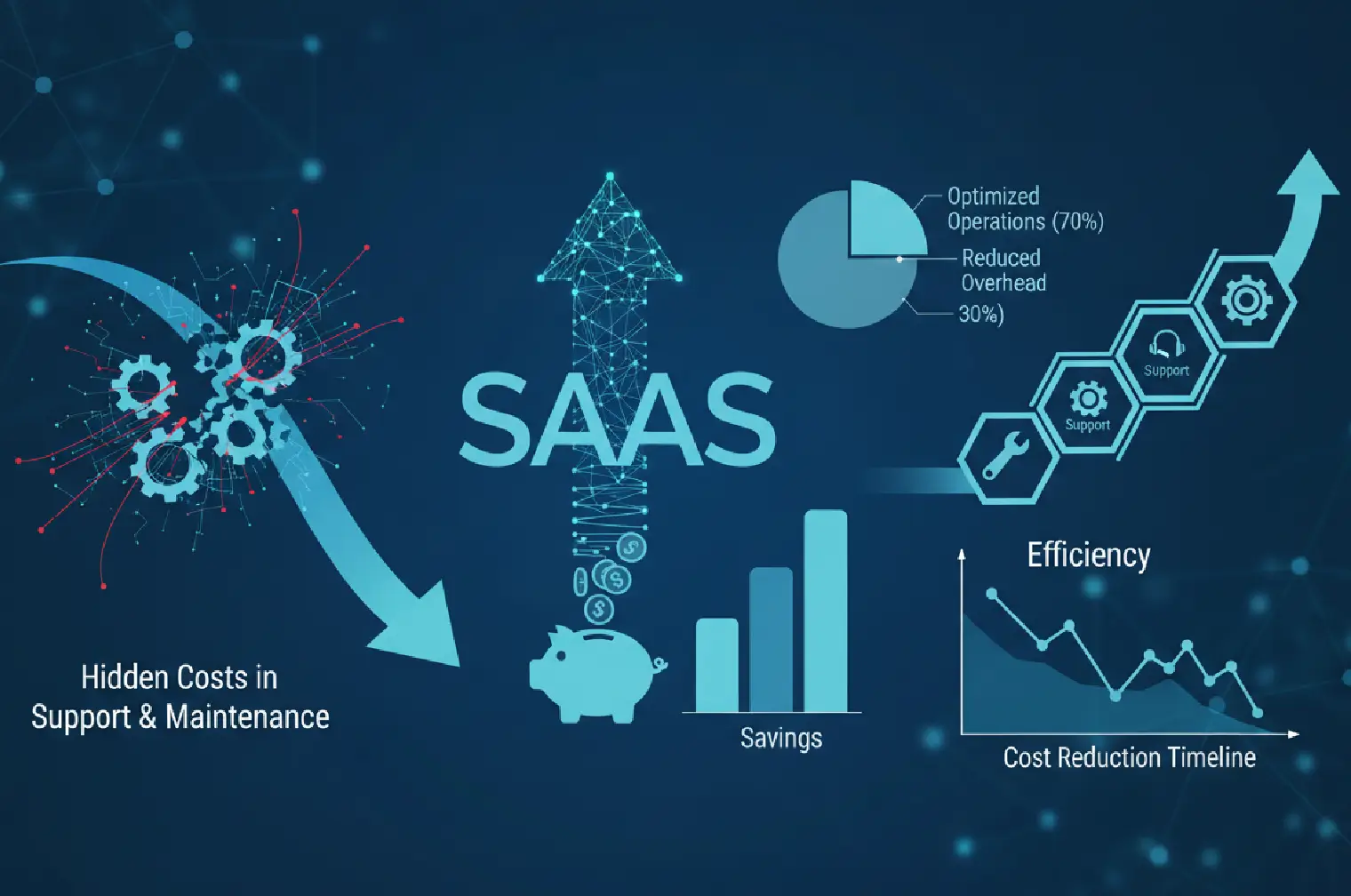
SaaS Optimization Strategies: How Business Owners Can Cut Hidden Costs in Support & Maintenance

Many SMBs and startups begin their digital journey assuming Software as a Service (SaaS) means predictable costs, only to discover that hidden SaaS costs often eat significantly into profitability.  

Without strategic oversight and SaaS optimization, the rapid proliferation of SaaS can lead to inefficiencies, redundant subscriptions, and unchecked spending. These financial leaks often stem from avoidable factors like unnecessary subscriptions or inefficient maintenance, making the SaaS product cost-heavy.  

Implementing robust strategies ensures that organizations can harness the full potential of their investments. 

This guide explores practical SaaS optimization strategies for startups and SMBs: 

  • Identifying the primary sources of hidden SaaS support and maintenance services costs. 
  • Actionable techniques to reduce operational waste and reduce hidden SaaS support costs. 

What Is SaaS Optimization and Why Does It Matter for SMBs? 

SaaS optimization is the strategic, ongoing process of effectively managing software applications to ensure they deliver maximum possible value while minimizing costs and inefficiencies.  

It involves assessing current application usage, scrutinizing duplicate tools, licenses, users, and associated spending, and aligning tools with strategic business objectives. While SaaS spend management focuses purely on tracking and controlling costs, SaaS optimization has a broader scope, aiming to maximize benefits such as improved employee productivity and overall business efficiency.  

For SMBs, effective SaaS cost optimization is critical because the ease of SaaS acquisition often empowers non-IT personnel to make purchases, leading to significant spend wastage from unused licenses and tool accumulation.  

The primary goal is identifying and resolving issues that impact the cost-effectiveness of your application, fostering continual enhancements in cost savings and usage efficiency. 

Why Do Hidden Costs in SaaS Support and Maintenance Occur? 

Hidden costs in SaaS support and maintenance services arise primarily from organizational complexity and a lack of oversight, a challenge often termed “SaaS sprawl”.

Key cost sinks include: 

  • Unnecessary Overpayments: Without regular monitoring, unused or underutilized SaaS licenses (often called “shelfware”) remain active, quietly draining financial resources. For example, a department might retain licenses for a project-specific tool long after the project ends, resulting in overpayments. 
  • Duplication of Services: When departments purchase software independently (Shadow IT), redundant subscriptions with overlapping functionality often go unnoticed, inflating costs unnecessarily and creating administrative complexity. 
  • Wasted Resources and Inadequate Training: Organizations continue paying for tools that no longer align with organizational goals or are rarely used. Furthermore, inadequate training on tools leads to inefficiency and squandered subscription money because team members may not fully utilize the advanced capabilities they subscribe to. 
  • Increased Complexity: As portfolios grow, managing multiple vendors, contracts, and renewal timelines becomes increasingly challenging, slowing down procurement processes and reducing efficiency. 

These factors require a proactive strategy to reduce hidden SaaS support costs and prevent financial and operational pitfalls. 

Check: Building Scalable SaaS Platforms for Retail Startups: A CTO’s Playbook 

Reduce Hidden SaaS Support Costs with Smart Optimization

Discover how to cut SaaS support costs for startups with tailored maintenance strategies that streamline operations and maximize ROI.

How Can Startups and SMBs Identify Inefficiencies in Their SaaS Operations? 

To implement effective SaaS optimization strategies, startups and SMBs must first gain complete visibility into their spending. Monitoring critical metrics consistently helps pinpoint where spending is inefficient and where optimization efforts should be focused. 

Typical red flags and metrics to monitor for inefficiency include: 

  • License Utilization Rate: This measures the percentage of active licenses compared to the total number purchased. Low rates suggest potential waste and the need for license right-sizing. 
  • App Overlap: Tracking how many tools perform the same function, such as when two project management tools serve similar purposes, identifies areas for consolidation and leads to immediate cost savings. 
  • High Cost, Low Usage: Prioritizing optimization efforts on applications that have the highest costs but show the lowest levels of usage yields the most rapid results. 
  • Churn Rate: This metric indicates the percentage of users who stop using a SaaS application over a specific period; a high churn rate may signal dissatisfaction or that better alternatives are available. 
  • Untracked Renewals: Tools with impending renewal dates should be prioritized for evaluation, as many SaaS contracts renew automatically, often at higher rates, leading to unexpected price hikes. 
  • Total Cost of Ownership (TCO): Maintaining a detailed record of all costs associated with each tool (subscription, implementation, support) allows for informed decisions about renewals or cancellations. 

What Are the Best SaaS Optimization Strategies for Cutting Hidden Costs? 

Implementing the following actionable SaaS optimization strategies is essential to reducing SaaS costs and creating a cost-effective SaaS maintenance plan for SMB: 

  • Get Complete Spend Visibility: Centralizing all SaaS spend data into a single system allows you to monitor subscriptions, track usage patterns, and perform regular SaaS audits to uncover unused or duplicate software. 
  • Consolidate Overlapping Apps and Vendors: Merging separate subscriptions for similar services simplifies operations, reduces administrative overhead, and unlocks opportunities for bulk discounts, benefiting from more favorable pricing. 
  • Reclaim Unused Licenses: Implement license harvesting workflows to continuously monitor usage, identify underutilized licenses, and reallocate them to employees who need access, optimizing resource use without overspending. 
  • Automate Renewals and Avoid Surprises: Use automation to track renewal deadlines and set up alerts, allowing timely evaluation of the subscription’s necessity, negotiation of better terms, or cancellation before the renewal date, thereby avoiding unwanted costs. 
  • Negotiate Based on Price Benchmarks: Leverage industry standard pricing insights to secure better deals during contract renegotiations. If a renewal price exceeds the market average, this information can be used as leverage to negotiate a lower rate. 
  • Focus on Low-Risk Optimization: Cut costs quickly by focusing efforts on optimizing non-production environments using strategies like utilizing spot instances or shutting down setups when nobody is using them. 
  • Prevent Shadow IT: Use regular audits and establish a clear, straightforward approval process for software purchases to curb unauthorized purchasing and prevent hidden costs and security risks. 

Read: Custom AI Solutions in SaaS: Applications, Use Cases, and Trends 

How Outsourced SaaS Support & Maintenance Can Improve Cost Efficiency 

For lean SMBs and startups, managing a growing, complex SaaS portfolio internally can be time-consuming and challenging. Outsourcing specialized functions like SaaS support and maintenance services is a strategic move to improve cost efficiency and allow internal teams to focus on core innovation. 

  • Access Expertise and Scale: Developing custom AI solutions or robust integration frameworks requires significant investment in expertise and infrastructure. By partnering with experts, organizations gain immediate access to experienced engineers and proven methodologies without needing to increase headcount. 
  • Streamlined Operations: Providers, such as ViitorCloud, specialize in SaaS support, maintenance & optimization. This partnership ensures seamless deployment and establishes systems for ongoing monitoring, maintenance, and enhancement of your SaaS product. 
  • Reduced Risk: Outsourced expertise helps mitigate security and compliance risks that arise from managing numerous unmanaged applications. Specialized providers ensure regular security updates, patches, and adherence to high security and compliance standards, which is a major focus in SaaS application development services. 

ViitorCloud delivers customized, scalable solutions, making it a trusted provider of SaaS support for SMBs. 

Scale Smarter with Proven SaaS Optimization Strategies

Leverage the best practices for SaaS product engineering for startups and SMBs to scale your support without hiring more agents.

What Role Does Continuous Performance Monitoring Play in Cost Reduction? 

Continuous monitoring and performance audits are fundamental elements of modern SaaS maintenance best practices. Relying on static audits is insufficient because the dynamic nature of SaaS requires ongoing vigilance to ensure perpetual optimization. 

  • Real-time Visibility and Waste Identification: Tools like AI-powered analytics are revolutionizing SaaS optimization by providing real-time visibility into inefficiencies and waste. These tools identify inactive licenses or overlapping apps across teams, offering actionable recommendations for consolidation and contract renegotiation. 
  • Data-Driven Negotiations: Continuous monitoring of usage patterns generates accurate data on license utilization, feature use, and user activity. This data is crucial for negotiating better contract terms with vendors, ensuring you align spending with actual needs and avoid overpaying for unnecessary capacity. 
  • Proactive License Management: Monitoring SaaS license utilization helps identify underutilized licenses. This discovery presents a valuable opportunity for reallocation to other employees who need access, effectively uncovering concealed cost-saving opportunities within your organization and ensuring optimal resource allocation. 

How to Build a Cost-Effective SaaS Maintenance Plan for Startups and SMBs 

Building a cost-effective SaaS maintenance plan for SMBs requires a focus on streamlined processes and automation to achieve scalability without relying on increased headcount. 

Key SaaS maintenance strategies for small businesses involve: 

  • Automation of Routine Tasks: Leveraging technology for tasks like user provisioning, license management, and deprovisioning reduces reliance on time-consuming manual processes. Automated onboarding and offboarding workflows, for instance, save valuable IT time and ensure rapid, secure access revocation. 
  • Transparent Procurement Guidelines: Establishing clear, documented procurement guidelines prevents decentralized purchasing authority from resulting in overlapping subscriptions and unnecessary spending (SaaS sprawl). 
  • Leverage License Harvesting: Implementing automated license reclamation workflows is a primary way to scale SaaS support without hiring more agents. These workflows continually monitor usage, identify inactive users, and reallocate licenses, ensuring optimal resource use without manual intervention. 
  • Prioritize Performance Monitoring: A comprehensive plan must include ongoing performance tracking, reliability checks, and continuous updates. Automated monitoring provides immediate feedback on application performance and security incidents, enabling rapid response and issue resolution without extensive manual oversight. 

Check: Why SaaS and Small Businesses Must Embrace Custom AI Solutions 

What Are the Best Practices for SaaS Product Engineering and Lifecycle Optimization? 

Optimization should be embedded in the product lifecycle from the start, a practice central to SaaS product engineering. Adhering to best practices for SaaS product engineering for startups ensures the foundation is set for sustainable, cost-effective growth. 

Key strategies for optimizing the SaaS product development lifecycle for startups: 

  • Cloud-Native Architectures: Utilizing scalable microservices-based architecture and cloud-native deployment with Continuous Integration/Continuous Deployment (CI/CD) pipelines ensures rapid delivery while maintaining scalability and security throughout the lifecycle. 
  • Infrastructure-as-Code (IaC): IaC solutions ensure a consistent, secure environment for provisioning, which is vital for managing resources efficiently and avoiding configuration drift. 
  • Agile and Iterative Development: Following Agile methodologies ensures the product evolves continuously. Iterative enhancement based on user testing and regular demo sessions guarantees that the product adapts to feedback and market changes quickly, reducing the likelihood of costly post-launch modifications. 

As a leading provider of SaaS product engineering services, ViitorCloud helps organizations develop highly scalable, user-centric cloud solutions that transform ambitious business visions into digital realities. 

Create an Effective SaaS Maintenance Plan for Your Business

Adopt data-driven SaaS maintenance strategies for small businesses and streamline your SaaS product development lifecycle for sustainable growth.

How Can ViitorCloud Help You Optimize and Scale Your SaaS Product? 

True scalability and cost efficiency in your SaaS operations depend on strategic SaaS optimization and robust development practices. By focusing on eliminating waste, centralizing visibility, and prioritizing maintenance from a SaaS product engineering perspective, business owners can significantly cut hidden costs in support & maintenance. 

ViitorCloud brings over 14 years of experience delivering exceptional SaaS product engineering services and specialized SaaS Support, Maintenance & Optimization.  

Our proven methodologies, which integrate generative AI and cloud services, ensure your organization can achieve up to 40% faster development cycles while maintaining enterprise-grade security standards.  

For the Best SaaS product engineering services for startups seeking to manage costs, streamline operations, and scale intelligently, partnering with ViitorCloud is the strategic next step. 

Contact ViitorCloud today for a complimentary consultation and discover how our expertise can drive efficiency and sustainable growth for your business. 

Intelligent Document Processing in Healthcare Data Pipelines

Manual data entry in clinical and back-office workflows remains a stubborn source of variability and risk, with published studies showing data processing error rates ranging from 2 to 2,784 per 10,000 fields depending on method and controls, underscoring the need for systematic remediation across ingestion, extraction, validation, and integration steps.

Intelligent document processing in healthcare, paired with resilient healthcare data pipelines, can combine OCR, NLP, validation rules, and human-in-the-loop review to deliver measurable error-rate reductions, with credible operational benchmarks indicating time-to-index reductions of 43.9% and accuracy approaching 96.9% in real-world settings, and a realistic pathway to up to 60% manual error reduction when layered with targeted human review and standards-based integration.

The opportunity is not just administrative efficiency but patient safety, because fewer transcription and indexing mistakes improve downstream analytics, care coordination, and EHR data integrity, especially when pipeline design enforces auditability, role-based access, and encryption controls aligned to HIPAA Technical Safeguards.

Why manual errors persist

Manual errors persist because document heterogeneity, scan quality, handwriting variability, and template drift impede consistent extraction, while cognitive load and repetitive keystrokes amplify small inaccuracies into systemic bias in patient registries and revenue-cycle datasets.

Empirical evidence shows that raw OMR/OCR on clinical intake forms yields uneven field accuracy, which improves substantially only when results are subjected to structured validation and human verification, proving that automation must be architected as a supervised system rather than a blind pass-through.

Speech-driven documentation further illustrates the point, where initial machine outputs show a mean error rate near 7.4% that falls to about 0.3–0.4% only after expert review, reinforcing the essential role of human-in-the-loop within documentation improvement automation.

Check: AI and Automation in Healthcare: Healing Medical Systems

Transform Healthcare Workflows with Intelligent Document Processing

Automate patient data, reduce manual errors, and accelerate insights with ViitorCloud’s Intelligent Document Processing and Data Pipelines solutions.

What IDP does in healthcare

Intelligent document processing in healthcare orchestrates classification, data extraction, validation, and routing for claims, referrals, consent forms, lab reports, and imaging narratives, transforming unstructured inputs into standardized data ready for EHR and analytics sinks.

Modern platforms blend OCR software for healthcare with machine learning in healthcare data extraction and clinical NLP to read typed and handwritten content, validate against deterministic rules, and escalate ambiguous fields for review, thereby enabling scalable document automation in healthcare with measurable error containment.

In practice, IDP solutions for healthcare minimize manual touches while enforcing provenance and confidence scoring so that medical data entry automation remains both accurate and auditable across diverse document types encountered daily in provider operations.

End-to-end pipeline architecture

Robust healthcare data pipelines implement a reference flow from ingestion to EHR and analytics endpoints: capture via batch and streaming channels, classify and separate multi-doc packages, extract entities, validate and normalize, and publish to FHIR/HL7 interfaces with lineage and governance preserved end-to-end.

Standards-aligned interoperability is the connective tissue of electronic health record automation, with ONC’s HTI‑1 adopting USCDI v3 timelines and reinforcing certified API transparency, enabling predictable integration to EHRs and registries while maintaining security boundaries between processing stages.

Within this architecture, orchestration coordinates idempotent tasks, SLOs for latency and throughput, and data quality SLAs that govern exception handling and retries, ensuring that healthcare workflow automation scales without sacrificing trust or traceability.

OCR and clinical NLP techniques

OCR model selection should consider scan resolution, noise characteristics, and language models for medical vocabularies, with post-processing that corrects token-level errors and applies confidence thresholds to isolate fields requiring manual confirmation to reduce manual errors in medical forms.

Clinical NLP for AI in healthcare documentation performs entity recognition across medications, procedures, and diagnoses, normalizes values to SNOMED CT, LOINC, and ICD‑10 where applicable, and maps payloads into FHIR resources for automating medical record indexing and downstream analytics consumption.

Template-free extraction handles layout variability while template-based extraction remains cost-effective for stable forms; hybrid strategies maximize recall and precision by fusing geometric, lexical, and semantic cues in data extraction in healthcare.

Streamline Clinical Data with Secure Data Pipelines

Enhance accuracy, compliance, and accessibility in healthcare records through ViitorCloud’s end-to-end Data Pipelines and Document Processing expertise.

Compliance-by-design for PHI

Compliance-by-design must implement HIPAA Technical Safeguards—access control, audit controls, integrity protection, person/entity authentication, and transmission security—as codified in 45 CFR §164.312, with unique user IDs, emergency access procedures, session controls, and appropriate encryption and decryption mechanisms for PHI in rest and transit.

HHS guidance emphasizes flexibility with accountability, requiring covered entities and business associates to apply reasonable and appropriate controls tied to risk analysis, thereby embedding role-based access, auditability, and data minimization into healthcare document automation workflows.

Designing pipelines with field-level masking, deterministic and probabilistic re-identification risk checks, and retention schedules aligned to organizational policies ensures IDP for healthcare compliance without impeding operational throughput.

Measuring the 60% reduction

Error reduction must be demonstrated against baselines using statistically sound sampling, precision/recall on field extraction, and exception-rate tracking, recognizing the wide baseline variability seen across manual and semi-automated methods in clinical data processing studies.

When OCR and validation achieve accuracy near 96.9% with 43.9% cycle-time reduction in production-like environments, and human-in-the-loop further suppresses residual errors, a compounded pathway to around 60% fewer manual errors becomes achievable in document-heavy workflows, especially when integrated with EHR endpoints that themselves correlate with lower medical error incidence.

Read: How ViitorCloud is Pioneering Digital Transformation in Healthcare

Implementation roadmap and reliability

A best-practice roadmap begins with high-signal use cases, defines SLOs for latency and throughput, and instrumented observability for extraction accuracy, exception aging, and drift detection, aligning with HTI‑1’s emphasis on transparency and metrics that characterize algorithmic behavior in clinical contexts.

Production readiness hinges on containerized deployments, automated scaling, and cost-per-document optimization, with deterministic validation for known-safe fields and ML-based anomaly detection for outliers to reduce manual errors in healthcare without overburdening reviewers.

Data governance must codify lineage, policy enforcement, and audit trails across each hop of end-to-end healthcare data pipelines so compliance evidence and operational forensics remain first-class artifacts of the platform, not afterthoughts.

Empower Decision-Making with Intelligent Document Processing

Leverage automated data extraction and integrated Data Pipelines to deliver faster, smarter healthcare operations with ViitorCloud.

ViitorCloud Is Your Trusted Tech Partner

ViitorCloud partners with provider organizations to design and operate IDP solutions for healthcare and end-to-end healthcare data pipelines, aligning clinical and administrative outcomes with HTI‑1 interoperability, HIPAA safeguards, and measurable accuracy and cycle-time targets that stand up to audit and scale demands in production.

If advancing intelligent document processing in healthcare and healthcare data pipelines is a current priority, collaborate with ViitorCloud to scope an assessment or pilot that targets a 60% error reduction goal using layered validation, confidence thresholds, and targeted human review; contact the team to define objectives, data domains, and integration endpoints for a proven path to accuracy, speed, and compliance in operational setting.

How OpenAI’s October 2025 Releases Move AI from Pilot to Platform

Enterprise leaders evaluating custom AI solutions now have a decisive moment. OpenAI’s October DevDay 2025 platform shift turns experimental pilots into production‑grade capabilities that are easier to build, govern, and scale across mission‑critical workflows.

The new stack spans:

  • Apps in ChatGPT with a preview of the Apps SDK
  • AgentKit for robust agentic orchestration
  • Sora 2 in the API
  • GPT‑5 Pro via API
  • Gpt-realtime-mini for low‑latency voice
  • gptimage1mini for cost-efficient visuals
  • Codex is now generally available

This collectively enables reliable, secure, and extensible foundations for enterprise AI and AI-driven automation at scale.

For organizations prioritizing uptime, governance, and total cost of ownership, these releases reduce integration friction, compress time to value, and narrow vendor risk by anchoring innovation on widely adopted, managed services rather than bespoke scaffolding.

This is the practical inflection point where custom AI solutions move from proofs to platforms—with the component maturity and ecosystem support C-suite and product stakeholders have been waiting for.

Turn OpenAI Innovation into Action

Leverage OpenAI’s latest advancements to build your next Custom AI Solution with ViitorCloud’s expert team.

What OpenAI Announced

Apps in ChatGPT

OpenAI introduced Apps in ChatGPT, a native app layer that runs inside ChatGPT, and a preview Apps SDK so developers can design chat‑native experiences with conversational UI, reusable components, and MCP‑based connectivity to data and tools while reaching an audience of hundreds of millions directly in chat.

AgentKit

AgentKit extends this by giving teams a production‑ready toolkit—Agent Builder for visual, versioned workflows, a Connector Registry for governed data access, ChatKit for embeddable agent UIs, and expanded Evals for trace grading and prompt optimization—so agents can be built, measured, and iterated with enterprise rigor.

Codex

Codex is now generally available with developer‑friendly integrations and enterprise controls, aligning agentic coding and code‑generation use cases with standardized governance and deployment patterns for engineering teams.

GPT‑5 Pro via API

On the model side, GPT‑5 Pro arrives in the API for tasks where accuracy and deeper reasoning matter—think regulated domains, complex decision support, and long‑horizon planning—enabling services that must explain, justify, and withstand audit, not just autocomplete.

gpt‑realtime‑mini

For voice, gpt‑realtime‑mini offers low‑latency, full-duplex speech interactions and is about 70% less expensive than the larger voice model, making natural voice UX viable for high‑volume support, concierge, and contact‑center automations. A practical scenario is a voice concierge that authenticates callers, looks up orders, and resolves intents in seconds via SIP/WebRTC, with observability and redaction applied upstream for compliance and quality assurance at scale.

gpt‑image‑1‑mini

For creative and product pipelines, gpt‑image‑1‑mini cuts image generation costs by roughly 80% versus the larger image model, which changes the unit economics for iterative concepting and catalog enrichment workflows across retail, marketplaces, and marketing operations.

Sora 2 in API

Sora 2 in API preview adds advanced video generation to application stacks, enabling controlled, high‑fidelity assets for training, product explainers, and promotional content, with teams able to prototype short videos and route them through brand safety checks and legal sign‑off before distribution.

Together, these updates let enterprises design composite systems. Apps in ChatGPT for front‑ends, AgentKit for orchestration, GPT‑5 Pro for reasoning, and Sora 2/gpt‑image‑1‑mini for rich media can be mapped to use cases like KYC automation, claims triage, controlled catalog enrichment, and multilingual support bots.

Check: AI Co-Pilots in SaaS: How CTOs Can Accelerate Product Roadmaps Without Expanding Teams

Scale Smart with Custom AI and Automation

Integrate OpenAI-powered intelligence into your workflows with our Custom AI Solution and AI Automation services.

Why This Matters Now

OpenAI reports platform scale of more than 4 million developers, 800 million+ weekly ChatGPT users, and approximately 6 billion tokens per minute on the API, a footprint that signals mature tooling, hardened operations, and a vibrant ecosystem of patterns, components, and skills that reduce integration risk and speed up delivery.

For CIOs planning phased adoption in FY26, this ecosystem density shortens learning curves, supports standardized controls, and improves hiring and partner availability, which directly improves time‑to‑value and mitigates vendor concentration risk.

The AMD–OpenAI strategic partnership commits up to 6 gigawatts of AMD Instinct GPUs over multiple years, beginning with a 1‑gigawatt rollout in 2026, adding meaningful supply to accelerate availability and stabilize latency for bursty and near‑real‑time inference demands as enterprise adoption grows.

Reporting from Reuters and the Wall Street Journal underscores the deal’s multi‑billion‑dollar trajectory and execution milestones, which should influence cost curves and capacity planning for AI‑first architectures beyond a single vendor stack.

For technology leaders, this translates into improved confidence in capacity headroom and planning for multi‑tenant loads, seasonal spikes, and global rollouts of voice and agentic experiences without relying on brittle, bespoke infrastructure.

From Pilot to Production

Production‑grade AI requires more than a model choice, which is why AgentKit’s evaluation and governance primitives—datasets for evals, trace grading for end‑to‑end workflows, automated prompt optimization, and third‑party model support—are consequential to building measurable, composable agent systems from day one.

A robust blueprint couples this with retrieval‑augmented generation for fresh, governed context, model‑agnostic evaluation harnesses for ground‑truth scoring, and role‑based guardrails that separate customer data entitlements from tool‑execution permissions for safer agent behaviors under stress.

Safety, compliance, and governance must be layered, with OpenAI’s October 2025 “Disrupting malicious uses of AI” update offering directional reassurance that abuse is being detected and disrupted across threat categories with transparent case studies and enforcement.

On the platform side, Azure OpenAI’s content filtering system and Azure AI Language PII detection provide model‑adjacent controls to flag harmful content and identify/redact sensitive fields as part of standardized pipelines that combine upstream filtering, domain‑specific red teaming, and human‑in‑the‑loop review.

For voice and real‑time experiences, OpenAI’s gpt‑realtime stack and Azure Realtime API patterns illustrate how to achieve low‑latency UX while instrumenting observability, retention policies, and transcript governance in regulated environments.

Read: AI Consulting and Strategy: Avoiding Common Pitfalls in Enterprise AI Rollouts

Build the Future with OpenAI and ViitorCloud

Transform your business operations through our Custom AI Solution and AI Automation expertise tailored to your goals.

Partnering with ViitorCloud

ViitorCloud offers focused consulting sprints that turn these releases by OpenAI into execution: GPT‑5 Pro reasoning service blueprints for regulated decision support, AgentKit‑powered agent design and evals, Sora 2 pilot pipelines for safe marketing and training assets, and voice UX prototyping with gpt‑realtime‑mini—all mapped to measurable operational KPIs and governance checkpoints.

The approach emphasizes rapid proof cycles tied to a prioritized workflow, such as claims triage or multilingual support, followed by hardening with eval datasets, retrieval, PII guardrails, and targeted human review gates before scaling across regions or business units.

Delivery teams operate from India, aligning IST workdays for strong overlap with EMEA and APAC while remaining deeply connected to India’s technology ecosystem and serving global clients with a follow‑the‑sun model for responsiveness and velocity.

Request a discovery workshop with ViitorCloud’s AI team to translate these October 2025 capabilities into enterprise results with confidence and speed, then scale what works across customer service, back‑office automation, and analytics augmentation.

From Legacy to Cloud-Native: Why IT Directors in Finance Can’t Delay System Modernization in 2025

Delaying legacy system modernization in finance is untenable in 2025 because regulatory enforcement (PCI DSS 4.0, DORA, UK operational resilience) and rising legacy costs converge with proven benefits from cloud-native transformation, including resilience, agility, and measurable cost reductions.  

Financial institutions that act now gain compliance readiness and speed-to-market while mitigating operational risk and optimizing spend through phased cloud migration in financial services. 

ViitorCloud partners with financial organizations to lead legacy system modernization and cloud-native transformation initiatives that respect stringent compliance demands and cost controls while accelerating delivery and resilience in regulated environments.  

In 2025, mandates like PCI DSS 4.0’s March 31 enforcement, DORA’s January go-live, and the UK’s operational resilience rules make modernization a board-level imperative for banks, insurers, payments, and fintechs. 

Why is 2025 the tipping point for finance modernization? 

Several regulatory clocks struck at once: PCI DSS 4.0 future-dated controls became enforceable on March 31, 2025, elevating authentication, logging, and continuous monitoring expectations across cardholder data environments.  

The EU’s DORA entered into application on January 17, 2025, standardizing digital operational resilience obligations for financial entities and their critical ICT providers, with supervisory scrutiny escalating through 2025. 

In the UK, the FCA and PRA shifted from preparation to proof as of March 31, 2025, requiring firms to demonstrate they can remain within impact tolerances during disruptions, making operational resilience a continuous discipline rather than a one-off milestone.  

Meanwhile, Basel III Endgame timelines target mid-2025 for phased implementations in the US, adding capital and risk-modeling pressure that favors agile, cloud-ready architectures for scenario planning and stress resilience. 

What risks arise when legacy systems linger? 

Legacy cores and brittle integrations amplify operational risk, prolong outages, and impede resilience demonstrations demanded by FCA and PRA supervision after March 2025. 

 Under DORA, ICT incidents and third-party concentration risks require robust governance, testing, and reporting—areas where monoliths and hard-to-instrument stacks frequently underperform. 

Cost and talent risks compound the exposure: banks report up to 70% of IT budgets absorbed by maintaining legacy systems, while COBOL dependencies and scarce skills increase both cost and vulnerability to knowledge attrition.  

In payments and core processing, global maintenance costs are projected to surge, diverting funds from transformation and making “replace legacy banking systems” a strategic necessity rather than a discretionary initiative. 

Move from Legacy to Cloud-Native with Confidence

Ensure seamless, secure, and scalable System Modernization with ViitorCloud’s proven expertise for financial enterprises.

How does cloud-native transformation lift compliance and security? 

Cloud-native transformation in finance supports continuous control monitoring, comprehensive logging, and strong identity—with architectures that make PCI DSS 4.0’s MFA, access governance, and telemetry more achievable at scale.  

DORA’s emphasis on resilience testing, incident response, and third-party risk aligns with cloud-native blueprints that standardize automation, recovery patterns, and vendor oversight across multi-cloud estates. 

Post-2025, the FCA’s supervisory lens favors demonstrable outcomes—remaining within impact tolerances under stress—which cloud-native deployment, automated failover, and observable microservices can evidence more reliably than opaque legacy stacks.  

The practical upshot is financial compliance cloud modernization that strengthens auditability while improving real-time defense and response across distributed services. 

Where do the real costs and savings materialize? 

Studies show cloud adoption is now pervasive in financial services, supporting the shift from CapEx to variable OpEx and enabling IT cost reduction with cloud migration at portfolio scale when combined with FinOps discipline.  

Cloud-native architecture for finance has been associated with TCO reductions over multi-year horizons, driven by lower infrastructure maintenance and improved disaster recovery efficiency. 

At the same time, status quo spending remains high: many banks still allocate the majority of their IT budgets to legacy upkeep, underscoring the financial sector system modernization imperative to free investment for growth and compliance innovation.  

The modernization ROI improves when migrations are phased, high-value workloads are prioritized, and hybrid patterns minimize disruption during the transition to cloud migration for financial services. 

Dimension Legacy (risk/cost) Cloud-native (benefit) 
Control and audit Siloed logs, brittle change control Centralized telemetry, policy-as-code, continuous compliance 
Resilience Slow failover, tied to specific hardware Automated recovery, regional failover patterns 
Cost profile High fixed costs, talent scarcity premiums Elastic spend, infra maintenance reductions over time 

Accelerate System Modernization in Finance

Adopt a cloud-native approach and gain agility, compliance, and cost efficiency with ViitorCloud’s modernization solutions.

Why do microservices and cloud-native architecture matter? 

Microservices architecture for the financial sector decouples change, enabling independent deployability, domain-aligned teams, and real-time event processing for high-volume payments, trading, and onboarding journeys.  

This decomposition reduces blast radius during incidents and targets scalability to the services that need it, improving both customer experience and operational efficiency in cloud-native transformation in finance. 

Cloud-native architecture in finance also accelerates release velocity and lowers outage frequency through container orchestration, automated rollbacks, and progressive delivery—lowering risk while lifting throughput for modernization strategies for banks.  

Together, these patterns make modernizing legacy fintech systems feasible without “big bang” rewrites, supporting safer increments under strong governance. 

Which modernization strategies work in regulated finance? 

Phased migration remains the dominant pattern: start with outward-facing or analytics workloads, build observability and security baselines, then progressively carve out domains from the monolith to replace legacy banking systems with API-first services.  

Hybrid models provide control where needed—keeping high-latency-sensitive or sovereign data workloads on private infrastructure while leveraging public cloud for elasticity and innovation sprints. 

Full cloud-native rebuilds suit cases where technical debt is prohibitive, time-to-market is strategic, and a greenfield core can be proven in parallel, but most banks combine phased and hybrid approaches to mitigate risk while advancing finance IT modernization.  

These IT modernization strategies for banks benefit from explicit domain roadmaps, refactoring factories, and platform teams that standardize security, networking, and release workflows across multi-cloud. 

Approach When it fits Notable considerations 
Phased carve-out Gradual de-risking of core domains Requires strong integration and observability 
Hybrid cloud Compliance-driven workload placement Governance and cost controls across estates 
Greenfield rebuild Severe monolith constraints Parallel run and migration tooling required 

How can leaders overcome resistance and prove ROI? 

Change management succeeds when teams see safer deployments and faster delivery cycles through platform guardrails, automated testing, and clear SLOs tied to business outcomes in finance IT modernization.  

Early wins—such as digitized onboarding, faster loan decisioning, or resilient payments cutovers—anchor confidence and create reusable patterns for broader legacy system modernization. 

Quantified ROI emerges from a portfolio view: redirecting spend from legacy maintenance into modernization epics, tracking TCO deltas, and measuring outage reductions and feature velocity gains linked to cloud-native transformation.  

Regulatory alignment milestones—PCI DSS 4.0 controls, DORA resilience testing, FCA impact tolerance evidence—provide additional, auditable value signals for executives and boards. 

Future-Proof Finance with Legacy to Cloud-Native Transformation

Stay competitive in 2025 and beyond by modernizing legacy systems with AI Co-Pilot and SaaS engineering expertise.

What’s the best way to engage? 

Successful programs begin with an assessment that prioritizes compliance-critical capabilities, defines domain boundaries, and sequences migrations to minimize risk while maximizing customer impact in cloud migration for financial services.  

An experienced modernization partner can stand up platform foundations, codify security and observability, and deliver phased outcomes that align with budgets and regulatory deadlines in 2025 and beyond. 

ViitorCloud can collaborate on a tailored roadmap spanning phased migration, hybrid placements, and target-state microservices that accelerate cloud-native transformation while meeting PCI DSS 4.0, DORA, and operational resilience expectations.  

To explore modernization strategies for banks that reduce risk, improve agility, and control costs, partner with ViitorCloud to co-design a plan aligned to business priorities and regulatory obligations. 

Frequently Asked Questions

All future-dated requirements became mandatory on March 31, 2025, so programs should validate MFA scope, access governance, logging, and documentation now to ensure sustained compliance. 

Yes, DORA applies to financial entities and also impacts third-party ICT providers outside the EU that serve EU financial institutions, with supervisory activities intensifying through 2025. 

Yes, the FCA and PRA have shifted focus to verifying firms can remain within impact tolerances in severe scenarios, making resilience an ongoing capability rather than a checkbox. 

Recent surveys indicate that cloud usage is nearly universal among financial organizations, reflecting the adoption of multi-cloud and hybrid models as standard operating practices for modernization. 

Gains often appear in reduced outage minutes, faster release cycles, and lower infrastructure maintenance costs, with studies reporting meaningful TCO reductions through cloud-native architecture for finance.

AI Co-Pilots in SaaS: How CTOs Can Accelerate Product Roadmaps Without Expanding Teams

AI co-pilots in SaaS are emerging now because enterprise generative AI usage leapt to 65–71% in 2024, creating the cultural and technical readiness to embed assistants that plan, execute, and optimize product workflows end-to-end.  

At the same time, agentic AI is on track to permeate one-third of enterprise software by 2028 and autonomize 15% of work decisions, signaling a near-term shift from passive helpers to outcome-driven AI teammates inside SaaS products and platforms. 

For CTOs, this convergence means strategic leverage: commercial and custom AI models can be wrapped into governed, measurable copilots that reduce toil, derisk launches, and amplify senior talent across product management, engineering, and operations without adding headcount.  

Generative AI investment is also compounding, with Gartner forecasting $644B in 2025 spend, which ensures rapid capability maturation across the stack that SaaS leaders can harness rather than rebuild from scratch. 

ViitorCloud pairs AI co-pilot development with mature SaaS product engineering to help startups and enterprises accelerate roadmaps with measurable business impact and production-grade governance. This blend of AI integration in SaaS and disciplined delivery allows teams to ship AI-powered SaaS solutions faster, safer, and with clear ROI milestones. 

How do AI co-pilots accelerate product roadmaps without hiring? 

AI co-pilots in SaaS compress discovery, build, and launch by automating document analysis, spec drafting, test generation, code review, release notes, and post-release analytics, moving critical work from hours to minutes and reducing context-switching overhead for senior contributors.  

McKinsey’s research shows generative AI can double speed on select software tasks, indicating copilots that target high-frequency activities can materially shorten critical path timelines across sprints. 

Because copilots learn from product artifacts and live telemetry, they continuously refine backlog quality, improve estimation, and reduce rework, which raises throughput without adding capacity.  

With enterprise gen AI adoption rising sharply, these gains are now repeatable at scale, provided leaders build the right guardrails for data, model choice, and feedback loops. 

Accelerate Product Roadmaps with AI Co-Pilots in SaaS

Leverage Custom AI Solutions to reduce development cycles and deliver value faster with ViitorCloud’s SaaS Product Engineering expertise.

What is the role of SaaS product engineering in AI adoption? 

SaaS product engineering provides the integration tissue—APIs, data pipelines, model ops, observability, and release automation—that turns clever prompts into durable platform capabilities that can be secured, scaled, and audited.  

In practice, that means designing AI co-pilots for SaaS startups and enterprises as services with SLAs, fallbacks, human-in-the-loop checkpoints, and versioned behaviors, not as ad hoc scripts. 

This discipline ensures AI integration in SaaS aligns with multitenant architectures, regional compliance constraints, and cost envelopes, so copilot value grows with usage rather than spiking then stalling under load or policy friction.  

It also enables continuous value capture by instrumenting AI-powered SaaS product development with KPI baselines, winrates, and error budgets that connect engineering work to commercial outcomes. 

Check: AI-First SaaS Engineering: How CTOs Can Launch Products 40% Faster 

Which AI agents for SaaS products deliver quick wins? 

Early wins come from AI agents for SaaS products that handle backlog hygiene, design doc first drafts, unit/integration test generation, dependency upgrades, and support triage summaries, all high-leverage activities proven to save developer time and raise quality.  

On the business side, B2B SaaS AI co-pilots that assist with customer research synthesis, release note generation, and in-app guidance accelerate the SaaS roadmap with AI by streamlining cross-functional handoffs. 

As agentic patterns mature, multistep copilots orchestrate tasks like “spectoteststoPRtodeploy” with human approval gates, reducing cycle time while preserving control and auditability in regulated contexts.  

For SaaS AI automation at scale, start with constrained scopes that map to measurable KPIs, then expand to adjacent workflows once reliability thresholds are consistently met. 

Copilot impact quickmap

Use case Measurable outcome Timetovalue 
Test generation and coverage suggestions Faster regression cycles and fewer escaped defects Days to weeks with seeded repositories 
Spec and doc drafting from tickets Reduced PM/eng context switching and higher doc completeness Immediate in existing tools 
Code review assistants Consistent standards and lower rework on recurring issues Weeks with policy scaffolds 

How do AI-powered SaaS solutions boost speed, agility, and innovation? 

AI-powered SaaS solutions improve speed by automating routine steps in the software delivery life cycle, freeing senior contributors to focus on architecture and product-market signal detection that meaningfully drives differentiation.  

They improve agility by turning telemetry into backlog insights and by enabling rapid, low-risk experiments via sandboxed copilot behaviors that can be A/B tested before broad rollout. 

Innovation accelerates when generative AI in SaaS is framed as a capability layer—search, summarization, generation, decision support—available to every squad, not a single team’s project, ensuring compounding reuse and lower marginal cost of new features.  

With global GenAI spending surging, the ecosystem will keep delivering models and runtimes that expand this capability surface for CTOs to exploit safely. 

Empower Your Teams with AI Co-Pilots in SaaS

Adopt Custom AI Solutions and SaaS Product Engineering to scale innovation without expanding headcount.

How can CTOs design an AI-powered SaaS product roadmap? 

Anchor the AI-powered SaaS product roadmap in objective value: pick 3–5 workflows with high volume, high cost, or high error rates, then set baseline KPIs and acceptance thresholds before enabling copilot actions beyond suggestions.  

Standardize evaluation with golden datasets, offline tests, and red team scenarios so changes to prompts, models, or tools never bypass product quality gates. 

Plan for platformization: expose copilot primitives as internal APIs so squads can compose new AI scenarios without reimplementing data prep, safety filters, and observability each time, turning “AI co-pilots in SaaS” into shared infrastructure.  

Finally, budget for operational excellence—latency SLOs, drift detection, abuse prevention—so success scales without unexpected cost or risk spikes. 

A simple sequencing framework 

  • Prove value with assistive modes, then graduate to semiautonomous steps with human approvals, and only then to fully autonomous actions in well-bounded domains. 
  • Tie each graduation to KPI gains and incident-free runtime hours to maintain trust with security, legal, and customer success stakeholders. 

What challenges block AI adoption, and how to mitigate them? 

Common blockers include unclear ROI, data fragmentation, governance gaps, and overreliance on PoCs that never cross the production chasm, which Gartner notes is prompting a shift toward embedded, off-the-shelf GenAI capabilities for faster time-to-value. Model reliability, evaluation drift, and cost predictability also confound teams when copilots scale across tenants and geographies. 

Mitigation starts with product engineering rigor: consistent evaluation harnesses, model registries, safety rails, and cost/performance policies that treat AI like any other critical dependency under change management.  

It continues with portfolio governance that sunsets low-value experiments and doubles down on “AI transforming SaaS industry” use cases where telemetry proves durable and compounding gains. 

Why partner with ViitorCloud to accelerate with AI co-pilots? 

ViitorCloud brings integrated SaaS product engineering and AI co-pilot development, combining strategy, build, and ongoing operations so copilots become resilient platform capabilities, not side projects that stall post-launch.  

The team delivers AI-powered SaaS product development with enterprise-grade security, observability, and governance tuned to multitenant environments. 

As demand and spend for GenAI intensify, a partner with proven AI integration in SaaS ensures the roadmap accelerates without expanding teams and without trading speed for reliability or compliance.  

ViitorCloud’s approach aligns copilot success to objective KPIs across quality, velocity, and cost, enabling “accelerate SaaS roadmap with AI” outcomes that leadership can measure and scale. 

Reimagine SaaS Growth with AI Co-Pilots

Unlock the power of SaaS Product Engineering and Custom AI Solutions to build smarter, scalable products with ViitorCloud.

How does this translate into tangible results next quarter? 

Within 90 days, most SaaS teams can deploy copilots for test generation, documentation, and support summarization that reduce cycle time and free senior talent for roadmap epics, validating value while building platform scaffolds for broader use. By Q2, expanding into code review assistance, release orchestration, and in-product guidance can raise throughput and customer adoption with clear audit trails and rollback paths. 

As agentic patterns mature, selected workflows can move to semiautonomous execution with human approvals, preserving control while realizing step-change gains in lead time for changes and mean time to recovery. The compounding effect is a resilient, AI-powered SaaS product roadmap that scales without proportional headcount growth, aligning directly to board-level outcomes. 

Partner with ViitorCloud to operationalize AI co-pilots in SaaS—from opportunity mapping to secure integration and runstate excellence—delivered by a team that unites AI engineering and SaaS product engineering under one accountable model. Explore ViitorCloud’s SaaS and AI engineering capabilities to turn strategic intent into shipped outcomes, faster and safer. 

Frequently Asked Questions 

An AI copilot is an embedded assistant that plans and executes defined tasks within the product lifecycle (from discovery to operations) under governance, observability, and KPIs tailored to SaaS contexts.

Most teams achieve measurable time savings within a few weeks by targeting high-frequency tasks, such as tests, documents, and triage, with research showing substantial productivity gains in specific developer activities.

Agentic AI is rapidly maturing, with forecasts indicating that one-third of enterprise apps will include agents by 2028; however, prudent rollout utilizes assistive and semi-autonomous stages with human approvals first.

Tie copilot releases to baseline KPIs (lead time, escaped defects, support resolution time, infra cost) and requires statistically meaningful improvements before graduating autonomy levels. 

ViitorCloud unifies AI solutions with SaaS product engineering—governed data, model ops, and platform integration—so “AI copilots for SaaS startups” and enterprises move from PoC to durable production value.

Tech Team Augmentation Strategies: How CTOs Can Scale Development Without Overhead

Key Takeaway:

The fastest, lowest-risk way to expand engineering capacity without fixed costs is to combine tech team augmentation strategies with a robust system integration in technology fabric so delivery scales while workflows, data, and security remain consistent end to end. This approach compresses time-to-impact versus 6–7 week hiring cycles and curbs long-term overhead from fragmented tools and technical debt that accumulate in ad‑hoc growth spurts.

Persistent talent scarcity makes pure hiring plays slow and expensive, with roughly three in four employers reporting difficulty finding the skills required for critical roles across regions and sectors in 2024–2025.

Even when roles are filled, time-to-hire for software engineers frequently stretches to a median of ~41 days, delaying delivery and leaving roadmap commitments exposed to compounding cycle-time risk.

At the same time, platform complexity is rising as portfolios span legacy, SaaS, and multi‑cloud, making point solutions brittle and reinforcing the need for an integration-first operating model to avoid duplicated work, data silos, and rising change failure rates.

In this environment, tech team augmentation strategies paired with system integration in technology shift capacity up or down on demand while protecting flow efficiency across the toolchain.

ViitorCloud helps CTOs operationalize this model by supplying vetted engineering capacity and building the integration and modernization fabric that keeps data, apps, and pipelines coherent as delivery scales, reducing risk and accelerating value realization. ViitorCloud aligns augmentation with architecture, governance, and measurable outcomes for enterprise programs.

Which tech team augmentation strategies actually work?

Start with outcome-aligned capacity mapping: define the backlog slices where external experts unblock throughput (e.g., API development, test automation, data engineering) and constrain augmentation to value-stream bottlenecks rather than generic headcount additions.

Use time‑boxed, goal-based engagements so leaders can dial capacity up or down as priorities shift, avoiding fixed overhead while locking in predictable delivery increments.

Embed augmented engineers inside product squads with shared rituals, coding standards, and definition-of-done to reduce coordination costs and improve lead time for change, instead of running isolated satellite tracks that increase rework.

Pair this with system integration in technology patterns—reusable APIs, eventing, and governed workflows—so new capacity feeds a scalable platform rather than accumulating point-to-point debt.

Read: System Integration for Tech SMBs: Unify Disparate Platforms

How should leaders balance in‑house and augmented teams?

Retain architectural decisions, security baselines, and platform ownership internally, while augmenting specialized build work, accelerators, and surge needs tied to product milestones.

This preserves institutional knowledge and guardrails while letting augmented contributors deliver feature velocity and quality without committing to permanent fixed costs.

Use a “platform-with-provisions” stance where internal platform engineering defines golden paths and reusable services, and augmented squads consume them to produce features faster and safer.

The result is fewer handoffs, higher reuse, and compounding speed gains, especially when combined with system integration in technology that standardizes data and process interfaces.

In‑house vs. augmented: where each excels

CapabilityIn‑house strengthAugmented strength
Architecture & governanceOwning standards, security, and long‑term platform roadmapsImplementing patterns at pace across services and data flows
Velocity for milestonesSustained cadence on core domainsRapid surge capacity for feature spikes and integrations
Cost profileFixed compensation and benefits overheadVariable, project‑bound spend with faster ramp-up
In‑house vs. augmented

Scale Development Without Overhead

Leverage smart Team Augmentation Strategies and expert System Integration in Technology to grow seamlessly.

Where does system integration unlock scale?

Integration turns headcount into throughput by eliminating duplicate entry, reconciling data, and automating cross‑app workflows, which boosts productivity, decision speed, and customer experience while cutting errors and rework.

Strategically, an integration fabric reduces technical debt by enabling API reuse and modular composition so new services plug in quickly without bespoke glue, lowering the total cost of ownership and speeding time to market.

Integration platform as a service (iPaaS) is expanding rapidly as organizations seek real‑time connectivity across hybrid and multi‑cloud estates to keep pace with product delivery and analytics demands.

For CTOs, anchoring tech team augmentation strategies on system integration in technology ensures additional capacity compounds value across portfolios rather than proliferating one-off connectors.

Check: Importance of Enterprise System Integration for Business Transformation

How does augmentation cut overhead yet preserve agility?

Augmentation avoids long recruiting cycles, relocation, and full-time benefits, converting fixed costs to variable opex tied to clear deliverables and timeboxes. Because teams ramp in weeks instead of months, leaders reduce opportunity cost and keep roadmaps on track, especially when synchronized with platform standards and automated pipelines.

Crucially, system integration in technology preserves agility by standardizing interfaces, data contracts, and observability, so additional contributors can deliver safely without introducing drift or brittle point‑to‑point pathways. That means more parallel work with fewer coordination tasks and faster incident recovery when changes hit production.

What best practices align augmented teams with business goals?

  • Define product outcomes, non‑functional requirements, and success metrics (e.g., lead time, change failure rate, MTTR) before onboarding, and tie SOWs to those targets for transparency and control.
  • Provide golden paths: API standards, event schemas, CI/CD templates, and security policies, so augmented contributors ship within safe, consistent rails from day one.
  • Establish shared rituals—daily syncs, demo cadence, and architecture office hours—with joint ownership of technical debt burn‑down to keep quality high and priorities aligned.

When integration guardrails and team norms are explicit, augmented squads perform as true extensions of product teams, improving predictability and stakeholder confidence without inflating management overhead.

Streamline Your Tech Team

Combine Team Augmentation Strategies with seamless System Integration in Technology to deliver faster and smarter.

What adoption challenges should CTOs expect—and how to solve them?

The most common failure modes are scattered backlogs, weak integration baselines, and unclear decision rights, which translate into rework, duplicate connectors, and cost overruns.

Solve this with an integration runway—reference architecture, API policies, data governance, and platform observability—before scaling headcount, then add capacity into the paved road.

Skills gaps also surface as teams navigate multi‑cloud and domain complexity; pair internal platform engineers with augmented specialists to coach on patterns while accelerating delivery.

Keep feedback loops tight with progressive delivery and automated testing at service boundaries so issues are caught early and learning compounds across teams.

What’s next with AI, automation, and integration—and how should leaders respond?

AI‑assisted development is shrinking some skill gaps and pushing teams to own more of the stack, which increases the importance of governed “golden paths” and reusable platform components to sustain speed without chaos.

As integration platforms add real‑time pipelines, eventing, and policy automation, expect even faster onboarding of services and data products, with iPaaS growth reflecting the enterprise shift to fabric‑based connectivity.

So, treat integration as a product, not a project; formalize platform governance; and deploy tech team augmentation strategies to capitalize on AI‑accelerated build cycles without ballooning fixed overhead.

Align these steps to measurable outcomes, cycle time, failure rate, MTTR, and data quality KPIs, so investments translate into business results quarter over quarter.

Build a Future-Ready Development Team

Use proven Team Augmentation Strategies and advanced System Integration in Technology to stay ahead of the curve.

Ready to scale without the overhead?

ViitorCloud partners with technology leaders to deliver augmentation squads, integration fabrics, and modernization programs that accelerate value while reducing risk, backed by a proven capability in system integration and cloud‑native transformation. The team brings enterprise governance, platform engineering, and outcome‑driven execution to help portfolios ship faster, safer, and smarter.

If you are looking to align augmentation with system integration in technology and scale delivery now, explore ViitorCloud’s services to architect the integration runway, add expert capacity, and hit milestone velocity without committing to long‑term fixed costs.

Contact our team at support@viitorcloud.com.

Low-Code Government Apps: Empowering Non-Tech Teams in Government & Public Sector

Low-code government apps are helping public institutions deliver modern services faster by shifting routine build work from constrained IT backlogs to domain experts, without compromising compliance or security.

AI-driven automation for government augments these apps with intelligent routing, document processing, and service orchestration to scale citizen services with fewer manual handoffs and improved auditability.

The modernization mandate

Across jurisdictions, demand for digital services continues to outpace IT capacity, making low-code and no-code viable accelerators for digital transformation in government with measurable gains in responsiveness and inclusion.

Analysts also frame an inflection point: by mid-decade, a majority of new applications are expected to use low-code/no-code approaches, underscoring a permanent shift in delivery models for the public sector.

Check: AI Automation Logistics for SMBs: Transforming Last-Mile Delivery

Build Smarter Public Services

Transform service delivery with Low-Code Government Apps and AI-Driven Automation for faster, seamless solutions.

Why low-code fits the government

By combining visual development, reusable components, and guardrails, low-code government apps compress delivery cycles from months to weeks while retaining extensibility for complex, policy-driven workflows.

This approach aligns with budget constraints by reducing specialist dependency and enabling incremental modernization for legacy portfolios, a priority for digital transformation in government. 

Factor Low-code in government Traditional development 
Delivery speed Visual tooling, templates, and composable services cut lead time to weeks for new public services. Full-stack builds and bespoke integrations extend timelines, delaying service improvements. 
Compliance & security Platforms offer baked-in controls and deployment to accredited enclaves such as FedRAMP/StateRAMP where available. Platforms offer baked-in controls and deployment to accredited enclaves such as FedRAMP/StateRAMP, where available. 
Total cost of ownership Lower build/maintenance effort and reuse reduce lifecycle costs across programs. Specialist-heavy teams and one-off patterns raise long-term maintenance costs. 
Empower non-tech teams Policy experts can compose workflows and forms safely, accelerating change cycles. Reliance on scarce developers creates bottlenecks and longer feedback loops. 
Interoperability API-first, modular services enable government workflow automation across departments. Case tracking was assembled ad hoc with limited analytics and inconsistent user experience. 
Case management Government case management apps delivered as CMaaS unify AI, workflow, and reporting. Case tracking was assembled ad hoc with limited analytics and an inconsistent user experience. 
Low-code fits the government

When platforms make it safe to empower non-tech teams, program managers can author service flows, forms, and rules, reducing reliance on IT bottlenecks and accelerating project delivery while IT governs standards and integrations. This shift has become central to no-code public sector automation initiatives where straightforward processes benefit from visual composition and rapid iteration.

AI-driven automation at scale

AI-driven automation for government blends machine learning, NLP, and intelligent automation to triage requests, extract data from documents, and route cases based on policy and risk, reducing manual effort and cycle time.

Done well, AI-driven automation in government raises service throughput and consistency while enhancing explainability through embedded audit trails and policy-linked decisioning.

  • Document intake and verification streamline permits, benefits, and grants with OCR and NLP, improving first-time accuracy and speed.
  • Virtual assistants extend 24/7 access, deflect routine queries, and escalate sensitive cases with full transcripts for compliance review.
  • Predictive analytics prioritize inspections, fraud screening, and emergency response, optimizing limited resources transparently.

Read: Importance of AI-Driven Automation for SMEs in 2025

Empower Non-Tech Government Teams

Enable your teams to create solutions quickly with Low-Code Government Apps integrated with AI-Driven Automation.

Case management transformed

Modern government case management apps deliver a unified operational picture—case data, evidence, tasks, SLA clocks, and communications—with AI assistance to accelerate resolution and improve citizen outcomes.

With case management as a service (CMaaS), agencies compose configurable solutions once and reuse patterns across benefits, licensing, grants, and enforcement programs, boosting ROI and consistency.

Public sector platforms increasingly offer deployment in accredited security enclaves and maintain continuous updates, aligning with frameworks like FedRAMP and StateRAMP to meet stringent data protection needs.

Governance practices recommended by audit bodies emphasize clear AI policies, model oversight, and risk controls to keep AI-driven automation in government both effective and accountable.

From pilots to platforms

Early wins often start with Government business process automation in a single program, then expand into cross-department Government workflow automation using an API-first, modular strategy.  

Scaling requires operating models that pair platform engineering with federated delivery so agencies can standardize guardrails while enabling No-code public sector automation where appropriate.

Low-code government apps typically reduce backlog by accelerating change requests, cutting handoffs, and surfacing metrics that guide continuous improvement across service lines.  

Combining low-code with AI-driven automation for government further improves throughput, reduces rework, and enables proactive service by detecting needs and risks earlier in the process.

Read: How AI Automation is Redefining Customer Experience 

Where to start

Target policy-stable, high-volume processes—permits, benefits, licensing—where Government business process automation offers immediate relief and clear KPIs for success. Next, expand into Government case management apps to unify channels, data, and decisions, creating a consistent experience across programs while tightening compliance controls.

Streamline Government Workflows

Reduce inefficiencies and enhance collaboration using Low-Code Government Apps powered by AI-Driven Automation.

Partner with ViitorCloud 

ViitorCloud helps public sector leaders accelerate digital transformation in government with a pragmatic platform strategy that blends low-code patterns, integration engineering, and AI-driven automation in government for measurable outcomes in months, not years.  

As a trusted delivery partner, ViitorCloud designs secure, maintainable solutions—from rapid pilots to enterprise-grade rollouts—grounded in reusable assets for Government workflow automation and repeatable success across portfolios. 

Explore how ViitorCloud’s digital experiences practice delivers resilient services, modern casework, and AI-ready architectures tailored to public sector needs, ensuring value, compliance, and citizen impact from day one. 

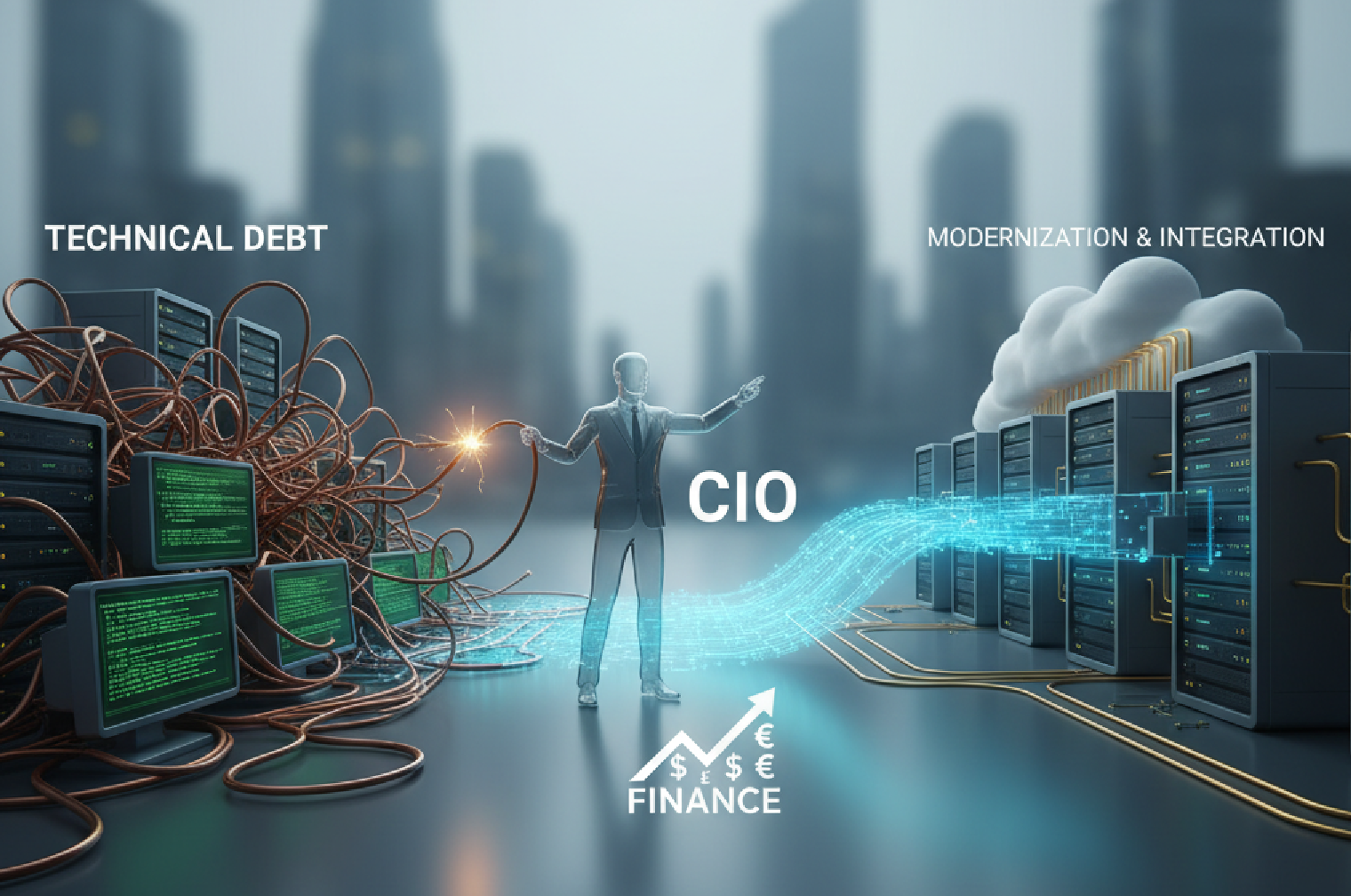
Legacy System Modernization: How CIOs in Finance Can Tackle Technical Debt Without Disrupting Operations

Legacy system modernization is now essential to reduce operational risk and technical debt, yet transformation must happen with near‑zero downtime in a heavily regulated, always‑on industry where service interruptions carry outsized consequences.

The fastest path forward blends progressive modernization with rigorous system integration, using API-first patterns, data interoperability, and controlled migration techniques that let core banking functions continue uninterrupted while the tech stack evolves behind the scenes.

ViitorCloud specializes in this exact balance for BFSI by designing resilient integration architectures and migration roadmaps that modernize incrementally, improve time‑to‑value, and protect business continuity from day one.

What is Legacy System Modernization in Finance?

Legacy system modernization in finance refers to updating or re‑platforming core banking and adjacent systems—often monolithic, mainframe-based, and highly customized—into modular, cloud-ready, API-driven architectures that improve agility, resilience, and regulatory responsiveness without interrupting daily operations.

Financial organizations accumulate technical debt because quick fixes, customizations, one‑off integrations, and deferred upgrades compound over years, making change risky and expensive while diverting budgets from innovation to keep‑the‑lights‑on activities.

Modernization targets those costs head‑on by progressively decoupling capabilities, rationalizing interfaces, and enabling open banking through standards-based APIs and composable services.

Read: System Integration for BFSI: Achieving Seamless Financial Operations

Modernize Legacy Systems Without Disruption

Upgrade your financial systems seamlessly with ViitorCloud’s Legacy System Modernization and System Integration solutions.

What Technical Debt Challenges Do Financial Institutions Face?

Technical debt in banking often represents a large share of the technology estate’s value, leading to spiraling maintenance costs, slower delivery, higher incident risk, and reduced capacity for new revenue initiatives, according to McKinsey’s research on tech debt’s systemic drag on transformation outcomes.

Fragmented point‑to‑point integrations, brittle batch processes, and vendor lock‑in exacerbate complexity, making core changes risky and multiplying the effort required for even routine feature releases. As a result, a disproportionate share of IT budget funds runs the bank activities, while innovation roadmaps stall under the weight of aging platforms and opaque dependencies across the stack.

Why Is Modernization a CIO Priority Now?

Bank IT spending is rising at a ~9% compound annual rate and already consumes more than 10% of revenues, making modernization essential to rein in run costs and improve ROI on digital investments, per BCG’s global banking tech analysis.

Gartner forecasts worldwide IT spending to surpass $5.7 trillion in 2025, fueled in part by AI infrastructure, meaning leaders must shift budgets from maintenance to value creation while navigating higher input costs and stakeholder scrutiny on outcomes.

Accenture notes that although banks have moved many satellite systems to the cloud, core banking remains the “elephant in the room,” so CIOs are prioritizing pragmatic, risk‑aware modernization that demonstrates incremental value and de‑risks the journey early.

How Can Banks Modernize Without Disrupting Operations?

Modernize in phases, isolating high‑change domains first and using parallel runs, feature flags, and canary releases to validate functionality in production with a controlled blast radius and clear rollback paths for safety.

Design for API-first interoperability so legacy and modern services coexist, and layer a robust integration fabric to normalize events, enforce policies, and standardize data contracts across channels and core systems, enabling reversibility and auditability at every step.

Treat observability as a migration enabler—instrument SLIs/SLOs, golden signals, and end‑to‑end tracing so anomalies are detected early and customer impact is minimized during cutovers and steady‑state operations.

  • Phased migration: Prioritize “hollow‑the‑core” patterns to externalize customer, product, and pricing capabilities via APIs before moving underlying records of truth, reducing risk while accelerating visible benefits.
  • API and microservices: Use domain‑aligned microservices and open banking APIs to decouple change cycles, scale independently, and integrate fintech ecosystems faster for new propositions and channels.
  • AI enablement: Deploy AI for fraud detection, underwriting assistance, service automation, and incident intelligence to improve resilience and customer experience during and after modernization.

Check: System Integration in Finance: Streamlining Compliance and Risk Management

Tackle Technical Debt with Confidence

Leverage expert System Integration to modernize legacy platforms while ensuring business continuity.

Legacy vs. Modernized Banking Systems

DimensionLegacy (Old)Modernized (New)
ArchitectureMonolithic cores with tightly coupled modules that slow releases and raise incident riskComposable, domain‑based services with API gateways and event streams for independent scaling and safer change
IntegrationPoint‑to‑point, batch-heavy interfaces that are brittle under changeAPI-first, event‑driven, real‑time integration that supports open banking and partner ecosystems
OperationsHigh MTTR, limited observability, heavy manual controlsAutomated SRE practices, full-fidelity telemetry, policy-as-code, and faster mean time to recovery
ComplianceRetrofitted reporting, fragmented data lineageUnified data models, lineage, and auditable workflows embedded in integration layers
Change RiskBig-bang upgrades with major outage windowsProgressive cutovers with canary/blue‑green and rollback automation to avoid downtime
Legacy vs. Modernized Banking Systems

How Does System Integration Power Finance Transformation?

System integration in finance creates a unified fabric that connects legacy cores, digital channels, risk and compliance platforms, and partner ecosystems, ensuring consistent data, policies, and SLAs while modernization occurs behind the scenes.

It standardizes API lifecycles, enforces governance, and orchestrates flows across hybrid and multi‑cloud, enabling CIOs to decouple delivery schedules and shield customers from backend change.

This discipline is the backbone for digital transformation finance programs, turning disparate systems into a coherent, resilient platform capable of continuous evolution.

Why Modernize Banking Platforms Today?

Banks that delay core and platform modernization face rising run costs, slower-than-market response, and greater operational and regulatory risk as customer expectations shift toward instant, personalized, and always‑on services.

Accenture highlights that only a fraction of bank workloads historically moved to the cloud, and value realization depends on interoperable, composable architectures—making platform modernization central to profitable digitization. With transaction banking, embedded finance, and AI‑driven risk models accelerating, modern platforms are the prerequisite for growth, resilience, and secure ecosystem participation.

Build a Future-Ready Financial Ecosystem

Transform legacy systems with modern, scalable, and integrated solutions tailored to your operations.

How ViitorCloud Supports CIOs with System Integration

ViitorCloud delivers system integration and modernization services purpose‑built for finance, unifying applications, data, and infrastructure so CIOs can execute legacy system modernization without disrupting customer experience or regulatory obligations.

From API integration and data interoperability to re‑architecture and refactoring, our teams implement domain‑specific patterns for BFSI that balance near‑term wins with long‑term architectural health and cost control.

Contact our team to set up a complimentary consulting call with our expert.

Frequently Asked Questions

It’s the process of progressively upgrading banking platforms and core systems into API‑first, cloud‑ready, and composable architectures—so capabilities evolve without interrupting daily operations or breaching regulatory SLAs.

Integration standardizes APIs, data contracts, and orchestration across channels and cores, allowing legacy and modern components to coexist safely while changes roll out in phases.

Big‑bang migrations, poor sequencing, and insufficient observability can impact customer experience and compliance; that’s why progressive cutovers, canary releases, and strong governance are essential.

Adopt “hollow‑the‑core” with targeted component exposure via APIs, migrate in phases with parallel runs, and invest in integration governance to decouple changes from customer‑facing services.

Open APIs enable interoperability with fintechs, accelerate product rollout, and decouple release cycles while supporting open banking requirements and partner channels.

Building Scalable SaaS Platforms for Retail Startups: A CTO’s Playbook

Scalable SaaS platforms for retail startups are built by anchoring every decision to the six pillars of cloud architecture, i.e., security, reliability, performance efficiency, operational excellence, cost optimization, and sustainability—while embracing multi-tenant patterns, event-driven designs, and data models that scale horizontally under spiky retail demand. 

The shortest path is to start with a multi-tenant baseline on a major cloud, automate tenant onboarding and routing, select storage per workload (SQL, NoSQL, or NewSQL), and instrument tenant-level metrics for capacity, cost, and experience, then iterate with load tests that mirror peak season and flash-sale behavior. 

Retail is scaling fast—global ecommerce revenue is expected to surpass $6.09 trillion in 2024 and reach over $8 trillion by 2028—so platforms must handle volatile traffic, complex inventory and pricing, and compliance-heavy payment flows from day one. 

What Makes a SaaS Platform ‘Scalable’ for Retail? 

Scalable SaaS platforms for retail startups should sustain rapid user growth and fluctuating order volumes without degraded latency by distributing state and compute, isolating tenants appropriately, and automating elasticity at each layer. 

It also minimizes operational toil through automated tenant onboarding, observability, and remediation so teams can ship changes quickly while preserving security, compliance, and cost efficiency. 

Finally, it adapts to evolving channel integrations—POS, marketplaces, payments, logistics—via decoupled interfaces and event-driven patterns that localize failures and allow independent service scaling. 

Check: What is SaaS Product Engineering and Why is it Crucial for Business Success? 

What are the core pillars of scalability? 

As stated, CTOs should continuously assess architecture against the six pillars: operational excellence, security, reliability, performance efficiency, cost optimization, and sustainability. 

These pillars translate into practices like autoscaling, fault isolation, continuous verification, least-privilege access, and spend visibility at the tenant and service level. 

Build Scalable SaaS Platforms for Growth

Empower your retail startup with robust SaaS product engineering designed to scale seamlessly.

How to size the opportunity and risk? 

E-commerce is compounding, with 2024 revenues projected at $6.09 trillion and a forecast to exceed $8 trillion by 2028, which means traffic spikes and seasonality will intensify across retail categories. 

Planning must assume higher-than-average peak-to-median ratios, flash promotions, and international rollouts, not just steady linear growth. 

How do you choose the right tech stack? 

Favor services and frameworks that support horizontal scaling and multi-tenancy, then select data stores per domain—relational for strong consistency, document/columnar for elastic catalogs and events, and NewSQL for ACID at scale. 

Use managed cloud primitives that encode best practices out of the box, reducing undifferentiated heavy lifting and compliance surface. 

Read: Why SaaS and Small Businesses Must Embrace Custom AI Solutions 

SQL vs NoSQL vs NewSQL for retail workloads 

Option Scaling model Consistency model Best for Retail examples 
SQL (e.g., PostgreSQL) Primarily vertical scaling with clustering/replication add-ons  Strong ACID transactions Orders, payments, and financial posting Checkout, invoicing, and refunds where integrity is critical 
NoSQL (e.g., MongoDB) Native horizontal sharding and scale-out Flexible schema, eventual consistency options Product catalogs, sessions, activity feeds High-variance attributes and rapid catalog updates 
NewSQL (e.g., distributed SQL) Horizontal scaling with ACID guarantees Strong consistency with distributed transactions High-throughput OLTP at scale  Flash-sale order capture across regions 
SQL vs NoSQL vs NewSQL

Accelerate Retail Innovation with SaaS

Leverage our expertise in scalable SaaS platforms to create future-ready retail solutions.

How should multi-tenancy be implemented? 

Adopt the pool, bridge, or silo model per tenant tier and data sensitivity, balancing isolation, cost, and operational simplicity. 

Leverage standardized onboarding, tenant-aware identity, routing, and metering so new tenants can be provisioned instantly and governed consistently. 

What about routing and integrations? 

Implement deterministic tenant routing at the edge and service tier, using headers or subdomains to direct requests to pooled or isolated backends. 

Decouple retail integrations—payments, marketplaces, logistics—through event buses and retries so external failures don’t cascade into core ordering and catalog flows. 

What compliance is non-negotiable? 

Retail SaaS commonly intersects with PCI DSS for payment flows, SOC 2 for trust controls, and GDPR for personal data in the EU, each shaping architecture and operational controls. 

Design for encryption in transit and at rest, least-privilege access, regional data residency when required, and auditable change management and logging. 

“SaaS is all about agility,” a reminder that architectural choices must accelerate onboarding, updates, and incident recovery without sacrificing isolation or trust. 

Read Also: AI-First SaaS Engineering: How CTOs Can Launch Products 40% Faster 

Optimize Your SaaS Product Engineering

Streamline development and scale confidently with our proven SaaS engineering expertise.

A 5-Step Playbook for Building Your Platform 

  1. Define tenant model and SLAs: Choose pool, bridge, or silo per customer segment and data risk, then codify SLAs for latency, availability, and data isolation. 
  1. Architect for elasticity and failure: Use autoscaling, circuit breakers, idempotent operations, and bulkheads to handle load surges and upstream outages gracefully. 
  1. Pick storage per domain: Combine relational for critical transactions, NoSQL for elastic reads, and distributed SQL where ACID must scale horizontally, all with clear data ownership and retention. 
  1. Build tenant-aware ops: Instrument per-tenant metrics for cost, performance, and feature adoption, and automate onboarding, routing, and policy enforcement. 
  1. Prove it with tests: Run load and chaos tests that simulate peak season and flash sales, validate scaling policies, and rehearse failover and rollback procedures. 

What pitfalls should be avoided? 

  • Treating multi-tenancy as an afterthought increases blast radius and migration cost later. 
  • Picking a single database for all workloads instead of aligning data stores to domains and access patterns. 
  • Skipping tenant-level cost and performance telemetry, which hides noisy neighbor risks and margin erosion. 

How do you integrate retail stats into planning? 

Use the e-commerce growth baselines, $6.09 trillion in 2024 and an eight-trillion trajectory by 2028, to set capacity curves and cost envelopes for the first 24 months. 

Translate forecast peaks into queue depth thresholds, read/write budgets, and cache warm-up timings across services. 

Partner with ViitorCloud for Scalable SaaS Product Engineering 

ViitorCloud specializes in end-to-end SaaS product engineering that builds secure, resilient, and scalable platforms capable of handling rapid user growth and integrating with modern retail ecosystems. 

Our team delivers tenant-aware architectures, composable integrations, and performance-first engineering patterns that evolve with market demands and enterprise compliance needs. 

Partner with ViitorCloud to co-architect the multi-tenant model, select the right data stores per domain, and harden the platform against real retail workloads—with a roadmap that accelerates time-to-value. 

Scale Your Retail SaaS Smarter

Unlock growth opportunities with scalable SaaS platforms designed for retail success.

The Playbook at a Glance 

  • Anchor engineering to the six pillars and treat multi-tenancy, routing, and observability as first-class concerns. 
  • Mix SQL, NoSQL, and NewSQL per domain to keep transactions safe and reads elastic at peak. 
  • Automate tenant onboarding, policy enforcement, and telemetry to scale customers and trust together. 
  • Design for peak and failure, not average load, using autoscaling, queues, and idempotent flows. 
  • Map PCI DSS, SOC 2, and GDPR into cloud-native controls early to avoid rework and deal with friction. 

Frequently Asked Questions

Enterprises often warrant the bridge or silo model for stronger data and performance isolation, while SMB tiers benefit from pooled resources with strong logical segregation and throttles. 

Push read-heavy paths to caches and CDNs, make payment flows idempotent, and isolate payment webhooks behind queues so upstream slowness does not block confirmation paths. 

Use a distributed SQL engine when ACID guarantees are mandatory under horizontal scale, such as global order capture or inventory reservations with strong consistency. 

Prioritize PCI DSS scope reduction if handling payments, establish SOC 2 controls for trust, and address GDPR where data subjects are in the EU, mapping controls into cloud services. 

Use deterministic identifiers at the edge and propagate tenant context through services, selecting routing strategies that match pool, bridge, or silo models.

What is AI-Powered Data Pipeline Development for Real-Time Decision Making in Technology Firms?

AI-powered data pipeline development is the engineered process of ingesting, transforming, and serving data—via both batch and streaming paths—to power machine learning and analytics, enabling decisions to be made with low latency and high reliability in production systems.  

In technology firms, this discipline connects operational data sources to model inference and business logic, enabling actions to be triggered as events occur rather than hours or days later, and facilitating truly real-time decision-making at scale.  

With AI-powered data pipeline development, custom AI solutions for technology firms convert raw telemetry into features and signals that drive automated actions and human-in-the-loop workflows within milliseconds to minutes, depending on the service-level objective. 

Real-time pipelines are crucial because applied AI and industrialized machine learning are scaling across enterprises, and the underlying data infrastructure significantly impacts latency, accuracy, trust, and total cost of operation. By the time a dashboard updates, an opportunity or risk may have vanished—streaming-first designs and event-driven architectures close this gap to unlock compounding business value. 

What is AI-Powered Data Pipeline Development? 

AI-powered pipeline development designs the end-to-end flow from data producers (apps, sensors, services) through ingestion, transformation, storage, and feature/model serving so that AI systems always operate on timely, high-quality data.  

Unlike traditional ETL that primarily schedules batch jobs, these pipelines incorporate event streams, feature stores, and observability to keep models fresh and responsive to live context. The result is a cohesive fabric that unifies data engineering with MLOps so models, features, and decisions evolve as reality changes. 

Build Smarter Decisions with AI-Powered Data Pipeline Development

Integrate data seamlessly and make real-time decisions with ViitorCloud’s Custom AI Solutions.

Why Real-Time Pipelines Now? 

Enterprise adoption of applied AI and gen AI has accelerated, with organizations moving from pilots to scale and investing in capabilities that reduce latency and operationalize models across the business.  

Streaming pipelines and edge-aware designs are foundational enablers for this shift, reducing time-to-insight while improving decision consistency and auditability for technology firms. 

How to Build an AI-Powered Data Pipeline 

  1. Define decision latency and SLA 
    Clarify the “speed of decision” required (sub-second, seconds, minutes) and map it to batch, streaming, or hybrid architectures to balance latency, cost, and reliability. 
  1. Design the target architecture 
    Choose streaming for event-driven decisions, batch for heavy historical recomputation, or Lambda/Kappa for mixed or streaming-only needs based on complexity and reprocessing requirements. 
  1. Implement ingestion (CDC, events, IoT) 
    Use change data capture for databases and message brokers for events so operational data lands consistently and with lineage for downstream processing. 
  1. Transform, validate, and enrich 
    Standardize schemas, cleanse anomalies, and derive features so data is model-ready, with governance and AI automation embedded in repeatable jobs. 
  1. Engineer features and embeddings 
    Generate and manage features or vector embeddings for retrieval and prediction, and sync them to feature stores or vector databases for low-latency reads. 
  1. Orchestrate, observe, and remediate 
    Track data flows, schema changes, retries, and quality metrics to sustain trust, availability, and compliance in production pipelines. 
  1. Serve models with feedback loops 
    Deploy model endpoints or stream processors, capture outcomes, and feed them back to improve data, features, and models continuously (industrializing ML). 
  1. Secure and govern end-to-end 
    Integrate controls for privacy, lineage, and access while aligning with digital trust and cybersecurity best practices at each pipeline stage. 

What Benefits Do Real-Time, AI-Powered Pipelines Deliver? 

  • Faster, consistent decisions in products and operations through event-driven processing and low-latency data delivery. 
  • Higher model accuracy and reliability because data freshness and feature quality are monitored and continuously improved. 
  • Better cost-to-serve and scalability via clear architecture choices that align latency with compute and storage economics. 
  • Stronger governance and trust with lineage, observability, and controls aligned to modern AI and cybersecurity expectations. 

Transform Your Tech Stack with AI-Powered Data Pipeline Development

Drive efficiency and scalability through real-time data processing with our Custom AI Solutions.

Which Pipeline Architecture Fits Which Need? 

Pipeline type Processing model Latency Complexity Best fit 
Batch Periodic ingestion and transformation with scheduled jobs Minutes to hours; not event-driven Lower operational complexity; simpler operational state Historical analytics, reconciliations, and monthly or daily reporting 
Streaming Continuous, event-driven processing with message brokers and stream processors Seconds to sub-second; near-real-time Operationally richer (brokers, back-pressure, replay) Live telemetry, inventory, fraud/alerting, personalization 
Lambda Dual path: batch layer for accuracy, speed layer for fresh but approximate results Mixed; speed layer is low-latency, batch is higher-latency Higher (two code paths and reconciliation) Use cases needing both historical accuracy and real-time views 
Kappa Single streaming pipeline; reprocess by replaying the log Low-latency for all data via stream processing Historical analytics, reconciliations, and monthly or daily reporting Real-time analytics, IoT, social/event pipelines, fraud detection 
Pipeline Architecture

What Do the Numbers Say? 

McKinsey’s 2024 Technology Trends analysis shows generative AI use is spreading, with broader scaling of applied AI and industrialized ML and a sevenfold increase in gen AI investment alongside strong enterprise adoption momentum. The report also highlights cloud and edge computing as mature enablers—key dependencies for real-time AI pipelines in production contexts. 

“Real-time pipelines are where data engineering meets business outcomes—turning raw events into timely, explainable decisions that compound competitive advantage,” —industry expert. 

How ViitorCloud Can Help Your Tech Firm 

ViitorCloud specializes in developing custom AI solutions for technology firms, designing and implementing robust AI-powered data pipelines that enable real-time decision making, enhance operational efficiency, and drive competitive advantage. With a global presence, the team aligns architecture, features, and model serving with the firm’s latency and reliability targets to deliver measurable business outcomes.  

For discovery sessions, solution roadmaps, or implementation support, explore the Artificial Intelligence capabilities and engage the team to discuss the specific pipeline needs and success metrics for the next initiative. 

Accelerate Decision-Making with AI-Powered Data Pipeline Development

Leverage real-time insights and automation tailored to your needs with ViitorCloud’s Custom AI Solutions.

How to Choose Between Architectures 

  • For event-driven products that demand seconds or sub-second responses, prioritize streaming or Kappa, then add replay and observability for resilience. 
  • For heavy historical recomputation with strict accuracy, keep a batch path or Lambda to merge “speed” with “truth” views. 
  • Where cost and operational simplicity dominate, use batch-first with targeted streaming for the few decisions that truly require immediacy. 

Frequently Asked Questions 

Traditional ETL moves data in scheduled batches for downstream analysis, while AI-powered pipelines unify batch and streaming paths to feed features and models for low-latency, in-production decisions. 

Lambda helps when both accurate historical batch views and fresh stream views are required, whereas Kappa simplifies to one streaming path and replays the log for reprocessing, where low latency is paramount. 

In most systems, real-time implies seconds to sub-second end-to-end latency enabled by event-driven ingestion and stream processing, distinct from minutes-to-hours batch cycles. 

Embed validation, schema management, and monitoring into transformation stages, then track lineage and retries to ensure consistent, trustworthy feature delivery. 

Data engineering, MLOps, and platform engineering are core, with demand rising as enterprises scale applied AI and industrialize ML across products.