Why are ethics in artificial intelligence required for maintaining balance?

Artificial Intelligence (AI) is rapidly advancing and its impact on society is becoming more pronounced. As AI technology becomes more intelligent and autonomous, it raises essential questions regarding AI ethics and human values.

The intersection of AI and ethics is a complex and multifaceted topic.

It requires careful consideration of the ethics of AI such as how AI systems are designed, and their implications on privacy, bias, transparency, accountability, and the overall well-being of individuals and communities.

we will delve into the intricate world of ethics in artificial intelligence, exploring the complexities, challenges, and potential solutions for ensuring AI and human values.

Understanding the ethics in artificial intelligence

According to the report, by 2025, as many as 97 million people will work in the AI space and the AI market size is expected to grow by at least 120% year-over-year.

This shows that Ethics in Artificial Intelligence are a crucial aspect to consider when developing and implementing AI systems.

The Ethical Concerns of AI are multi-faceted and involve various issues such as privacy, bias, accountability, and transparency.

These complexities highlight the importance of understanding the ethical issues of AI to navigate the ever-evolving landscape of technological advancements while still prioritizing and upholding human values.

Importance of AI ethics principles in the technological age

In today’s technological age, AI has become increasingly integrated into various aspects of our lives, making the ethics of AI more important.

As AI development progresses and exerts increasing influence on our society, it becomes imperative to prioritize ethics. This ensures that the creation and utilization of AI align with our fundamental societal values.

It is important to drive the complexities of AI and human values responsibly and ethically, so it doesn’t compromise our core principles while embracing the advancements of AI technology.

Defining AI ethics and its role in society

AI ethics refers to the principles and guidelines that govern the responsible use of artificial intelligence technologies within society. Understanding artificial intelligence’s meaning is essential for ensuring that these technologies are implemented in a way that is ethical and beneficial for all.

This involves establishing norms for how the ethics of AI systems should be designed, developed, deployed, and used to ensure they align with our societal values.

It is through ethical concerns of AI that we can navigate the complexities of human ethics in Artificial Intelligence, ensuring that technological advancements are aligned with our societal goals and principles.

Incorporation of human values

By incorporating human values into the design process, we can promote fairness, accountability, transparency, inclusivity, and overall trust in AI systems.

By prioritizing Ethics in Artificial Intelligence, we can mitigate risks associated with biased algorithms, data privacy breaches, and other ethical concerns that arise from AI implementations.

Ethical considerations of using artificial intelligence

Artificial intelligence (AI) not only brings about technological advancements but also raises important ethical questions that need to be addressed.

One such concern is the issue of privacy and data security. With AI systems having access to massive amounts of data, ensuring the privacy and security of this information becomes crucial.

Additionally, there is a need for Ethics in Artificial Intelligence for programming and monitoring to prevent the perpetuation of biases and discrimination.

The potential impact of AI on employment is another ethical consideration, as automation can lead to job displacement and economic inequality.

Finally, Ethics in Artificial Intelligence Concerns present challenges in terms of accountability and transparency, as the algorithms powering AI systems can be complex and difficult to understand.

Human values and AI

By integrating AI and Human Values, we can establish a framework that guides machines toward responsible decision-making. This can help prevent potential biases and discrimination from being perpetuated by AI systems.

By including a wide range of voices and experiences, we can avoid any unintended biases and promote inclusivity of Ethics in Artificial Intelligence.

The establishment of ethical guidelines and frameworks can provide a clear roadmap for the implementation of human values in AI, ensuring that these values are upheld throughout the development and use of this transformative technology.

AI and privacy concerns

Artificial intelligence (AI) has revolutionized the way we interact with technology, but it also brings with it a host of concerns, particularly when it comes to privacy.

AI systems can collect and analyze vast amounts of personal data, which raises important questions about how this information is stored, shared, and protected.

Privacy concerns in AI revolve around issues such as data security, consent, and transparency in algorithms.

Ethical concerns of AI play a crucial role in ensuring privacy rights and protecting sensitive information.

The role of data privacy in AI development

Data privacy is a crucial aspect in the development of artificial intelligence as it promotes trust between users and AI systems.

By protecting individuals’ privacy, it enables responsible collection and use of data for training AI models.

Moreover, data privacy safeguards are necessary to address potential biases and discrimination in ensuring the morality of AI.

Mitigating risks of data breaches and unauthorized access

Minimizing the risks of data breaches is of utmost importance when it comes to the ethical concerns of AI.

The potential consequences of data breaches can be harmful and have far-reaching implications, underscoring the need for stringent access controls.

By adopting privacy-enhancing technologies such as differential privacy, the likelihood of re-identification attacks on user data can be significantly reduced, further safeguarding individuals’ privacy and promoting responsible AI usage.

Importance of regular audits

Regular audits and monitoring play a vital role in identifying vulnerabilities and ensuring compliance with privacy regulations in the context of AI applications.

By prioritizing data privacy, we can ensure that AI systems operate in an ethically responsible and accountable manner while promoting the greater good for all.

Future of AI ethics

Artificial intelligence ethics is a rapidly evolving field that is gaining increasing attention as AI technologies continue to advance.

Ethical considerations in AI will become even more complex as AI systems become increasingly autonomous and capable of making decisions without human intervention.

The future of AI ethics will require interdisciplinary collaboration between experts from various fields, including philosophy, computer science, law, and social sciences.

By bringing together diverse perspectives, we can develop comprehensive frameworks and guidelines that address the ethical challenges posed by AI technologies and safeguard human values in the increasingly complex AI landscape.

Conclusion

Navigating Ethics in Artificial Intelligence by Incorporating human values is essential to ensure that they align with societal needs and uphold human rights.

By considering potential implications and involving diverse stakeholders in shaping responsible AI practices, we can create an AI future that not only benefits society but also upholds human values and respects our collective ethical concerns over the morality of AI.

Frequently asked questions

The pillars of AI ethics are the foundational principles that guide the development and deployment of AI systems. These pillars include Transparency, Fairness, Privacy, Accountability, and Robustness.

The ethical challenges of AI include biased algorithms, lack of transparency, privacy concerns, job displacement, and accountability for errors.

Educating the public about the ethical issues of AI can be done through public awareness campaigns, accessible resources, and interdisciplinary education.

Collaboration between AI and human values goes a long way

Artificial Intelligence (AI) has made remarkable strides in recent years, transforming various aspects of our lives.

From autonomous vehicles to virtual personal assistants, AI and human values are becoming increasingly evident.

Further, we will delve into the convergence of AI and human values, emphasizing the growing significance of integrating these values into AI systems.

Building a foundation of human values within AI technology is not just a moral imperative; it’s a necessity for the betterment of our society and the future of technology.

Current approaches to incorporating human values into AI

AI is becoming a bigger part of our lives. But making sure that AI helping humans is essential.

There are three main ways to do this: value alignment, value-sensitive design, and value extrapolation.

Value alignment means making AI follow human values

Think about self-driving cars: they are programmed to keep passengers safe while avoiding harm to others.

This way, they balance individual and group values.

Value-sensitive design is about getting ethics and values into the AI design process

Ethicists and other experts help in building AI so that it respects our values.

For example, when making chatbots or virtual assistants, they work with experts to make sure these systems understand and respect diverse human values.

Value extrapolation is a bit like AI guessing our values based on data

For example, when you watch videos on a platform, AI tries to recommend similar videos you might like.

It’s trying to guess your values by what you’ve watched before.

Let’s look at the advantages and limitations of AI approaches:

Advantages

  • Value alignment makes AI systems more adaptable to different human values, making them better for everyone.
  • Value-sensitive design helps avoid conflicts between AI and human values by getting experts involved in the design process.
  • Value extrapolation personalizes our experiences with AI, offering us content or services we might like based on our past choices.

Limitations

  • Implementing these approaches can be difficult, as they often need complex programming and a deep understanding of human values.
  • Sometimes, it’s challenging to predict and understand all the values of a diverse group of people.

Finally, there are examples of ai helping humans to bring the best value.

For instance, some chatbots are designed to provide emotional support with empathy. Content recommendation systems filter out harmful content and prioritize user privacy.

Benefits of AI helping humans

AI and human values have brought many benefits in various domains.

Here are some key points highlighting the positive aspects of AI and human values and how it has improved industries and daily life:

Efficiency and Productivity: AI-powered automation and machine learning algorithms have significantly increased efficiency and productivity in industries such as manufacturing, logistics, and customer service.

Tasks that were once time-consuming and labor-intensive can now be completed quickly and accurately with the integration of AI and human values.

Enhanced Healthcare: AI has revolutionized healthcare by improving diagnostics, treatment planning, and patient care.

Machine learning algorithms can analyze vast amounts of medical data to detect patterns and make accurate predictions, leading to early disease detection and personalized treatment plans.

AI-powered robotic systems have also assisted surgeons in performing complex procedures with precision.

Smart Personal Assistants: Virtual assistants like Siri, Alexa, and Google Assistant have become an integral part of daily life, providing convenience and assistance.

These AI-powered personal assistants can perform various tasks such as setting reminders, answering questions, playing music, and controlling smart home devices, making our lives easier and more efficient.

Improved Safety and Security: AI has played a crucial role in enhancing safety and security measures. Facial recognition systems and surveillance cameras powered by AI algorithms help in identifying potential threats and preventing crimes.

AI-powered cybersecurity systems can detect and respond to cyber threats in real-time, protecting sensitive data and digital infrastructure.

By ensuring transparency, fairness, and accountability in AI decision-making processes, we can harness the power of AI to align with human values such as privacy, fairness, and social good.

Prospects and innovations in human values in AI

The future of AI and human values holds immense promise. Ongoing research is exploring innovative ways to make AI systems more aligned with diverse human values.

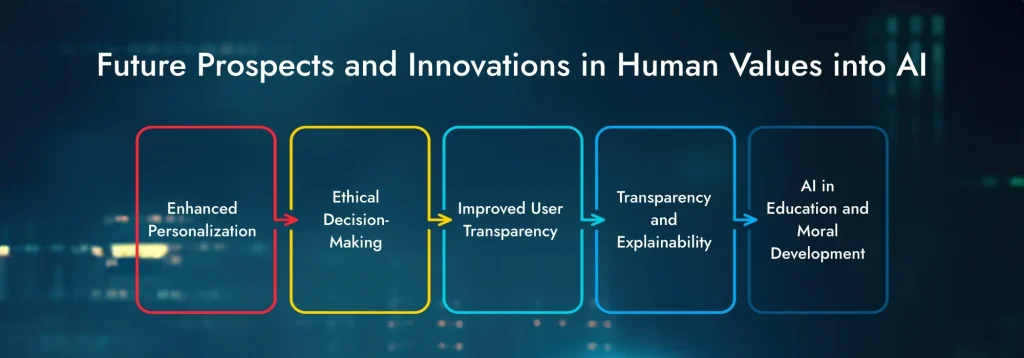
Future Prospects and Innovations in Human Values into AI

By Integrating values into AI, we can expect:

  • Enhanced Personalization: AI systems will better understand and adapt to individual values, offering more tailored experiences and services.
  • Ethical Decision-Making: AI will play a crucial role in solving complex ethical dilemmas, and making choices that align with societal values and ethical norms.
  • Improved User Transparency: Future AI systems will be designed to be more transparent, allowing users to understand and influence the values governing AI behavior.
  • Transparency and Explainability: AI will be designed to provide clear explanations for its decisions, making it understandable to the average user. This will enhance trust and allow users to actively influence the values and decision-making processes of AI.
  • AI in Education and Moral Development: Interactive AI tutors and educational tools will not only teach subjects but also impart values, fostering a more responsible and empathetic society.

The future prospects and innovations in building human values in AI systems represent a vision of technology that is deeply intertwined with our ethical, moral, and cultural principles.

It’s a future where AI becomes a force for the betterment of humanity, a companion in our quest for ethical decision-making, and a tool for addressing global challenges while respecting individual and collective values.

How ViitorCloud is building human values into AI

ViitorCloud, a leading Immersive technology company, has been at the forefront of incorporating human values into AI.

We understand that AI should not only be a tool but a responsible and empathetic companion for humans and hence ViitorCloud is committed to building AI and human values that respect individual values and cultural diversity.

Our AI development services prioritize a human-centric approach. We collaborate closely with experts through extensive research and development and incorporate continuous user feedback. This ensures that the AI solutions we create are not only effective but also aligned with human values.

Wrap up

The integration of AI and human values is a crucial step towards a more ethical and inclusive future.

As technology continues to evolve, ViitorCloud stands as an example of a company dedicated to this vision.

As we move forward, it’s essential to remain vigilant, collaborative and committed to realizing this vision for a more ethical and value-driven future.

Frequently asked questions

AI has the potential to enhance productivity, improve healthcare outcomes, and advance scientific research.

Ethical principles, such as fairness, transparency, and accountability, should be embedded to align with AI and human values.

Future trends in the field of AI ethics are Increased regulation, Ethical considerations in AI development, Bias mitigation, Explain ability and transparency, AI governance, Human-centric AI, and international collaboration

AI can be used to develop advanced surveillance systems, autonomous vehicles, and predictive policing algorithms, which can help prevent accidents and protect human lives.

How AI in cybersecurity helps companies protect digital assets

Artificial Intelligence (AI), has revolutionized the field of Cybersecurity by offering more advanced and more effective methods for detecting, preventing and demolishing cyber threats. The adoption of AI in cybersecurity is continuously growing, with many businesses making it a cornerstone of their security framework.

As per a MarketsandMarkets report, the worldwide AI’s integration into the cyber security sector is poised for significant expansion, projecting an increase from $8.8 billion in 2020 to an estimated $38.2 billion by 2026, indicating a robust 23.3% compound annual growth rate throughout the forecasted period.

According to the report, factors such as the increase in cyber-attacks and the scarcity of qualified cybersecurity specialists are primary reasons why the demand for AI-based solutions is increasing in the world of Cybersecurity.

Importance of AI in cybersecurity

In today’s world, digital entities are an integral part of every business, whether it is a startup or a well-established enterprise. And cyber threats are a major concern for every business out there. As the volume of digital data continues to surge every year, so does the number of cyber threats to businesses.

Additionally, factors such as the increase in the number of connected devices, the surge in usage of cloud-based services and more resources working remotely are fueling the demand for cybersecurity.

Cyber threats can cause significant financial losses to companies and can also tarnish their market image in events such as data breaches. However, with the correct AI solution integrated in your security, it is feasible to detect and prevent cyber threats before they cause any damage to your IT system.

How AI technology is used in cybersecurity

These days, data security professionals are extensively using AI technology to detect and prevent the threats of cyber-attacks in real time. AI algorithms can quickly scan vast datasets to identify any pattern that signals a potential cyber threat.

Without further ado, let’s understand the role of artificial intelligence in cybersecurity.

Detecting malware

Malware poses a significant cybersecurity threat, and while traditional antivirus software relies on signature-based detection, it falls short against evolving malware. On the other hand, AI in cybersecurity solutions leverages machine learning algorithms to detect both known and unknown malware threats by analyzing data patterns and anomalies. These solutions can be trained using labeled and unlabeled data, offering a more sophisticated approach to malware detection through techniques like static and dynamic analysis.

Identifying phishing

Phishing is basically an example of cybercrime that includes phishing attacks, where cybercriminals use deceptive tactics to steal sensitive information from unsuspecting individuals or companies. When you use AI in cybersecurity, they can trace patterns and anomalies to identify phishing attempts, preventing users from clicking on a suspicious link or writing back to a phishing email.

Enhancing security through log analysis

AI-driven log analysis can analyze bigger datasets of security logs in less time and identify any breach in security. This helps companies mitigate any potential risk before it causes any severe security incident. Modern-day AI technology helps companies trace user behavior across different applications and systems, detecting any sign of potential insider threat scenarios such as unauthorized data transfer and unapproved access.

Monitoring network security

AI and machine learning can also be used to actively monitor network operations, identify unauthorized devices and detect suspicious traffic patterns on the network. AI algorithms use past traffic data of the network to understand patterns that are unusual, or rather suspicious. In short, AI-driven cybersecurity solutions empower IT departments to thwart security threats proactively, preventing cybercriminals from exploiting vulnerabilities.

Safeguarding end devices

Laptops and smartphones, which are referred to as endpoint devices in the digital realm, are often primary targets of cybercriminals. The AI-powered endpoint security solutions scan for malware, block unauthorized access and prevent cyber criminals from getting access to sensitive data. And one of the biggest advantages of opting for AI is it can evolve its algorithms to continuously defeat the new threats.

Key benefits of AI-powered cybersecurity

AI-powered security solutions have kickstarted a new era of cybersecurity. They are enabling companies to stay one step ahead of all potential security threats.

Without further ado, let’s dive into some of the most significant benefits of incorporating AI in the Cybersecurity realm.

The next-level efficiency

By automating routine tasks, AI can free up data security professionals for more complex issues including threat hunting and incident response. Security analysts often find it challenging to trace through a huge number of logs, reports and alerts to detect any potential cyber threat, but AI algorithms can perform this task more efficiently and more quickly.

AI-driven automation doesn’t stop there; it autonomously scans networks and systems, revealing potential weak points in the IT systems that cybercriminals might exploit. Furthermore, AI takes the lead in incident response, offering real-time assessments, alerts, and recommendations, enabling security teams to react swiftly and effectively.

Higher accuracy

AI in cybersecurity leverages machine learning to identify unknown malware variants that are difficult to identify using traditional signature-based detection methods used by humans. It also uses NLP (Natural language processing) to scan any suspicious content pattern to recognize phishing emails.

What’s more, AI-based security solutions use computer vision to accurately identify anomalies in network traffic and prevent any potential intrusion. One of the key reasons behind the higher accuracy of AI-driven solutions is the fact their algorithms keep up to date with new data, which enables them to stay abreast with the new patterns of cyber threats and detect them in time.

Cost savings

Businesses can harness AI-driven automation to reduce the expenditure cost of cybersecurity operations. For example, tasks, from log analysis to patch management, once handled manually, are now automated, enhancing operational efficiency and reducing their reliance on security analysts.

AI’s enhanced precision in threat detection further contributes to cost reduction by minimizing false positives, streamlining incident response processes, and limiting the impact of breaches. Additionally, AI continuously monitors global threat sources, providing businesses with timely, actionable intelligence to proactively address risks, efficiently allocate human resources, and realize substantial savings in security management.

Immediate threat detection and AI-driven response

In this ever-changing landscape of cybersecurity, businesses must be capable of detecting and responding to cyber-attacks immediately. And AI helps to do exactly this! Machine learning algorithms equip AI to recognize known attack patterns and adapt to emerging threats, offering proactive defense capabilities.

AI-based automation streamlines response actions, minimizing the time cybercriminals have and reducing potential damage. AI’s real-time capabilities are pivotal in preventing data breaches, financial losses, and reputation damage, offering instantaneous threat neutralization and preventing further disruption.

Enhanced scalability

Conventional cybersecurity methods are no longer effective in today’s time. They aren’t capable of analyzing vast amounts of data logs and keeping an eye on constantly evolving cyber-attacks. And here is why integrating AI in your cyber security operations makes total sense.

Al algorithms can analyze an enormous amount of data such as system logs, network traffic logs and threat intelligence feeds all in minimal time, ultimately providing businesses with the desired scalability in their security operations. AI’s scalability empowers businesses to outpace cyber threats and safeguard their digital assets effectively.

Conclusion

Using AI in cybersecurity brings numerous benefits such as improved efficiency, higher accuracy, real-time threat detection and automated response, reduced security management cost and improved scalability. All these advantages justify the growing adoption of AI solutions by companies of all sizes.

How humans perceive and interact with artificial intelligence: the psychology of AI

Have you ever wondered about the wild world of artificial intelligence (AI) and how we humans wrap our minds around it? So many questions and little to no answers.

All your queries end here as we dive into the fascinating world of “How humans perceive and interact with artificial intelligence: the psychology of AI.” Let us dig deeper into the human-AI relationship.

What is artificial intelligence?

Sci-fi movies introduced concepts of robots and computers chatting with humans, which once seemed achievable only in film. However, we are now living in that reality with voice assistants like Siri and Alexa, smart home devices, and self-driving cars. Artificial Intelligence definition is the simulation of human intelligence in machines designed to think and act like humans, is spreading its wings everywhere.

To make things easy to understand, let us learn what AI development is.

AI, or Artificial Intelligence, is machines’ simulation of human processes. AI allows devices and computers to perform tasks that would otherwise require human intelligence, such as understanding natural language, recognizing patterns, making decisions, and learning from experiences.

AI can be perceived as a helpful sidekick or a threat; the psychology behind our perception can depend on our experiences, beliefs, and cultural influences. Humans can embrace AI with significant interactions rather than being afraid.

Types of AI chatbots

AI development comes in various flavors, such as:

  1. Narrow or Weak AI: This type of AI is designed to perform a specific task. Think of chatbots, virtual personal assistants (like Siri or Alexa), and recommendation systems (like Netflix suggesting movies).
  2. General or Strong AI: This hypothetical AI can understand, learn, and apply knowledge across a wide range of tasks – just like a human. We’re not quite there yet, and discussions about the potential ethical and philosophical implications of such AI are ongoing.
  3. Machine Learning: A subset of AI, machine learning involves creating algorithms that allow computers to learn from and make predictions or decisions based on data. It’s like training a computer to recognize patterns without explicitly programming it.
  4. Deep Learning: A subfield of machine learning, deep learning uses neural networks with multiple layers to analyze and learn from data. It’s behind the advancements in image and speech recognition.

Research on AI chatbots

AI chatbots have become integral to our lives, from customer service interactions to personal assistants. Researchers and developers continually work to improve these chatbots, making them more intelligent, human-like, and effective. Here’s a glimpse into the ongoing research areas:

  1. Natural Language Processing (NLP): This area focuses on teaching chatbots to understand and generate human language. The research aims to improve chatbot responses, enhance language understanding, and tackle nuances like sarcasm and context.
  2. Contextual Understanding: Researchers are exploring ways to make chatbots understand and maintain context during conversations. This involves recognizing references and recalling past interactions for more coherent responses.
  3. Emotion Recognition: Educating chatbots about users’ emotions enhances their effectiveness. Researchers are working on enabling chatbots to detect emotions from text or voice cues, leading to more empathetic interactions.
  4. Ethical and Bias Concerns: AI chatbots can inadvertently display biases in training data. Researchers are addressing these biases to ensure that chatbots provide fair and unbiased responses.
  5. Personalization: Personalizing interactions improves user satisfaction. The research aims to create chatbots that adapt to users’ preferences, interests, and needs, making conversations more relevant and engaging.

Research on AI chatbots is all about enhancing the capabilities of these virtual conversational partners, making them more innovative, more understanding, and better integrated into our daily lives.

How is psychology used in artificial intelligence?

AI development is about understanding human thinking and behavior rather than just about computers and algorithms. AI in psychology works as shown below:

  1. Teaching Computers to Think Like Us: Psychology helps AI learn how humans think and make decisions. Imagine teaching a computer to recognize a smile or detect sadness in someone’s voice—psychological insights make it possible! By studying how humans process information, AI can mimic our thought processes and make more intelligent choices.
  2. The Power of Human Language: Ever chatted with a virtual assistant like Siri or Alexa? That’s AI understanding human language. Psychology comes in when AI needs to grasp the meaning behind our words. Just like humans understand context and emotions, AI can, too, thanks to psychological research on language and communication.
  3. Embracing Emotions: Did you know AI can understand feelings? Psychology helps AI recognize emotions from text and speech. This enables AI to interact with us more like human friends, understanding whether we’re happy, sad, or joking. It’s like AI is learning to read our minds!
  4. Personalizing Experiences: Have you noticed how Netflix suggests you might like? That’s AI using psychology to personalize content. By understanding our preferences and interests, AI can recommend things we’re likely to enjoy, just like a friend who knows our taste in movies.
  5. Learning and Growing: Remember when you learned to ride a bike? AI learns similarly! Psychology helps AI systems improve over time. By analyzing user interactions and feedback, AI can adjust its responses and become better at helping us.
  6. Working Together: AI and humans team up thanks to psychology. From solving problems to creating content, AI works alongside us. Psychology helps AI understand human needs and collaborate effectively, making tasks easier for both.

Psychology is like the science that teaches AI how to understand us, connect with us, and work harmoniously alongside us!

Artificial intelligence in psychology: examples

AI is revolutionizing the field of psychology, offering innovative ways to understand human behavior, provide therapy, and enhance mental well-being.

  1. Virtual Therapists: AI technology provides virtual therapists like Woebot offer 24/7 emotional support. These chatbots engage users in conversations, provide coping strategies, and monitor mood patterns to offer personalized mental health assistance by human-computer interaction.
  2. Mood Analysis: AI algorithms can analyze social media posts, texts, or voice recordings to detect emotional patterns. This artificial intelligence chatbot helps psychologists understand individuals’ mental states and tailor interventions accordingly.
  3. Autism Detection: AI tools can aid in early autism diagnosis by analyzing a child’s vocal patterns, facial expressions, and social interactions. These insights assist clinicians in making more accurate assessments.
  4. Mental Health Apps: AI-driven mental health apps, such as Wysa, offer interactive exercises and self-help content. These apps use AI to adapt content based on user responses, ensuring a personalized therapeutic experience.
  5. Predictive Analytics: artificial intelligence chatbots can predict mental health trends by analyzing various factors like demographics, economic data, and social media behavior. This aids in identifying populations at risk and allocating resources effectively.
  6. Cognitive Behavioral Therapy (CBT): AI-powered CBT platforms deliver therapy through chatbots, guiding users through structured exercises and interventions to manage anxiety, depression, and other mental health issues. The integration of AI technology in psychology holds immense promise, from providing accessible mental health support to enhancing diagnostic accuracy. As technology continues to advance, the synergy between AI and psychology has the potential to reshape the landscape of mental well-being for the better.

Conclusion

As AI evolves, so does our relationship with it. The understanding is that AI isn’t here to replace us, but to complement and make our work easier and smoother than ever before. Our psychology shapes how we perceive, trust, connect and work with AI.

Humans and AI are living co-existent in the world, and it is a rollercoaster of emotions, perceptions, and interactions.

So next time you chat with Siri or debate letting your self-driving car take the wheel, remember that you’re part of the ever-evolving dance between human psychology and AI technology.

Frequently asked questions

AI has the potential to revolutionize various industries, including healthcare, by enabling more accurate diagnoses and personalized treatment plans.

The future of AI-human interactions is expected to become more seamless and natural. Advancements in natural language processing and emotion recognition will allow AI systems to better understand and respond to human emotions.

The Human Machine interface plays a crucial role in achieving human-like output. By designing intuitive interfaces, AI systems can better understand human input and generate responses that align with human expectations.