How AR can be used for augmented reality engineering solutions

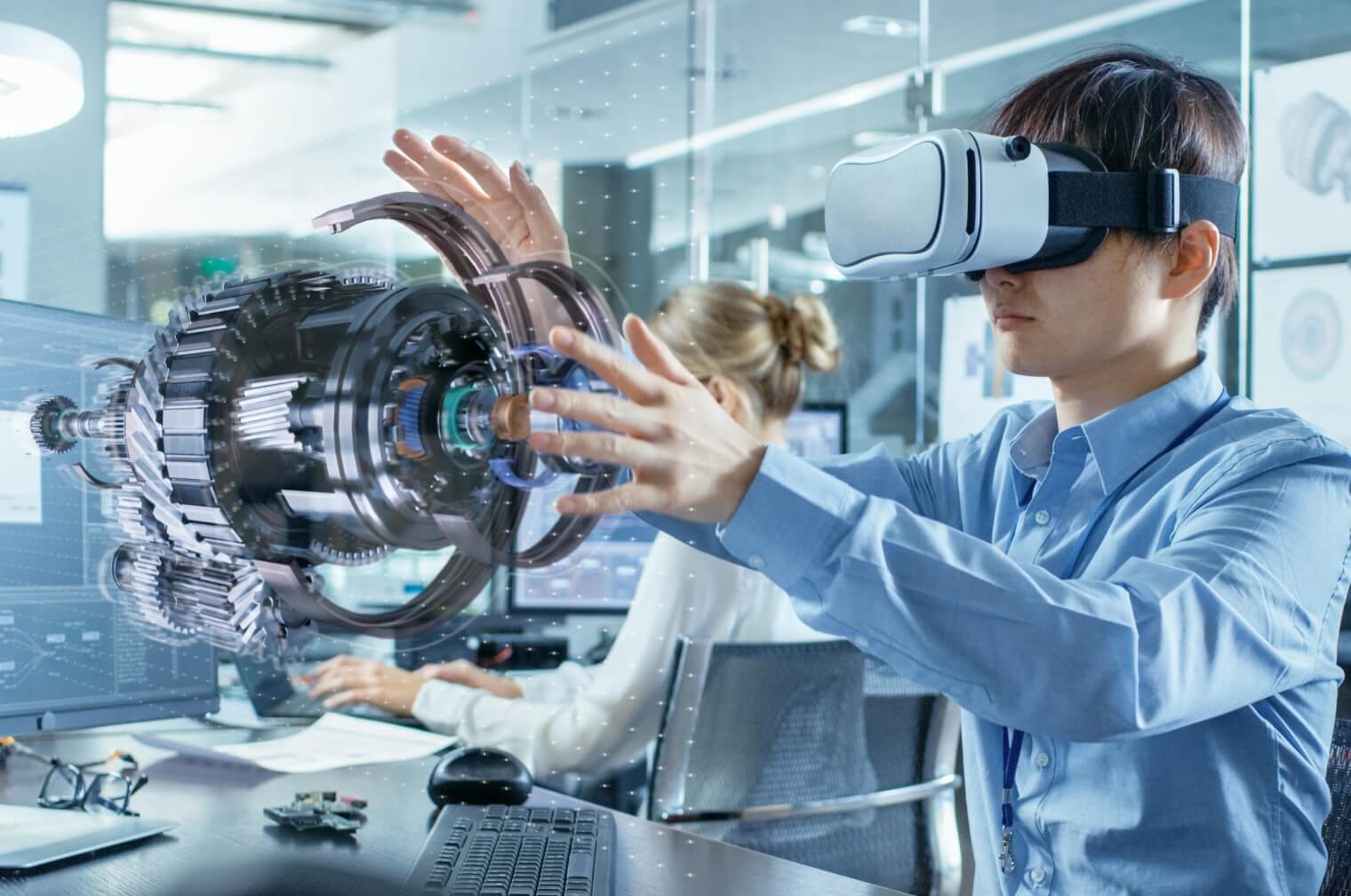
Today, Augmented Reality (AR) has emerged as one of the most significant futuristic technologies used across many industries, including engineering. The integration of augmented reality engineering solutions can unlock a realm of possibilities, fundamentally altering how professionals design, construct, and maintain various structures and systems.

AR overlays digital information onto the real world, enabling engineers to visualize and interact with their designs in a more immersive and intuitive way. This can help to improve the accuracy, efficiency, and safety of engineering projects.

Applications of AR in engineering

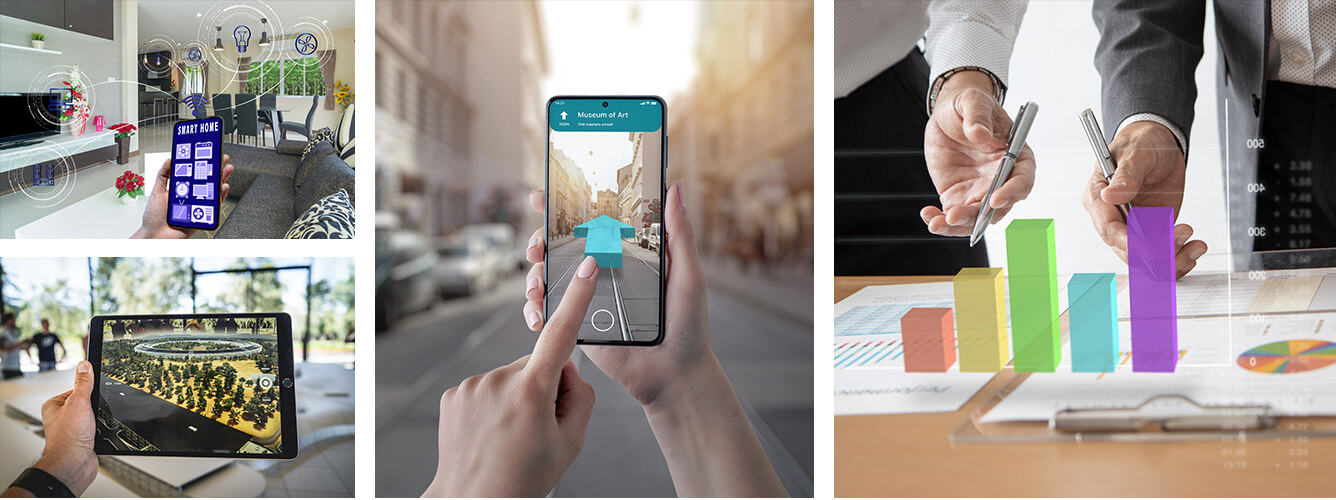
Augmented reality (AR) is being applied in a wide range of engineering fields, including architecture, manufacturing, and construction. By transforming traditional approaches and enhancing various fields, AR has made substantial strides in the engineering sector.

Let’s understand the role of AR in engineering:

Applications of AR in Engineering

Architecture

Augmented reality in engineering is revolutionizing the way blueprints and designs are visualized. Using AR applications, architects can overlay digital models onto physical spaces. This allows them to see how the design will look and feel in the actual space, and to make necessary adjustments before construction begins.

Such a visualization not only aids in improving the design process but also facilitates better communication with clients and stakeholders by providing them with a realistic preview of the final product.

For example, an architect can show a client how their new home will look on their property, or they can collaborate with engineers to ensure that the design is feasible and meets all applicable codes and standards.

Manufacturing

AR is optimizing assembly line processes in manufacturing industries. Through AR-powered engineering solutions, workers receive step-by-step visual guidance overlaid onto the physical work environment.

This guidance significantly reduces errors, enhances productivity, and accelerates the learning curve for new processes or machinery. Workers can access critical information in real-time, ensuring accuracy in complex assembly tasks.

Construction

AR can be used to visualize the layout of construction sites. This can help to improve the efficiency of construction operations and to reduce the risk of errors. By using AR, engineers and workers can detect potential safety risks, such as underground utilities or structural weaknesses, before initiating construction.

This proactive approach not only minimizes risks but also ensures a safer working environment for on-site workers, significantly reducing accidents and project delays. AR can also be used to train workers in new construction techniques.

Training and education

Today, a large number of companies are leveraging AR to enhance training and education for engineers, For instance:

Boeing utilizes AR technology to train aircraft mechanics, offering digital experiences on wiring and repairing airplanes.

Siemens employs AR to train factory workers, guiding them through the assembly of complex machines with step-by-step interactive instructions.

Autodesk incorporates AR to educate students on engineering concepts, such as thermodynamics and fluid mechanics, providing an interactive learning environment.

Big brands led engineering innovation with AR

Let’s explore how leading brands have embraced AR, revolutionizing their engineering processes:

BMW: visualizing prototypes with precision

This popular automobile brand has integrated augmented reality software with its product data management system. This integration allows them to visualize and interact with true-to-scale prototypes, offering an in-depth understanding before finalizing designs for manufacturing.

BASF: leveraging digital twin technology for on-site precision

BASF has adopted augmented reality engineering solutions, through the implementation of digital twins. Engineers at BASF use AR to visualize planned pipelines on-site, ensuring accurate assessments of their intended functionality. AR aids in on-site monitoring, enabling swift identification of any design faults before they escalate into larger problems.

Lockheed Martin: enhancing aircraft assembly with ar integration

This global aerospace and defense company has embraced augmented reality to optimize its aircraft assembly processes. By integrating AR technology into their assembly lines, they can overlay digital schematics and instructions onto physical aircraft components in real time. This innovative approach reduces the likelihood of errors and improves overall efficiency while resulting in substantial cost savings.

Implementing an augmented reality engineering solution

The process of implementing an augmented reality engineering solution typically involves the following steps:

  • Identify the specific engineering needs and goals for the business or project. What are the specific challenges that the business or project is facing? How can AR be used to address these challenges?
  • Choose the right AR platform and hardware. There are a variety of AR platforms and hardware devices available on the market. It is important to choose the right platform and hardware for the specific needs of the business or project.
  • Develop or customize the AR solution. Partner with a reputable AR solutions provider company like ViitorCloud to build a custom AR engineering solution.
  • Deploy and train your workforce on the AR solution. Once the AR solution is developed, the users need to be trained on how to use it.

Starting augmented reality development

If you are considering implementing an augmented reality engineering solution, there are many companies like ViitorCloud that offer AR development services.

In the engineering field, AR is being used to revolutionize design, manufacturing, construction, and training processes. Engineers are increasingly leveraging AR to innovate and enhance their processes, leading to more efficient and effective solutions.

Conclusion

As the tech landscape continues to evolve, the future of engineering through AR presents an unparalleled horizon of possibilities. AR is not just a futuristic concept but a present-day reality shaping how engineers design, build, and innovate. ViitorCloud is at the forefront of this AR-led innovation in the field of engineering.

If you are looking for ways to improve the efficiency, accuracy, and safety of your engineering projects, consider building a custom augmented reality engineering solution that addresses these needs. Choose ViitorCloud as your partner for AR integration in engineering and embrace the future today!

Frequently asked questions

Augmented reality in engineering is revolutionizing designs, simulations, and safety assessments across the industry, transforming the way engineers visualize and interact with complex structures.

Applications of AR in engineering significantly enhance efficiency, accuracy, and safety, propelling the industry toward innovative solutions and streamlined processes.

Augmented reality in engineering optimizes processes by offering step-by-step visual guidance, reducing errors in complex assembly tasks, and improving overall productivity.

Applications or AR in engineering span across diverse sectors, from architecture to manufacturing and construction.

Engineers can get started with augmented reality by using existing AR platforms and hardware, or by developing their own AR applications.

How augmented reality travel solutions are changing the tourism industry?

The tourism industry is one of the largest and most dynamic economic sectors in the world. Technology has always played an important role in the industry, helping to make travel more convenient, affordable, and accessible. One of the most promising new technologies for travel is augmented reality travel solutions.

Augmented reality for tourists is revolutionizing the way travelers explore new destinations, offering immersive and interactive experiences that go beyond traditional guidebooks. In this blog, we will delve into the world of innovative AR travel solutions, uncovering the endless possibilities they offer to both travelers and businesses.

What is augmented reality (AR) in travel?

Augmented reality in travel industry refers to the integration of digital information into the real-world travel experience. Through the use of AR-enabled devices such as smartphones or smart glasses, travelers can overlay virtual elements onto their physical surroundings, creating an enhanced and immersive travel experience.

Whether it’s exploring historical landmarks, discovering hidden gems, or accessing real-time information, augmented reality travel app development helps elevate the way we interact with destinations.

How AR works in travel applications

AR in travel applications utilizes the capabilities of smartphones, tablets, smart glasses, or headsets to deliver AR experiences. These devices are equipped with cameras, sensors, and GPS, enabling them to detect the user’s location and orientation in real-time.

Here’s how augmented reality travel apps are used:

  • Real-time Object Recognition: By analyzing the visual data from the device’s camera, AR technology can identify specific objects and trigger virtual content associated with them.
  • Digital Overlays: Once the real-world object is recognized, AR overlays digital information onto the user’s view.
  • Interactive Elements: AR allows users to interact with the virtual elements overlaid on their physical environment.
  • Real-time Data Integration: AR can integrate real-time data into the user’s view, enriching their travel experience.

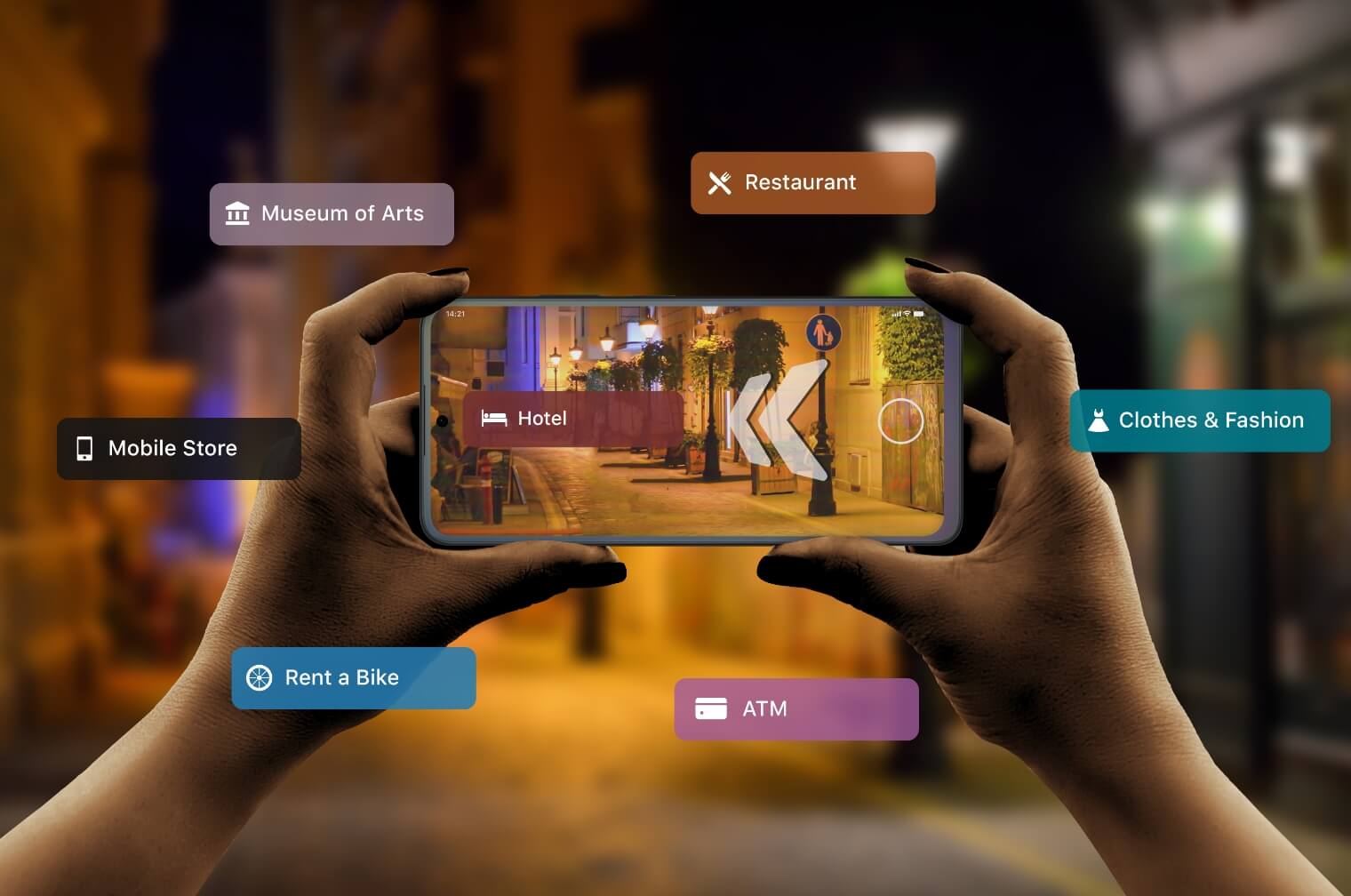
Travel businesses can unlock a new dimension of exploration with augmented reality travel solutions, providing real-time information and interactive experiences at their fingertips. 

Applications of augmented reality for travel industry

Technology’s constant evolution is reshaping how we experience the world. In the travel industry, augmented reality (AR) is a game-changer, crafting innovative digital experiences that elevate your journeys.

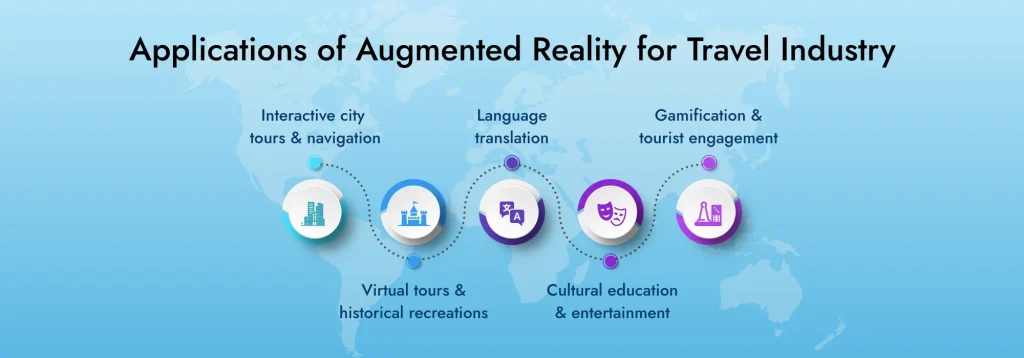
Applications of Augmented Reality for Travel Industry

Here are some of the key applications of AR in travel:

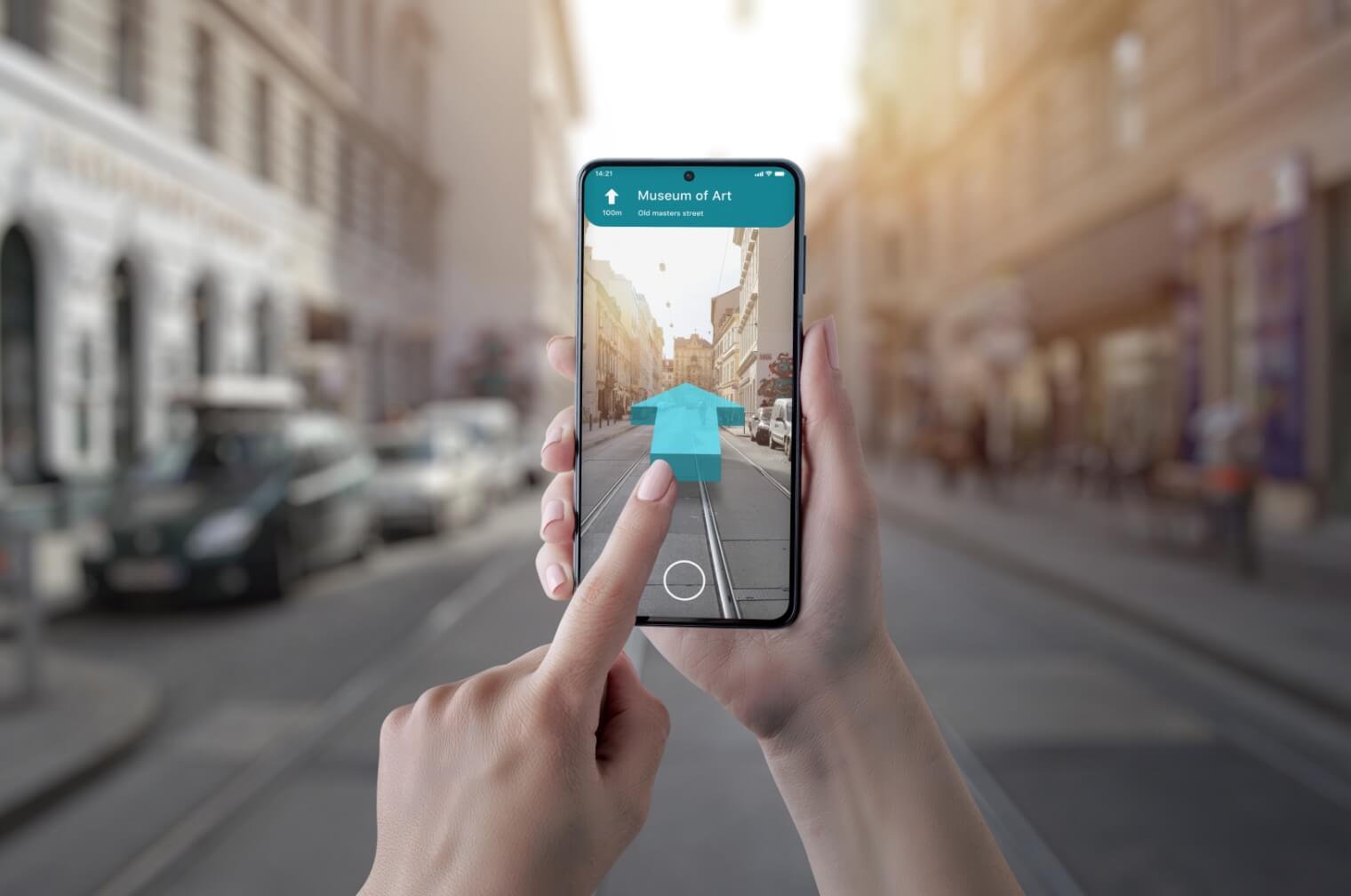
  1. Interactive city tours and navigation: AR apps can be used to help travelers to navigate unfamiliar cities and find their way around.
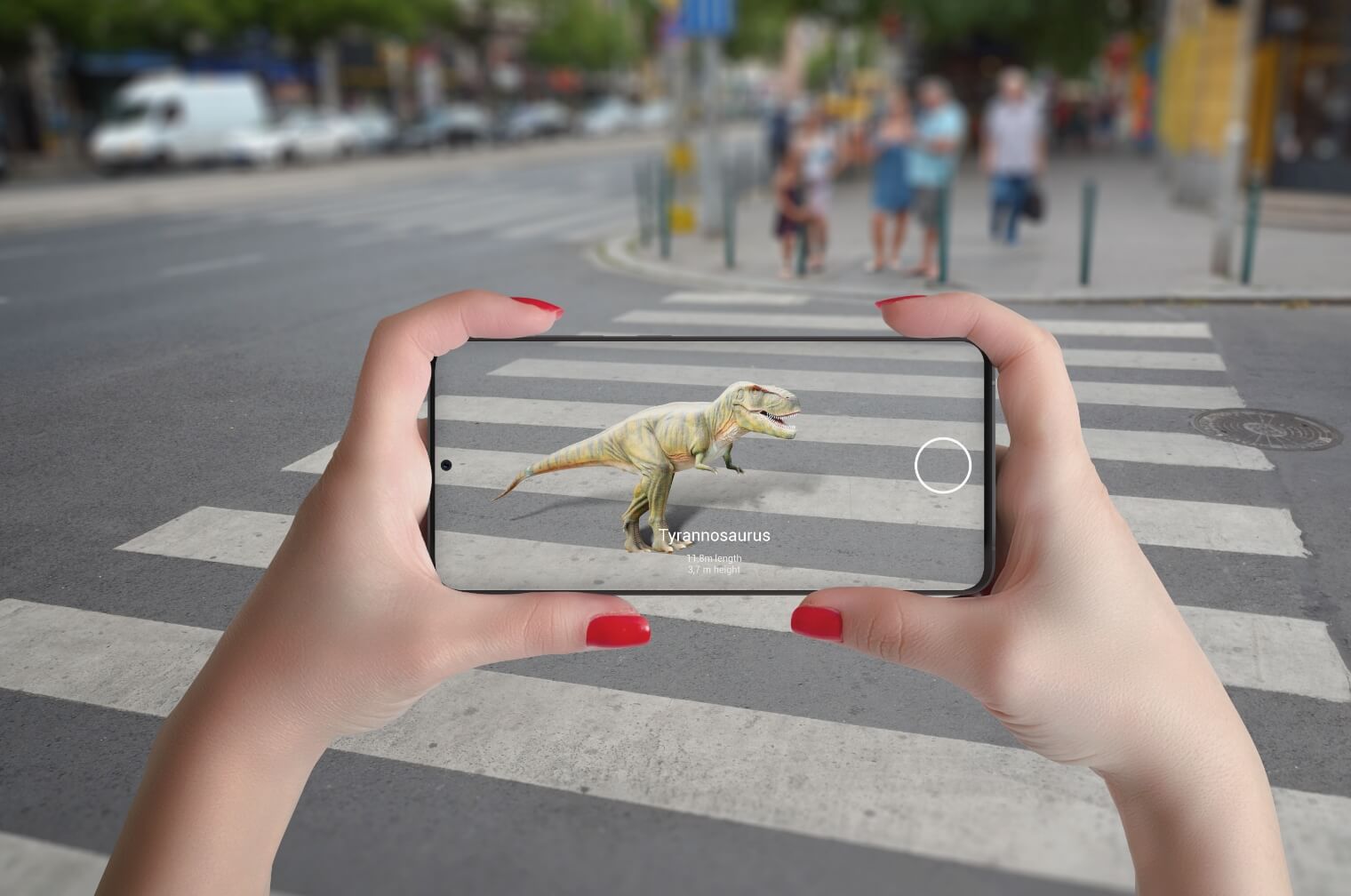
  2. Virtual tours and historical recreations: It can be used to transport travelers back in time or to visit places that are inaccessible or no longer exist.
  3. Language translation: It can be used to translate text and spoken language in real time, helping travelers to communicate with locals and overcome language barriers.
  4. Cultural education and entertainment: It can be used to create engaging and interactive educational experiences that teach travelers about different cultures and histories.
  5. Gamification and tourist engagement: It can be used to create fun and interactive games and experiences that can engage travelers and make exploring new places more enjoyable.

These augmented reality tourism trends redefine the way we explore, making travel an immersive and revolutionary experience.

Challenges and limitations of AR navigation in travel

Here is a table that discusses the challenges and limitations of augmented reality navigation in travel, as well as how businesses can overcome these challenges:

ChallengeLimitationHow to Overcome
Hardware LimitationsAugmented reality heavily relies on hardware such as AR glasses or smartphones with advanced capabilities, limiting accessibility for some travelers.Develop applications that are compatible with a wide range of devices, optimizing performance for various specifications to reach a larger user base.
Accuracy and ReliabilityAR navigation accuracy can be affected by factors like GPS signal accuracy, environmental interference, and technical limitations, leading to potential misguidance.Employ multiple sensors and technologies for better location accuracy. Integrate machine learning to improve location and direction accuracy over time.
Data Privacy and SecurityAR apps collecting location data raise concerns about user privacy and potential security vulnerabilities, impacting user trust and confidence.Allow users to control data sharing and offer clear opt-in/opt-out choices regarding location sharing.
User Experience ComplexityComplex user interfaces and overwhelming AR features can confuse or overwhelm users, hindering the adoption and ease of use for some travelers.Simplify user interfaces for intuitive navigation. Offer tutorials or onboarding sequences to guide users.  Implement user feedback mechanisms to refine and improve the app over time.

How to develop an AR travel app

AR travel apps are reshaping the way people navigate the world, offering immersive and personalized experiences. If you’re intrigued by the idea of creating your own augmented reality travel app, here is a step-by-step guide for you:

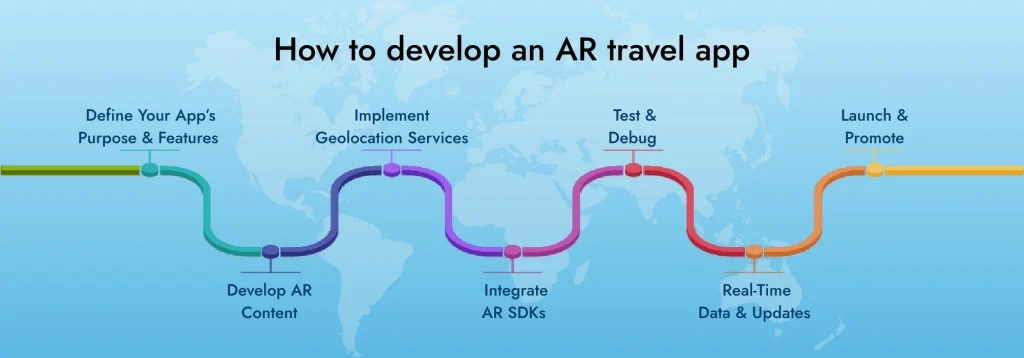
How to Develop an AR Travel App

Define your app’s purpose and features

Begin by identifying the primary goal of your augmented reality travel app. What unique value will it bring to users? Clearly defining your app’s purpose is the first and crucial step.

Develop AR content

This step involves creating the AR content that will be superimposed onto the real world. It may include 3D models, geolocation data, historical information, or any content relevant to your app’s purpose.

Implement geolocation services

For location-based AR features, you’ll need to integrate geolocation services. This allows your app to recognize the user’s position and provide context-aware information.

Integrate augmented reality SDKs

Incorporate the chosen AR development tools and SDKs into your app’s architecture. This will enable your app to recognize real-world objects and augment them with digital information.

Test and debug

Thoroughly test your app on various devices to ensure its functionality, stability, and performance. Address any bugs, glitches, or compatibility issues that arise during testing.

Real-time data and updates

Keep your app current by providing real-time data, updates on attractions, events, and travel-related information. Ensure that your content remains fresh and relevant.

Launch and promote

Once your augmented reality travel app is fully developed and thoroughly tested, launch it on the app stores. Promote it across marketing channels.

Are you ready to experience the future of travel with our cutting-edge augmented reality travel solution, seamlessly guiding you through unfamiliar destinations? At ViitorCloud, we specialize in creating immersive augmented reality solutions. Our expert team can help turn your vision of an AR travel app into reality.

Real-world examples of augmented reality travel solutions

Augmented reality travel solutions elevate your travel experience, by turning every step into a captivating story through interactive digital overlays. Here are some examples of travel businesses that have successfully implemented augmented reality navigation solutions:

  1. GuideAR is an app that provides users with real-time directions, turn-by-turn navigation, and information about nearby points of interest.
  2. Timelooper app allows users to explore the history of famous landmarks and locations, while the app AR Walking Tours provides virtual tours of popular tourist destinations.
  3. The app AR Museums allows users to scan artifacts and paintings to learn more about them, while the app AR Interactive History provides augmented reality experiences at historical sites.

To wrap up

Augmented reality navigation is revolutionizing the travel industry, offering innovative solutions that enrich the travel experience. Collaborating with AR app development experts like ViitorCloud opens the door to unlocking the full potential of this innovative technology for the travel industry.

From immersive virtual tours and seamless navigation to cultural insights, the potential for augmented reality in travel is vast. As this technology continues to shape the future of exploration, it’s imperative for travel businesses to harness these advancements. Partner with us and revolutionize your itinerary planning with our augmented reality travel solution, offering detailed insights and engaging visual aids for a memorable trip.

Frequently asked questions

It is the integration of digital information and virtual elements into the real-world travel experience, enhancing exploration and providing interactive and immersive content.

It utilizes cameras, sensors, and GPS on AR-enabled devices to overlay digital directions and points of interest onto the user’s real-time view, guiding them through their surroundings.

They include advanced AR wearables, seamless integration with voice assistants, personalized recommendations, and AI-driven content generation.

By offering virtual tours, 360-degree experiences, and real-time information about attractions, accommodations, and transportation, helping travelers make informed decisions and visualize their itinerary.

AR ecommerce logistics development: the future is now

The eCommerce industry is growing exponentially, presenting challenges and opportunities for the logistics industry. In the digital world where speed and convenience are the two most important things, logistic companies constantly seek more efficient and innovative solutions to streamline their operations and enhance customer experiences. Here is when VR and AR eCommerce Logistics development comes into the picture.

Rise of virtual and augmented reality in e-commerce logistics

Virtual reality (VR) technology generates a computer-simulated environment, immersing users in a virtual realm usually via headsets or goggles. By substituting the physical world with a digital environment, VR endeavors to deliver a complete immersion digital experience service.

Augmented Reality (AR), on the other hand, overlays digital information onto the real-world environment. It enhances the physical world by adding a layer of virtual objects, images, or information onto the user’s view of the actual world. Simply put, AR does not replace the real world, as VR does, but it adds digital elements, offering a mix of the physical and virtual worlds.

Applications of Virtual Reality (VR) and Augmented Reality (AR) are no longer limited to the gaming and entertainment sector. These breakthrough technologies are making waves in almost every sector, and eCommerce logistics is no exception.

Both AR and VR have gained significant popularity in recent years. They can potentially address some of the key challenges witnessed in the eCommerce logistics sector. In this blog post, you will explore how AR and VR technology is benefiting the eCommerce logistics industry in a number of ways. Continue reading!

Applications of AR solutions for eCommerce logistics

AR technology is increasingly being adopted in eCommerce logistics for various benefits. Let’s explore what these 3d eCommerce development are.

Efficient order picking and packing

AR solutions can help optimize the process of order picking and packing in warehouses. AR-enabled smart glasses or mobile devices can overlay digital information onto the workers’ field of view and guide them on which items must be picked, in what quantity, and from which location.

So, basically, AR technology helps reduce picking time, enable fast shipment, and enhance the overall accuracy of the process. It can also be used to identify misplaced items in the warehouse, which ultimately helps in efficient inventory management.

Real-time inventory visualization and tracking

Warehouse managers can leverage AR interfaces to get real-time insights into inventory location, movement patterns and levels. AR can help you overlay digital labels onto all physical items, enabling you to track all product information easily and accurately.

Leveraging augmented reality in logistics will help you monitor stock movement and identify low stock levels more effectively. If there is any discrepancy in inventory management, the AR solution will help you spot it more quickly.

Improving last-mile delivery

Last-mile delivery us a significant part of eCommerce logistics, and AR assistance can help improve it in a number of ways, including:

Route optimization: Augment reality logistics can help delivery drivers find the most efficient routes to their destinations, considering factors such as traffic conditions, weather, and delivery windows. This can help save a good amount of time and fuel.

Navigation: AR navigation solutions provide turn-by-turn directions and highlight potential hazards or obstacles on the road. This helps drivers make informed decisions and choose the best routes to optimize delivery time and minimize fuel consumption. This helps reduce the chances of missed or failed deliveries.

Proof of delivery: AR devices can be used to capture digital signatures and photos of deliveries, proving that the package was delivered to the correct person at the correct time. This provides an indisputable record of successful delivery and assists in resolving any delivery-related disputes.

Customer communication: The AR interface can be used to communicate with customers about the delivery status, tracking information, and estimated delivery time of products. This can help to improve customer satisfaction and reduce the number of customer service inquiries.

AR eCommerce Logistics development is playing a vital role in streamlining supply chain management processes in this industry. By providing real-time information and enhancing navigation capabilities, AR solutions optimize route planning, navigation, and last-mile delivery.

Virtual try-on and product visualization

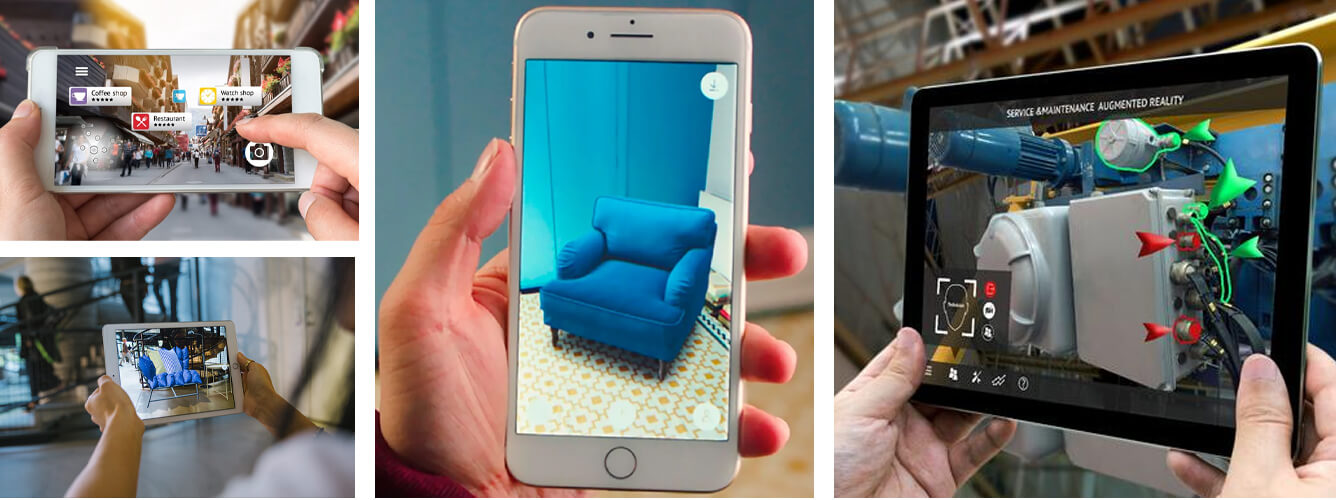
Investing in AR application development enables customers to try on products virtually and visualize them in real life. By using AR applications on their mobile devices, customers can overlay virtual images of products onto themselves and visualize how they would look or fit.

This virtual try-on feature is more valuable for industries such as fashion, eyewear, and cosmetics, where customers can visualize how clothing items, eyeglasses, or makeup products would appear on them before making a purchase. This feature reduces the need for physical try-ons, increases customer confidence, and reduces the possibility of product returns.

AR-enabled product information and reviews

This AR-enabled product information and reviews enhance the overall customer experience, reduce information asymmetry, and increase customer satisfaction. Customers can access detailed product specifications, user reviews, and ratings by scanning product labels or codes using AR applications.

AR overlays this information onto the physical product or displays it through the AR interface, allowing customers to make more informed purchasing decisions. They can learn about product features, compare different options, and read reviews without the need to search for information on separate websites or platforms.

VR advancements in AR eCommerce logistics development

There are several ways VR technology is reshaping the realm of ecommerce logistics. Let’s understand it in detail.

VR-based training and simulation for warehouse operations

One of the key applications of VR in e-commerce logistics is providing warehouse workers with immersive training and simulation experiences. With VR-based training, warehouse employees can practice order picking, packing, and inventory management tasks within a safe and controlled setting of the virtual world. Such training sessions help improve their skills, reduce errors, and enhance overall productivity.

Additionally, VR-driven simulations enable employees to familiarize themselves with complex machinery and equipment. They can learn how to operate forklifts, automated picking systems, and other warehouse technologies without the risk of accidents or damage to inventory.

Virtual layout planning and optimization

This is another application of VR in warehousing and fulfillment centers. Designing an efficient and ergonomic warehouse layout can involve factors such as product placement, picking routes, and storage capacity.

Using VR for eCommerce logistics enables businesses to visualize and simulate different layout configurations before implementing them physically. Warehouse managers can create virtual representations of their facilities and test various layouts to identify the most optimal arrangement.

VR solutions for supply chain visualization and analysis

In addition to its applications in warehousing, Virtual reality logistics is also harnessed to enhance supply chain visualization and analysis. Ecommerce businesses can leverage immersive VR environments to represent various supply chain metrics, such as inventory levels, transportation routes, and demand patterns.

VR for supply chain management facilitates a deeper understanding of the data, enabling decision-makers to identify trends, bottlenecks, and opportunities in the supply chain network.

By visualizing data more intuitively and interactively, organizations can make data-driven decisions more effectively, improving operational efficiency and responsiveness.

VR-based predictive analytics for demand forecasting

One of the biggest challenges for eCommerce businesses is accurately forecasting demand. This helps in inventory management as well as in supply chain optimization. VR-based predictive analytics leverages advanced AI algorithms and machine learning techniques to analyze historical data, market trends, and other relevant factors to forecast future demand patterns of the stocks.

VR for eCommerce logistics enables decision-makers to interact with demand forecasts more intuitive and immersive. They can explore different scenarios, simulate the impact of various factors on demand, and make informed decisions based on the insights provided by VR solutions.

Virtual showrooms and immersive shopping experiences

Virtual showrooms enable customers to explore and interact with products in a virtual environment, providing a more engaging and realistic shopping experience. Customers can visualize products in 3D, examine them from different angles, and even try them virtually before purchasing. VR-powered virtual showrooms help bridge the gap between online and offline shopping experiences, enhancing customer satisfaction and reducing the likelihood of returns.

Moreover, virtual showrooms can be customized based on individual customer preferences. By collecting and analyzing customer data, businesses can create virtual environments that showcase relevant products, recommend complementary items, and tailor the shopping experience to each customer’s preferences and needs.

Intelligent virtual assistants and chatbots

VR-driven virtual assistants and chatbots offer a new level of customer support and engagement. By integrating VR technology into chatbot interfaces, businesses can create virtual assistants capable of guiding customers through their shopping journey, answering queries, and providing personalized recommendations.

These virtual assistants can offer more interactive and immersive interactions with customers. They can showcase product features, provide demonstrations, and even simulate how products look and function in real-world settings. This enhances customer engagement and improves overall customer satisfaction.

Real-world examples: AR and VR-powered e-commerce logistics

In recent years, many companies have successfully implemented AR and VR solutions to revolutionize various aspects of their supply chain operations and enhance the overall customer experience. Let’s explore some real-world examples of how AR and VR are powering e-commerce logistics:

  • Amazon: One of the world’s largest e-commerce giants, Amazon, has implemented AR in its warehouses to improve order-picking efficiency. Workers wear AR glasses that display information about the items they need to pick, helping them locate and pack items more quickly and accurately. The company also uses AR to help its delivery drivers find the correct addresses in dense urban areas. They also use VR to train their warehouse workers to pick and pack orders.
  • IKEA: They have embraced both VR and AR solutions for eCommerce logistics. The IKEA Place app allows users to visualize how furniture will look in their homes before purchasing. And their VR experience app allows users to browse product catalogs and explore a virtual home in 3D where they can see how different products will look. These applications enhance the customer experience and reduce the likelihood of returns.
  • Walmart: The company’s AR app helps product delivery drivers navigate dense city areas; it provides directions to the specific apartment unit where they need to deliver the package.
  • FedEx: They use VR to train their employees for various tasks, including package handling, customer service, and safety. The company’s VR training program helps employees learn new skills and procedures in a safe and immersive environment.
  • L’Oreal: This global cosmetics brand has integrated AR into its e-commerce strategy. They offer virtual try-on experiences, allowing customers to test makeup products through their smartphones or computers before purchasing. This not only boosts customer engagement but also reduces the number of returns.
  • Lowe’s: The home improvement retailer employs AR in its stores to assist customers in finding products. The Lowe’s Vision app uses AR to guide customers to the location of items on their shopping lists, making the shopping experience more convenient.
  • UPS: They use AR to help their delivery drivers capture digital signatures and photos of deliveries. The company’s AR app allows drivers to scan a QR code on the customer’s smartphone to capture their signature and then take a photo of the package at the delivery location.

Future trends and innovations in AR and VR for eCommerce logistics

As augmented reality (AR) and virtual reality (VR) technologies continue to evolve, the potential for their application in eCommerce logistics is expanding. Looking ahead, here are some future trends that we can expect to see in this domain:

  • More immersive experiences: As AR and VR hardware and software continue to improve, we can expect to see more immersive and lifelike experiences for eCommerce logistics. This will allow customers to have a more accurate understanding of products and services before they buy them.
  • Wider adoption: We can expect to see more eCommerce businesses adopt these technologies. This will lead to a wider range of AR/VR applications in eCommerce logistics, such as virtual showrooms, AR-guided picking and packing, and VR-powered delivery drones.
  • More innovative solutions: As these immersive technologies continue to develop, we can expect to see new applications emerge in this space. For example, we may see AR/VR used to create virtual warehouses that can be used to store and manage inventory more efficiently. VR can be used to develop autonomous delivery drones that can navigate and deliver packages without the need for a human driver. This could revolutionize last-mile delivery.

Final thoughts

All the real-world examples and applications of AR and VR in the eCommerce logistics sector make it evident that these immersive technologies are transforming this niche from warehouse management and order fulfillment to customer experience and last-mile delivery.

These eCommerce AR advancements and VR-powered logistics will continue to redefine how the supply chain operates, making them more efficient, cost-effective, and customer-centric. Want to harness the power of VR and AR eCommerce Logistics development? Book a free consultation with our tech experts NOW!

Frequently asked questions

What are the future trends in AR for e-commerce logistics?

Future trends in the niche of AR eCommerce Logistics development include more immersive AR experiences, innovative AR applications, and wider adoption of this groundbreaking technology by eCommerce businesses.

How is AR being used in e-commerce logistics today?

Ecommerce businesses primarily use AR to improve customer experiences, optimize supply chain operations, and train workers.

How to use AR in eCommerce?

To use AR solutions for eCommerce logistics, integrate AR technology into product visualization, allow customers to virtually try products, and implement AR overlays for real-time product information and interactive shopping experiences.

Beyond imagination: How Augmented Reality is reshaping our world?

Augmented Reality is a technology that enhances reality by weaving real world with computer-generated perception and gives user an interactive experience by augmenting reality. Once installed it requires near zero guidance. Today, it’s being used in varied fields- advertisement, entertainment, consumer-friendly business frameworks and exercise etc. Augmented Reality start-ups are projected to touch more than a billion in a few years.

Ever sent a snap using filters on your photo? Yes! Congratulations you have successfully used Augmented Reality. Everyone’s talking about Augmented Reality today. It seems like some rocket science but it is not. Snapchat filters, Pokemon Go etc have all used AR to enhance user digital experience. Let’s understand AR further:

Evolution of Augmented Reality

It was developed by the “Father of Graphics”, Sutherland in the year 1968 and since then it has made its presence in every possible field. Augmented Reality became popular amongst advertising agencies specifically in Germany. Gradually the technology was adopted by companies like National Geography and Disney. In its next phase, AR brought revolution in customer’s experience by introducing the concept of “Try-On”. From watch to jewellery to house architecture, it provides “real” feel and hence definitely enhances user-experience. Now, it’s also being used in museums to bring alive the streets that are 1000s years old. Augmented reality thus, brings alive the past, enhances the present and shows the future!

Working of Augmented Reality

  1. Capturing the reality: First of all, one needs to have equipment like camera or sensors to capture the reality. Better quality camera provides better Augmented Reality as there is better depth information.
  2. Processing of data: As actual reality is being enhanced in AR therefore, one needs to process a lot of parameters such as depth, speed, position etc. With the advancement of technology this has become an easy task for our existing hardware structures such as- our smart phones.
  3. Layering: After capturing and processing of data. Layers of information are added to create an immersive experience.
image

Applications of Augmented Reality

Industries today have realised that the opportunities provided by AR are difficult to achieve using other technologies. AR is steadily forming roots in different industries today.

  1. Healthcare: AR is proving to be a life-saving and life-easing technology for patients and doctors. It is being used to train new doctors. It helps nurses find veins easily for inserting IV. A company NuEyes has developed AR glasses to help blind children see well enough to read and recognise people.
  2. Education: Augmented Reality can revolutionise education by making it an interactive experience for students. For example, in subjects like Geography– explaining core of the Earth or vastness of the space becomes interesting. It also improves retention of knowledge in students. Not only this but AR Flash Cards can be used for younger kids to show them “A for Aeroplane”. This is definitely the future of education.
  3. Training: AR has become an important tool for Human Resource Managers for onboarding and training of employees. It not only increases efficiency of training but also reduces its duration. It can help to practice tasks, re-skill, up-skill and guide employees so that they learn at their own pace.
  4. Tours and travel: It is increasingly being used to provide additional authentic information about the landmarks, paintings in a museum, historic buildings etc in one’s own language. It also provides guidance at places like Airports.
  5. Entertainment: Before buying tickets for a stadium or a theatre you can have a 3D view of actual seat position vis-a-vis stadium or theatre, Thanks to AR. Many sports leagues are using this technique for enhancing their user-experience and also to show statistics of the game, parameters such as speed of the ball etc in real time.

Real world examples of Augmented Reality

  1. Ikea Place app: It allows user to scan the room or the house for which furniture is to be bought and hence aids in the choice of color and design using this new interactive environment.
  2. Sephora’s Virtual Artist / Lenskart: It uses AR technology to help users try the product without actually buying them and making an informed choice. Starbucks is set to open an immersive coffee wonderland.
  3. Pokemon Go: An AR game wherein there is imposition of digital pokemon in the real world gained immense popularity.

What is the difference between AR and VR?

The fundamental difference between the two is that Virtual reality is set in a virtual world whereas Augmented reality is set in the real world, enhancing the actual events. Virtual reality requires specific equipment such as VR headsets, glasses, controllers etc whereas Augmented Reality requires simple hardware such as a smart phone. Virtual reality fabricates entire world using heavy graphics and giving out of the world experiences to the user whereas Augmented Reality only adds new information to the existing real world.

Future of AR

The industry of Augmented Reality and the Virtual Reality are a high yielding industry set to reach $25 Billion in the coming years. No sector will remain untouched by these technologies. Healthcare sector alone will gain more than $5 billion by the year 2025. It will also boom the employment sector providing millions of jobs in these fields. According to Statista, the AR market size will touch over 198 billion U.S. dollars by the year 2025. AR is the future and it is here to stay.

Conclusion

Looking at the applications of Augmented Reality in today’s world, it can be said that it is still in the stage of “infancy” because of the enormous potential that is yet to be explored. It is definitely a tool to improve standard of living, enhance entertainment experience and revolutionise work places and consumer-experience. With the advancement in technology and more research in the field we will see the true potential of Augmented Reality but at the same time we need to strengthen our privacy framework so that the “boon” provided by AR does not turn into “bane”.

5 ways augmented reality can step-up your marketing game

We all know that Augmented Reality (AR) is a buzzword these days; however, is it effective? Are marketers focusing on this new shiny technology? Indeed AR is an innovative technology that has proven to be a valuable, profitable, and effective marketing tool. Marketers are using AR technology for several good reasons, and here you will know the reasons.​

Deloitte found that about 90% of enterprises with an annual turnover of $100 million to $1 billion have started using AR or VR technology.

Generally, AR is connected with cranial, ultra-futuristic displays, as we have seen in movies like The Terminator. But, more aware of hardware is indeed where we see the notion of AR heading.

The mix of information-heavy and mobile computing and user-generated services has built a robust background for new AR applications that presumes the boundaries on what potential and possibilities we thought.

The growth of mobile computing and microprocessors has completely transformed AR from a tech fiction pipedream to crucial technology.

According to The Drum reports, Augmented Reality can grab people’s attention for more than 85 seconds, increase click-through rates to purchase by 33%, and improve interaction rates by 20%.

It is not a big deal if we say that businesses have realized the potential of AR as a strong marketing tool. The early adopters of technology can bring profits and revenue to their business in less time.

Also, Purch conducted a pool for smaller firms, which discloses that 10% of the marketers are using AR technology while 72% are already planning to use it in the future.

AR has become a brand differentiator as it has made your brand unique and stable for a long time. IT has offered lots of convenience and a new level of speed with enhanced brand impressions.

image

Let’s check how Augmented Reality helps you in marketing your business:

Focus on core business strategy According to Markets and Markets research, the AR marker is predicted to achieve $117.4 billion by 2022. Irrespective of the medium you prefer, it is vital that the brand’s strategy and messaging always top your considerations in any advertising or marketing campaign. It shows that marketers should stay steady and innovative when it comes to bringing augmented reality into the role. Therefore, you must be focused on promoting the unmatched value of the product/service instead of the cool & latest effect.

Localized promotion

Localized promotional bring huge profit opportunities to your business & build stimulation of their potential clients in localized vicinity. You can turn lots of ideas into reality that’ll be dedicated to what your clients often do around you and their searching pattern. The tourism industry is gaining huge benefits from it.

Product placements

In highly dense areas, businesses spend a significant amount on marketing and promotional activities; however, with AR, the brands are getting new trends and means of marketing for their users. Thus, it has become essential for big brands to become a part of such innovative technology experiences in the augmented or virtual worlds. AR has offered several new ways of marketing.

Allow customers to see products in real-time

The introduction of AR technology and tools supported the eCommerce industry in different ways. As customers, you can get the chance to try the products before you buy them; it offers a highly intuitive experience to users and improves conversion rates. It also assists businesses to improve their service quality, and customer experience, improve products’ visibility and increase your business revenue. Companies like Lego and IKEA have followed AR in their business and have achieved tremendous success. Using AR in your eCommerce business can also help you create a bridge between your customers and the eCommerce platform.

Creating a whisper around your brand

AR can serve as a valuable asset, both directly and indirectly, within your online marketing strategy. Whether you’re debuting a new product or not, leveraging augmented reality technology can amplify your brand’s visibility and credibility among your desired audience. By delivering an immersive digital experience to your users, you can generate substantial excitement surrounding your startup or new brand. Utilizing AR has the potential to provide customers with a memorable encounter with your brand.

    Finally, we can say that augmented reality is playing a crucial role in transforming ways of marketing for businesses. With rapidly increasing users of tablets and smartphones, the technology is revolutionizing in a required a compelling way.
    Superior software, robust apps, and superfast bandwidth are indeed going to build new wonders in different kinds of AR solutions. The motto of AR companies is to bring customers’ attention and retain their engagement with this fascinating technology which can be ultimately utilized to build zestful marketing campaigns.

    An overview into the augmented reality cloud: unleashing a digital revolution

    An Augmented Reality (AR) cloud is a technology that tends to build immersive and highly intuitive experiences by unifying digital and physical worlds. Moreover, it can also be termed a spatial or real-time 3D map paved onto the real world.

    AR Cloud allows experiences and information to be shared, tied or augmented to specific physical locations to persist and occur across devices and apps. In the near future, companies will develop custom versions that will enable them to advertise their unmatched approaches and features effortlessly.

    In Reality, they will do the same things: upload and connect data in the cloud to intelligent and handheld devices that will enable AR devices to become an easy gateway for new avatars in this domain of Reality overlaid with interactive virtual information.

    According to Statista, “The majority of users (about 43%) will come from gaming and entertainment domain; however, significant services including engineering 14% and healthcare, i.e., 15% are striking AR market fast.

    Ar cloud has emerged as one of the widely used amalgamations of existing processes and technologies, including:

    1. Edge Computing, & 5G Connectivity, IoT   Expectations of people for internet speed have increased with the intervention of 5G technology. Gigabit connectivity is not easy to offer data nearly to the intelligent edge of the existing network where several data processing and computation must occur.
    2. Industrial Manufacturing Augmented Reality has several use cases for manufacturing industries. AR wearable assists technicians to measure changes, identify unsafe conditions, review information related to industrial functions in real-time. Google Glass Enterprise Edition provides AR-enabled solutions in healthcare, manufacturing, logistics and more industries.
    3. Digital-first Business Models Many retail organizations will need to include augmented Reality and adapt the business model’s capabilities to their offered services. A seamless and intuitive digital experience journey to a customer will be the base to provide a universal and real-time experience in the physical and digital world.
    4. Packaged Business Capabilities (PBC) PBC incorporates APIs, services, event channels, and data schema to provide intuitive and immersive business functionality without any external dependency. In addition, well-defined and structured capabilities are offered via technology to identify a particular business function.
    5. AR in Computer Vision Delivery of AR and data-intensive computation overlays will need more efficient and intelligent models, paving the clear path for the methods of Digital Twins and Advanced Computer Vision (two of the highly efficient and emerging technology trends as per Gartner reports).
    6. Healthcare AR will also impact the healthcare industry in conducting different medical processes in a precise manner. With the AR cloud, doctors and medical practitioners can also make models for several diseases like tumours, cancer and then make better decisions to treat or remove them. The handheld devices will work more efficiently and provide better results to reduce the risks.
    7. In-Store Marketing Supermarkets are growing at rocket speed and using AR for advertising. AR versions of celebrities and brand ambassadors could be approaching products at supermarkets in the future. AR technology assists in making marketing more efficient, cost-effective and profitable. These instances show the potential for AR cloud, yet they are still moderately separated experiences. All in all, even though they are collaborative, they exist autonomously with one another and are not a component of a comprehensive experience. Indeed AR cloud solutions offered by professional augmented reality development company will require an ecosystem system to convey scalable, persistent and collaborative experiences.
    image

    The future of AR cloud applications

    One of the significant issues in AR adaption is the lack of off-the-shelf and scalable solutions – despite all such solutions being built purposefully to solve a set of specific problems. AR cloud experiences will intensify all such hindrances in different manners by requiring scalability while being ubiquitous, collaborative, and persistent.

    By 2021, Gartner assumes AR cloud will be among the top four most useful immersive technologies.

    While AR cloud still needs time to reach the mainstream, tech professionals implement this in their business processes. For example, App Clips by Apple can be utilized as anchors for an AR cloud system. It is activated by pointing your phone’s camera at App Clip codes, NFC tags, or QR codes.

    Final words

    AR applications are intended towards getting tremendous growth in the future. Lots of other augmented reality applications will add more functionalities and features to improve their user experience.

    AR cloud technology will power up more businesses and assists them in creating next-generation applications. The AR cloud will allow users to access and interact easily with distinctive components of the Metaverse too.

    An Augmented Reality (AR) cloud is a technology that tends to build immersive and highly intuitive experiences by unifying digital and physical worlds. Moreover, it can also be termed a spatial or real-time 3D map paved onto the real world.

    AR Cloud allows experiences and information to be shared, tied or augmented to specific physical locations to persist and occur across devices and apps. Shortly, companies will develop custom versions that will enable them to advertise their unmatched approaches and features effortlessly.

    In Reality, they will do the same things: upload and connect data in the cloud to intelligent and handheld devices that will enable AR devices to become an easy gateway for new avatars in this domain of Reality overlaid with interactive virtual information.

    According to Statista, “The majority of users (about 43%) will come from gaming and entertainment domain; however, significant services including engineering 14% and healthcare, i.e., 15% are striking AR market fast.

    AR cloud has emerged as one of the widely used amalgamations of existing processes and technologies, including:

    1. Edge Computing, & 5G Connectivity, IoT   Expectations of people for internet speed have increased with the intervention of 5G technology. Gigabit connectivity is not easy to offer data nearly to the intelligent edge of the existing network where several data processing and computation must occur.
    2. Industrial Manufacturing Augmented Reality has several use cases for manufacturing industries. AR wearable assists technicians to measure changes, identify unsafe conditions, review information related to industrial functions in real-time. Google Glass Enterprise Edition provides AR-enabled solutions in healthcare, manufacturing, logistics and more industries.
    3. Digital-first Business Models Many retail organizations will need to include augmented Reality and adapt the business model’s capabilities to their offered services. A seamless and intuitive digital experience journey to a customer will be the base to provide a universal and real-time experience in the physical and digital world.
    4. Packaged Business Capabilities (PBC) PBC incorporates APIs, services, event channels, and data schema to provide intuitive and immersive business functionality without any external dependency. In addition, well-defined and structured capabilities are offered via technology to identify a particular business function.image
    5. AR in Computer Vision Delivery of AR and data-intensive computation overlays will need more efficient and intelligent models, paving the clear path for the methods of Digital Twins and Advanced Computer Vision (two of the highly efficient and emerging technology trends as per Gartner reports).
    6. Healthcare AR will also impact the healthcare industry in conducting different medical processes in a precise manner. With the AR cloud, doctors and medical practitioners can also make models for several diseases like tumours, cancer and then make better decisions to treat or remove them. The handheld devices will work more efficiently and provide better results to reduce the risks.
    7. In-Store Marketing Supermarkets are growing at rocket speed and using AR for advertising. AR versions of celebrities and brand ambassadors could be approaching products at supermarkets in the future. AR technology assists in making marketing more efficient, cost-effective and profitable. These instances show the potential for AR cloud, yet they are still moderately separated experiences. All in all, even though they are collaborative, they exist autonomously with one another and are not a component of a comprehensive experience. Indeed AR cloud solutions offered by professional augmented reality development company will require an ecosystem system to convey scalable, persistent and collaborative experiences.

    The future of AR cloud applications

    One of the significant issues in AR adaption is the lack of off-the-shelf and scalable solutions – despite all such solutions being built purposefully to solve a set of specific problems. AR cloud experiences will intensify all such hindrances in different manners by requiring scalability while being ubiquitous, collaborative, and persistent.

    By 2021, Gartner assumes AR cloud will be among the top four most useful immersive technologies.

    While AR cloud still needs time to reach the mainstream, tech professionals implement this in their business processes. For example, App Clips by Apple can be utilized as anchors for an AR cloud system. It is activated by pointing your phone’s camera at App Clip codes, NFC tags, or QR codes.

    Final words

    AR applications are intended towards getting tremendous growth in the future. Lots of other augmented reality applications will add more functionalities and features to improve their user experience.

    AR cloud technology will power up more businesses and assists them in creating next-generation applications. The AR cloud will allow users to access and interact easily with distinctive components of the Metaverse too.

    The benefits and potential of augmented reality revealed

    The billion-dollar industry, Augmented Reality (AR), has completely changed the way people interact with their physical environment. With an immersive user experience, AR has opened many possibilities for businesses across the world, irrespective of their niche and the services they offer.

    AR is enhancing information on multiple sensory devices. It is generally paired and used with artificial intelligence to assist businesses in enhancing their staff performance and cut costs.

    Augmented Reality is one of the best immersive and revolutionary technologies that superimpose virtual reality over the real world. Currently, augmented reality deals with live computer-originated imagery. However, it is a widely known technology utilized in different industries for a varied number of purposes.

    According to IDC, “AR/VR spending to increase $18.8 billion in 2020, a 78.5% increase. Also, IDC predicts that the lion’s share of this spending to be done in the commercial sector.

    Let’s check the benefits of Augmented Reality (AR):

    1. AR enhances customer experience As we can see, lots of companies are suffering from ROI, and they are continuously seeking to improve their condition. Here Augmented Reality can help you in enhancing your business performance and ROI. AR can be developed into mobile apps, it can be built into the products like automobiles, or it can also involve Magi Leap Googles or HoloLens. A big list of companies using AR in their business processes and products to enhance customer experience, workplace training, attract customers to purchase products, and an interactive and immersive experience. Lots of studies show that more companies will use AR and leverage its benefits with an Augmented Reality development company.
    2. Technology is noticeable as well as unique Today customers are seeking differentiation and convenience – which is where AR can assist you. There is no need to have a specific business background to implement AR and enter the market. Indeed, there are many technologies and tools available to assist you in surprising your customers; however, using a buzzing technology like AR is advantageous in different manners. AR helps you give something unique and noticeable that your competitors don’t have yet. When you use AR, you take a step ahead in the success of your business. It is better to offer a unique customer experience and get attention from them by using AR.
    3. Improve user engagement What is brand popularity? What do you think about user engagement in your business products and services? Initially, AR was largely used for the gaming and entertainment industry; however, it has expanded its width to more industries with the changing time and supporting them in different ways. As a result, AR is continuously improving user engagement and enhancing your ROI. According to a study, “In the year 2020, 83.1 million US consumers were using AR on a monthly basis. Store signage, scannable product labels, interactive ads, and others are some of the ways AR is helping you increase user engagement. In addition, AR delivers information in a snackable and quick way to engage users in your business. All business leaders working on improving user engagement, here AR comes in. User engagement works as a gateway to lots of benefits. For more profit, business reach, customer loyalty, and enhanced performance, AR is the best bet. Moreover, if you want to make your business established and stable, choose AR. It is quite challenging to implement it in business processes; however, you can easily achieve your decided target with AR with the right tools and expert hands. So, hire augmented reality developer to get the full benefits of this immersive technology.
    4. AR is a decent tool for content marketing Content is king. For all online businesses, content is superior and plays a vital role in business development. By implementing AR, you will be able to create high-quality content to improve your business presence on the web. But you should also consider customer’s pain points and cure their issues in less time. By doing so, you can easily unleash the real power of AR technology.
    img

    Know the merits of Augmented Reality

    AR, as one of the best immersive technologies, has brought lots of benefits to businesses. It has already become an essential part of the gaming and entertainment industry. Augmented Reality app developers are investing their best efforts to get the best possible outcomes from it.

    Let’s check some of the best merits of AR:

    1. AR apps are very convenient, time-saving, and can be used on the go. Therefore, you can use them very quickly to achieve your business motives.
    2. AR enables businesses to drive users’ attention and increase their engagement to increase sales of products and services. In this way, AR assists in increasing your profits.
    3. As an immersive technology, AR contributes to the popularity and value of brands, services, and products.
    4. AR apps are created with the motto to meet a growing market’s needs, which is a perfect platform to meet potential customers.
    5. There is no need to have social media tools; this is a highly functional and affordable option to lots of existing social media channels.

    The benefits associated with augmented reality are seamless and limitless. It brings many undeniable advantages to businesses. It transforms the way you interact, serve, and introduce new content to your customers. But, of course, AR is not a cheap technology in any manner. Therefore, it is essential to think about its implementation cost before you invest in it.

    Finally, AR is bringing new opportunities in the 21st Century; why not adopt it now!