How AI Agents in Healthcare Are Transforming Medical Services

Integrating AI Agents in Healthcare is completely transforming the medical industry. They bring better efficiency, accuracy, and innovation, and enhance healthcare services. As of 2025, the global market for AI agents is valued at $7 billion and is projected to reach 47 billion by 2030. This shows the quick adoption of these technologies across healthcare systems worldwide.

From personalized treatment plans to chatbots, there are many use cases and applications of AI agents in healthcare. They help provide patient-centric and cost-effective healthcare services.

ViitorCloud helps healthcare providers build customized healthcare AI agents. Does your healthcare institution need an AI agent? Let’s discuss what healthcare AI agents are, their applications, their advantages, and how we can make you future-ready.

What Are AI Agents for Healthcare?

AI Agents are self-governing software programs that perceive their environment, make decisions, and act to achieve specific goals. In simple words, they perform selected tasks autonomously using machine learning, computer vision, and natural language processing technologies. They are designed to mimic human cognitive functions such as learning, problem-solving, and decision-making.

In healthcare, these agents analyze vast datasets, interact with patients or clinicians, and make decisions to improve care delivery. They act as virtual assistants, diagnostic tools, and operational optimizers to enable healthcare providers to focus on patient care while automating repetitive tasks.

Check: Innovative AI Use Cases in Healthcare Industries

Transform Patient Care with AI Agents in Healthcare

Enhance efficiency, reduce errors, and improve patient outcomes with our tailored AI solutions.

Functions of AI Agents in Healthcare

AI Agents in Healthcare are transforming the industry by automating tasks, offering better diagnosis, and personalizing patient care.

Some of their key functions include:

AI-Powered Medical Diagnosis 

By analyzing patient symptoms, medical history, and test results, AI Agents can assist healthcare professionals in diagnosing medical conditions. An example would be an AI Agent analyzing a patient’s symptoms and suggesting potential diagnoses for a physician’s consideration.

Personalized Treatment Recommendations

AI Agents analyze patient data, genetic information, and medical history to create personalized treatment plans according to individual needs and risks. For example, an AI Agent could recommend specific therapies based on a patient’s genetic predisposition to a particular disease.

Administrative Automation

Employing AI agents can automate tasks like appointment scheduling, billing, and medical transcription. This speeds up such tasks with automation processes while employees can focus on other work that needs more attention.

Remote Patient Monitoring

AI Agents enable continuous monitoring of patient’s vital signs, medication adherence, and other health indicators remotely through wearable devices and sensors. This allows for early detection of potential issues and timely interventions. For example, an AI Agent could alert a physician if a patient’s blood pressure readings consistently fall outside a healthy range.

Tampa General Hospital uses an AI-powered tool called DAX Copilot to convert patient interactions into clinical summaries automatically and save time for clinicians.

Read: How ViitorCloud is Pioneering Digital Transformation in Healthcare 

Unlock the potential of AI to revolutionize your healthcare operations today.

Enhance efficiency, reduce errors, and improve patient outcomes with our tailored AI solutions.

What Are the Applications and Use Cases of AI Agents in Healthcare?

AI Agents in Healthcare are being applied across a wide range of areas, including:

Virtual Health Assistants

AI-powered virtual assistants provide patients with 24/7 access to medical guidance, appointment scheduling, and medication reminders. This improves patient engagement and adherence to treatment plans. A patient can interact with a virtual assistant to book an appointment or get answers to basic medical questions at any time.

Medical Imaging Analysis and Diagnosis

AI Agents in healthcare can analyze medical images like X-rays, CT scans, and MRIs to detect abnormalities and assist in early disease diagnosis. For example, AI Agents could help radiologists identify potentially cancerous lesions in mammograms, or they can identify tumors with greater precision than traditional methods.

Personalized Medicine

AI Agents help tailor treatments to individual patients based on their genetic makeup, lifestyle, and other factors to improve treatment effectiveness and reduce side effects. An AI Agent could use a patient’s genetic information to predict their response to a particular medication and recommend the most appropriate dosage.

Treatment Planning and Chronic Disease Management

A healthcare AI Agent can create personalized treatment plans based on a patient’s individual characteristics and medical history. It also considers potential risks and benefits. For example, they can suggest the most effective chemotherapy regimen for a cancer patient based on their specific tumor type and genetic profile.

Drug Discovery and Development

Customized AI Agents can speed up the process of drug discovery and development by analyzing vast amounts of data to identify potential drug candidates and predict their efficacy. With proper analysis of clinical trial data, they can identify patterns and predict the success rate of a new drug.

Mental Health Support

AI-powered chatbots and virtual assistants provide mental health support by offering resources and coping strategies. It provides an early intervention for those in need. Patients who don’t have anyone to talk to can interact with an AI chatbot to manage anxiety or access helpful resources for dealing with stress.

Administrative Efficiency

AI Agents streamline administrative tasks such as medical billing and appointment scheduling. It also helps in managing electronic health records. This reduces administrative burdens and improves operational efficiency.

Optimize Healthcare with Cutting-Edge AI Agents

Streamline processes, deliver precision care, and stay ahead in the healthcare industry.

Advantages of Implementing Healthcare AI Agents

The application of AI agents in healthcare can be beneficial for both patients and doctors or healthcare providers.

Here’s how the implementation of AI agents for healthcare offers many advantages:

Prior Prevention and Detection

As discussed earlier, AI Agents can identify potential health risks earlier. This allows for timely interventions and preventive measures.

Improved Accuracy

AI Agents analyze data with speed and accuracy. It helps to make more precise diagnoses and treatment plans.

Simplified Administrative Tasks

The use of AI agents can automate administrative tasks, and this frees up healthcare workers’ time for patient care.

Around-the-Clock Patient Support

AI-powered chatbots and virtual assistants provide 24/7 support and guidance to patients. This improves their access to healthcare information.

Remote Patient Monitoring

As already discussed, AI agents enable continuous remote monitoring of patients. It allows for timely intervention and personalized care.

Decreased Healthcare Costs

By improving efficiency and reducing errors, AI Agents can significantly lower healthcare costs.

Also Read: How AI is Helping Healthcare Reduce Costs and Improve Efficiency

Main Components of AI Agents in Healthcare

Now that it is established how healthcare AI agents can make healthcare more efficient, it is important to understand its key components.

Here are the main components of artificial intelligence agents that power their functions: 

Natural Language Processing (NLP)

NLP enables AI Agents to understand and interpret human language, allowing them to interact with patients and analyze text-based medical data.

Machine Learning (ML)

ML algorithms allow AI Agents to learn from data, identify patterns, and make predictions. This is crucial for tasks like disease diagnosis and treatment planning.

Collaborative Interaction

AI Agents are designed to interact seamlessly with healthcare professionals, patients, and other systems to provide comprehensive care.

Computer Vision

AI Agents with computer vision capabilities can analyze medical images such as X-rays and MRIs to assist in diagnosis.

Planning and Decision-Making

AI Agents use sophisticated algorithms to analyze data, assess risks, and make informed decisions regarding patient care. 

Also Check: Artificial Intelligence in Healthcare: How AI is Utilized in the Healthcare Industry 

Empower Your Practice with AI Agents in Healthcare

Leverage innovative AI agents to redefine patient care and operational excellence.

How to Build an AI Agent for Your Healthcare

There are multiple use cases and applications of AI agents in healthcare. For instance, they can be used as virtual assistants to provide better patient experiences or improve diagnostic outcomes. So, you need to question yourself about why you really need an AI agent and how it can be built with responsible development practices.

Here’s what you need to do:

You first need to identify the specific healthcare challenges you want to address with an AI Agent and AI integration. This should define your needs and the AI agent’s role in healthcare services.

Next, you need to select an AI agent service provider like ViitorCloud that can understand your needs and create customized healthcare AI agents according to your needs.

Collect relevant medical datasets from EHRs, imaging systems, or IoT devices for training and ensure they are clean, accurate, and compliant with privacy regulations.

Now, with the guidance of ViitorCloud, you need to select appropriate AI technologies like NLP, ML, and computer vision based on your needs and the role of healthcare AI agents.

Build and train the AI model using the chosen technologies and prepared data.

Deploy the AI Agent and continuously monitor its performance, making adjustments as needed.

Redefine Medical Services with ViitorCloud’s AI Expertise

Adopt AI agents in healthcare for smarter, faster, and more reliable medical solutions.

ViitorCloud Has Ready-to-Customize and Deploy AI Agent Solutions

We are an expert digital transformation company that offers ready-to-customize and deploy AI Agent solutions for healthcare. Our solutions are designed to address a wide range of healthcare challenges, from automating administrative tasks to providing an AI chatbot.

We empower AI Agents with technologies like NLP, ML, and computer vision to deliver efficient, accurate, and scalable solutions. We develop industry-specific AI agents with responsible AI practices and provide end-to-end support.

Contact our team right now to learn how our expertise can help you enhance healthcare services.

Check Out Our Success Stories

Bottom Line

Hence, AI Agents in Healthcare are transforming the industry by automating tasks, enhancing diagnosis, personalizing patient care, and improving operational efficiency. As AI technology continues to advance, we can expect even more innovative applications of AI Agents in Healthcare. With partners like ViitorCloud offering customized AI solutions, the future of healthcare looks more efficient and patient-focused.

Join us on LinkedIn for exclusive insights and the latest developments in Artificial Intelligence from ViitorCloud! Let’s prepare for the future together!


Generative AI Trends for SMBs to Watch in 2025

In the last few years, we have realized the power of AI and how generative AI can transform businesses. According to recent statistics, the adoption of Generative AI trends has increased from 55% in 2023 to 75% in 2024 among business leaders.

Moreover, Generative AI has the potential to contribute $2.6 trillion to $4.4 trillion annually to the global economy, which shows its transformative potential. Generative AI is expected to redefine industries, boost productivity, and create new opportunities for businesses. So, in 2025 and the coming years, businesses must stay ahead of the curve by understanding the latest Generative AI Trends.

ViitorCloud is dedicated to empowering businesses like yours to leverage the power of Generative AI. Understanding generative AI trends and their implications on businesses is important.

Here are the generative AI trends CXOs and decision-makers in small businesses need to know:

1. Agentic AI

Vertical AI agents can handle your daily workflows autonomously and free up your time and resources for more strategic initiatives. It is all about creating autonomous AI agents capable of tackling complex tasks without constant human intervention.

Think of it like this: You have a virtual assistant who can not only schedule appointments and send emails but also analyze data, generate reports, and even interact with customers on your behalf. This level of automation can significantly increase productivity and efficiency, allowing you to focus on what truly matters: growing your business.

As Agentic AI continues to evolve, expect to see:

  • Sophisticated Frameworks: Tools and platforms specifically designed for building and deploying Agentic AI applications will become more prevalent.
  • New Job Roles: The rise of Agentic AI will create new job opportunities for professionals skilled in developing and managing these intelligent agents.
  • Increased Adoption: Businesses across various industries will embrace Agentic AI to streamline operations and unlock new possibilities.

Read: Why Legacy Application Modernization Is Critical in 2025

2. AI Infrastructure

It is obvious that building and training powerful Generative AI models requires robust infrastructure. As models become larger and more complex, traditional computing resources may not be enough. This is where specialized AI infrastructure comes into play.

Key developments in AI Infrastructure to look out for:

  • GPU-as-a-Service: Access to powerful GPUs (Graphics Processing Units) will become easier and more affordable through cloud-based platforms, allowing businesses to train and run AI models without investing in expensive hardware.
  • Inferencing Compute Engines: These specialized engines will optimize the process of accessing and using large language models (LLMs), ensuring fast and efficient inference (getting outputs from the model).

So, as a business owner, you don’t need to build a massive data center to use the power of Generative AI. Emerging artificial intelligence infrastructure solutions will provide access to the necessary resources on demand, which makes it more accessible for businesses of all sizes.

3. Large Models

The trend towards bigger and more powerful Generative AI models is set to continue in 2025. We are talking about LLMs and Large Vision Models with billions, and eventually trillions, of parameters. These large models have the potential to perform incredibly complex tasks, but they also require significant computational power and data to train.

We expect to see a race among companies to develop and release even larger and more capable models, both in the open-source and paid domains.

For businesses, the availability of these advanced models will open new doors of possibilities for innovation and problem-solving.

Businesses will be able to leverage these models for tasks like:

  • Analyzing massive datasets
  • Developing new products and services

4. AI Edge Devices

Edge computing brings AI processing closer to the source of data. It reduces latency and enables real-time decision-making. In 2025, we expect to see a rise in AI Edge Devices specifically designed for Generative AI applications. These devices, like the Nvidia Jetson Orin, pack the power to run sophisticated AI models locally without relying on constant cloud connectivity.

Why this is important for businesses:

  • More Privacy: Processing data locally can address privacy concerns associated with sending sensitive information to the cloud.
  • New Applications: Edge AI will enable new applications in areas like robotics, autonomous vehicles, and personalized healthcare.

Also Read: Reduce Carbon Footprint with AI and Automation in Energy & Utilities Industry

5. Small Models

While large models grab the headlines, the development of efficient, small models is equally important. These models are designed to run on devices with limited resources, such as smartphones and IoT devices.

Benefits of small models:

  • Accessibility: They democratize access to AI, making it possible to deploy AI-powered solutions on a wider range of devices.
  • Speed: Small models often provide faster inference times, which is crucial for real-time applications.

Microsoft’s phi-1 is a prime example of a small yet powerful language model.

ViitorCloud can use these small models to empower businesses with AI-powered solutions that are more scalable, cost-effective, and adaptable to various environments.

6. Responsible AI and Security

As Generative AI becomes more prevalent, ensuring its responsible and ethical use is important. 2025 will see a focus on strengthening AI security.

Focusing through:

  1. Regulations: Governments and regulatory bodies will introduce frameworks to govern the development and deployment of AI models, addressing concerns related to bias, fairness, and data privacy.
  2. Ethical Considerations: The industry will prioritize developing and implementing ethical guidelines for AI, ensuring that models are used responsibly and do not perpetuate harmful biases.

7. Open Source Models

The open-source movement is gaining traction in the Generative AI space. Companies like Nvidia are partnering with others to create linguistic models in various languages and making them openly available.

This trend towards open-source Generative AI will:

  • Accelerate Innovation: Open access to models fosters collaboration and allows developers to build upon each other’s work, driving rapid advancements in the field.
  • Reduce Barriers to Entry: Open-source models make Generative AI more accessible to startups and businesses with limited resources.

Check: How Blockchain in Supply Chain Can Revolutionize Operations

8. AGI

Artificial General Intelligence (AGI), the concept of AI that can perform any intellectual task that a human can, remains a long-term goal. However, the advancements in Generative AI are bringing us closer to this reality.

What to expect in 2025:

  • Continued Research: Expect to see significant investments in AGI research, leading to the development of more sophisticated and capable AI models.
  • Early Applications: While true AGI may still be some time away, we may see the emergence of early applications that demonstrate aspects of general intelligence.

ViitorCloud Is Your Trusted Partner for Generative AI Solutions

The development and innovations in Generative AI present new opportunities for small businesses to transform their operations, improve customer experiences, and unlock new growth avenues.

However, it is better to have an expert like ViitorCloud for guidance and support. We provide generative AI solutions to the needs of small businesses.

Our team of experts can help you:

  • Identify the right AI solutions for your business challenges.
  • Develop and deploy custom AI applications.
  • Integrate AI seamlessly into your existing workflows.
  • Ensure the responsible and ethical use of AI in your organization.

Contact us to learn how we can empower your small business to become future-ready in the age of Generative AI.

Read our success stories to learn more.

Conclusion

Generative AI is going to witness explosive growth in 2025. By staying informed about these trends, businesses can position themselves to take advantage of the transformative power of this technology. Embracing these advancements will not only enhance productivity and efficiency but also unlock new opportunities for innovation and growth.

ViitorCloud stands ready to be your trusted partner in this journey. Our team of experts can guide you in identifying the right AI solutions, developing and deploying custom AI applications, seamlessly integrating AI into your workflows, and ensuring the responsible and ethical use of AI within your organization. So, make the right call now.

Connect with us on LinkedIn for unique insights and the latest updates on Generative AI from ViitorCloud! Together, let’s get ready for the future!

Reduce Carbon Footprint with AI and Automation in Energy & Utilities Industry

The pressure is on for businesses to confront the rising threat of global warming. Consumers, regulators, and investors are all paying attention to the environmental impact of companies across every industry.

AI and automation in energy are emerging as powerful tools to help utility companies as they can offer insight into a company’s carbon footprint and find ways to cut costs, accelerate sustainable transformation, and save money. A recent report from the BCG suggests that AI could help mitigate 5% to 10% of global greenhouse gas (GHG) emissions by 2030.

Studies also show that using AI in business sustainability could generate $1.3 trillion to $2.6 trillion in value through new revenue and cost savings by 2030. Want to learn how? Let’s explore how AI and automation can make your business more sustainable and profitable.

The Role of AI and Automation in Energy Optimization

With 92% of executives in the energy sector planning to digitize operations through AI-powered automation by 2026, the momentum for change is undeniable.

Here’s how AI and automation are revolutionizing the energy sector by enabling utilities to:

Monitor Emissions 

AI-powered systems can automatically track emissions across the entire value chain, providing real-time insights into a company’s carbon footprint. Companies can gain a comprehensive understanding of their environmental impact by collecting data from various sources, including operations, travel, IT equipment, and suppliers. Artificial intelligence can further enhance this process by estimating missing data and determining the certainty of the results.

Predict Emissions

AI algorithms can forecast future emissions based on historical data, current reduction efforts, and future energy demand. This predictive capability allows companies to set realistic emission reduction targets, adjust strategies as needed, and track progress toward a more sustainable future.

Reduce Emissions

AI can optimize operations to minimize energy consumption and waste, thereby reducing carbon emissions. By analyzing data from sensors, smart meters, and other sources, AI can identify areas for improvement, suggest efficiency measures, and automate processes to minimize environmental impact.

Optimize Your Energy Operations Today!

Discover how our AI and Automation in Energy solutions help reduce carbon footprints and improve efficiency. Partner with us to transform your energy and utilities strategy.

Use Cases of AI and Automation in Energy & Utilities Industry

AI and automation are revolutionizing energy production and distribution across the value chain, offering solutions for an efficient and sustainable energy future.

Here are some key use cases:

1. Predictive Maintenance

AI algorithms analyze data from sensors and other sources to predict equipment failures before they occur. Integration of AI in energy for proactive maintenance reduces downtime, minimizes energy waste, and extends the lifespan of assets. For instance, an oil and gas company can implement a machine-learning-based system to predict maintenance problems. This can reduce carbon emissions and save costs.

2. Renewable Energy Integration

AI and automation play a crucial role in integrating variable renewable energy sources like wind and solar power into the grid. By forecasting renewable energy output based on weather patterns and historical data, AI algorithms can ensure a seamless transition between different energy sources, maximizing the use of renewables and minimizing reliance on fossil fuels.

3. Smart Grid Management

AI-powered smart grids dynamically manage energy distribution based on real-time demand and supply data, optimizing energy flows and reducing waste. This enables utilities to integrate more renewable energy sources, improve grid stability, and reduce the overall carbon footprint of the energy sector. In the U.S., over 95 million smart meters have been installed since 2000 for more efficient grid management.

4. Energy Efficiency Optimization

AI algorithms analyze data from energy production operations to identify areas for improvement, suggesting measures to enhance efficiency and reduce carbon emissions. AI-based process controls eliminate waste and reduce energy intensity, which helps in reducing carbon emissions and in cost savings.

5. Carbon Footprint Monitoring and Reduction

AI-powered tools enable companies to track their carbon emissions across the value chain, providing insights to identify areas for improvement and implement targeted reduction strategies. Companies can analyze data from operations, corporate travel, IT equipment, and their entire supply chain, including suppliers, transporters, and even downstream users of their products.

6. Customer Engagement and Personalization

AI can personalize energy consumption recommendations, empowering customers to manage their energy usage and reduce their carbon footprint. AI integration can provide tailored insights into energy consumption patterns, suggest efficiency measures, and incentivize sustainable behavior.

7. Automation of Routine Tasks

Many operational processes in data centers, such as server upgrades, scheduling, monitoring, and maintenance, are repetitive and error-prone. AI-powered process automation can automate these tasks, freeing up human resources for more strategic initiatives and improving overall efficiency. Examples include using robots for server disposal, decommissioning, and destruction and for remote monitoring to detect irregularities and security risks.

8. Digital Twin Technology

Digital twins, virtual representations of physical assets, offer a powerful tool for optimizing data center operations and reducing their environmental impact. By collecting data from all sources and analyzing it with AI and ML, digital twins enable real-time adjustments, predictive maintenance, and energy optimization, leading to reduced carbon emissions and operational costs.

Lead the Way in Sustainable Energy!

Leverage AI and Automation in Energy to make a lasting impact on sustainability. Let us help you streamline operations and reduce your environmental footprint.

ViitorCloud’s Expertise in AI and Automation for the Energy and Utilities Industry

We are a technology consulting firm with expertise in AI and automation solutions for various industries, including the energy and utilities sector. Our approach focuses on using advanced technologies like AI, blockchain, cloud, and data analytics to optimize energy management, enhance sustainability, and drive digital transformation for our clients.

We developed a centralized web portal for Co4 Cloud, an energy management organization in Liechtenstein. This platform leverages AI and automation to centralize energy and resource management, provide real-time monitoring and reporting, enable dynamic object creation, facilitate accurate billing, and track carbon emissions. The platform’s modular architecture ensures scalability and ease of maintenance.

You can contact us to incorporate AI and automation in your business and pave the way for a sustainable future.

Achieve Green Energy Goals with AI!

Empower your energy business with our innovative AI and Automation in Energy solutions. Take the first step towards efficiency and sustainability.

Conclusion

The future of the energy and utilities sector hinges on the successful integration of automation in energy processes. AI and automation offer a powerful toolkit for reducing carbon emissions, optimizing energy consumption, and enhancing the reliability and sustainability of energy operations. Companies like ViitorCloud are leading this transformation by providing tailored solutions that address industry-specific challenges while promoting eco-friendly practices.

As the industry continues to evolve, adopting these technologies will become increasingly crucial for utilities to remain competitive, meet regulatory requirements, and contribute to a cleaner, more sustainable energy future. Join us on LinkedIn for exclusive insights and updates from ViitorCloud! Let’s connect and prepare for the future together!

Frequently Asked Questions 

AI can optimize energy usage, predict demand, manage renewable energy integration, and streamline logistics, reducing emissions by up to 10% in certain sectors.

AI enhances grid management, predicts maintenance needs, forecasts energy demand, and integrates renewable energy sources for efficient and sustainable utility operations.

Automation optimizes processes, reduces waste, and lowers energy consumption in industries like manufacturing and logistics, cutting emissions by up to 15%.

AI-powered systems like smart thermostats and lighting adjust usage based on real-time data, saving up to 40% in energy costs for homes and businesses.

Advanced AI Solutions to Elevate Energy and Utilities

Artificial intelligence is rapidly reshaping industries worldwide, and the energy and utilities sector is no exception. According to a report by PwC, AI has the potential to unlock $15.7 trillion in the global economy in 2030.

Integrating AI solutions is driving significant transformation in the energy and utilities sector. By leveraging advanced algorithms and machine learning techniques, companies can optimize operations, reduce costs, and enhance sustainability efforts. This shift toward digital transformation is essential for energy and utility providers to stay competitive and meet the evolving needs of a rapidly changing world.

The Role of AI in Energy and Utilities

Artificial intelligence is rapidly becoming a powerful tool for addressing complex challenges in the energy and utilities sector. According to the U.S. Department of Energy, AI has the potential to make significant contributions to the development of a modern electrical grid and a clean energy economy.

This innovative technology offers a range of benefits for energy and utility companies, helping them address critical industry issues. Let’s delve deeper into how AI is paving the way for a more efficient, cost-effective, and sustainable energy landscape.

Benefits of AI for a Brighter Energy Future

The energy and utilities sector faces many challenges, such as:

  • Demand forecasting: Accurately predicting energy demand is crucial for efficient resource allocation.
  • Asset management: Maintaining aging infrastructure and ensuring equipment reliability is a constant concern.
  • System optimization: Optimizing energy distribution and grid management is essential for minimizing losses and outages.

AI, with its advanced analytical capabilities, offers solutions to these challenges:

  • Demand Prediction: AI algorithms can analyze historical data, weather patterns, and consumer behavior to forecast energy demand with greater accuracy. This allows utilities to optimize power generation and distribution, reducing costs and preventing blackouts.
  • Smart Asset Management: AI-powered systems can monitor equipment performance in real time, identifying potential problems before they occur. This proactive approach minimizes downtime, extends asset lifespan, and lowers maintenance costs.
  • System Optimization: AI can analyze complex data sets to optimize energy flow across the grid. This helps to minimize energy losses during transmission and distribution, leading to greater efficiency and cost savings.

Custom AI Solutions: A Tailored Approach

AI can be used in many ways and we can customize it accordingly. While the AI applications in the energy sector listed above are broad, custom AI solutions can be tailored to address specific challenges faced by individual energy and utilities companies.

Here are some examples:

  • A utility company can implement an AI-powered system that analyzes smart meter data to identify high-energy consumption patterns. This information can then be used to create personalized energy-saving recommendations for customers.
  • A renewable energy provider can use AI to forecast wind and solar power generation, allowing them to integrate these variable sources more effectively into the grid.
  • A distribution company can leverage AI to predict and prevent equipment failures, minimizing disruptions and improving service reliability.

By embracing custom AI solutions, energy and utility companies can unlock a spectrum of benefits, enhancing their operations, reducing costs, and contributing to a more sustainable future.

Transform Energy Operations with AI Solutions

Explore how ViitorCloud empowers energy and utility businesses with cutting-edge AI solutions.

Smarter Electricity Grids with AI

The traditional electricity grid is undergoing a transformation, fueled by the power of AI. This shift towards smarter electricity grids promises a more reliable, efficient, and sustainable energy infrastructure. 74% of energy companies are embracing AI for their use.

AI plays a pivotal role in creating these smarter grids by leveraging its analytical prowess in two key areas:

Enhanced Grid Planning and Resilience

  • Predictive analytics, a cornerstone of AI, allows for more informed grid planning. AI algorithms can analyze vast amounts of data, including historical usage patterns, weather forecasts, and real-time sensor readings.
  • This data helps utilities anticipate future energy demands and potential grid weaknesses. By proactively identifying vulnerabilities, they can take preventive measures such as upgrading infrastructure or deploying distributed energy resources to strengthen the grid’s resilience against outages and disruptions.

Real-Time Data and Optimization

The integration of smart meters and sensors across the grid generates a constant stream of real-time data on energy consumption and grid conditions.

AI can analyze this data instantly, enabling utilities to:

  • Optimize energy flow in real-time, minimizing energy losses and maximizing efficiency.
  • Respond quickly to changes in demand or disruptions, ensuring a more stable and reliable power supply for consumers.

These capabilities of AI align perfectly with initiatives like the Grid Modernization Initiative (GMI), launched by the U.S. Department of Energy. GMI aims to future-proof the nation’s electrical grid infrastructure by promoting the adoption of advanced technologies like AI.

By embracing AI and collaborating with initiatives like GMI, energy and utilities companies can build smarter, more resilient grids. This will ensure reliable power delivery and also pave the way for a more sustainable future by facilitating the integration of renewable energy sources.

AI-Powered Energy Management Systems

The rise of AI brings a powerful tool to the energy and utilities sector: AI-powered energy management systems (EMS). These intelligent systems are revolutionizing the way we manage energy consumption, offering a path toward greater efficiency, resource optimization, and reduced emissions.

What are AI-powered EMS?

Think of AI-powered EMS as the hub for your energy usage. These systems use AI to analyze large amounts of data from smart meters, sensors, and other sources.

This data can include:

  • Real-time energy consumption patterns
  • Historical usage trends
  • Weather forecasts
  • Equipment performance data

By analyzing this data, AI-powered EMS can:

  • Monitor and control energy usage in real-time, identifying areas for optimization.
  • Predict future energy demand, allowing utilities to proactively allocate resources and avoid disruptions.
  • Optimize energy distribution across the grid, minimizing losses and ensuring efficiency.

Benefits for a Sustainable Future

The advantages of AI-powered EMS extend far beyond simple cost savings.

Here are some key benefits:

  • Reduced energy consumption: With AI providing insights and recommendations, companies and consumers can actively manage their energy use, leading to significant reductions in overall consumption.
  • Optimized Resource Allocation: Utilities can optimize their resource allocation based on real-time demand, resulting in lower operational costs.
  • Reduced Emissions: By reducing energy waste and optimizing resource allocation, AI-powered EMS contribute to a cleaner and more sustainable energy future.

These benefits are driving the rapid adoption of AI-powered EMS in the energy and utilities sector. As AI technology continues to evolve, we can expect even more sophisticated systems that further enhance energy efficiency and contribute to a greener tomorrow.

Optimize Utilities with Advanced AI Solutions

Leverage tailored AI solutions to improve efficiency and sustainability in energy and utilities.

Smart Meters and Advanced Data Analytics

Smart meters, paired with the power of advanced data analytics, are transforming how we understand and manage energy consumption. These intelligent devices act as the eyes and ears of the energy grid, providing real-time data on energy usage with unprecedented detail.

AI-driven Smart Meters: Capturing Real-Time Energy Data

Estimated bills based on past averages are now a thing of the past. Smart meters, equipped with AI capabilities, continuously collect data on energy consumption.

This detailed data includes:

  • Real-time energy usage: Track your energy consumption by the hour, day, or week, allowing you to identify peak usage periods and potential areas for reduction.
  • Appliance-level data: (with your consent) Some smart meters can even provide insights into the energy consumption of individual appliances, helping you identify hidden energy drains.
  • Power quality metrics: Monitor voltage fluctuations and other power quality issues that can impact equipment performance.

Advanced Analytics: Transforming Data into actionable Insights

Data from smart meters becomes even more valuable when combined with advanced analytics.

AI can use this data to:

  • Identify energy usage patterns: Understand how your energy consumption varies throughout the day, week, and year.
  • Predict future demand: Anticipate peak usage periods and prepare the grid to meet demand efficiently.
  • Improve billing accuracy: Eliminate estimated bills and ensure your energy bills reflect your actual usage.

Benefits Beyond the Meter: Customer Engagement and Operational Efficiency

The impact of smart meters and advanced data analytics extends beyond simply providing real-time data.

Here are some additional benefits:

  • Customer Engagement: Consumers empowered with data-driven insights can make informed decisions to optimize their energy consumption.
  • Operational Efficiency: Utilities can use smart meter data to improve grid management, optimize resource allocation, and reduce operational costs.

The combined power of smart meters and advanced data analytics paints a clear picture of energy usage, empowering both consumers and utilities to make informed decisions for a more efficient and sustainable energy future.

Grid Modernization and Resilience

The reliable delivery of electricity is essential for modern life. However, aging infrastructure and the increasing integration of renewable energy sources pose challenges for the traditional grid. This is where the Grid Modernization Initiative (GMI) comes in. This initiative, spearheaded by the U.S. Department of Energy, aims to future-proof the nation’s electrical grid by promoting the adoption of advanced technologies like AI.

AI as the Backbone of Grid Resilience

AI plays a crucial role in achieving the goals of GMI and building a more resilient grid.

Here’s how AI lends its power:

  • Enhanced Fault Detection and Response: AI algorithms can analyze data from sensors and smart meters across the grid to detect potential faults and equipment failures in real time. This allows for faster and more targeted repairs, minimizing outages and downtime.
  • Predictive Maintenance: Transform predictive maintenance in energy by analyzing historical data and equipment performance, AI can predict potential issues before they occur. This enables utilities to conduct preventive maintenance, preventing major breakdowns and ensuring uninterrupted power supply.
  • Optimized Energy Distribution: AI can analyze real-time data on energy demand and generation across the grid. This enables utilities to optimize energy distribution by directing power flow efficiently and minimizing losses.

The Future of Grid Resilience: Powered by AI

The integration of AI into grid modernization efforts paves the way for a more resilient and sustainable energy future.

Here’s a glimpse of what we can expect:

  • Self-healing grids: AI-powered systems will be able to autonomously identify and respond to grid issues, minimizing disruptions and ensuring a more reliable power supply.
  • Enhanced integration of renewables: AI can help optimize the integration of renewable energy sources like solar and wind into the grid, accommodating their variable nature and ensuring a stable energy supply.
  • Improved cyber security: AI can be used to detect and prevent cyberattacks on the grid, protecting critical infrastructure and ensuring the smooth operation of the energy sector.

Revolutionize Energy Management with AI

Partner with ViitorCloud to unlock the potential of AI solutions for smarter energy and utility strategies.

AI for Renewable Energy Optimization

Renewable energy sources like solar and wind offer a clean and sustainable alternative to traditional fossil fuels. However, their variable nature can pose challenges for energy grids. Here’s where AI steps in, playing a pivotal role in optimizing renewable energy sources for utility companies.

Optimizing Renewable Energy with AI

AI algorithms excel at analyzing vast amounts of data, making them ideal for optimizing the use of renewable energy sources.

Let’s explore how AI contributes:

  • Improved Forecasting: AI can analyze historical weather data, environmental factors, and consumption patterns to predict solar and wind power generation with greater accuracy. This allows utilities to integrate these variable sources more effectively into the grid and minimize reliance on fossil fuels.
  • Balancing Supply and Demand: A key challenge in integrating renewables is managing the fluctuations between supply and demand. AI can analyze real-time data on energy generation and consumption, enabling utilities to adjust grid operations and energy storage systems to maintain a stable power supply.
  • Smart Energy Storage Management: Energy storage systems play a crucial role in balancing the grid and maximizing reliance on renewables. AI can optimize the charging and discharging of energy storage systems, ensuring they are ready to meet peak demand periods.

Custom AI Solutions for Sustainability

The beauty of AI lies in its adaptability. Custom AI solutions can be tailored to address specific challenges faced by individual energy.

  • A utility company with a large solar farm can leverage AI to optimize panel positioning based on historical sun patterns, maximizing energy production.
  • A wind farm operator can use AI to predict high-wind events and prepare the grid to handle surges in power generation.
  • An energy provider with a mix of renewable and traditional sources can utilize AI to create dynamic energy mixes that minimize reliance on fossil fuels and optimize sustainability goals.

By leveraging advanced AI integrations and solutions, Energy and utility companies can unlock the full potential of renewable energy sources, contributing significantly to achieving a cleaner and more sustainable energy future.

Drive Innovation in Energy with AI Solutions

Enhance decision-making and streamline operations in energy and utilities with expert AI services.

Conclusion

ViitorCloud is at the forefront of providing advanced AI solutions that are reshaping the energy and utilities sector. Our AI-driven systems help optimize operations, improve grid resilience, and promote the integration of renewable energy, empowering your business to meet efficiency, cost-saving, and sustainability goals. As the industry continues its digital transformation, we are here to guide energy and utility companies through the complexities, offering custom solutions that drive innovation and future-proof operations.

Want to make your energy business more efficient and eco-friendly? Contact ViitorCloud to build AI solutions for the energy and utilities sector. Also, we invite you to connect with us on LinkedIn for professional engagement and networking opportunities.


Frequently Asked Questions

AI solutions optimize operations by improving grid efficiency, predicting equipment maintenance needs, and reducing energy waste. These benefits translate to cost savings, improved reliability, and enhanced customer satisfaction.

Smart meters with AI continuously collect detailed data on energy use, enabling real-time monitoring and more accurate billing. This data also supports predictive analytics, helping utilities better manage demand and prevent outages.

Data security is a top priority in AI deployments. Reputable AI solutions include robust encryption, secure data storage, and strict access controls to ensure compliance with regulatory standards and protect customer data.

Build Smart AI Chatbots with Node.js and NLP Technology

Everyone is building smart AI chatbots using Node js and Natural Language Processing (NLP), and it’s easy to see why. We live in the age of the evolving AI era, where new releases in AI are happening every day. Every organization is adopting AI to make processes smoother for their customers. As a result, AI-driven customer engagement has become a necessity. Chatbots have become powerful tools for businesses to improve customer satisfaction, streamline operations, and provide 24/7 support.

At ViitorCloud, an AI development company, we specialize in building smart, responsive chatbots that utilize Node.js and Natural Language Processing. Our expertise helps businesses deliver personalized, human-like interactions that keep customers engaged and satisfied.

We use cutting-edge tools and technologies, including Node.js, AI, and NLP. Our approach combines performance with intelligence, allowing us to build future-proof chatbots customized to your business needs. With us as your partner, you’ll get chatbots that enhance customer experience and drive measurable results.

Why Choose Node js for AI Chatbot Development?

Node.js is an ideal choice for AI chatbot development due to:

  • Speed and Scalability: Node.js’s non-blocking I/O model enables it to handle multiple connections efficiently, ensuring quick and reliable chatbot responses.
  • Event-Driven Architecture: This architecture allows for asynchronous processing, making it perfect for real-time chatbot interactions.
  • Extensive Library Support: Node.js boasts a rich ecosystem of libraries like Bot-builder and Natural, simplifying chatbot development and enhancing natural language understanding.

Our Artificial intelligence experts leverage Node.js to create intelligent and scalable AI chatbots. We integrate advanced libraries for natural language processing and machine learning to create intuitive, responsive conversational interfaces. With our expertise in optimizing Node.js applications, we deliver AI chatbot solutions that meet current needs and are primed for future growth, making us a reliable partner for AI chatbot development.

Empower Your Business with Smart AI Chatbots

Leverage the potential of Node.js and Natural Language Processing to build intelligent chatbots tailored to your business needs.

Role of Natural Language Processing in AI Chatbots

What is NLP?

Natural Language Processing (NLP) is a branch of artificial intelligence dedicated to enabling interactions between computers and human language. NLP empowers machines to comprehend, interpret, and produce human language in a meaningful way.

Why is NLP Crucial for Chatbots?

NLP is the backbone of intelligent chatbots. It enables chatbots to:

  • Understand human language: NLP helps chatbots comprehend the nuances of human language, including slang, idioms, and context.
  • Interpret intent: It identifies the underlying meaning behind user queries, allowing chatbots to provide accurate and relevant responses.
  • Generate human-like responses: NLP empowers chatbots to communicate naturally and convincingly, creating a more engaging user experience.

Benefits of NLP for Business Chatbots

The benefits of using Natural Language Processing (NLP) for business chatbots include:

  • Improved Customer Satisfaction: NLP-powered chatbots can understand customer queries more accurately, leading to faster and more effective resolutions.
  • Personalized Responses: By analyzing user behavior and preferences, NLP enables chatbots to provide tailored recommendations and assistance.
  • Enhanced Efficiency: NLP-driven automation can handle routine inquiries, freeing up human agents to focus on complex tasks.
  • 24/7 Availability: NLP-powered chatbots can provide support around the clock, improving customer accessibility.

ViitorCloud’s NLP Expertise

At ViitorCloud, we leverage the power of NLP to create intelligent chatbots that can:

  • Understand User Intent: Our team uses NLP techniques to accurately interpret user queries and identify their underlying needs.
  • Process Natural Language: We integrate NLP with JavaScript-based tools to enable chatbots to handle a wide range of language variations and complexities.
  • Generate Contextual Responses: By analyzing the conversation history, our chatbots can provide relevant and personalized responses.
  • Continuously Learn and Improve: We employ machine learning techniques to train our chatbots to learn from user interactions and adapt to evolving language patterns.

Top Node.js Libraries for Chatbot Development with NLP

Node.js offers a robust ecosystem of libraries to build sophisticated chatbots. Here are some of the most popular libraries for chatbot development with NLP.

Key Libraries for Chatbot Development and NLP

nlp.js is an open-source NLP library for building multilingual chatbots.

  • Why it’s useful: It allows you to create chatbots that can understand and respond to natural language queries in multiple languages.
  • How it fits: It’s ideal for handling complex language processing tasks, such as sentiment analysis, intent recognition, and entity extraction.

Bot-builder is a framework for building and deploying bots.

  • Why it’s useful: It integrates seamlessly with platforms like Microsoft Bot Framework, allowing you to create advanced conversational experiences.
  • How it fits: It provides a structured approach to chatbot development, handling tasks like dialog management, state management, and message routing.

Natural is a natural language processing library for Node.js.

  • Why it’s useful: It offers tools for tasks like tokenization, stemming, and part-of-speech tagging.
  • How it fits: It’s a great choice for building chatbots that require advanced language understanding and generation capabilities.

Transform Customer Engagement with AI-Powered Chatbots

Utilize our Node.js Development Services and AI Solutions to create chatbots that deliver seamless interactions.

How We Build Smart, AI-Powered Chatbots at ViitorCloud

Our Development Process

At ViitorCloud, we follow a structured approach to build intelligent chatbots:

  1. Client Consultation: We begin by understanding your specific business goals and target audience. This helps us tailor the chatbot’s capabilities to your needs.
  2. Data Collection and Preparation: We gather relevant data, such as customer interactions and product information, to train the chatbot’s AI models.
  3. NLP Model Development: We use advanced NLP techniques to develop models that can understand and respond to natural language queries.
  4. Chatbot Development: We build the chatbot’s core functionality, including dialog flows, intent recognition, and response generation.
  5. Integration: We integrate the NLP models and chatbot with your existing systems, such as CRM or helpdesk.
  6. Testing and Refinement: We rigorously test the chatbot to ensure it performs as expected and make necessary adjustments.
  7. Deployment and Monitoring: We deploy the chatbot to your platform and continuously monitor its performance to identify areas for improvement.

Implementing NLP in Chatbots

Implementing NLP in chatbots includes the following steps:

  1. Data Preparation: We clean and preprocess the data to remove noise and inconsistencies.
  2. Model Training: We train NLP models on large datasets of text and code.
  3. Model Evaluation: We evaluate the model’s performance on a validation dataset to ensure accuracy.
  4. Integration: We integrate the trained models into the chatbot’s backend, allowing it to understand and respond to user queries.

Customization and Scalability

We ensure that each chatbot is tailored to your specific needs by:

  • Customizing the Language: We can train the chatbot to understand and respond in multiple languages.
  • Integrating with Existing Systems: We seamlessly integrate the chatbot with your CRM, helpdesk, or other systems.
  • Scaling for Growth: We build chatbots that can handle increasing user loads and evolving language patterns.

Quality Assurance and Testing

We prioritize quality assurance to deliver reliable and effective chatbots:

  • Functional Testing: We test the chatbot’s core functionalities, such as intent recognition and response generation.
  • Performance Testing: We evaluate the chatbot’s response time and scalability under different load conditions.
  • User Acceptance Testing: We involve real users to gather feedback and identify areas for improvement.
  • Continuous Monitoring: We monitor the chatbot’s performance in real-world scenarios to identify and address any issues.

By following these steps and leveraging our expertise in AI and NLP, we create intelligent chatbots that enhance customer experiences and drive business growth.

Streamline Interactions with Advanced AI Chatbots

Combine the power of Node.js and NLP technology to revolutionize customer support and engagement.

Use Cases and Business Benefits of AI Chatbots Developed with Node.js and NLP

  1. Customer Support Automation: 24/7 support, faster response times, and improved customer satisfaction.
  2. Lead Generation: Automated lead qualification and nurturing.
  3. E-commerce Guidance: Personalized product recommendations and order assistance.
  4. Internal Company Assistance: Streamlined employee onboarding, IT support, and HR inquiries.
  1. Increased efficiency and productivity
  2. Enhanced customer experience
  3. Cost reduction
  4. Data-driven insights
  5. Competitive advantage

By leveraging the power of Node.js and NLP, we can help you build intelligent chatbots that transform your business and deliver exceptional customer experiences.

Why Partner with ViitorCloud for Chatbot Development?

At ViitorCloud, we have a team of skilled developers with a deep understanding of Node.js and NLP technologies. We’ve successfully built and deployed numerous chatbots across various industries, gaining invaluable experience in crafting intelligent and effective conversational agents.

Our expert team believes in a collaborative approach to chatbot development. We work closely with our clients to understand their specific needs and goals. This allows us to tailor our solutions to your unique requirements, ensuring that the chatbot aligns perfectly with your business objectives.

We stay ahead of the curve by constantly exploring the latest advancements in AI integrations and NLP. This enables us to deliver cutting-edge chatbot solutions that are not only functional but also engaging and innovative. By partnering with ViitorCloud, you’re not just getting a chatbot; you’re gaining a technological advantage.

Unlock the Potential of AI Chatbots for Your Business

Design and deploy smarter chatbots using Natural Language Processing and Node.js expertise.

Conclusion

Using the power of Node.js and Natural Language Processing (NLP), ViitorCloud creates smart chatbots that improve customer interactions and streamline business operations. With our expertise in these technologies, we build chatbots that can handle high volumes of user interactions, ensuring they’re both scalable and efficient. Our chatbots are designed to be intelligent and responsive, able to understand and respond to complex questions in a natural, human-like way. We also focus on customization, creating flexible solutions that fit your business needs and can adapt as you grow.

Ready to enhance your customer experience? Contact us to discuss your AI chatbot project and see how we can help you achieve your business goals. Also, feel free to connect with us on LinkedIn to view our work.


Frequently Asked Questions

Building AI chatbots like ChatGPT involves using advanced NLP models to create a conversational experience. At ViitorCloud, we utilize tools like Node.js and custom NLP techniques to develop chatbots that offer intelligent, natural interactions tailored to business needs.

Yes, ViitorCloud specializes in creating AI-powered chatbots customized for B2B needs, from customer support to lead generation, using technologies like Node.js and NLP to drive effective, scalable solutions.

Our AI chatbots can be designed to enhance sales by providing personalized product recommendations, answering queries instantly, and guiding customers through the buying process, boosting engagement and conversions.

How to Choose an AI Services Company

Businesses must strike a balance between innovation and customer satisfaction to achieve sustainable growth. While innovation enhances efficiency and productivity, customer satisfaction drives sales. This is where AI services come into play, bridging the gap between meeting customer expectations and fostering innovation.

AI technologies, such as chatbots and data analytics, not only enhance customer interactions but also facilitate product improvements based on feedback. Furthermore, AI automates manual processes, mitigates cybersecurity risks, and leverages data analytics for informed decision-making.

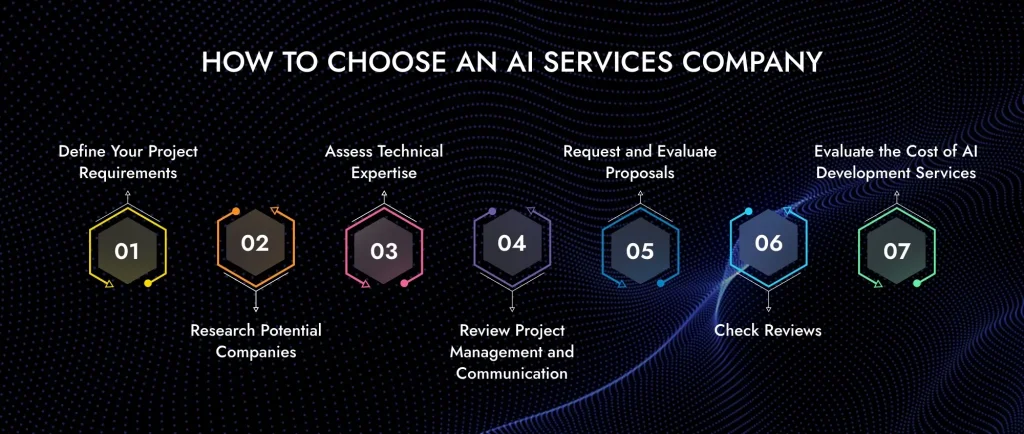
When seeking to integrate AI into your business, selecting a reliable partner is crucial. Here’s how to choose the right AI development company and the benefits of partnering with an expert in AI development services.

CHECK: AI in Business | Prepare Your Business for the Future

How to Choose the Best AI Services Company

Adopting AI technology is no longer optional; it has become essential for businesses aiming to thrive. Research indicates that 75% of entrepreneurs believe AI opens new opportunities, with 91% of leading companies investing in AI solutions.

To navigate this landscape effectively, consider the following steps:

How to Choose the Best AI Development Company

1. Define Your Project Requirements

Before searching for an AI services provider, clearly define your project needs. Whether you require generative AI services, custom web app development, or market automation, having well-defined requirements will guide you in selecting the right partner.

2. Research Potential Companies

Once you have outlined your project requirements, research companies that specialize in those areas. Visit their websites and seek references from colleagues or industry experts. Compile a list of potential partners that align with your needs.

3. Assess Technical Expertise

Evaluate the technical capabilities of the companies on your list. Look for expertise in relevant AI tools and technologies that match your project requirements. Review their case studies, software development practices, client references, and portfolios to gauge their proficiency.

4. Review Project Management and Communication

Effective project management and communication are vital for successful collaboration. Inquire about the company’s project management processes and how they track progress. Clear communication ensures you stay informed about developments throughout the project lifecycle.

5. Request and Evaluate Proposals

After narrowing down your options, request proposals from your shortlisted companies. A comprehensive proposal should outline timelines, project scope, budget estimates, and other critical details. Compare these proposals to find one that aligns with your requirements and offers transparency.

6. Check Reviews

Investigate client reviews and testimonials to gain insights into each company’s communication style, work ethics, and project management skills. This information will help you make an informed decision.

7. Evaluate the Cost of AI Development Services

Finally, consider the cost of services offered by potential partners. Pricing can vary based on location, technology stack, project size, and complexity. Many companies provide free quotations tailored to your project’s needs, making it easier for you to assess costs.

By following these steps, you can confidently choose the right AI development services partner to integrate AI into your business effectively.

AI Services for Your Business.

Discover how ViitorCloud’s AI Services empower your business with innovative solutions tailored to your goals.

Benefits of Partnering with an AI Development Company

Choosing an experienced AI services partner offers numerous advantages that can significantly impact your business growth:

Benefits of Partnering with an AI Development Company

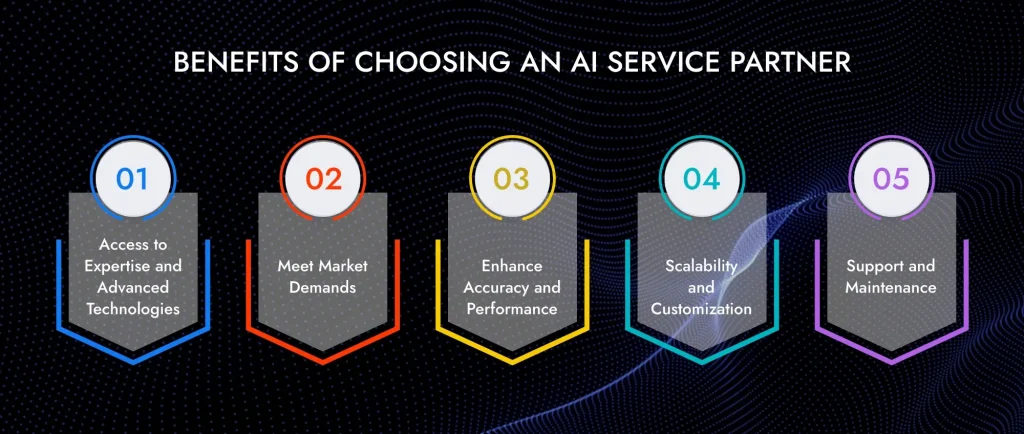
An established AI development company brings specialized knowledge in advanced technologies such as natural language processing, machine learning, and computer vision. Their experience across various industries equips them to tackle specific challenges effectively.

AI companies streamline development cycles and optimize resource allocation to build effective AI components swiftly. This agility allows businesses to meet market demands promptly.

With continuous learning and optimization techniques like neural networks and deep learning, an AI partner can refine algorithms to improve accuracy in tasks such as predictive analytics and image recognition.

An expert in AI development services can help scale your business by leveraging machine learning algorithms and cloud computing technologies. They tailor solutions to meet your unique business objectives and data resources.

Post-launch support is crucial for ensuring the optimal performance of AI systems. A reliable partner will provide ongoing maintenance services, monitor key performance indicators, address issues promptly, manage data security, and ensure compliance with privacy regulations.

Choose the Right AI Partner with Confidence

Explore ViitorCloud’s expert AI Services designed to drive growth and enhance efficiency.

Accelerate Your Business Growth with ViitorCloud

At ViitorCloud, we understand that leveraging AI solutions is key to accelerating your business growth. Our comprehensive range of customized AI development services is designed to enhance data analysis processes, automate tasks, personalize customer interactions, and optimize operations.

If you’re looking for a trusted partner to elevate your business through innovative AI solutions, look no further than ViitorCloud. Our team of experts excels in project management communication skills tailored to your specific needs.

Contact us today for a consultation and discover how our tailored solutions can transform your business!


Frequently Asked Questions

When choosing an AI company, define your project requirement first, then research potential companies, assess technical expertise, review project management and communication, request and evaluate proposals, check reviews, and evaluate the cost of AI development services.

When you choose an AI service company, consider factors such as the expertise of a person in the industry. Also, check track of successful projects, proficiency in AI technology, communication skills, and costing.

The leading companies in AI services include ViitorCloud, Amazon, Microsoft, Google, OpenAI, and IBM. ViitorCloud is committed to driving innovation and efficiency through its expert AI solutions, making it a key player in the evolving landscape of artificial intelligence.

How to Prepare Your Business for the Future of AI in Business

In the era of rapid technological advancement, AI in business is becoming essential for enhancing operations and overall performance. Companies face challenges such as operational inefficiency and strategic decision-making, compounded by the vast amounts of data generated daily, which can overwhelm traditional analytical methods. AI excels in data analytics, effectively addressing these challenges.

Artificial Intelligence is paving the way for a future where chatbots and virtual assistants manage customer inquiries efficiently. Utilizing natural language processing, AI technology is transforming business operations to improve productivity and efficiency. According to Forbes Advisor, AI is projected to contribute $15.7 trillion to the global economy by 2030, with the Indian AI market expected to reach $3,935.5 million by 2028, reflecting a growth rate of 33.28% from 2023 to 2028.

Understanding the impact of AI in business is crucial for preparing your organization for a future driven by this technology. Establishing ethical policies and optimizing workflows are vital steps for companies aiming to thrive in an AI-enhanced environment.

Understanding the Impact of AI in Business

Artificial Intelligence is revolutionizing various industries by improving productivity, fostering innovation, and enhancing decision-making capabilities. It automates routine tasks, allowing employees to focus on more complex responsibilities, thereby boosting overall productivity. Additionally, AI algorithms analyze data to provide valuable insights into customer behavior, enabling businesses to make informed decisions.

Key benefits of AI in business include:

  • Personalization of messages and product recommendations through chatbots, enhancing customer satisfaction.
  • Predictive analytics that forecast customer behavior and market trends, optimizing inventory management and marketing strategies.
  • Competitive advantages gained through improved market understanding and targeted campaigns.
  • Enhanced security measures against malware, phishing attacks, and spam emails.
  • Streamlined supply chain processes through automation.

These advantages illustrate how AI in business is transforming sectors such as healthcare, finance, and technology.

Unlock Your Potential with AI in Business

Prepare your business for the future of AI in business. Discover how our AI development services can transform your operations and drive innovation.

Our 7-Step Process for Businesses to Prepare for the Future with AI

Integrating AI in business requires careful planning and execution to ensure success. AI also helps organizations to reduce costs, improve efficiency, and gain a competitive edge.

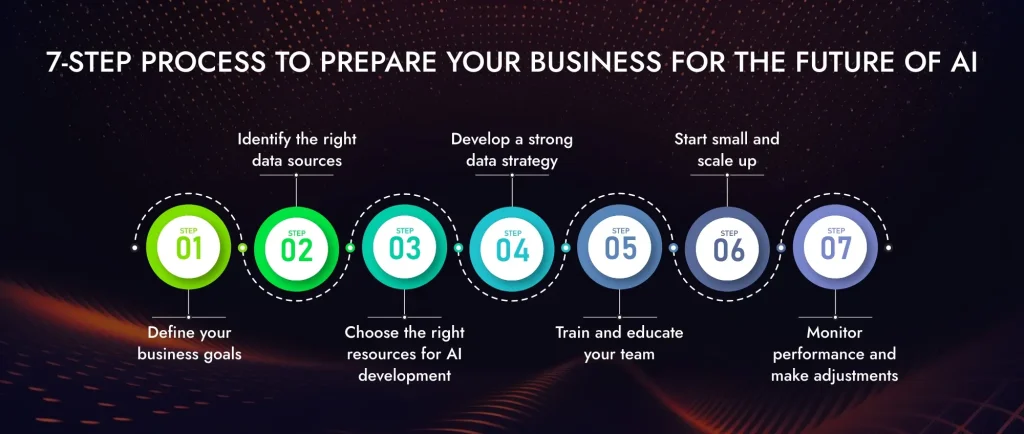
Here’s a seven-step process designed to help organizations prepare for an AI-driven future:

7-Step Process for Businesses to Prepare for the Future with AI

1. Define Your Business Goals

Clearly outline the objectives of integrating AI into your operations. Determine what specific problems you aim to solve with AI and identify metrics for improvement, such as productivity or customer satisfaction.

2. Identify the Right Data Sources

Since AI relies heavily on data for accurate predictions and decisions, identifying both internal (CRM systems, supply chains) and external (social media feeds) data sources is essential. Ensure that all data is accurate, relevant, and up-to-date.

3. Choose the Right Resources for AI Development

With numerous AI tools available, selecting those that align with your business needs is crucial. Consider factors such as cost, user-friendliness, and the expertise of development service providers when choosing technologies like natural language processing or machine learning algorithms.

4. Develop a Strong Data Strategy

A robust data strategy is vital for implementing AI in business effectively. This includes planning for data storage, collection methods, analysis processes, privacy measures, and governance policies.

5. Train and Educate Your Team

Equip your team with the necessary skills and knowledge to work with AI systems. Invest in training programs focused on machine learning and data science to ensure your workforce can leverage these technologies effectively.

6. Start Small and Scale Up

Begin by implementing AI solutions in a specific department before expanding across the organization. This phased approach allows for manageable integration while minimizing disruption.

7. Monitor Performance and Make Adjustments

Continuously assess the performance of your AI systems by analyzing metrics such as speed, accuracy, and efficiency. Gather user feedback regularly to make necessary adjustments that enhance system performance.

This structured approach will facilitate the successful integration of AI in business, leading to significant benefits.

Transform Your Operations with AI Solutions

Prepare your business for the future of AI in business. Partner with us to implement cutting-edge AI solutions that enhance efficiency and decision-making.

How ViitorCloud Helps Businesses Become Future-Ready with AI

The future of AI development in business is set to revolutionize operational efficiency and enhance strategic decision-making through the power of predictive analytics and automation. By harnessing cutting-edge technologies such as computer vision and machine learning, companies can streamline processes and improve decision-making across various industries.

At ViitorCloud, we are dedicated to being your trusted partner in this transformative journey toward implementing AI solutions in business. Our expertise in AI development services allows us to guide organizations in selecting the most suitable tools tailored to their unique requirements. With our support, your business will be equipped to excel in an increasingly competitive landscape shaped by artificial intelligence.

If you’re ready to integrate AI solutions into your operations, we are here to provide expert guidance at every stage. We specialize in delivering innovative AI solutions in business, particularly for the energy sector, ensuring your organization is prepared for the future with state-of-the-art technology.

Choose ViitorCloud as your partner for AI development services, and let us help you achieve your business goals. If you’re looking to utilize AI for success in your organization, feel free to connect with us on LinkedIn!


Frequently Asked Questions

They are implementing AI in the business by identifying areas for automation or insight generation. Additionally, AI tools should be chosen to integrate them into existing systems and continuously optimize the system with data insights. These data insights help in improving operations, customer experiences, and decision-making.

AI business strategy helps businesses to improve customer engagement with chatbots. Additionally, automated tasks of the business processes and optimized operations with data analytics were performed. As a result, it improves productivity and efficiency.

AI-powered future with machine learning advancement, edge computing integration, and increased data availability. Additionally, it will improve transparency with the AI frameworks.

Generative AI in React: Smarter UIs with Vercel AI SDK 3.0

Generative AI in React is revolutionizing web development, delivering productivity gains of up to 50% and speeding up routine tasks by 96% as per our market research. With tools like Vercel AI SDK 3.0, developers can automate repetitive processes, freeing time to focus on building more engaging, dynamic UIs.

This AI-driven approach empowers teams to create responsive web experiences that intelligently adapt to user needs, boosting engagement and raising the bar for modern applications. By leveraging generative AI, developers set a new standard for efficiency and innovation in web development.

What is Generative AI?

Generative AI is a subset of Artificial Intelligence that focuses on creating new content, designs, and solutions based on patterns learned from extensive datasets. Unlike traditional AI, which primarily analyzes and classifies existing data, generative AI can produce original outputs such as text, images, music, and even code. This technology employs machine learning algorithms, particularly deep learning models, to understand complex data patterns and generate creative outputs autonomously.

Significance of Generative AI in Modern Applications

Generative AI holds transformative potential across various industries:

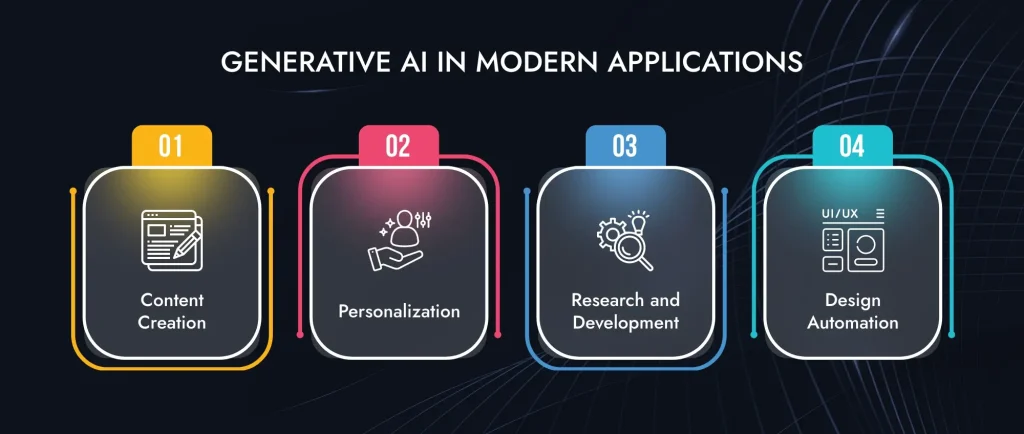
Generative AI In Modern Applications
  1. Content Creation: Tools like ChatGPT and DALL-E exemplify generative AI’s ability to produce high-quality written and visual content rapidly. This capability enhances productivity by automating tasks that previously required significant human effort.
  2. Personalization: Generative AI enables businesses to customize experiences for users by analyzing behavior and preferences. For instance, streaming services like Netflix use generative algorithms to recommend shows based on user history, enhancing engagement.
  3. Research and Development: In fields like healthcare, generative AI accelerates drug discovery by simulating molecular interactions and generating new protein sequences. This capability can lead to faster innovations in pharmaceuticals.
  4. Design Automation: In UI/UX design, generative AI assists designers by creating multiple design variations quickly. It automates repetitive tasks, allowing designers to focus on strategic decision-making and creativity.

How Generative AI Enhances User Interfaces and Experiences

Generative AI significantly improves user interfaces (UI) and user experiences (UX) through several key mechanisms:

  1. Personalized User Experiences: By leveraging user data, generative AI can create customized interfaces that adapt to individual needs. This personalization leads to more intuitive interactions and increased user satisfaction.
  2. Automated Design Processes: Generative AI tools can generate design templates, prototypes, and wireframes based on user behavior analysis. This automation reduces manual work and accelerates design iterations.
  3. Real-Time Data Insights: Generative AI provides designers with actionable insights by analyzing user interaction patterns. This data helps identify pain points in the user experience, enabling quick adjustments for improved usability.
  4. Accessibility Improvements: Generative AI enhances accessibility by adapting content for users with varying abilities. It can create gesture-based controls or modify layouts to ensure a more inclusive experience.
  5. Enhanced Aesthetics: By suggesting design adjustments based on user preferences and trends, generative AI helps refine UI aesthetics. This ensures that designs remain visually appealing while meeting functional requirements.

Elevate Your User Experience with Generative AI

Integrating Vercel AI SDK 3.0 can transform your React apps. Let ViitorCloud bring smarter, intuitive UIs to life with cutting-edge Generative AI solutions.

Introduction to Vercel AI SDK 3.0

The Vercel AI SDK 3.0 is an innovative, open-source toolkit designed to empower developers to create AI-powered user interfaces (UIs) with frameworks like React, Next.js, and Svelte. This SDK stands out due to its robust feature set that simplifies the integration of artificial intelligence into web applications, allowing for the development of dynamic and responsive UIs.

Overview of New Features

The Vercel AI SDK 3.0 introduces several key features that enhance its functionality:

  • Framework Compatibility: It supports multiple frameworks, including React/Next.js, boosting React AI integration, along with Svelte/SvelteKit, with plans for expanding to Vue/Nuxt.
  • Streaming Capabilities: The SDK enables real-time data streaming through hooks such as useChat and useCompletion, allowing developers to build interactive smart UIs and manage text completions effortlessly.
  • Generative AI Features: Developers can dynamically generate UI components based on user interactions, enhancing engagement by tailoring responses in real-time, crucial for building AI in React applications.
  • Integration with Leading AI Providers: The SDK seamlessly connects with popular AI models from OpenAI, Hugging Face, and Anthropic, providing a unified API for generating text and structured objects, ideal for React AI projects.
  • Edge and Serverless Ready: It is designed to work with Vercel’s serverless architecture, allowing applications to scale efficiently while maintaining low latency, making it an optimal solution for AI SDK React implementations.

A Game-Changer for Developers

The Vercel AI SDK is a game-changer for developers building AI-powered UIs due to its ease of use and powerful capabilities. By abstracting complex integrations with various AI models, the SDK allows developers to focus on building engaging smart UIs rather than managing the underlying infrastructure. Its framework-agnostic approach means that developers can utilize familiar tools while harnessing the power of Generative AI.

Moreover, the SDK’s support for real-time streaming and dynamic component generation enables the creation of applications that are not only responsive but also highly interactive. This capability is crucial in today’s digital landscape, where user expectations for seamless interactions are higher than ever. The integration of Vercel AI tools makes it easier for developers to create React UI components that respond intelligently to user inputs.

Vercel AI Tools for Efficient React Integration

We use several tools within the Vercel ecosystem + Cursor AI which complement the Vercel AI SDK for efficient React AI integration:

  • useChat Hook: This hook simplifies the process of managing chat states and responses, allowing developers to implement chat interfaces with minimal code, a vital tool for building smart UIs.
  • useCompletion Hook: It facilitates handling text completions from AI models, automatically updating the React UI as new data arrives, making AI SDK React development more efficient.
  • Chat & Prompt Playground: An interactive platform that allows developers to experiment with different models and parameters in real time, streamlining the development process from concept to deployment using Vercel SDK.

The Vercel AI SDK 3.0 equips developers with the necessary tools to create sophisticated AI-driven applications efficiently. By leveraging its features, developers can build smarter UIs that enhance user engagement and streamline application performance. For more detailed information about getting started with the Vercel AI SDK.

Laverage Generative AI in Your UI

Use the potential of Vercel AI SDK to create responsive, intelligent interfaces. Partner with ViitorCloud to explore innovative AI Development Services tailored to your needs.

Integrating Generative AI in React

Integrating Generative AI into React can transform business applications, enabling real-time personalization, automation, and intelligent user interactions. At ViitorCloud, we specialize in providing AI solutions to enhance user experience and drive business value.

How ViitorCloud Can Help

ViitorCloud Integrating Generative AI In React
  1. Custom AI Solutions: We design customized AI components that integrate seamlessly into your React applications, from chatbots and predictive analytics to dynamic content generation, leveraging tools like the Vercel SDK.
  2. Expert Implementation: Our team leverages advanced tools like the Vercel AI SDK and OpenAI APIs, enabling features such as real-time data streaming, adaptive React UI elements, and multimodal content support.
  3. Scalable AI Architectures: We build scalable, robust AI-driven systems optimized for high performance, ensuring your applications can handle complex data processing and increased user demands with the support of AI SDK React technologies.
  4. End-to-End Deployment: From initial strategy and development to deployment on platforms like Vercel or Netlify, we offer comprehensive support to ensure seamless integration and rapid time-to-market using Vercel AI tools.

Use Cases We Deliver

  • AI-Powered Chatbots: Automate customer interactions with intelligent, context-aware responses using React AI solutions.
  • Predictive Dashboards: Visualize real-time insights for strategic decision-making powered by Generative AI.
  • Smart Content Management: Use Generative AI for automated tagging, content recommendations, and personalization, transforming how users interact with your platform.

Make Smarter UIs a Reality with Vercel AI SDK

Supercharge your React applications with Generative AI—ViitorCloud’s AI experts craft solutions that drive engagement and boost functionality.

Building Smart UIs with AI

Smart UIs refer to user interfaces that leverage artificial intelligence to enhance user interaction, personalization, and overall experience. These interfaces are capable of adapting in real-time to user inputs and preferences, making them more intuitive and engaging.

Role of AI SDK in React

The Vercel AI SDK plays a crucial role in building smart UIs within React applications. By providing a unified API for integrating various AI models, the SDK simplifies the process of creating dynamic and responsive user interfaces.

Key features include:

  • Generative UI Capabilities: The SDK allows for the on-the-fly generation of UI components based on user interactions, enabling a more personalized experience through generative AI.
  • Real-time Data Streaming: Hooks like useChat and useCompletion facilitate real-time updates, allowing applications to respond instantly to user inputs using AI SDK functionalities.
  • Framework-Agnostic Design: The SDK supports multiple frameworks, making it versatile for developers working with React, Next.js, and others.

Benefits of Using AI in React

Integrating AI in React applications offers several benefits for creating dynamic and responsive UIs:

  • Dynamic Personalization: AI algorithms analyze user behavior to tailor content and layouts, enhancing user satisfaction.
  • Conversational Interfaces: The integration of chatbots powered by natural language processing allows users to interact through voice or text, improving accessibility.
  • Predictive User Experience: By anticipating user needs based on historical data, AI can suggest relevant actions or content, creating a seamless experience.
  • Visual and Speech Recognition: Incorporating image and speech recognition capabilities enables users to interact with applications in more intuitive ways.

Key React AI Features for Smarter UIs

  1. useChat Hook: Manages real-time chat interactions, streamlining the integration of conversational interfaces powered by React AI.
  2. useCompletion Hook: Facilitates automatic updates as new content is generated by the AI SDK, ensuring a fluid user experience.
  3. Generative UI Technology: Enables the dynamic creation of UI elements based on user queries, significantly enhancing engagement through Vercel AI tools.
  4. Context-Aware Interfaces: React components can adjust based on user context, improving relevance and usability.

By leveraging these features from the Vercel AI SDK, developers can build smarter UIs that not only meet but exceed user expectations, leading to more engaging and effective web applications.

Revolutionize Your UI with Generative AI

Transform your digital experiences with ViitorCloud’s expertise in Vercel AI SDK integration. Lead in smarter UIs. Let’s innovate together!

How Vercel AI SDK Enables These Use Cases

The Vercel AI SDK simplifies the integration of generative AI into React applications by providing:

  1. Unified API Access: Easily connect to various AI SDK models, such as language models and predictive analytics tools, to implement diverse AI functionalities.
  2. Real-Time Interaction: Features such as useChat and useCompletion allow developers to build responsive applications that update dynamically based on user input.
  3. Generative UI Capabilities: The Vercel SDK enables developers to create smart UIs with AI that adapt based on user interactions, making interfaces more intuitive and personalized.

Why Choose Vercel AI SDK for React?

The Vercel AI SDK is a powerful toolkit tailored specifically for integrating Generative AI capabilities into React applications. It provides a robust foundation for building intelligent, dynamic user interfaces, making it the go-to choice for developers looking to implement React AI integration effectively.

  • Seamless Integration: The Vercel AI SDK is designed to work effortlessly with React UI and Next.js, allowing developers to incorporate AI features into their applications without complex configurations.
  • Real-Time Data Handling: With built-in hooks like useChat and useCompletion, developers can easily implement React AI features that fetch and render streaming responses from AI models, enhancing interactivity.
  • Interoperability: The SDK supports multiple large language models (LLMs), such as OpenAI and Hugging Face, offering flexibility in choosing the best AI SDK for specific business needs.
  • Edge and Serverless Ready: Optimized for deployment on Vercel’s serverless platform, the SDK ensures scalable, high-performance applications.
  • Streaming Capabilities: The Vercel AI SDK allows for real-time streaming of AI-generated content, elevating user experiences through immediate feedback and interaction.
  • Unified API: The Vercel SDK provides access to various LLMs through a single API, simplifying the process of integrating and managing different models.
  • Framework-Agnostic Hooks: While primarily used in React AI integration, the SDK includes hooks compatible with other frameworks like Svelte, enabling AI SDK React developers to implement Smart UIs with AI across multiple platforms.
  • Prompt Playground: Vercel’s interactive playground allows developers to experiment with different prompts and models, accelerating development and enabling quick iterations.

The Vercel AI SDK stands out for its ease of use, robust features, and flexibility, making it an excellent choice for React developers looking to integrate advanced AI capabilities into their applications efficiently.

Experience Next-Level UIs with Generative AI

ViitorCloud’s AI Development Services bring the advanced capabilities of Vercel AI SDK to your projects, enhancing user interaction like never before.

Partner with ViitorCloud

Unlock the power of AI in your applications with ViitorCloud. Our team brings expertise in using advanced AI tools like Vercel AI SDK 3.0 to create smarter, scalable solutions that connect with users and simplify processes. Partnering with us means gaining tailored, AI-driven applications that fit your needs and deliver seamless digital experiences. Connect with us to bring innovative AI solutions to your next project.

Bottom Line

Generative AI is changing how interactive web applications are built—automating complex tasks, personalizing in real-time, and boosting user engagement. With tools like Vercel AI SDK 3.0, adding these features to React apps becomes simple, helping developers build dynamic, intelligent applications.

With our AI development services, we help businesses use these technologies to create scalable, AI-driven solutions that transform digital experiences. Hire an AI developer and unlock the full potential of generative AI for your next project, driving innovation in your applications.


Frequently Asked Questions

Generative AI automates repetitive tasks, delivers personalized user experiences, and enables real-time interactions, leading to enhanced efficiency and improved customer engagement.

We implement stringent security measures and compliance standards (e.g., GDPR, CCPA) to safeguard data, ensuring all AI interactions are secure and aligned with industry regulations.

Absolutely. We design custom AI solutions to specific use cases, ensuring the solutions are aligned with your business goals and technical requirements.

We provide comprehensive support, including performance optimization, updates, and scaling assistance to ensure your AI-driven applications run smoothly and effectively adapt to evolving business needs.

How AI Is Revolutionizing Predictive Maintenance in Energy 

The integration of AI in energy is revolutionizing the way businesses approach equipment maintenance. At ViitorCloud, we offer cutting-edge AI solutions in energy that are designed to enhance operational efficiency and reduce costs. With predictive maintenance becoming increasingly sophisticated, our AI development services enable organizations to leverage predictive analytics for optimizing operations and extending equipment lifespan.

The global predictive maintenance market is projected to grow from USD 10.6 billion in 2024 to USD 47.8 billion in 2029, at a CAGR of 35.1% during the forecast period. ViitorCloud stands at the forefront of this transformation, providing tailored AI solutions that address the unique challenges faced by the energy sector. Our expert team collaborates closely with clients to develop innovative strategies that not only meet immediate needs but also align with long-term business goals.

What Is Predictive Maintenance?

Predictive maintenance is a proactive approach that leverages data analysis tools and techniques to identify potential equipment issues before they escalate into failures. Unlike traditional preventive maintenance, which is based on scheduled inspections, predictive maintenance harnesses real-time data to forecast the optimal timing for maintenance tasks. This strategy is particularly crucial in the energy and utilities sector, where the integration of AI in energy is transforming how we manage critical assets like turbines, transformers, and pipelines.

Even minor equipment failures can lead to significant outages and substantial revenue losses, making it essential to stay ahead of potential problems. By adopting predictive maintenance, energy companies can enhance reliability and efficiency, ultimately safeguarding their operations and bottom line.

Unlock Your Energy Potential

Discover how AI can transform your predictive maintenance strategy.

How AI Enhances Predictive Maintenance in the Energy Sector

1. AI-Powered Data Collection and Analysis

The integration of AI in energy has revolutionized predictive maintenance by streamlining data collection and analysis. In the past, monitoring equipment relied heavily on manual analysis of sensor data, which often led to missed insights. Today, AI systems can swiftly process massive datasets in real time, uncovering patterns that might elude human observers. This capability is particularly vital in the energy sector, where even minor deviations in equipment performance can signal significant issues.

By leveraging AI-driven predictive analytics for continuous equipment monitoring, energy companies can minimize downtime, prolong machinery lifespan, and enhance overall operational efficiency. For instance, machine learning algorithms can scrutinize vibration patterns in wind turbines, allowing companies to anticipate mechanical wear before it escalates into a major concern. This proactive approach not only safeguards assets but also fosters a more reliable energy supply for everyone.

2. Real-Time Monitoring and Alerts

The integration of AI in energy systems is transforming how companies track and enhance equipment performance. With the capability for real-time monitoring, AI technologies can alert technicians when the risk of a breakdown rises. This proactive approach allows for maintenance to be performed exactly when necessary, eliminating the need for disruptive scheduled downtimes.

Take, for example, power grids that utilize AI to assess the condition of vital components such as transformers. By analyzing data in real-time, AI delivers instant feedback, facilitating timely repairs or adjustments. This shift towards predictive maintenance not only helps avoid expensive breakdowns but also boosts the efficiency of energy distribution. Embracing AI in energy systems is not just a trend; it’s a smart strategy for maintaining operational excellence and reliability.

3. AI and Digital Twins in Predictive Maintenance

One of the most thrilling advancements in AI technology for predictive maintenance is the integration of AI in energy through the use of digital twins. A digital twin serves as a virtual counterpart to physical equipment, leveraging real-time data to simulate, predict, and enhance performance. In the energy sector, these AI-driven digital twins offer valuable insights into how assets respond under different conditions.

Energy companies are increasingly adopting AI-based digital twins to model the effects of various stressors on their equipment. By running these simulations, they can accurately forecast how equipment will age over time, allowing for more effective maintenance scheduling. This innovative technology not only boosts operational efficiency but also significantly lowers maintenance costs, making it a game-changer in the industry.

Benefits of Integration of AI in Energy for Predictive Maintenance

1. Reduced Downtime and Maintenance Costs

One of the primary advantages of using AI in energy for predictive maintenance is the reduction in downtime. Unplanned outages can be costly, not only in terms of repairs but also due to the loss of production. AI’s ability to predict equipment failures allows energy companies to schedule maintenance during off-peak hours, minimizing the impact on operations.

Additionally, AI technology helps companies reduce maintenance costs by ensuring that repairs are only performed when necessary. This targeted approach prevents unnecessary maintenance and extends the lifespan of expensive equipment, leading to significant cost savings over time.

2. Improved Safety and Reliability

Safety is a critical concern in the energy sector, and predictive maintenance using AI greatly enhances workplace safety. By predicting equipment failures before they happen, energy companies can prevent accidents and ensure the safety of their workers. For example, in oil and gas operations, AI-driven predictive analytics can detect irregularities in pipelines, preventing potential leaks or explosions.

Moreover, AI improves the overall reliability of energy systems by ensuring that equipment operates at peak performance. Reliable equipment means fewer outages and more consistent energy delivery, which is especially important as renewable energy sources like wind and solar become more integrated into the grid.

3. Sustainability and Environmental Impact

AI-powered predictive maintenance also contributes to sustainability efforts within the energy and utilities industry. Efficient equipment operation means less energy waste, which directly translates to lower carbon emissions. For instance, by predicting when a wind turbine’s components will wear out, companies can replace them before they cause efficiency losses. This proactive maintenance ensures optimal energy production, reducing waste and improving the overall sustainability of energy operations.

Furthermore, AI in energy supports the integration of renewable energy sources by improving the reliability of the grid. With AI’s ability to predict and manage the fluctuating power generation from renewable sources, the energy industry can more confidently rely on clean energy, reducing its dependence on fossil fuels.

Stay Ahead of Equipment Failures

Learn more about our tailored AI solutions for the energy sector.

How Are Energy Companies Implementing AI in Predictive Maintenance?

Many power plants have already begun integrating AI for predictive maintenance. AI systems in these plants monitor equipment like turbines, boilers, and generators to detect signs of wear or inefficiencies. By analyzing historical data and real-time information, AI can predict when a component is likely to fail, allowing technicians to address issues before they become critical.

For instance, General Electric (GE) uses AI technology in its power plants to monitor turbine performance and predict when maintenance is necessary. This system has led to improved operational efficiency and a reduction in unplanned outages, saving millions of dollars annually.

The renewable energy sector is also benefiting from AI-driven predictive maintenance. Wind and solar farms, for example, use AI to monitor the performance of turbines and solar panels, ensuring that these assets operate at maximum efficiency. AI-powered drones and sensors can also perform visual inspections, identifying potential issues that might not be detected during routine maintenance checks.

This technology allows renewable energy companies to schedule maintenance only when necessary, reducing costs and downtime while ensuring that green energy sources remain productive.

What Are the Challenges of Implementing AI in Predictive Maintenance?

While the integration of AI in energy offers numerous advantages, it also presents several challenges that must be addressed. One significant hurdle is the substantial initial investment required for AI systems and sensors. Smaller energy companies may struggle to justify this cost, even though the long-term savings from AI can be considerable.

Moreover, the effectiveness of AI technology hinges on having access to accurate and comprehensive data. If the data quality is lacking, AI systems may struggle to deliver precise predictions, which can result in suboptimal maintenance strategies.

Another critical factor is the need for workforce adaptation. The energy and utilities sector must prioritize training employees to effectively utilize AI systems. This training should encompass not only the technical aspects of these tools but also the skills needed to analyze and interpret the data they produce. By addressing these challenges head-on, companies can fully harness the potential of AI in predictive maintenance and drive significant improvements in their operations.

Optimize Your Operations Today

Join the revolution in predictive maintenance and enhance your efficiency.

Conclusion

The integration of AI in energy is transforming predictive maintenance, offering energy companies the tools to minimize downtime, reduce costs, and enhance safety. Through AI-powered predictive analytics, real-time monitoring, and digital twin technology, you can anticipate equipment issues before they occur and streamline your operations. As AI advances, these solutions will play an even more crucial role in making energy systems more reliable and sustainable.

Harness the power of AI solutions in energy. ViitorCloud’s AI development services are tailored to elevate your predictive maintenance strategy and future-proof your business. Partner with us and optimize your energy operations today! You can also send us a message on LinkedIn, and we will respond as soon as possible.


Frequently Asked Questions

ViitorCloud offers AI-driven predictive maintenance solutions that analyze real-time data from your energy assets to predict equipment failures. We help you minimize downtime, reduce operational costs, and improve the reliability of your infrastructure.

We use advanced AI technologies, including machine learning, predictive analytics, and digital twins, to monitor and predict the performance of critical energy assets, ensuring timely and efficient maintenance actions.

Yes, our AI solutions are fully customizable to meet the specific needs of your energy operations, whether you’re managing turbines, pipelines, or transformers.

ViitorCloud integrates AI-powered sensors and software into your existing systems without requiring a complete overhaul, ensuring a smooth and cost-effective transition to AI-driven predictive maintenance.

Innovative AI Use Cases in Finance Industries 

AI technologies have transformed the BFSI sector, impacting millions of lives globally by providing 24/7 access to accounts, seamless customer support, and smoother operations. With ViitorCloud’s AI finance solutions, your business can benefit from the power of AI to optimize efficiency and elevate customer experiences.

One of the key advantages of AI is its ability to analyze vast amounts of data in real-time. This capability allows financial organizations to identify patterns, predict market trends, and make informed decisions that drive business growth. Whether it’s fraud detection, risk management, or personalized financial advice, AI use cases in finance continue to unlock immense value for both banks and customers alike.

At ViitorCloud, we specialize in delivering AI development services tailored to the unique needs of financial institutions. Our AI-powered tools enhance operational efficiency, improve decision-making, and ensure smooth transactions, positioning your business to stay ahead of the competition. Whether you’re looking to streamline customer interactions, optimize financial processes, or safeguard against cybersecurity threats, our AI solutions can help you navigate the complexities of today’s financial landscape.

Explore how we can drive your business forward with cutting-edge AI finance solutions in the following blog. We focus on practical, scalable implementations that deliver measurable results, ensuring that your finance operations run efficiently and effectively.

READ: Benefits of AI in Finance: Transforming Financial Services

Why Finance Companies are Turning Into AI

The financial sector is at a point of change due to the development of artificial intelligence technologies, which are opening new avenues for value creation. However, distinguishing between temporary trends and sustainable AI use cases in finance can be challenging, with the market buzzing with AI advancements.

Nevertheless, according to Nvidia, 91% of financial companies report improvements from implementing AI. In simpler terms, machine learning (ML) and deep learning (DL) are making financial companies more profitable and helping them capture a larger market share. Many industry players are increasing the deployment of AI-powered applications. In 2023, 43% plan to continue investing in AI/ML and 42% in advanced predictive analytics, as per OneStream. AI drives a new generation of customer-facing products like personal finance use case apps, robot advisors, and lending tools.

For instance, RBC recently launched NOMI, an AI-powered personal financial management app described by 53% of users as a “powerful weapon” for their budgeting purposes. On the back end, AI in finance helps employees in finance services with intelligent process automation, advanced financial analytics, next-best-action recommendations, automated account reconciliation, and risk management. Such as JP Morgan Chase implemented an ML-powered platform for compliance management saving about 360k hours annually by its legal and lending teams. Through implementing AI in FinTech organizations can achieve four major results: higher profits; at-scale personalization; distinctive omnichannel experiences; and faster product innovation.

ALSO READ: Top Applications of AI in Finance Transforming the Industry

Uncover the Potential of AI Use Cases in Finance!

Leverage AI to improve your financial operations, minimize risk, and foster innovation. ViitorCloud’s AI Development Services can revolutionize your Banking, Financial Services, and Insurance business.

7 Innovative AI Use Cases in Finance

We provide you with insights into key market trends, helping you to concentrate your efforts on those areas where they will be most effective on AI use cases in finance. Learn how our AI solution can transform front-office (customer-facing) processes and back-end operations, making you the number one player in this market.

7 AI Use Cases in Finance

1. Detect and Prevent Fraudulent Activities

Traditional rule-based systems for fraud detection cannot keep pace with the growing volumes or increasing variety of transactions that need to be checked. These systems programmed by humans often result in high false positive rates, which causes users’ payments to decline in frustration. Consequently, merchants with high card decline rates switch payment service providers (PSPs) so that 33% of consumers won’t shop again with a business after a false decline.

In contrast, AI-powered fraud detection algorithms keep learning from transaction patterns and get better at distinguishing between genuine ones and fraudulent activities. For instance, Stripe Radar assesses over 1,000 transaction characteristics in seconds to gauge its likelihood of being fraudulent. This AI use case in finance systems evolves continually, thanks to its deep neural network (DNN) architecture, which can be re-trained in under two hours with new insights from all Stripe transactions.

For instance, as more than 90% of cards on the Stripe network were used more than once, it enables Stripe to make better decisions and reduce false positives. Thus only 0.1% of legitimate transactions are wrongly blocked by Stripe Radar. Looking at the payments sector’s hyper-growth rate, one can easily see how an investment in our solution for AI-based fraud detection pays off quickly as it minimizes financial losses while enhancing merchant satisfaction.

2. Integrate chatbots for customer service

Customer service is crucial for business success but satisfying diverse customer needs might be time-consuming and expensive. This is where our solution of Generative AI-driven chatbots comes into play. Generative AI-powered chatbots simulate natural human-like conversations allowing customers to instantly talk to them around the clock. Unlike simple rule-based systems, these bots comprehend context, sentiment, and language subtleties leading to smooth personalized interactions.

The generative model we build into the chatbot analyzes queries made by customers using generative AI before providing relevant responses or solutions they may require. These chatbots perform various tasks such as checking account balances, explaining transaction details, or assisting with account setup allowing human agents to deal with more complicated questions when asked by your clients.

Banks can improve customer satisfaction using generative AI-driven chatbots that we develop according to your needs and offer non-stop assistance to your customers. Moreover, these robots cut operational expenses while increasing response time. Furthermore, chatbots accumulate valuable data on customers and help the banks gain a better understanding of their clients and customize services based on customer’s needs. By focusing on improving overall customer experiences while driving operational efficiencies, our generative AI-powered chatbot solutions are transforming service delivery in banking.

3. Anti-Money Laundering

The highest concern of banks is to prevent money laundering and meet regulatory obligations. Combining with Generative AI, it has proved to be an influential tool in enhancing Anti-Money Laundering (AML) practices. Additionally, huge transaction datasets, consumer profiles, and historical patterns can be analyzed by generative AI models. These models can identify known money laundering methods and new, evolving schemes, helping banks stay ahead of criminals.

What makes Generative AI especially effective in AML is its ability to create predictive models that detect anomalies and patterns that suggest money laundering. These models learn from new data, allowing them to adapt to new threats.

For banks, using generative AI in AML means more accurate detection of illegal activities, fewer false positives, and better compliance with regulations. This helps banks protect their reputation, avoid large fines, and maintain trust with customers and regulatory authorities.

4. Simplify Documentation and Data Processing

AI simplifies document and data processing in the financial sector. Traditional methods of handling paperwork and data are time-consuming and prone to human error. AI-driven solutions, such as optical character recognition (OCR) and natural language processing (NLP), can efficiently extract and process data from various documents, including loan applications, contracts, and financial statements.

For example, AI can quickly scan and interpret mortgage applications, validating the information and ensuring compliance with regulatory standards. This reduces the processing time and minimizes errors, leading to faster and more accurate decision-making. Additionally, AI can analyze historical data to identify patterns and trends, providing valuable insights for future business strategies.

5. Track Transactions in Real Time

Data security in the banking and finance sector is crucial due to the sensitive nature of customer information. With the abundance of publicly available data and rising fraudulent activities, protecting usernames, passwords, and security questions has become increasingly difficult for organizations. The future may shift away from traditional security methods like passwords, usernames, and security questions toward more seamless and effective fraud prevention techniques.

Leading FinTech companies are gradually moving from traditional SQL databases to blockchain technology, which offers a more secure platform for storing sensitive information. Machine learning applications are set to elevate security in the finance sector through voice and face recognition, along with other biometric data. This approach enhances security, customer retention, and satisfaction by providing a secure and seamless authentication process.

Companies such as Adyen, Payoneer, and Stripe have invested heavily in machine learning-based security and are actively working towards this shift. From a more technical perspective, banking algorithms employ Natural Language Processing (NLP) to supervise the amounts of emails and other information entering their systems. These algorithms use supervised machine learning techniques like support vector machines (SVM) and random forest trees to detect patterns that may indicate malicious behavior or any customer information leakage.

6. Get Personalized Recommendations

AI-powered personalized recommendations improve customer experience by offering customized financial advice and product proposals. The personalized recommendations are enabled by machine learning algorithms that analyze data on clients, including transactional history, spending habits, and financial goals.

For instance, AI can suggest investment opportunities based on a client’s risk tolerance and objectives. Using AI technologies, robot advisors recommend offering customers tailored investment plans and providing continuous monitoring and adjustments. Thus, the degree of personalization helps clients to make informed choices relating to finance, hence leading them closer to the achievement of financial objectives.

7. Analyze Market Trends

AI analyzes massive amounts of market data in search of patterns and predictions. This could be done by real-time processing using machine learning models that collect data from stock markets, economic indicators, or news articles to identify emerging trends.

AI is used by financial institutions worldwide for predictive analytics that help with forward-looking decisions built on facts instead of intuition. For example, through historical data analysis alongside market sentiment reviews, artificial intelligence algorithms predict future movements in stock prices.

Based on these insights, traders/investment managers can thus optimize trading strategies for better returns. Moreover, global economic indicators and geopolitical events can be monitored through AI, giving a comprehensive overview of the market dynamics within which banks operate, increasing certainty around strategic planning processes, reducing risks, and ensuring better client outcomes.

SEE: Finance Cost Optimization with AI Solutions

Supercharge Your Financial Services with AI!

Explore innovative AI use cases in finance to optimize decision-making, improve customer experiences, and boost efficiency. Let ViitorCloud’s AI experts craft solutions tailored to your needs.

How does ViitorCloud Reshape Finance Operations With AI?

AI is revolutionizing the finance sector, offering transformative solutions that enhance every aspect of financial operations. With advanced AI use cases in finance, such as fraud detection, risk management, personalized financial recommendations, and market trend analysis, businesses are empowered to improve efficiency, accuracy, and customer experience. As AI continues to evolve, financial institutions must stay ahead of the curve by embracing innovative AI finance solutions that drive competitiveness and operational success.

At ViitorCloud, we specialize in providing cutting-edge AI finance solutions tailored to your business needs. Our team delivers customized AI development services that go beyond the basics, offering sophisticated tools like AI-powered chatbots, video analytics solutions, and intelligent AI assistance. By integrating these AI-driven tools into your financial ecosystem, you’ll achieve seamless operational improvements, streamline decision-making, and unlock the full potential of AI solutions for maximum ROI.

Choosing us as your AI partner means tapping into our expertise and proven track record in transforming financial operations. Whether you’re looking to enhance risk management, personalize customer experiences, or optimize your market analysis, our AI-driven strategies ensure your business remains competitive in an ever-evolving landscape. Let us help you stay ahead by implementing AI finance solutions that truly make a difference.

Partner with us today and take your financial operations to the next level with our world-class AI solutions. Maximize your growth, streamline your processes, and secure a future of innovation. Also, reach out to us on LinkedIn and we will help you to achieve your business goals faster than ever!


Frequently Asked Questions

AI has disrupted finance by improving its efficiency, fostering risk management, allowing personalized customer service, and automating routine tasks. It leads to cost savings, better decision-making, and increased customer satisfaction.

AI may be used in finance for fraud detection, credit scoring, personalized financial advice, algorithmic trading, and process automation among others. This enables it to analyze data sets giving insights into predicting trends or optimization of financial operations.

JPMorgan Chase uses artificial intelligence to manage regulatory compliance among other areas. The company’s artificial intelligence platform saves its legal teams 360000 hours annually through automation of document review as well as compliance processes related to regulations applicable within the lending divisions of JPMorgan Chase bank amongst others.