Why is AI-powered process automation necessary for your business?

AI business process automation is necessary for businesses because of market competition. A business requires a quick solution to its problem where artificial intelligence is helpful.

Artificial intelligence technology helps reduce costs, streamline operations, and improve productivity. Also, it allows people to focus on critical tasks.

Here is a detailed overview of why AI-powered process automation is necessary for your business. Also, know the application of AI automation and learn how to use AI process automation.

What is AI-powered automation?

AI-powered automation integrates AI technology and algorithms into various processes and systems to operate, automate tasks, and make decisions. Also, it helps in handling complex and cognitive tasks.

The capability of machine learning, predictive analytics, etc., is used in AI. It is where data is analyzed to identify patterns, provide business insights, and automate the business process to improve efficiency and productivity.

Applications of AI automation in business

AI technology, such as natural language processing, machine learning, and computer vision, is helpful in business by streamlining the process. These tools help make data-based decisions, improving customer experience and overall performance. Let’s understand in detail the applications of AI automation in business.

ClickUp

ClickUp is the AI assistant which assists you in various tasks such as follows:

  • Text generation – ClickUp AI is useful for different purposes, such as writing content for blog posts, marketing content, or condensing extensive documents.
  • Translation – It helps translate text in multiple languages.
  • Answering queries – ClickUp AI is good at solving inquiries for different topics. The topics include project management, productivity, or any complexity of business.
  • Idea Generation – It is a companion for brainstorming innovative concepts, such as product development or strategic marketing campaigns.
  • Document Summarization – ClickUp AI helps convert lengthy documents into short document and concise formats.

Chatgpt

OpenAI developed the ChatGPT, an AI power language that produces text resembling human beings. Let’s understand in detail how ChatGPT is useful.

  • Conversation with humans: Chatgpt helps engage with people. As it responds to inquiries, creates narratives, and follows instructions.
  • Text generating: It helps generate text in different formats. The format, such as blogs, articles, and marketing content, helps summarise the document.
  • Translation: Chatgpt helps translate text into multiple languages.
  • Answering questions: It can solve queries on science, history, or current events.
  • Dall-E: OpenAI developed Dall-E, which helps with text-to-image creation. It can generate images based on text descriptions. For instance, using the prompt “ create a dog riding bicycle,” the image will be created using Dall-E.
  • Artistic creation: DALL-E 2 is a tool for producing original artwork, drawings, sculptures, and spanning paintings.
  • Product design: DALL-E 2 produces novel products such as furniture, clothing, and toys.
  • Education: DALL-E 2 helps create illustrative materials, such as diagrams and visuals for educational material.
  • Marketing collateral: You can generate marketing materials, custom posters, flyers, and advertisements with Dall-E 2.

These are the tools that are useful in business process automation with AI.

Elevate your business with AI

Maximize efficiency and innovation with AI-driven process automation from ViitorCloud. Our expertise ensures seamless integration and exceptional results for your business.

How are businesses using AI automation?

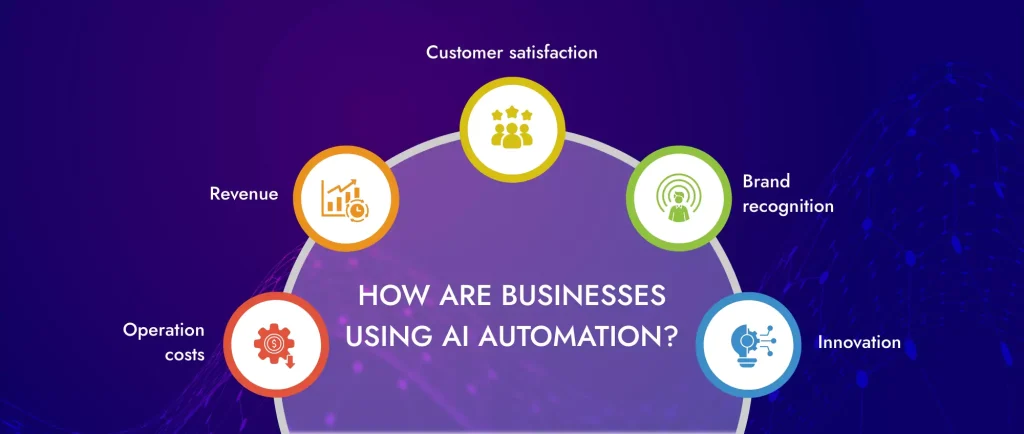
AI automation in business helps improve efficiency, reduce costs, and improve productivity. Also, it is helpful in various areas to achieve business goals. Some of these areas are:
how are businesses using ai automation

Operation costs

AI will automate routine tasks in the operation department, such as data entry, inventory management, and invoicing. With business process automation AI, operations costs will be reduced and profits will increase.

The tools used for automating operation tasks are Ontraport or Zapier; when these tools are used, it saves costs that are investing in labour.

Revenue

The main objective of any business is to generate revenue and increase with time. Businesses generate revenue commonly through sales, customer base, launching new products or services, or price increases. In this place, AI tools are helpful.

For instance, CRM software like HubSpot helps automate lead generation and lead nurturing. The chatbots help personalize product recommendations and solve customer inquiries. You can automate the invoice process using FreshBooks or QuickBooks.

Customer satisfaction

Customers are an essential part of any business; their satisfaction is a priority of the company. When satisfying the customer, businesses must provide high-quality products or services, good customer support, and listen to customer feedback. It is challenging to provide 24/7 with the help of humans. But AI has made it possible with chatbots. The chatbots can assist 24/7, resolving real-time issues and providing personalized product recommendations. As a result, customers are satisfied and loyal to the business.

Brand recognition

Businesses need to invest in marketing and advertisement to build an online presence and create a positive brand image. AI helps build an online presence for brand building. For instance, Hootsuite automates social media posting and engagement, Moz helps improve SEO ranking and optimize website content. Additionally, AI understands your audience and creates an effective marketing campaign.

Innovation

Things are changing in the world fast with the help of technology, so innovation in your product or service is essential. You can innovate products or services by analyzing customer feedback from surveys, social media, and reviews. Also, you can understand customer pain points and needs and make new products according to them. AI helps provide insights into customer needs and pain, which helps businesses innovate their products or services.

Why does your business need AI-powered process automation?

Automating half of the processes in today’s fast process environment is easy. Automation enhances productivity, reduces costs and

helps you stay out of the competitors. Let’s understand in detail why your business needs AI powered process automation.

why does your business need ai-powered process automation

Big data management

In the digital world, a lot of data is generated from every corner of the world, which is considered big data. The data is helping businesses with innovations, better decision-making, improve productivity, and help in planning customer satisfaction. Moreover, big data is helpful for business success, but managing is a big hurdle for business.

The hurdle of managing data is solved with business process automation AI, as it helps process the data, discover the data patterns, convert the unstructured data into structured data, and give insights to draw better conclusions.

Improved business productivity

There are two ways AI business automation Improves Productivity.

Automate repetitive tasks

AI-powered process automation performs repetitive tasks so human beings can focus on critical tasks. As a result, productivity increases.

The software is programmed with high configurational logic, which provides accuracy and no human error, which provides a massive benefit from automation.

Data-driven process

According to the latest information, around 48% of businesses are utilizing AI to process, observe, and monitor significant data patterns to get knowledge to improve the process. Data is the biggest asset for the company.

Process mining and optimizing current business processes are used to make business decisions. It is the way data is useful in AI business process automation.

Revenue with product recommendations

eCommerce is a convenience store for digital users as it allows shopping at benefits and discounts. Also, e-commerce stores are becoming intelligent with AI process automation. AI analyzes customer behaviour related to buying, shopping carts, and wishlists. On the basis of that, they recommend the product to customers. For instance, if you are looking for a dress, add 2 to 3 dresses in the cart and do not buy now. After some days, you will see an advertisement of the same and similar dresses with discounts. On average, 2 to 3 visits and on the 4th and 5th visit, you will buy the product.

Price optimization

People prioritize prices and quality, but businesses must predict the right product price and optimize it according to market trends. Also, the company has a range of products. Manually deciding the cost is difficult, but powered software helps determine the price.

AI business process automation software considers all factors in product price prediction and optimizes prices. It is possible as software to scan the data from bulk, refer to different price scenarios, and suggest a reasonable product price for a profitable business.

Improved sales and marketing

In sales and marketing, the right strategy and appropriate solution should be executed at the right time so the business can generate sales. The human brain can do this work but with limits. However, AI business process automation can do this work efficiently in the following ways:

  • Know buyer journey
  • Tips to improve sales performance
  • Better schedule management
  • Customer value is boosted and retention is increased
  • Gain insights on business sales strategy
  • Help in creating a content strategy
  • Helps create content such as blogs, articles, podcasts, whitepapers, case studies, and email marketing.
  • AI helps in searching keywords.

Augment your business potential with AI-powered automation

Revolutionize your business operations with advanced AI technology from ViitorCloud. Our team of experts will collaborate with you to streamline processes, boost efficiency, and propel your company towards unprecedented growth.

Why is AI-powered data automation the future?

According to data capture solutions are going to hit $3.84 billion globally by 2024. The manual data entry work will end, and AI automated technology will take its place in the marketplace.

Here are some reasons AI-powered data automation is the future.

Data sorting

Businesses have to deal with thousands of data daily, and that data needs to be categorized so it is accessible easily. It is not possible manually; AI makes it easy. AI process automation technology classifies the data into different formats, such as documents, images, and PDFs. Additionally, AI solutions can identify the data type and know where to extract the data. Also, human errors are reduced as accuracy is provided during data entry.

Increase productivity

AI automation is helpful in the data entry process and increases productivity in business functions.

It ensures to:

  • Reduce paperwork and save money.
  • Reduce manual errors
  • Improve clarity
  • Fasten the process

The error decreases with manual data processing, so you can focus on strengthening relationships with the stakeholders and customers with AI automation solutions. AI Automation helps boost profit and improve productivity.

Validity and security

The manual data processing might cause data duplication, misidentification, and lateness. With the help of AI automation, data duplication or error can be identified and rectified.

Employees must match documents and confirm validity when manual data entry is processed. AI automation saves the time and energy wasted on matching documents manually and getting validity.

Automate your business with ViitorCloud AI services

AI business process automation is changing the way business functions. It automates the business’s operations, customer support, human resources, marketing, and sales functions. Automation is improving the productivity and efficiency of the company.

When you are looking for someone to integrate automation into your business functions, connect to Viitorcloud, an AI consultancy service with a global presence and technology that helps you grow the business, Viitorcloud is a team of professional experts who have experience in AI technology, work on AI projects and complete the project.

Partner with us to integrate AI power automation. Contact our team on the website and send your project requirements; we will contact you for further processing.

Frequently asked questions

AI business automation refers to automating tasks and processes. The technology used is machine learning, natural language processing, and computer vision to enhance efficiency, accuracy, and productivity across various businesses.

AI impacts business process automation by improving productivity, decision-making, personalized recommendations, data management, and customer service. Also, it provides accuracy and reduces human errors.

The cost to implement AI for business automation depends on several factors, such as the scope of the project, the complexity of the tasks, the type of AI technology, and the industry requirements.
Innovate your businesses through AI development services

Artificial Intelligence helps innovate the business, transforming the business in unprecedented ways. Generative AI is powerful in reshaping the boundaries of creativity and innovation in various industries.

AI technology, such as machine learning, computer vision, natural language processes, AI product development, and chatbots, improves business work and helps bring innovation.

Let’s get a detailed overview of AI development services, how AI development services foster business innovation, and the benefits of using AI services.

What are AI development services?

AI development services are a professional offering specializing in creating, implementing, and maintaining artificial intelligence. These services help transform raw data into actionable insights and make the business work more efficiently. Let’s understand five types of AI services in detail.

Smart assistants and AI chatbots

AI chatbots are computer programs that work as human conversations in written or spoken language. Chatbots are integrated with natural language processing to understand questions and responses.

There are two types of chatbots.

Declarative chatbots

These chatbots combine NLP and machine learning to generate automated responses when questions are asked. Declarative chatbots are most commonly useful in customer support services.

Predictive chatbots

Predictive chatbots are a type of chatbot designed to predict user needs and questions with the help of predictive analytics, NLP and machine learning. These chatbots help recommend products or services to customers, generating sales for the business.

Machine learning

Machine learning is an artificial intelligence that allows machines to learn things from data and experience. Past experience helps identify patterns related to sales and risk in business. As a result, companies can increase sales and make the right decision to prevent risk. In addition, machine learning identifies repetitive tasks such as data entry, document analysis, screening, and customer inquiries. These repetitive tasks are automated with machine learning.

Natural language processing

Natural language processing allows a computer to interpret, manipulate, and comprehend human language. The business has large volumes of data in text format from emails, social media platforms, news channels, videos, audio, and more. Additionally, the NLP helps automate and analyze the data.

In businesses like insurance, legal, and healthcare, the large volume of documents like medical records and financial and private data is sorted and protected with the NLP. Additionally, NLP is useful in customer service businesses like Amazon, where customers’ moods, preferences, habits, and behaviors are predicated, and the product or service is recommended to customers.

AI security

Artificial intelligence security is a key component in cybersecurity that defends cyberattacks. Using machine learning algorithms and deep learning techniques, AI can analyze unusual patterns and behavior in the system, which detects threats. Also, real-time monitoring helps identify security incidents quickly.

Additionally, AI helps detect phishing and malicious emails. Also, AI automates vulnerability scanning and assessment. It is the way AI in business is helpful.

Generative AI

Generative artificial intelligence can generate text, images, videos, or other data in seconds. It can generate text through blogs, articles, social media posts, and code development. Generative AI helps create music, voiceovers or realistic sound effects for video games.

It helps create video content such as deepfakes, animations or realistic video game environments. Additionally, it helps create images of people who don’t exist, creating artwork and modifying pictures in real time. It is a way generative AI is helpful.

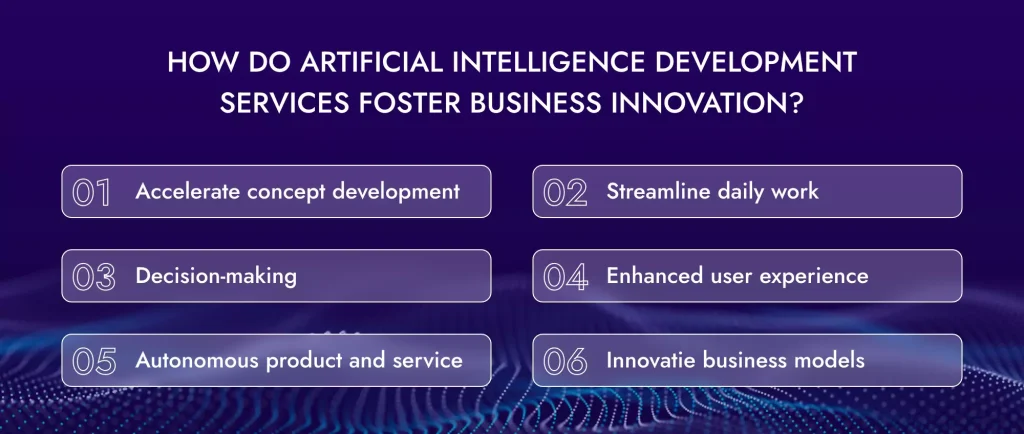
How do Artificial Intelligence development services foster business innovation?

Adopting AI technology in business increases efficiency and productivity and helps the business grow. Let’s understand how AI solutions services foster business innovation in 6 main areas.

How do Artificial Intelligence development services foster business innovation?

Accelerate concept development

Traditionally, product development relies on human intelligence and experience. However, AI has made this process easy with machine learning algorithms. A machine algorithm analyses the user data and identifies patterns, preferences, and pain points. This provides valuable insights to the developer.

In addition, AI has sped up the brainstorming and validation processes for new products and services. Also, businesses can quickly test and refine their ideas with AI tools such as rapid prototyping and synthetic testing.

Streamline daily work

Simple tasks like data entry, conducting research, managing projects, and predicting feedback are streamlined with AI tools. So the team can focus on innovation work rather than simple tasks.

Decision-making

AI helps make decision-making faster in business by collecting large amounts of data, analyzing data and generating insights in real time. Also, it helps analyze various risk factors in business, which businesses can mitigate.

Enhanced user experience

Natural language processing helps interact with users in new ways. It means less time spent navigating and enjoying tailoring individual needs more seamlessly.

Autonomous product and service

In AI personalization, recommended methods suggest products or services to customers. It takes place by analyzing the customer’s preferences, habits, and behavior. Known brands like Amazon and Netflix use this method of personalization recommendation.

Innovative business models

The use of AI-enhanced business models is not just a technology upgrade. It brings a shift in business operations. The ability of AI to analyze large amounts of data and provide action insight is a game changer for the business and provides a competitive edge. Also, the data brings new opportunities for business innovation.

It is the way AI integrates in business for innovation.

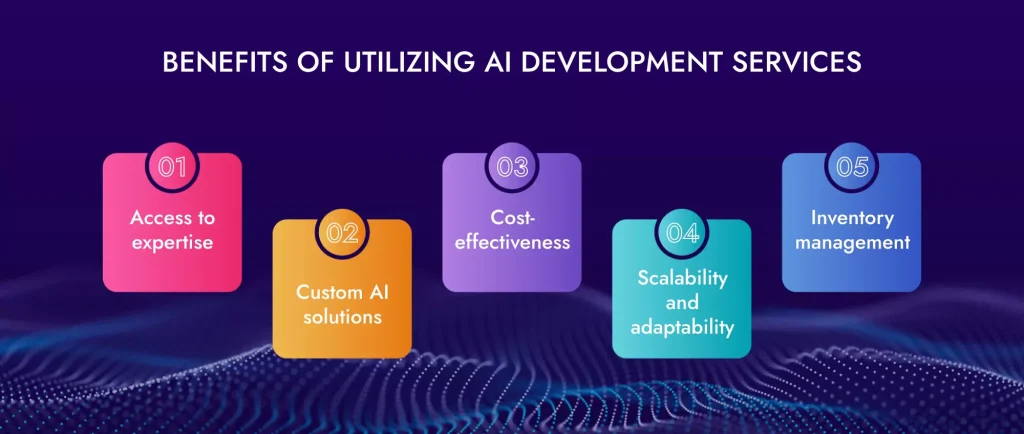
Benefits of utilizing AI development services

AI development services offer a variety of benefits to businesses, such as reduced costs, time savings, and increased efficiency. Let’s study in detail the benefits.

Benefits of utilizing AI development services

Access to expertise

AI service users in business can access a pool of AI experts and machine learning. These experts stay updated with current trends, tools, and frameworks to ensure that AI projects are developed efficiently and according to customer requirements. Also, time and resources are invested in training a team business to fast-track the project process and reduce costs.

Custom AI solutions

When business needs are recognized, the AI development service becomes useful. AI development took place according to business requirements. For instance, if a business needs to automate tasks to improve customer interaction, AI automates the tasks in the customer service department. The business needs to analyze the data to provide product or service recommendations; AI will help. AI’s personalization approach helps companies bring results and deliver a return on investment.

Cost-effectiveness

When you have to develop AI software internally, hiring experts, managing infrastructure, and acquiring technology comes with expenses. The adoption of AI service is cost-effective as it provides a top-notch AI expert team at a low cost. This cost reduction makes AI services affordable for medium businesses and empowers them to adopt artificial intelligence in their business.

Scalability and adaptability

Adapting and scalability are easily available when you adopt AI development services and then hire a team of experts in the company. Because it saves the cost of hiring, and training AI experts, it saves time for managing the internal AI team, and adoption of the latest AI tools is easy through AI development service.

AI development services generally offer expert teams, customized solutions, cost-effective services, and easy scalability, empowering small businesses to adopt AI technology. Also, you can stay ahead of competitors with evolving AI technology.

Inventory management

The business can streamline the operation process with artificial intelligence, reduce costs, and increase efficiency. This inventory management is possible by analyzing sales data to estimate product demand and automatic restocking is possible with AI. Also, AI helps track inventory from supplier to customer, decreasing the normal process’s inefficiency.

According to forbes advisor survey, 40% of businesses use AI in inventory management.

Choosing the right AI development partner

When choosing an AI development partner, you must consider many things to make your project successful. Firstly, you must clearly understand your project scope, goals, and requirements. Whether looking for a natural language processing application or machine learning, you must communicate clearly with your partner.

Secondly, look for an AI development company with technical skills and expertise to partner with. Technical skills include machine learning, algorithm design, data analysis, and other AI technologies. Thirdly, look for companies that protect your business data with the regulations. Lastly, enquire about the company project management processes to ensure project work is on track. It is how to choose the right AI consultancy services partner for your business.

Automate and strengthen business intelligence with our custom AI services

Revolutionize your business with ViitorCloud AI services

Continuously, AI is revolutionizing the business, so you need to stay updated and adopt AI in your business to stay ahead of competitors. AI is revolutionizing how businesses reach customers with effective advertising and marketing techniques. Also, how businesses use technology for customer satisfaction, informed decision-making, and automate tasks.

We understand the importance of adopting AI technology in digital landscapes. Our artificial intelligence services company ensures that your business adopts AI smoothly. Additionally, we take care that the implementation of AI helps you improve efficiency and productivity in the business. Also, we ensure your business goal of inserting AI succeeds in the long run.

Frequently asked questions

AI development services help expand businesses with automation processes. Also, it provides valuable insight through data analysis and enhances the decision-making process. These artificial intelligence development services improve efficiency and competition in the market.

The benefits of using AI for business innovation are increased productivity and effective decision-making. Also, it enhances customer experience and retention, reduces costs, and saves time.

When starting with AI development services, you need to recognize business requirements. After identifying business requirements, decide your goal and mission to use in business and ensure you have precise and quality data. Afterward, look for an AI solution services partner to help you achieve your AI goal.

Future of AI development: How Artificial Intelligence is transforming the world

Currently, AI can defeat humans in a few skills, but according to future predictions, AI can also beat humans in cognitive skills. This innovation of AI will have good and bad impacts.

Additionally, artificial intelligence innovation shapes humanity’s future in every industry. The industry likes tech, health, and media to finance. AI is the core driver of emerging technologies like robotics, IoT, big data and generative AI.

Here is detailed information on the future of AI development, as well as the future of AI in different industries and its trends. Let’s read the information and dive into AI’s future, which will transform the world.

What is the future of AI development?

According to the Goldman Sachs Research estimates, investment in artificial intelligence will reach $200 billion globally by 2025, which will increase more. AI is expected to boost by 14.5% in the USA by 2030.

According to 83% of business people believe that AI is the priority in business growth. In the creative, IT, and marketing professions, 31% of people will invest in AI technology over 12 months. Let’s understand in detail the future of AI development.

Improved business automation

Chatbot innovation helps businesses rely on AI to handle simple conversations with customers and employees in the organization. The AI capability to analyze wide amounts of data and convert them into visual formats will help the company owner and core people make quick decisions about future trends, customer behavior, and market changes, saving them time.

Machine learning model in AI helps detect fraud, and risk assessment saves costs and minimizes human hours. Also, AI can extract unstructured data from emails, PDFs, and scanned documents. This is particularly useful in industries with vast amounts of paperwork, such as finance and healthcare. Implementing AI will improve efficiency and reduce costs, enabling businesses to focus on innovation and strategic growth.

Advance science

Artificial intelligence helps solve complex problems in medical discovery, climate science, and engineering. This way, scientists and researchers can explore various scenarios and optimize solutions with minimum cost and slow physical experiments.

AI can simulate the effects of climate change, the behavior of financial markets, the spread of diseases, and the 3D structure of a protein. Also, AI helps find new chemical structures and compounds that you can use in advanced fields such as pharmaceuticals and materials science.

AI helps in creativity

We can generate text, images or art creatively using AI. However, AI can’t replace human creativity, as AI can be a valuable tool for brainstorming ideas and creating prototypes for your businesses. Also, the AI tools for video editing help streamline content creation for filmmakers and content producers.

Develop secure systems

Data security is important for businesses as they have ample amounts of data that must be kept confidential. Where AI and machine learning are helpful as they can protect all the system data, additionally, AI can help identify potential threats and data breaches, provide needed solutions and avoid any existing loopholes in the systems.

Enhance coding productivity

Artificial intelligence helps programmers detect and overcome software bugs and helps in writing the codes. Some forms of AI have been developed to provide suggestions in coding, which increase efficiency and productivity. Additionally, it offers bug-free code for developers.

Did you know your business is part of a $15.7 trillion AI economic opportunity?

Future of industries with AI development?

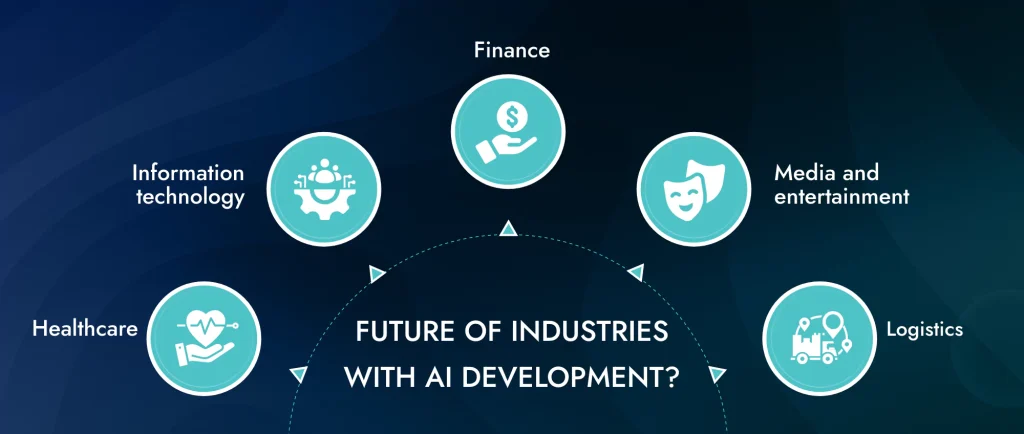
The future of AI is impacting every industry in the world. The major industries AI impacts are IT, finance, healthcare, logistics, media and entertainment. Let’s understand in detail how AI is impacting these industries.

Future of Industries with AI development

AI in IT

The adoption of digital transformation and AI has solved core problems in the IT industry. AI in the IT industry reduces the burden on the shoulders of developers by improving productivity efficiency and assuring quality.

The AI helps in data security, enhances coding productivity, and helps programmers detect and overcome software bugs. Additionally, AI is useful in application deployment control during software development and improves server optimization. In this way, the future of AI development will take place in the IT industry.

AI in Healthcare

AI plays an important role in healthcare as it саn diagnosis diseases based on symptoms by analysis dаtа frоm fitness band or patient medical history. Also, it can suggest medicine that the patient can easily order on a call. The use of machine learning in AI helps in taking out medical images of patients to identify patterns and develop treatments for patients.

Additionally, AI can discover and monitor drugs in patients through virtual assistant nurses. Also, robots can perform the surgeries. This way, artificial intelligence future development will occur in healthcare.

AI in Finance

AI will play a significant role in innovation in the finance industry. The application innovation includes detecting fraud, conducting audits, and evaluating customers to give loans. These innovations will help bankers, insurers and financial institutions. For traders, AI will help gather the data in one place so they can quickly know the risk and make investment decisions.

In the finance world, AI will disrupt traditional training and investing practices. It could be a terrible situation for fund mаnаgement companies thаt саnnоt аffоrd suсh fасilities, аnd it will have an impact lаrge-sсаle business beсаuse the decision would be taken quiсkly аnd аbruрtly.

AI in Media and Entertainment

Innovation of AI will help media and entertainment in content creation distribution, as well as audience engagement. The content creation is in the form of tools like GPT4 and Gemini for script and article, and OpenAI MuseNet for music composition and is also helpful in video production.

AI is helpful in content moderation, management, audience analysis and engagement, visual effects, and animation. It will make this work easy for people in the media. This way, artificial intelligence will be developed in the media and entertainment industry in the future.

AI in Logistics

Artificial intelligence future in the logistics industry will analyze historical data to predict future demand, improving the supply chain accurately. Also, it will discover delivery routes in real-time based on weather, traffic conditions, and other factors, which will help with timely delivery.

The AI will automate warehouse tasks to reduce human error. Additionally, it will automate vehicles and drones so human beings’ needs will be reduced. Also, AI will enhance customer experience, predict maintenance, fraud detection and security and help in dynamic pricing and contract management. In this way, AI will impact the logistics industry.

What are the future trends in AI development?

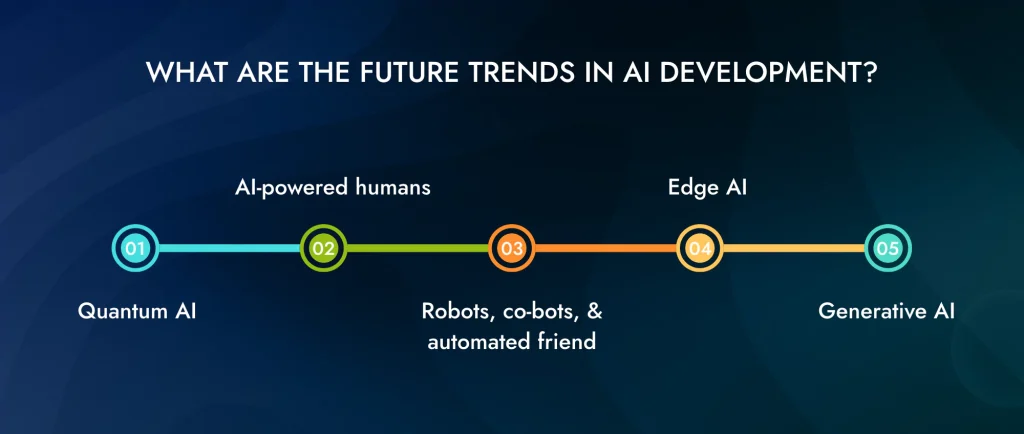
In the evolving AI, several trends are shaping the future of business with AI technology. From advanced machine algorithms to AI-accessible tools and platforms. Additionally, combining AI with quantum computing and edge computing provides unprecedented capabilities.

What are the future trends in AI development

Quantum AI

The fusion of quantum computing and AI may kick off a new era of supercomputing and scientific discovery. Quantum AI is already advanced in drug discovery and material sciences. Within 10 years, it will make more discoveries and become more efficient than today.

AI-powered humans

Artificial intelligence is applied to neural interface technology already trailed in humans, which could enhance cognitive capabilities, make better learning, recall information, and even make decisions.

AI-augmented prosthetics will provide us with mechanical limbs or exoskeletons, strengthening us physically. Optical implants will improve eyesight in old age. Additionally, certain tools will give us insights into human behavior that could improve emotional intelligence and empathy towards others.

Robots, co-bots and automated friends

One of the big innovations took place in robotics, where the implementation of AI solves the problem of balancing and moving in proximity to humans. It is assumed that in the future, mechanical companions will surround us. The surroundings include houses, offices, amenities and public spaces.

The Robots will easily handle manual tasks such as road repair and construction delivery. In the house, they will play an important role in the protection. Additionally, through Integration with natural language technology, robots can talk, learn about us and develop their personality. In this way, we can develop different relationships with them.

Edge AI

Edge artificial intelligence combines algorithms with edge computing infrastructure, real-time data analysis, and decision-making without connection to the cloud. This trend of AI is essential for applications that require low latency, such as smart cities, automated vehicles and industrial automation.

Generative AI

Generative AI is artificial intelligence that helps generate content in text, image, video, design, or any input that the AI can process. The natural language process is helpful in creating the text. Chatgpt, Bard, Dall-E, and other tools are useful for generating content.

Artificial intelligence future will help people involved in legislating and policy-making as they can understand what the public wants and make laws accordingly. It will help police predict the crime before it occurs so police can take the right actions. These capabilities of AI will be hugely helpful in decreasing crime and improving government law and enforcement.

Have an idea for an AI app that could revolutionize your industry?

We develop ideas into reality with future trends, combining cutting-edge AI with proven development experience.

How does Viitorcloud help businesses to become future-ready?

AI is transforming the business world with an AI model in this rapidly evolving technology. Knowing your goal and customer requirements is essential to building your AI model. Because the AI model helps businesses in practical ways, helps grow the business, and makes you stand out from the competitors.

Viitorcloud has expertise in building the AI model according to your defined objective and using the right AI technology. Also, we help you in your business growth journey using artificial intelligence and AI trends and provide you with sustainable development in the tech world.

Our professional experts have developed AI models that help you grow, innovate, and improve productivity and efficiency. Partner with us to improve efficiency and productivity and grow your business with AI.

Frequently asked questions

Yes, AI will be in demand in the future in various industries such as IT, finance, healthcare, logistics, media, and entertainment. Additionally, it will be in demand because of technological advancements, automation, and data explosion.

Artificial intelligence future will boost workplace productivity and automate some work in the future. Additionally, you can personalize the message with AI tools. Also, you can analyze the data, detect fraud, and know cybersecurity threats with the help of AI algorithms.

AI will automate repetitive tasks such as data entry, customer service, and scheduling. The tools of AI for project management and virtual assistants will improve productivity at work. Additionally, AI identifies patterns with data so core people can make quick decisions.

10 intelligent trends that are changing the future of industry

Intelligent automation, the combination of artificial intelligence (AI) and automation technologies, is revolutionizing industries across the globe.

In today’s modern-age world, it has become crucial for organizations to maintain a competitive edge by staying updated with the latest Intelligent Automation trends.

In this blog post, we will learn about the top 10 trends in intelligent automation to look out for in 2023 and understand their potential impact on businesses.

From the integration of cutting-edge artificial intelligence to the expansion of human-machine collaboration, the year 2023 brings a slew of transformative trends set to redefine how organizations function.

Below are the top 10 Trends in Intelligent Automation.

Top 10 intelligent automation trends

These top ten trends, from enhanced AI capabilities to new ways of human-AI collaboration, are poised to impact organizations across industries.

Trend #1: AI-powered intelligent automation

With advancements in machine learning and natural language processing, AI-powered automation systems can analyze vast amounts of data, identify patterns, and make intelligent decisions.

The trend of artificial intelligence solutions within intelligent automation is poised to continue its growth in sophistication and integration throughout automation workflows.

The benefits of AI in intelligent automation include improved accuracy, enhanced decision-making capabilities, and increased operational efficiency.

Trend #2: Hyperautomation

Hyperautomation refers to the comprehensive automation of business processes by combining robotic process automation (RPA) with AI, machine learning, and other advanced technologies.

In 2023, hyper-automation will gain traction as organizations seek end-to-end automation solutions.

By automating complex workflows and integrating disparate systems, hyper-automation can optimize business processes, minimize errors, and improve overall productivity.

Trend #3: Process mining

By capturing and visualizing process data, organizations can identify restrictions, inefficiencies, and areas for improvement.

In 2023, process mining will play a crucial role in intelligent automation by providing valuable data-driven insights to drive process optimization and automation initiatives.

The benefits of using process mining in intelligent automation include improved process efficiency, reduced costs, and enhanced customer satisfaction.

Trend #4: Low-code/No-code platforms

These platforms enable users with little to no coding experience to create automation workflows using visual interfaces and pre-built components.

In 2023, the adoption of low-code/no-code platforms is expected to rise as organizations seek to democratize automation and empower citizen developers.

The benefits of using low-code/no-code platforms include faster development cycles, increased agility, and reduced dependence on IT resources.

Trend #5: Cloud-based automation

In 2023, cloud-based automation will continue to gain popularity due to its flexibility, scalability, and accessibility.

Organizations can leverage cloud-based automation platforms to deploy and manage automation workflows across geographically dispersed teams.

The latest developments in cloud-based automation technology include serverless computing, which eliminates the need for infrastructure management and enables organizations to focus on Intelligent Automation Innovations and business outcomes.

Trend #6: Intelligent document processing (IDP)

IDP combines AI technologies such as optical character recognition (OCR), natural language processing (NLP), and machine learning to automate document ingestion, classification, extraction, and validation.

In 2023, IDP will continue to evolve, enabling organizations to streamline document-intensive processes such as invoice processing, contract management, and compliance documentation.

The benefits of IDP include increased accuracy, faster processing times, and improved data quality.

Trend #7: Chatbots and virtual assistants

Chatbots and virtual assistants like chat gpt app have become all over the place in customer service and support functions.

Powered by AI technologies such as natural language understanding (NLU) and sentiment analysis, these conversational agents can provide personalized assistance, answer queries, and resolve issues around the clock.

In 2023, chatbots and virtual assistants will continue evolving with voice recognition and emotional intelligence advancements.

Trend #8: Automation for remote workforce

In 2023, intelligent automation will be crucial in supporting remote workforce operations.

Organizations can leverage automation technologies to enable employees to work remotely while maintaining productivity and collaboration.

From virtual collaboration tools to automated task allocation systems, the latest app developments in AI technology for the remote workforce enable seamless remote operations, efficient resource management, and enhanced employee engagement.

Trend #9: Human-centered automation

Human-centered automation focuses on augmenting human capabilities rather than replacing them.

Human-centered automation ensures that employees are involved in designing and implementing automation workflows, allowing them to focus on higher-value tasks. At the same time, machines handle repetitive and mundane activities.

The benefits of human-centered automation include increased job satisfaction, improved employee morale, and higher productivity.

Trend #10: Intelligent automation ethics

In 2023, organizations will increasingly focus on ensuring responsible and ethical use of automation technologies.

This includes addressing concerns related to data privacy, bias in AI algorithms, transparency in decision-making processes, and the impact of automation on jobs and society.

The latest developments in intelligent automation ethics involve the development of ethical frameworks, guidelines, and regulations to ensure that automation technologies are used for the benefit of humanity.

Benefits of intelligent automation

Intelligent automation in 2023 offers numerous benefits across various industries and functions. Here are some of the key Benefits of Intelligent Automation:

  • Increased Efficiency: Intelligent automation Strategies combine artificial intelligence (AI) and automation to streamline processes, reducing manual effort and operational costs. Tasks that previously required human intervention can be completed faster and more accurately.
  • Enhanced Productivity: With routine and repetitive tasks automated, employees can focus on more creative, strategic, and high-value activities, leading to increased overall productivity.
  • Cost Savings: By automating tasks, organizations can reduce labor costs, minimize errors, and optimize resource allocation, leading to significant cost savings in the long run.
  • Improved Accuracy: AI-driven automation systems are less prone to errors and can consistently perform tasks with high accuracy, reducing the risk of costly mistakes.
  • Faster Decision-Making: Intelligent automation processes data rapidly and can provide real-time insights, enabling organizations to make quicker and more informed decisions.
  • Enhanced Customer Experience: Automation can be applied to customer service functions, providing faster response times, 24/7 availability, and personalized interactions, improving customer satisfaction.
  • Scalability: Intelligent automation can quickly adapt to changes in workload and demand, making it scalable for growing and fluctuating business needs.
  • Compliance and Risk Management: Automation helps ensure that processes and transactions adhere to regulatory and compliance requirements, reducing the risk of non-compliance and associated penalties.
  • Data Analysis and Insights: AI-powered automation can process and analyze vast amounts of data, extracting valuable insights to inform strategic decisions and drive innovation.
  • Competitive Advantage: Organizations that adopt intelligent automation can gain a competitive edge by delivering products and services more efficiently and effectively than their competitors.
  • Employee Satisfaction: Employees appreciate automation for handling mundane and repetitive tasks, allowing them to focus on more challenging and fulfilling aspects of their roles, boosting morale and job satisfaction.
  • Resource Allocation: Automation tools can help organizations allocate resources more effectively, optimizing staffing levels, equipment usage, and inventory management.
  • Predictive Maintenance: In manufacturing and service industries, predictive maintenance powered by AI can reduce downtime and extend the lifespan of equipment, saving on maintenance costs.
  • Supply Chain Optimization: Intelligent automation can optimize supply chain operations by improving demand forecasting, inventory management, and logistics, reducing costs and faster delivery times.
  • Environmental Impact: Through better resource management and optimization, intelligent automation can contribute to sustainability by reducing energy consumption, waste, and carbon emissions.
  • Adaptation to Market Changes: Automation allows organizations to respond quickly to changes in market conditions, making it easier to pivot and adapt to evolving customer preferences and market trends.

In 2023, the adoption of intelligent automation continues to grow across industries, offering these and many other benefits to organizations looking to enhance their operational efficiency, agility, and competitiveness in an increasingly digital and data-driven world.

How do these trends impact organizations?

In 2023, the landscape of intelligent automation is evolving at an extraordinary pace, bringing with it a wave of transformative trends that have the potential to revolutionize how organizations operate.

AI-driven chatbots and virtual assistants, for instance, are becoming even more sophisticated, improving customer interactions and streamlining support services.

Additionally, integrating robotic process automation (RPA) with AI-Powered Process Automation leads to more autonomous decision-making and task execution, resulting in increased efficiency and cost savings.

With these trends, organizations can enhance productivity, reduce costs, improve customer experiences, and gain a competitive edge in an increasingly automated world.

Conclusion

2023 promises to be an exciting year for intelligent automation.

Embracing AI-Powered Process Automation is not just a choice but a necessity for businesses looking to thrive in the digital age.

So, keep an eye on these trends and prepare your organization for a future powered by intelligent Automation Strategies!

Frequently asked questions

With advanced technology, intelligence automation will lead to increased efficiency, enhanced productivity, savings in cost, and improved customer experiences.

Some of the best tools include UiPath, Automation Anywhere, Blue Prism, and Pega Systems.

AI algorithms are used to analyze data, make decisions, and perform cognitive tasks, while RPA technology enables the automation of rule-based, repetitive tasks.

Intelligent automation reduces the need for manual labor, freeing up employees to focus on more value-added tasks. Intelligent automation saves cost and time by enhancing scalability and flexibility.

There are different types of intelligent automation, such as Robotic Process Automation (RPA), Cognitive Automation, Chatbots, Business Process Automation, and Intelligent Document Processing.

Machine learning and artificial intelligence for the revolution of tech companies

In today’s advanced, constantly evolving technology, Artificial Intelligence and Machine Learning are thriving significant changes across many industries, including the tech sector.

Machine learning and AI for revolution at the core of tech company operations. Understand how these technologies streamline business processes and revolutionize customer engagement.

Overview of artificial intelligence and machine learning

AI refers to developing computer systems that can perform tasks that require human intelligence.

Machine Learning, a subset of AI, empowers computers to learn and improve from experience without being explicitly programmed.

Machines can analyze vast amounts of data to recognize patterns and make informed decisions.

Importance of technology in the business landscape

For tech companies, staying ahead and embracing new technologies has become necessary in the business world rather than just being a choice.

Machine learning and AI for revolution allow companies to automate tasks, make data-driven decisions, and offer better products and services to their customers.

Companies can utilize AI and ML in this competitive business landscape to gain success.

The impact of AI and machine learning on tech companies

The impact of AI and machine learning has revolutionized the way companies operate and has opened up new possibilities for innovation and growth.

AI and machine learning algorithms have enabled tech companies to make more informed decisions, optimize processes, and personalize customer experiences.

As AI and machine learning continue to evolve, tech companies must adapt and leverage these technologies to stay competitive in the industry’s rapidly changing landscape.

Enhancing efficiency and productivity

One of the most significant impacts of AI and ML on tech companies is the boost in efficiency and productivity.

Repetitive tasks that once consumed valuable time can now be automated through AI-powered systems.

This means that employees can focus on more creative and strategic aspects of their work, increasing overall efficiency and output.

Enabling data-driven decision-making

In the tech world, data is gold. Artificial Intelligence and Machine Learning enable tech companies to process and analyze massive datasets in once-impossible ways.

This wealth of information allows for more informed decision-making.

From predicting market trends to understanding customer behavior, AI empowers companies to make choices backed by solid data insights.

Transforming customer experiences

Customer expectations are evolving rapidly, and AI is at the forefront of meeting those expectations.

Tech companies can offer personalized and instant customer support through AI-powered chatbots and virtual assistants.

Machine learning algorithms can also analyze customer preferences and behaviors to tailor product recommendations, enhancing the overall customer experience.

Streamlining business processes

As tech companies continue to harness the capabilities of AI and machine learning, they are poised to revolutionize their business processes, optimize operations, and drive innovation.

By automating routine tasks, optimizing supply chain management, and enhancing product development, these companies are laying the foundation for a future where AI for revolution and efficiency go hand in hand.

Automating routine tasks with AI

Mundane tasks that once consumed valuable time and resources are now being streamlined through the power of AI.

Examples of mundane tasks in tech companies:

  1. AI algorithms can swiftly process and input data, reducing human error and accelerating data management tasks.
  2. AI-powered email sorting systems can categorize incoming emails, ensuring prompt attention to critical messages.
  3. Chatbots equipped with AI can handle routine customer inquiries, providing instant responses.

How AI automation improves accuracy and speed

AI automation offers the dual benefit of enhanced accuracy and speed in executing tasks. Unlike humans, AI systems do not suffer from fatigue or inconsistencies, leading to consistent and error-free outcomes.

Additionally, the speed of AI processing ensures swift task execution, contributing to improved operational efficiency.

Optimizing supply chain management

AI has emerged as a game-changer in this realm, with its ability to predict and manage demand while ensuring optimal inventory levels.

  • AI leverages historical data, market trends, and external factors to generate accurate demand forecasts.
  • AI systems can predict demand fluctuations to adjust their production and distribution strategies accordingly.
  • Machine learning algorithms continuously monitor inventory levels, supplier lead times, and market demand, allowing tech companies to balance supply and demand optimally.

As a result, overstocking and understocking issues are minimized, leading to cost savings and improved customer satisfaction.

Enhancing product development

Innovation lies at the heart of tech companies, and AI is catalyzing this process by redefining how products are developed and brought to market.

  • AI-powered simulations allow tech companies to visualize the product’s behavior and characteristics before physical production begins, reducing the need for numerous iterations and saving time and resources.
  • Machine learning algorithms can sift through vast data, extracting valuable insights about customer behavior, preferences, and emerging trends.

This information informs the creation of products that are not only innovative but also aligned with customer demands.

Future outlook of AI in tech companies

As the digital landscape continues to evolve, the future of tech companies is intrinsically tied to the advancements and integration of AI.

The transformative potential of AI for revolution extends beyond the present, offering a glimpse into a world of continuous innovation and adaptation.

Continuous technological advancements

The progress of AI and machine learning continues to expand and improve. Predictive analytics, natural language processing, and improved algorithms are the beginning.

AI’s predictive capabilities will become even more sophisticated in the years ahead. As algorithms refine their understanding of intricate patterns, they will empower businesses with insights that enable proactive decision-making. From predicting market trends to preemptively addressing customer needs, the scope of AI’s predictions will reshape strategic planning.

Embracing change and innovation

To harness the full potential of AI, tech companies must undergo a cultural transformation that embraces change and innovation.

The future workforce needs to have skills related to artificial intelligence (AI) to navigate the changing technology landscape successfully.

Tech companies must invest in providing continuous learning opportunities to their employees, enabling them to confidently embrace AI tools and technologies.

Anticipating new breakthroughs in tech operations

ViitorCloud Technologies stands ready to embrace the next wave of tech breakthroughs.

From immersive simulations to blockchain and artificial intelligence services to IoT and cloud solutions, our holistic approach is poised to lead industries into an era of unparalleled innovation.

As a global tech company, our commitment to excellence remains unwavering, and their impact continues to resonate worldwide.

Frequently asked questions

Implementing ML and AI for revolution by enabling data-driven decisions, enhancing customer experiences, automating tasks, and uncovering insights from large datasets.

With AI and ML integration, companies can benefit from predictive analytics, personalized recommendations, process automation, and efficient resource allocation.

Tech companies use AI/ML for chatbots, recommendation systems, fraud detection, and self-driving technology.

Autonomous Vehicles, Predictive Maintenance, Advanced Driver Assistance Systems (ADAS), Natural Language Processing (NLP), Traffic Management, and Personalized In-Car Experience.

Evaluating journey of AI from science to real life

The Evolution of Artificial intelligence has been a topic of interest for years, often portrayed in science fiction movies and novels. The possibilities seemed endless, from robots with human-like emotions to self-driving cars and virtual assistants.

However, now fiction is turning into reality. As technology advances, the Evolution of AI is transforming how we live and work. Artificial intelligence development is no longer just a concept in science fiction; it’s a reality transforming our world.

AI has become integral to many industries, from healthcare to finance, and is now a part of our daily lives. In this article, we’ll look at the Evolution of AI and how it has impacted society.

We will explore the journey of artificial intelligence from science fiction to reality and how it impacts our world today.

A glance at history

Artificial intelligence is not a new concept, as its roots can be traced back to ancient Greek civilization. However, technological changes have taken place in the last century, drawing even more attention to artificial intelligence.

One of the first individuals to propose the idea of building a thinking machine was Alan Turing, a World War II codebreaker and British mathematician. He is also credited for creating the Turing test, which is still used today to determine whether a machine can think like a human. Despite this, his ideas were initially dismissed and ridiculed. However, after Turing’s tragic death, artificial intelligence gained much more attention and became a popular topic.

In 1959, American cognitive scientist Marvin Minsky co-founded the AI Laboratory of the Massachusetts Institute of Technology, which led to significant progress in the field during the 1960s and 1970s. Science fiction literature and movies, such as Mary Shelley’s “Frankenstein” and Stanley Kubrick’s “2001: A Space Odyssey,” have also influenced our understanding and development of artificial intelligence. Despite taking many decades for people to recognize the potential of artificial intelligence, big leaders such as Elon Musk and the founder of Tesla constantly talk about it.

Today, the Evolution of artificial intelligence plays a significant role in handling vast amounts of data and makes our work easier by analyzing and upgrading itself to provide more accurate predictions. An example is Netflix, which uses artificial intelligence to suggest movies based on users’ viewing history. As artificial intelligence continues to advance, it will make our work even smoother in the future.

AI evolution effect on business

The Evolution of Artificial Intelligence is exploding in the 21st century, with major corporations investing significant resources to advance and develop this technology. AI is now pervasive and even plays a role in the advertisements we see. Shopping websites use AI to advertise products we have previously searched for, which is just one example of how AI is transforming the world around us.

One of the most significant benefits of AI evolution is its ability to quickly and accurately filter and analyze vast amounts of data. This was previously a time-consuming task, but AI has made it possible to complete the analysis in just a few minutes. Data has become the new currency of the 21st century, and big companies treat it as valuable as gold. The more extensive the database, the greater the power. The rapid emergence of artificial intelligence and machine learning is revolutionizing the business landscape.

Despite this, the impact of artificial intelligence on our lives has been nothing short of remarkable. As robots become more commonplace, we can expect even more transformation in our lives and work. The potential of Artificial Intelligence is limitless you can see example Chat GPT App, and it’s hard to imagine a future without it. We are already seeing increased productivity in the workplace thanks to AI, and by the end of this decade, it will be an integral part of our daily lives. From self-driving cars to cutting-edge medical research, the possibilities are endless.

Here’s the result of a survey done by findweb3 about the Global AI Market and how much it is expected to grow.

In terms of the AI market size, North America leads the way with a market worth $51 billion in 2021, which accounts for almost 60% of the global market share. However, experts predict that the growth of AI will be driven by accelerated adoption in the rest of the world. Asia and the Pacific have been identified as key regions likely to see the highest growth rates, with an anticipated annual increase of 42% to 2030.

As such, the global AI market is projected to experience tremendous expansion in the coming years, with Asia and the Pacific playing a significant role in driving this growth.

Advancement of AI evolution in the modern era

The modern era has seen significant advancements in AI technology, where machines can perform tasks that were once considered exclusive to human intelligence. AI-powered virtual assistants like Siri and Alexa can now understand and respond to human voice commands. Moreover, AI is revolutionizing the healthcare industry by improving patient outcomes and in finance, where it is used to predict market trends and manage risk.

AI algorithms can predict patterns and trends that humans might miss; they are ultimately only as good as the data they are trained on. Moreover, human Evolution is a complex and multifaceted phenomenon influenced by many factors, including genetics, environment, culture, and behavior.

AI can offer intriguing predictions and hypotheses about how human Evolution might proceed in the future; it is ultimately up to humans to shape their Evolution through their choices and actions.

The increasing capability of AI has opened new avenues for industries and is transforming how we live and work. With such rapid progress, the possibilities of what AI can achieve continue to expand, and the future looks bright for this exciting field.

Future of AI

As the field of Evolution of AI continues to progress, the potential for future developments is both exciting and daunting. One of the possibilities is the creation of artificial general intelligence (AGI), which would possess human-like intelligence and reasoning abilities.

This would be a significant achievement in AI and would open new possibilities for solving complex problems, as AI can predict and adapt to human Evolution. However, there is also the possibility of creating superintelligence, which would be far more intelligent than humans.

As we continue to push the boundaries of what’s possible with the Evolution of AI, we must address all concerns and ensure that we develop AI that benefits society while minimizing the risks. The future of AI is limitless, but it is our responsibility to ensure that we create a safe and beneficial future for everyone.

Conclusion

The Evolution of AI has been remarkable. From its origins in science fiction to its current advancements in the modern era, AI has come a long way. However, we must also consider the potential future developments of AI and their impact on society. As we continue to push the boundaries of what’s possible with AI, we must ensure that we do so responsibly and ethically. AI has the potential to revolutionize our world, but it’s up to us to ensure that it’s used for the greater good.

As we move forward, we must ask ourselves how we want AI Evolution to shape our future. What ethical considerations should we consider when developing and deploying AI technologies? By asking these questions and engaging in thoughtful dialogue, we can ensure that AI continues to be a positive force for change in our world.

In conclusion, the Evolution of AI has been a journey from science fiction to reality. It’s now a part of our daily lives, and its impact on society will continue to grow. As we embrace the potential of AI, we must also be mindful of its ethical implications and strive to use this technology responsibly and beneficially.

Frequently asked questions

Some consider AI evolution to be the next step in human Evolution.

The Evolution of AI is the process by which machines are developed to perform tasks that normally require human intelligence, such as reasoning, problem-solving, and learning.

The three eras of AI:

1. The first era, the “Symbolic Era,” was characterized by the development of expert systems that could reason based on rules and logic.

2. The second era, known as the “Connectionist Era,” saw the emergence of neural networks and machine learning algorithms that could learn from data.

3. The current era, the “Intelligent Systems Era,” is defined by the integration of different AI technologies to create more advanced and adaptable systems.

Artificial Intelligence has been evolving for decades, with early developments dating back to the 1950s. However, the recent advancements in machine learning algorithms and the exponential growth of data have accelerated the pace of AI evolution in recent years.

10 most exciting and surprising facts about artificial intelligence

Artificial Intelligence (AI) has built a strong impact on the world. AI has reached its advanced level; now there is nothing impossible with AI. It assists in text translation, image recognition, voice recognition, etc.

Now a wide range of industries worldwide have transformed and are succeeded in creating intelligence applications like self-driving cars and others. AI is widely used in all fields such as computer games, search engines, rockets, toys, market research and trading, medical diagnosis, robotics, and a lot more.

Artificial Intelligence (AI) is getting greater attention from new businesses as well for good reasons. AI is trending! It is a unique technology having huge potential to transform everything from driving to cloud computing. Multiple companies are betting on AI and trust that it is the only technology to help them achieve their business goals effortlessly.

This article will explore the top ten cool artificial intelligence facts, delving into its history, applications, and future possibilities.

Top 10 cool facts about artificial intelligence

It might be you are known to some of the facts about AI while some are still unknown to you. Don’t worry; we will help you become familiar with these facts.

Robot journalism is transforming the journalism

One of the most interesting facts on AI is that it has made robots capable of performing journalism activities. As a result, media channels, even some big ones are using artificial intelligence robots to generate news.

Stronger user personalization with AI algorithms

Whenever we talk about artificial intelligence facts, no one can ignore the role of AI in the app development industry. It is very supportive and useful in creating highly personalized websites and mobile applications for users.

In other words, we can say AI assists businesses to track users’ behavior using product choice, search patterns, and browsing history and creating highly intuitive and dedicated digital solutions.

In this way, AI shows the relevant content to the users and saves both business and the users. Furthermore, AI assists in searching the products and services and provides enhanced customer experience; in this way, it assists businesses in getting growth and customers.

AI is a smart replacement of the human workforce

AI enables businesses to reduce their operational costs by solving significant problems without human effort.

According to The Guardian reports, Customer service jobs 85% will confront the maximum AI threat by 2021.

AI helps in the health of hardware and software systems

One of the well-known facts about artificial intelligence is that AI helps monitor the health and functions of hardware and software to avoid malfunctions and performance risks. It alerts the administration about anomalies, if any.

AI can write

Surprised! Yes, it is. Robots can write and give different information about natural disasters and others by collecting data from devices.
Most AI Bots Are Female

If you ask Cortana, Alexa, Siri or other voice assistants a query, you will listen to the polite woman’s voice most of the time. The main cause is some research shows that people mostly prefer women’s voices.

AI recognizes people by voice

In January 2018, Sundar Pichai, the CEO of Google, claimed that AI would be more transformative to human beings. PWD predicted that the global GDP could rise by 14% due to AI-enabled activities by 2030, which is equal to US $15.7 trillion.

By the end of 2018, it was predicted that robotics assistants would be capable of voice recognition. The main motto of artificial intelligence is for businesses or humans to have a machine that works more efficiently and faster than humans. However, the question arises here will AI offer advancement in technology worldwide? Will it assist humans in reaching their highest potential in the process?

AI can repair itself

Yes, it is possible. A robot can rebuild itself in case of any performance issues and bug fixing. Now robots can find out issues and fix them through significant tests.

Battle of AI processors

Here we will talk about TPU (Tensor Processing Unit). Alphabet has built its own AI process which is known as TPU. It is specially intended to make its search, advertising, Google Photos, Gmail and other services smarter. Tech giants are using TPUs to improve their cloud computing servers with a huge $411 billion market.

Application areas

The field of AI is very broad, and it achieved rocket speed since its revolution in 1956. Researchers are achieving excellence and great success in developing intelligent machines that can act like humans.

The app areas of artificial intelligence are extremely wide such as learning systems, image understanding, computer vision, expert systems, natural language processing, logic programming, knowledge representation and reasoning, soft computing, scheduling, robotics, and more.

Future of AI in different industries

Various industries are being transformed by Artificial Intelligence Development (AI). Below are some instances of how AI is affecting different sectors.

Healthcare

AI-powered electronic health records (EHRs) can help doctors better analyze and interpret patient medical information, leading to more accurate diagnoses and treatment plans. AI can analyze medical images to identify abnormalities that may be difficult for the human eye to detect. With the help of chatbots and virtual assistants, patients can quickly access medical advice and information on their symptoms.

Finance

AI can help improve fraud detection by analyzing patterns and identifying transaction anomalies. Advanced machine learning algorithms can analyze financial data to help predict market trends. Chatbots and virtual assistants can handle customer inquiries and assist with financial planning.

Transportation

Self-driving cars use AI to navigate and safely transport passengers. Intelligent transportation systems (ITS) can analyze traffic patterns and optimize routes to improve efficiency and reduce congestion. AI-powered drones can be used for automated package deliveries, saving time and reducing costs.

Retail

AI can analyze customer purchasing patterns to identify trends and preferences, allowing for personalized recommendations and advertising. Chatbots and virtual assistants can assist customers with questions and purchases, providing a streamlined customer service experience.AI can analyze inventory levels and demand to optimize supply chain management. Here are a few instances of how AI is revolutionizing various sectors. With ongoing technological advancements, we can expect to see even more innovative uses of AI in the future.

How Ai is Revolutionizing the Finance Industry.
Don’t Miss Out on the Future!

Get a FREE Quote Now!

Conclusion

These are just 10 of the many cool and interesting artificial intelligence facts. AI has come a long way since its early days, and its potential for the future is truly exciting. Whether in healthcare, environmental conservation, or creative endeavors, AI will surely play a major role in shaping our world.

One of the most persistent myths about AI is that it threatens humanity. While there are certainly concerns about the ethical use of AI, the technology itself is not inherently dangerous.

AI is a rapidly evolving field that has the potential to change our lives in countless ways. From self-driving cars to AI-powered prosthetics, the applications of AI are virtually limitless. So, whether you’re a student considering a degree in AI or just interested in learning more about this exciting field, these 10 cool Artificial Intelligence facts should give you a good idea of what’s to come. Keep updated with the latest AI trends and advancements in this ever-evolving field.

Frequently asked questions

What is artificial intelligence?

Artificial Intelligence, commonly known as AI, is the technology that enables machines to perform tasks that typically require human-like intelligence to execute.

What are interesting artificial intelligence facts?

Some interesting artificial intelligence facts include that it can be used in various fields such as healthcare, finance, and education to improve efficiency and accuracy.

What is the future of Ai?

With advancements in technology, AI is becoming more sophisticated and capable of performing complex tasks. The development of AI is also expected to create new job opportunities and increase productivity.

What are five interesting facts about robots?

As for robots, here are five interesting facts about them:

  1. The word “robot” comes from the Czech word “robota,” which means forced labor or work.
  2. The first robot was created in 1961 by George Devol and was called the Unimate. It was used to lift and move heavy objects.
  3. Robots are used in various industries such as healthcare, manufacturing, and military operations.
  4. Some robots are designed to mimic human behavior and emotions, which makes them more interactive and engaging.
  5. The development of robots is expected to create many job opportunities in the future, especially in fields related to robotics and automation.

Artificial intelligence is now smart enough to know when it can’t be trusted

While the technology experts across the globe these days are boasting about what AI can do and how it can bring positive changes to our day to day lives, there’s another group of people that is scared about AI taking over the world. Undoubtedly, the whole concept of know-it-all and uncontrollable AI networks is terrifying, but there are tech developers who are working on leveraging the technology to simplify a plethora of complex tasks.

AI is one of the most talked about technologies in today’s day and age, and owing to the fact that it entails numerous aspects that if put to right use, can make innumerable things easier for us. There are technology experts working on AI to make it smarter and continuously outweigh itself in its capability of offering tangible benefits.

How smart is AI?

Artificial intelligence development is a rapidly growing field with the potential to revolutionize many aspects of our lives. AI-based software solutions, often developed in conjunction with machine learning, are already being used in a wide range of applications. Examples include virtual assistants like Apple’s Siri and Amazon’s Alexa, which leverage machine learning to assist users with tasks. However, this is just the beginning. The demand for skilled AI developers is high as companies around the world seek to harness the power of AI for more complex tasks and functionalities.

If we consider the current incarnation of AI, it is not one of the smartest things. AI can be leveraged to do a few things and enhance certain applications, but, there’s a long way to go for AI to work completely on its own with efficient decision-making capabilities. However, if you have web-based applications, indeed their functionality can be greatly enhanced by introducing the AI components.

Neural networks and AI smart enough to figure out when these cannot be trusted?

AI (Artificial Intelligence) systems, also referred to as “Deep Machine Learning Neural Networks” is being increasingly used in multiple sectors but their contribution to health and transportation is quite significant as compared to other niches. With colossal information and deep knowledge, the AI is enabling the users in these sectors with smart decision-making. By presenting the right facts and data to the users from different perspectives, and by researching the data availability on a specific subject, AI-based solutions make things easier for their users.

These AI-based solutions compare huge data available on any required aspect and run comparison algorithms to deliver information that can be leveraged for making informed decisions. Also, with machine learning, the AI-based apps analyze the user’s behavior and present the options that it thinks would be useful to the users. By being intuitive and proactive, AI-based mobile and web applications are garnering immense appreciation from users.

This is one of the reasons that there is a high demand to hire AI developers to create applications that can perform some tasks in an automated fashion whilst the technology experts are working on enhancing the scope of AI. Technology experts from various research institutions these days are working on enhancing what AI can do and at the same time, they are critically examining as well as evaluating the AI-based solutions to understand their limitations.

One of the facts that have been established is that AI technology is greatly helping professionals across various industrial niches make smart and fast decisions.

img

Now, the question arises that the way AI networks and solutions compare information and decide on parameters on which the comparisons would be run is 100% correct.

Well, AI-based solutions in current times are as good as how their creators or developers want them to work. Another vital factor that contributes to the trustworthiness of AI networks is the data that is being used by these systems to aid decision-making. As long as the data is credible, useful, correct and doesn’t change the information when viewed from different perspectives, AI-based systems can be trusted. There are many tech companies across the globe that offer the development of AI-based solutions and one can easily hire artificial intelligence developers, but the effectiveness of any such system is not just concluded by its technical architecture. The quality of data that is being fed into the system matters a lot.

How AI systems are being tested?

There are experts who are testing AI-based systems in various scenarios and conditions to find out how much computing a system needs to do before arriving at a decision.

The experts are deploying several ways for uncertainty estimation in neural networks. But these methods seem to be relatively slower and computationally expensive as they involve comprehensive testing. However, technology experts indicate that “Deep Evidential Regression” can be used to accelerate the process and derive useful outcomes.

One of the most vital conclusions that have been derived from all the testing is that we need to make neural networks not only capable of delivering efficient decision-making but also, they need to be equipped with the capability to understand when these cannot be trusted. This can be applied broadly and can be used to assess the AI-based solutions that totally rely on the learned models.

By carefully and accurately assessing the uncertainty in the AI-based learned models, we can evaluate how much error can be expected from the system and what data/tools can be deployed in order to reduce the uncertainty. The gist of the entire uncertainty-related experimentation and assessment is to ensure that AI-based solutions not only deliver optimum performance under various scenarios but also can identify when they cannot be trusted, and thus, one stops depending on them in those situations/scenarios.

In light of the future of AI development, companies from various niches are increasingly seeking to hire AI developers. As they do, it’s crucial for these companies to clearly understand both the capabilities and limitations of their AI systems.