How AR can be used for augmented reality engineering solutions

Today, Augmented Reality (AR) has emerged as one of the most significant futuristic technologies used across many industries, including engineering. The integration of augmented reality engineering solutions can unlock a realm of possibilities, fundamentally altering how professionals design, construct, and maintain various structures and systems.

AR overlays digital information onto the real world, enabling engineers to visualize and interact with their designs in a more immersive and intuitive way. This can help to improve the accuracy, efficiency, and safety of engineering projects.

Applications of AR in engineering

Augmented reality (AR) is being applied in a wide range of engineering fields, including architecture, manufacturing, and construction. By transforming traditional approaches and enhancing various fields, AR has made substantial strides in the engineering sector.

Let’s understand the role of AR in engineering:
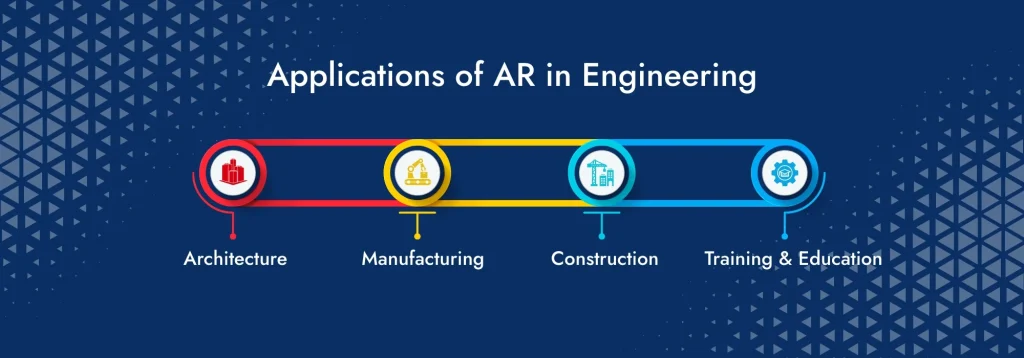
Applications of AR in Engineering

Architecture

Augmented reality in engineering is revolutionizing the way blueprints and designs are visualized. Using AR applications, architects can overlay digital models onto physical spaces. This allows them to see how the design will look and feel in the actual space, and to make necessary adjustments before construction begins.

Such a visualization not only aids in improving the design process but also facilitates better communication with clients and stakeholders by providing them with a realistic preview of the final product.

For example, an architect can show a client how their new home will look on their property, or they can collaborate with engineers to ensure that the design is feasible and meets all applicable codes and standards.

Manufacturing

AR is optimizing assembly line processes in manufacturing industries. Through AR-powered engineering solutions, workers receive step-by-step visual guidance overlaid onto the physical work environment.

This guidance significantly reduces errors, enhances productivity, and accelerates the learning curve for new processes or machinery. Workers can access critical information in real-time, ensuring accuracy in complex assembly tasks.

Construction

AR can be used to visualize the layout of construction sites. This can help to improve the efficiency of construction operations and to reduce the risk of errors. By using AR, engineers and workers can detect potential safety risks, such as underground utilities or structural weaknesses, before initiating construction.

This proactive approach not only minimizes risks but also ensures a safer working environment for on-site workers, significantly reducing accidents and project delays. AR can also be used to train workers in new construction techniques.

Training and education

Today, a large number of companies are leveraging AR to enhance training and education for engineers, For instance:

Boeing utilizes AR technology to train aircraft mechanics, offering digital experiences on wiring and repairing airplanes.

Siemens employs AR to train factory workers, guiding them through the assembly of complex machines with step-by-step interactive instructions.

Autodesk incorporates AR to educate students on engineering concepts, such as thermodynamics and fluid mechanics, providing an interactive learning environment.

Big brands led engineering innovation with AR

Let’s explore how leading brands have embraced AR, revolutionizing their engineering processes:

BMW: visualizing prototypes with precision

This popular automobile brand has integrated augmented reality software with its product data management system. This integration allows them to visualize and interact with true-to-scale prototypes, offering an in-depth understanding before finalizing designs for manufacturing.

BASF: leveraging digital twin technology for on-site precision

BASF has adopted augmented reality engineering solutions, through the implementation of digital twins. Engineers at BASF use AR to visualize planned pipelines on-site, ensuring accurate assessments of their intended functionality. AR aids in on-site monitoring, enabling swift identification of any design faults before they escalate into larger problems.

Lockheed Martin: enhancing aircraft assembly with ar integration

This global aerospace and defense company has embraced augmented reality to optimize its aircraft assembly processes. By integrating AR technology into their assembly lines, they can overlay digital schematics and instructions onto physical aircraft components in real time. This innovative approach reduces the likelihood of errors and improves overall efficiency while resulting in substantial cost savings.

Implementing an augmented reality engineering solution

The process of implementing an augmented reality engineering solution typically involves the following steps:

  • Identify the specific engineering needs and goals for the business or project. What are the specific challenges that the business or project is facing? How can AR be used to address these challenges?
  • Choose the right AR platform and hardware. There are a variety of AR platforms and hardware devices available on the market. It is important to choose the right platform and hardware for the specific needs of the business or project.
  • Develop or customize the AR solution. Partner with a reputable AR solutions provider company like ViitorCloud to build a custom AR engineering solution.
  • Deploy and train your workforce on the AR solution. Once the AR solution is developed, the users need to be trained on how to use it.

Starting augmented reality development

If you are considering implementing an augmented reality engineering solution, there are many companies like ViitorCloud that offer AR development services.

In the engineering field, AR is being used to revolutionize design, manufacturing, construction, and training processes. Engineers are increasingly leveraging AR to innovate and enhance their processes, leading to more efficient and effective solutions.

Conclusion

As the tech landscape continues to evolve, the future of engineering through AR presents an unparalleled horizon of possibilities. AR is not just a futuristic concept but a present-day reality shaping how engineers design, build, and innovate. ViitorCloud is at the forefront of this AR-led innovation in the field of engineering.

If you are looking for ways to improve the efficiency, accuracy, and safety of your engineering projects, consider building a custom augmented reality engineering solution that addresses these needs. Choose ViitorCloud as your partner for AR integration in engineering and embrace the future today!

Frequently asked questions

Augmented reality in engineering is revolutionizing designs, simulations, and safety assessments across the industry, transforming the way engineers visualize and interact with complex structures.

Applications of AR in engineering significantly enhance efficiency, accuracy, and safety, propelling the industry toward innovative solutions and streamlined processes.

Augmented reality in engineering optimizes processes by offering step-by-step visual guidance, reducing errors in complex assembly tasks, and improving overall productivity.

Applications or AR in engineering span across diverse sectors, from architecture to manufacturing and construction.

Engineers can get started with augmented reality by using existing AR platforms and hardware, or by developing their own AR applications.
How oil and gas metaverse solution bring change to the industry?

The concept of metaverse is getting acknowledged as the digital landscape is evolving daily. As the metaverse spreads its wings in various industries, Oil and Gas also experience the effect of Immersive Technology.

The metaverse is a collective virtual shared space that intervenes in the lines between physical and virtual worlds.

Traditionally, the oil and gas app development industry has been characterized by its high-risk environments, complex operations, and substantial reliance on data and communication.

Oil and gas metaverse solutions display an intriguing chance for innovation and transformation.

Understand the metaverse

The metaverse is a combination of various technologies, including Virtual Reality (VR), Augmented Reality (AR), Mixed Reality (MR), Blockchain, and more.

VR creates immersive, computer-generated, virtual environments, while AR overlays digital information onto the real world.

MR combines the features of both AR and VR, enabling the interaction of digital and physical objects. It is particularly useful for visualizing and inspecting products in real-time.

Blockchain technology ensures secure and transparent transactions within the Metaverse Development Company.

How the metaverse is changing the oil and gas industry

The oil and gas industry has been a crucial part of the global economy for a long time, providing the energy necessary for different sectors and driving economic growth.

However, in recent years, the industry has encountered several challenges, such as fluctuating oil prices and growing environmental concerns.

The oil and gas metaverse solution has come out as a transformative power, bringing new possibilities and reshaping the operations of the oil and gas industry.

With advancements in technology, ViitorCloud has created a world of opportunity by keeping the metaverse in its hands

Applications of the metaverse oil and gas development

With its immersive and interactive nature, the metaverse offers numerous applications that can greatly benefit the oil and gas metaverse development.

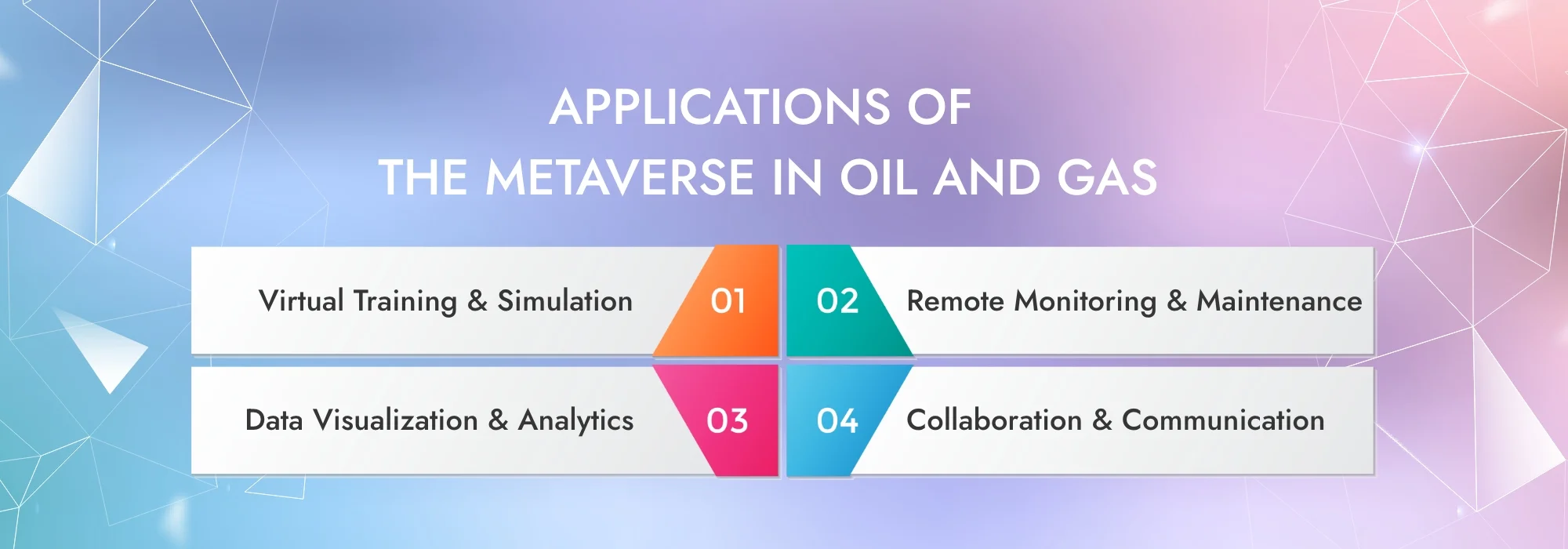
Applications of the Metaverse Oil and Gas Development
  • Virtual Training and Simulation:

This Oil and Gas Metaverse industry involves a high-risk environment, and that’s why ensuring the safety and competency of employees is very important.

With VR, employees can be trained in emergency response protocols and equipment handling by creating artificial scenarios and without exposure to the risks involved.

This improves safety and also saves costs associated with traditional training methods.

  • Remote Monitoring and Maintenance:

AR can be utilized for remote monitoring and maintenance in the Oil and gas metaverse solution.

AR applications provide real-time insights regarding the conditions of the assets, which helps in determining proactive maintenance and minimizing downtime. This way the need for on-site visits, time, and resources are saved in the oil and gas app development.

Technicians can access step-by-step instructions and visual aids through AR glasses or mobile devices, enabling them to perform complex tasks with greater efficiency.

  • Data Visualization and Analytics:

With the help of immersive technologies, such as virtual reality and augmented reality, data can be visualized more intuitively and interactively.

By creating virtual representations of oil fields, reservoirs, and pipelines, geologists and engineers can gain a deeper understanding of the data they are working with.

This allows for better analysis and interpretation, leading to more informed decision-making.

  • Collaboration and Communication:

Virtual meeting spaces and collaboration tools within the metaverse allow global teams to connect and work together in a more immersive and engaging manner to become effective and engaging.

Furthermore, immersive environments allow for brainstorming sessions that go beyond traditional video conferencing, allowing for more innovative and collaborative problem-solving.

Challenges and considerations in metaverse oil and gas

Incorporating the metaverse into the oil and gas industry has its own share of challenges and considerations. Some of these challenges are:

Challenges in metaverse oil and gas

  • Data Security and Privacy: The oil and gas industry deals with sensitive and critical data. Ensuring data security and privacy within the metaverse is a paramount concern.
  • High Initial Costs: Creating and maintaining a presence in the oil and gas metaverse solution can be costly, including the development of virtual oil rigs and operational environments.
  • User Training and Adoption: Training the existing workforce to navigate and operate within the metaverse includes ensuring that employees are comfortable with new virtual tools and environments.
  • Connectivity and Bandwidth: The oil and gas industry often operates in remote areas, so ensuring reliable and high-speed internet connections can be problematic.

Considerations in metaverse oil and gas

  • Remote Operations: The oil and gas metaverse solution can enable remote monitoring and control of oil and gas operations. Companies can manage rigs, pipelines, and facilities from anywhere, reducing the need for physical presence and improving safety.
  • Training and Simulation: Oil and gas metaverse solutions can help in practicing emergency response, equipment maintenance, and troubleshooting in a virtual environment, enhancing their skills without physical risk.
  • Collaboration and Communication: Virtual meeting spaces and collaborative tools in the metaverse can facilitate better communication between geographically dispersed teams, allowing for quicker decision-making and problem-solving.
  • Data Visualization: The metaverse can provide advanced data visualization tools, allowing professionals to interact with complex data sets in immersive 3D environments. This aids in data analysis and decision-making.

Case studies of oil and gas metaverse solution

The oil and gas industry is embracing technology, including the metaverse, to improve operations, safety, and efficiency.

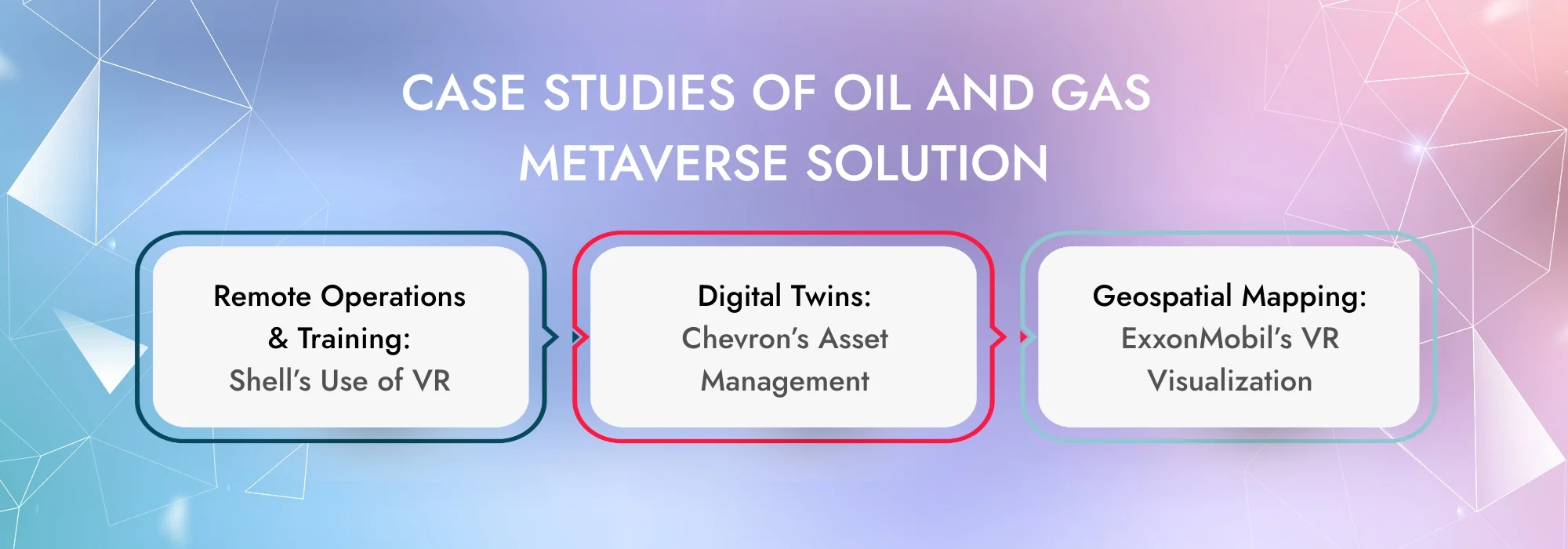
Case Studies of Oil and Gas Metaverse Solution

Remote operations and training: shell’s use of VR

Shell has implemented virtual reality (VR) and augmented reality (AR) for remote operations and training.

They use immersive technologies to provide realistic training scenarios and allow experts to guide field operators remotely.

Digital twins: chevron’s asset management

Chevron employs digital twin technology, a concept closely related to the metaverse, to create a virtual replica of physical assets.

This enables real-time monitoring, predictive maintenance, and efficient resource management in cooperation with oil and gas metaverse solutions.

Geospatial mapping: exxonmobil’s VR visualization

ExxonMobil utilizes VR for geospatial mapping and reservoir visualization.

Engineers and geologists can immerse themselves in data-rich 3D models, enabling better decision-making regarding exploration, drilling, and reservoir management.

Conclusion

Metaverse technology is arising with the potential to revolutionize Metaverse Oil and gas development in many ways.

Oil and gas metaverse solutions have the potential to improve efficiency, safety, and sustainability. It can also help the industry to attract and retain new talent.

With the Exciting Possibilities of metaverse Transform Your Industry and stay ahead of the game!

Frequently asked questions

Oil and Gas Metaverse can reduce costs by enabling remote operations, training, and collaboration, as well as by optimizing operations through data visualization and analytics.

Metaverse Oil and gas development can improve efficiency by streamlining workflows, automating tasks, and reducing downtime.

Metaverse Oil and Gas offers many benefits, including improved efficiency, reduced costs, increased safety, and enhanced sustainability.

Future trends for the metaverse in oil and gas include the development of more immersive and interactive applications, the integration of artificial intelligence and machine learning, and the increasing use of metaverse for remote operations and training.

How VR construction safety solutions transform safety?

Construction Safety VR Solutions are rapidly transforming the way workers are trained to navigate the perilous world of construction sites.

VR, which stands for Virtual Reality, is a technology that creates an artificial, immersive environment for training purposes.

VR immerses trainees in realistic construction environments, allowing them to learn and practice safety protocols without real-world risks.

By providing a safe and controlled learning environment, VR construction safety solution training addresses the unique challenges of the industry.

Evaluation of VR construction safety solution training programs

Evaluating the effectiveness of Virtual Reality VR safety training Solution programs is a crucial step to ensure that your investment in this innovative technology is delivering the desired results.

Measuring learning outcomes and knowledge retention

Evaluate trainee knowledge by assessing how effectively they apply safety measures in real-world scenarios with VR construction safety solution.

Assessing behavioral change and performance improvement

Look for improved safety behaviors and performance on construction sites, as this indicates the effectiveness of VR construction safety solution.

Analyzing cost savings and efficiency gains

Analyze cost savings related to reduced injuries, accidents, and training expenses, while also measuring efficiency gains.

Reviewing user feedback and satisfaction ratings

User feedback is invaluable. Collect ratings, comments, and suggestions to continually improve VR training programs.

Realism and accuracy

Evaluate the realism and accuracy of the VR simulations in representing construction site scenarios. Assess if the virtual environment accurately reflects potential hazards, site conditions, and safety procedures.

How to use VR for construction safety training

Virtual Reality (VR) has emerged as a game-changing technology for enhancing construction safety training. Here’s a step-by-step guide for Effective VR Training Techniques:

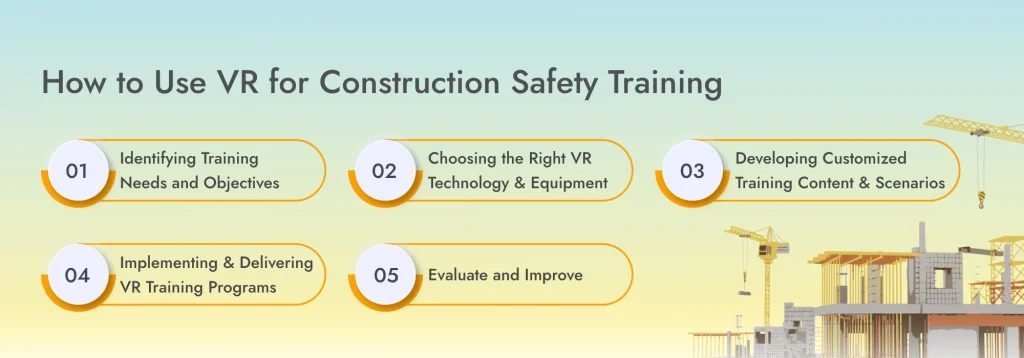
How to Use VR for Construction Safety Training

Identifying training needs and objectives

Before implementing VR training, it’s essential to identify the specific safety training needs and objectives for your construction workforce.

Choosing the right VR technology and equipment

Selecting the appropriate equipment for VR construction safety solution is crucial. Factors like cost, compatibility, and durability should be considered to ensure a seamless training experience.

Developing customized training content and scenarios

Tailoring training content to your construction projects and hazards ensures that trainees receive relevant, scenario-specific training.

Implementing and delivering VR training programs

The successful implementation of VR training involves onboarding, technical support, and training management. A clear delivery plan is crucial for trainees to access the content easily.

Evaluate and improve

Evaluate the effectiveness of the VR training program through ongoing assessment, feedback, and continuous improvement. Use evaluation results to refine the VR content, adjust training objectives, and enhance the overall training program.

Benefits of VR in construction safety training

Ensuring that construction workers are well-trained to handle the difficulties they face on the job site is important. The benefits of VR in construction are listed below.

Enhanced learning and retention

The immersive nature of VR makes training more engaging, resulting in better knowledge retention.

Digital experience services, like VR construction development, allow trainees to experience the consequences of their actions in a safe, virtual environment. This immersive training reinforces the importance of safety procedures in a way that traditional methods cannot.

Realistic and immersive training scenarios

Construction Safety VR Solutions recreates real construction environments, enabling trainees to experience realistic scenarios.

This enhances their preparedness for on-site situations and helps them develop effective safety habits.

Safe and controlled environment for practice

VR allows trainees to make mistakes and learn from them without jeopardizing their safety.

This controlled environment is ideal for mastering complex safety procedures and equipment operation.

Reduced costs and increased efficiency

Traditional safety training often involves expenses like travel, equipment setup, and physical materials.

VR construction development eliminates these costs and increases training efficiency, as it can be accessed from anywhere with compatible equipment.

Customizable training

VR allows for customizable training scenarios based on the specific needs of the trainees.

They can experience different scenarios, hazards, and procedures, allowing them to practice and master skills in a variety of situations.

Developing effective VR construction safety training programs

VR technology is offering a revolutionary approach to safety training. It provides an immersive and interactive learning experience, imitates real hazards, and offers cost-effective and customizable solutions.

With VR construction safety training programs, companies can better protect their workers, reduce incidents, and create a safer working environment.

As technology continues to advance, the construction industry must embrace these innovations to ensure the well-being of its workforce.

ViitorCloud Technologies has expertise in software development and VR application design has allowed our VR Developers to create highly realistic and effective safety training programs for the construction industry.

Conclusion

VR construction safety solution offers a groundbreaking solution to the safety challenges faced by the construction industry.

Implementing VR construction safety solutions will not only improve your workforce’s safety but also your bottom line.

By investing in Construction Safety VR Solutions, we invest in the lives and well-being of our construction workforce, making the future of construction brighter, safer, and more sustainable.

Frequently asked questions

VR can be used to improve construction safety in several ways, including Training workers on safety procedures, Identifying and mitigating hazards, and Improving communication and collaboration.

The cost of VR training for construction can vary depending on a number of factors, including the size and complexity of the training program, the type of VR equipment used, and the experience of the VR training provider.

Some of the best VR training providers for construction include STRIVR, Stantec, VR Training Alliance, HTC VIVE Enterprise, and 360Training.

Some of the benefits of using VR for construction designs are Visualizing designs in 3D, collaborating with stakeholders, Improved communication, and identifying and assessing potential problems.

How VR safety training can improve the oil and gas industry

In the dynamic and high-risk world of the oil and gas industry, safety is paramount. Workers often face perilous situations, complex machinery, and challenging environments that require rigorous training and preparedness.

Ensuring the well-being of employees is a top priority, and this is where VR Safety Training solution comes into play.

Let’s explore the various facets of VR safety training solutions for the oil and gas sector, its benefits, applications, challenges, and how to develop and implement VR Safety Training app development.

Overview of the oil and gas industry and its safety challenges

Virtual Reality, or VR, is an immersive technology that transports users to computer-generated environments, providing a realistic and interactive experience solution.

It has gained prominence in numerous industries, including healthcare, education, and entertainment.

From drilling rigs to refineries, employees are exposed to potential risks like fires, explosions, toxic gases, and heavy machinery accidents.

However, VR Training for Safety has proven to be a game-changer in the oil and gas sector, where its applications for safety training are transforming the way workers prepare for the challenges they may encounter.

VR Safety Training app development is non-negotiable due to the potential for catastrophic incidents.

Importance of VR in oil and gas safety training

VR technology is addressing the unique safety training needs of the oil and gas industry.

It offers a practical solution to immerse workers in realistic simulations, enabling them to practice and refine their skills without real-world risks.

The importance of VR in this context cannot be overstated, as it enhances safety measures, minimizes accidents, and ultimately saves lives.

Challenges and solutions of VR in oil and gas safety training

Challenges and LimitationsSolutions
Adoption and Implementation BarriersEnhanced Learning and Retention
Technical Challenges and Integration IssuesRealistic and Immersive Training Scenarios
Regulatory Compliance and CertificationSafe and Controlled Environment for Practice
Limited Access to Technology and ResourcesReduced Costs and Increased Efficiency

Real-life example:

There are numerous examples of companies using VR for safety training in the oil and gas industry.

Companies like Shell and BP have implemented VR safety training solution programs, reporting substantial benefits in terms of improved safety records, reduced accidents, and cost savings.

User feedback and satisfaction ratings in these programs have been overwhelmingly positive.

Applications of VR in oil and gas safety training

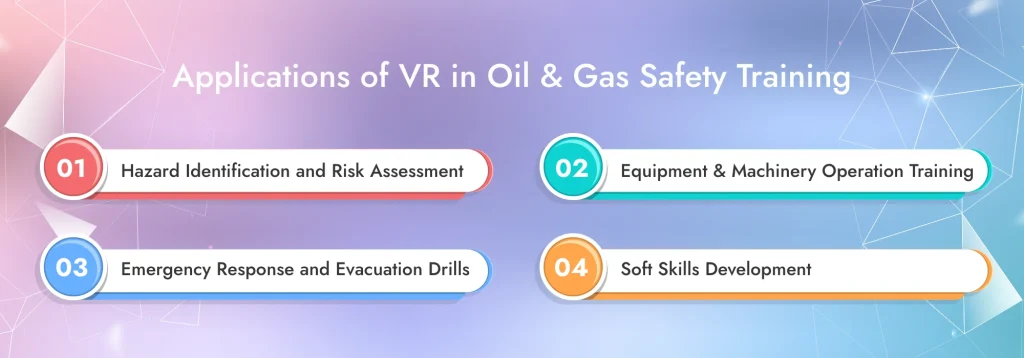
As we move forward, it is clear that VR has a pivotal role to play in the well-being of the industry and its workers. Some examples of application of VR in Oil and gas safety training are:

Applications of VR in Oil & Gas Safety Training

Hazard identification and risk assessment

VR training for safety enables employees to identify potential hazards and assess risks in a lifelike environment. This empowers them to proactively mitigate dangers, enhancing overall safety.

Equipment and machinery operation training

Operating heavy machinery and equipment in the oil and gas industry demands precision and skill.

VR simulations allow workers to familiarize themselves with machinery operations without the inherent risks of hands-on training.

Emergency response and evacuation drills

Oil and gas facilities must be prepared for emergency situations.

VR allows for realistic emergency drills, helping employees practice response procedures, evacuation routes, and crisis management.

Soft skills development (communication, leadership, etc.)

In addition to technical skills, soft skills are vital for safety in the industry.

VR can simulate challenging communication and leadership scenarios, helping employees develop the necessary interpersonal skills to manage critical situations effectively.

How to develop and implement a VR safety training solution program

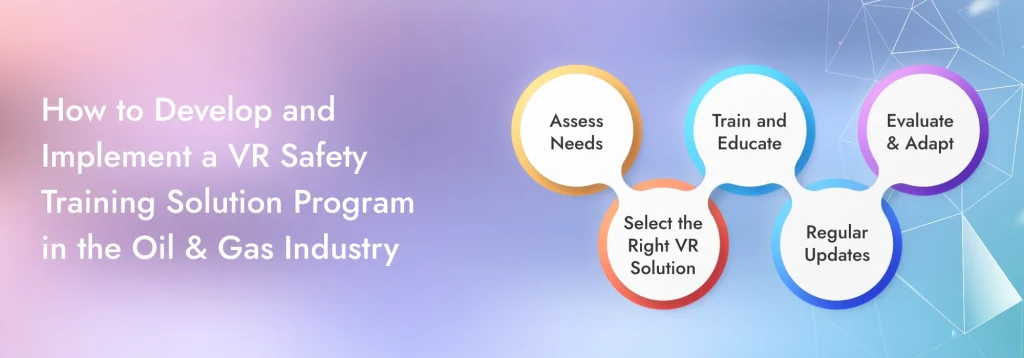
To develop and implement a VR safety training solution program in the oil and gas sector, companies should consider the following steps:

How to Develop and Implement a VR Safety Training Solution Program in Oil & Gas Industry
  • Assess Needs: Identify specific safety training requirements and areas where VR can make the most impact.
  • Select the Right VR Solution: Choose or develop VR training programs that cater to your industry’s specific needs.
  • Train and Educate: Provide comprehensive training for employees, ensuring they are comfortable using VR technology.
  • Regular Updates: Keep VR simulations and training materials up to date to reflect industry changes and emerging risks.
  • Evaluate and Adapt: Continuously assess the effectiveness of VR training, gather feedback, and make necessary adjustments for improvement.

Conclusion

VR is revolutionizing safety training in the oil and gas industry. The benefits are clear, from enhanced learning and risk reduction to improved efficiency and cost savings.

While there are challenges to overcome, the future of VR Safety Training app development in oil and gas safety training is promising.

VR Safety Training Solutions, VR for Safe Work Environments, and VR for oil and gas safety training are no longer just catchphrases; they are vital tools for enhancing safety and protecting lives in this high-risk industry.

Embracing this technology is not just a choice; it’s a responsibility.

Frequently asked questions

VR enhances oil and gas safety by offering immersive, risk-free training scenarios that prepare workers for real-world challenges.

VR can prevent falls in oil and gas by simulating working at heights and helping workers practice safety measures in a safe, virtual environment.

Leading VR safety training solution providers for oil and gas include Honeywell, EON Reality, and Strivr for their tailored safety programs.

Virtual reality is used in safety training by creating lifelike simulations for hazard identification, equipment operation, and emergency response.

How extended reality manufacturing solutions changing the industry?

In the ever-evolving landscape of manufacturing, staying ahead of the competition and optimizing processes is vital.

Extended Reality (XR), a revolutionary technology, is paving the way for a transformative shift in the manufacturing industry.

This comprehensive guide is tailored for manufacturing professionals, including engineers, designers, production managers, and C-suite executives.

We will explore Extended Reality Manufacturing Solutions in the industry, along with applications, benefits, development, real-world examples, and best practices for successful implementation.

What is extended reality (XR)?

Extended Reality, commonly referred to as XR, is a broad term that includes various immersive technologies designed to merge the real world with the virtual one.

XR includes Augmented Reality (AR), Virtual Reality (VR), and Mixed Reality (MR).

These digital experience solutions offer distinctive interactions merging physical settings with digital components, presenting users with fresh perspectives and engagement opportunities in their environment.

Augmented reality (AR)

AR enhances the real-world environment by overlaying digital information. For instance, AR can project assembly instructions onto a physical product, aiding workers in the manufacturing process.

Virtual reality (VR)

VR immerses users in a completely digital environment. It is often used for training and simulations, allowing employees to practice complex tasks without real-world consequences.

Mixed reality (MR)

MR combines aspects of both AR and VR, enabling the interaction of digital and physical objects. It is particularly useful for visualizing and inspecting products in real-time.

Why is XR relevant to manufacturing?

Extended reality manufacturing app development has become relevant for several compelling reasons:

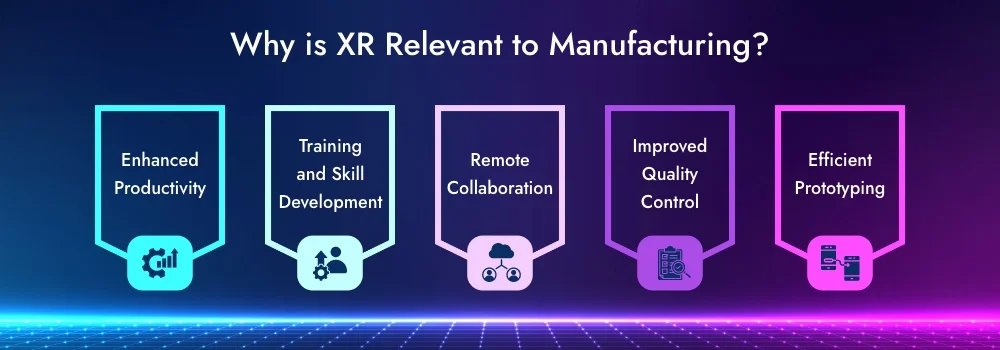
XR Benefits in the Industry are spreading widely. With the below-listed XR Benefits for Manufacturers, the industry is growing rapidly by implementing XR.

Why is XR Relevant to Manufacturing
  • Enhanced Productivity: XR technologies streamline processes, reduce errors, and enhance productivity on the factory floor.
  • Training and Skill Development: XR provides a safe and cost-effective environment for training employees, especially in high-risk industries.
  • Remote Collaboration: XR enables experts to provide remote assistance, reducing downtime and minimizing travel costs.
  • Improved Quality Control: XR aids in identifying defects, and ensuring products meet stringent quality standards.
  • Efficient Prototyping: XR facilitates the rapid development and testing of prototypes, saving time and resources.

XR applications in manufacturing

Extended Reality Manufacturing Solutions is becoming a versatile tool. Some of the applications are as follows:

Product design and prototyping

Manufacturers can create and manipulate 3D prototypes, allowing for more efficient and accurate design iterations.

Virtual training and simulation

XR provides a safe environment for employees to train and simulate complex tasks, reducing the risk of accidents and errors.

Remote inspection and maintenance

Technicians can remotely inspect and maintain complex machinery, reducing downtime and improving maintenance efficiency.

Quality control and assurance

XR technologies help in identifying defects and ensuring products meet the highest quality standards.

Process optimization

Manufacturers can use XR to visualize and optimize production processes, reducing waste and improving efficiency.

Supply chain management

XR assists in tracking inventory and managing the supply chain more efficiently, ensuring products reach customers on time.

Extended reality manufacturing solutions development

Implementing extended reality manufacturing solutions is developing a structured approach:

Identify your needs and goals

Begin by identifying the specific areas in your manufacturing process that can benefit from XR. Set clear goals to measure the success of the implementation.

Choose the right XR technology for your application

Select the most suitable XR technology—AR, VR, or MR—based on the requirements of your application.

Develop or select an XR solution

Depending on the complexity of your needs, you can either develop a custom XR solution or choose from existing ones.

Integrate the XR solution into your manufacturing workflow

Ensure a seamless integration of XR into your existing processes, considering hardware, software, and user interfaces.

Train your employees to use the XR solution

Comprehensive training is crucial for the successful adoption of XR technology. Provide hands-on training to ensure your employees are comfortable with the new tools.

ViitorCloud uses Extended Reality to develop customized solutions according to your requirements.

Extended reality manufacturing solutions examples

Real-world examples of Extended Reality Manufacturing solutions are given below:

  • Boeing employs AR glasses to guide workers through the intricate process of assembling aircraft wiring, reducing errors and improving efficiency.
  • BMW utilizes VR simulations to train employees in complex production processes, ensuring they are well-prepared for real-world tasks.
  • Siemens employs AR technology to guide technicians in maintaining complex machinery, reducing downtime and saving on travel costs.
  • Ford utilizes MR to allow workers to visualize and inspect products in real-time, improving quality control and reducing errors.

Best Practices for implementing XR manufacturing solutions

Extended reality manufacturing solutions are transforming the industry. These technologies offer innovative solutions that improve efficiency, safety, and productivity.

ViitorCloud helps in the successful implementation of XR manufacturing solutions which requires careful planning and process to best practices.

Here are some key guidelines for a successful XR integration in manufacturing:

Start small and scale up gradually

Begin with pilot projects in specific areas of your manufacturing process. Once proven successful, expand XR implementation to other areas.

Get buy-in from employees and stakeholders

Involve employees and key stakeholders in the decision-making process to ensure support and enthusiasm for XR adoption.

Provide adequate training

Invest in comprehensive training programs to equip your workforce with the skills needed to effectively use XR technology.

Measure and track results

Continuously monitor the impact of XR in Smart Factories, on your manufacturing processes, and optimize performance.

Conclusion

The future of Extended Reality in manufacturing is promising. XR technologies offer innovative solutions to enhance productivity, improve quality control, and provide cost-effective training.

As manufacturing professionals, embracing XR can revolutionize your operations, keeping you at the forefront of the industry’s evolution.

Develop your projects with extended reality manufacturing solutions, because it’s not just a trend, it is here to stay.

Frequently asked questions

How to implement XR in manufacturing?

Implementing Extended Reality Manufacturing solutions involves defining needs, selecting the right technology, integrating it into workflows, and providing thorough employee training.

How does XR improve manufacturing productivity?

XR improves manufacturing productivity through streamlined processes, reduced errors, and efficient training, leading to enhanced efficiency on the factory floor.

How does XR reduce manufacturing costs?

XR reduces manufacturing costs by minimizing the need for physical prototypes, enabling remote maintenance, and lowering travel expenses through remote collaboration.

How could the manufacturing sector utilize extended reality?

The manufacturing sector can utilize extended reality for product design, training, remote collaboration, quality control, and supply chain management, among other applications.

What are some use cases of XR in manufacturing?

Some use cases of XR in manufacturing include AR-guided assembly, VR-based training simulations, MR-enhanced inspections, and AR-driven quality control.