
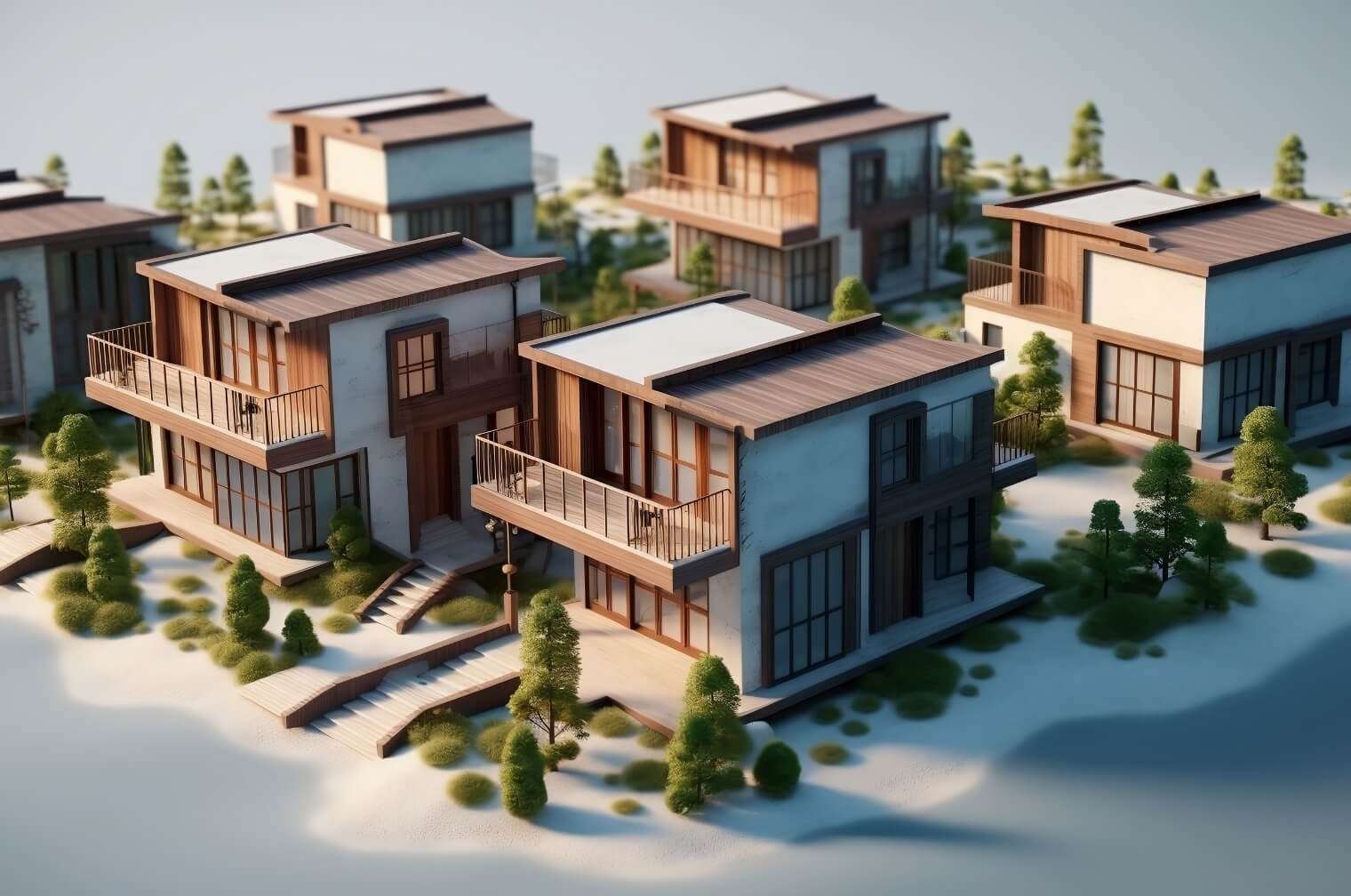
How real estate 3d rendering development is a game changer

The real estate industry is one of the industries which is constantly updating and upgrading. With the use of the latest technologies, this industry is undergoing an intense transformation in its marketing and sales strategies.

Real Estate 3D Rendering development has emerged as a game-changing innovation in the industry.

Let’s further explore everything about Real Estate 3D Rendering development, including its definition, applications, challenges, and area of app development with 3D rendering real estate solutions.

Real estate marketing and sales landscape

More than any other industry, Real Estate relies more on effective marketing and sales techniques.

The success of real estate transactions depends on the ability to capture the imagination of potential buyers and investors.

Traditional methods of showcasing properties, such as photographs and blueprints, often fall short in conveying the full appeal of a space.

Role of technology in transformation:

The real estate industry has embraced technological innovations over the years to improve the marketing and sales processes.

From online listings to virtual tours, technology has played a pivotal role in redefining how properties are presented to clients. 3D rendering for is the next logical step in this evolution.

What is 3d rendering?

3D rendering is a technology that allows for the creation of highly realistic visualizations and representations of physical spaces.

3D rendering for real estate can bring properties to life, providing potential buyers and investors with immersive experiences.

The future of real estate rendering is taking shape, and it promises to revolutionize the industry.

3D solutions for real estate refer to the process of generating three-dimensional visualizations of properties, both interior and exterior.

These visualizations are highly detailed and photorealistic, offering a comprehensive view of what a property looks like.

How does 3d rendering work?

The process involves creating a digital model of the property and applying textures, lighting, and other elements to make it look as realistic as possible.

The result is a virtual representation that can be explored from different angles, much like a real property.

A comparison with traditional methods

When compared to traditional real estate marketing methods, 3D rendering real estate solution stands out.

While photographs and 2D-floor plans offer limited perspectives, 3D rendering allows potential buyers to virtually walk through a property and visualize it as their own.

By creating engaging and informative digital experiences, businesses can significantly enhance decision-making and shorten the sales cycle.

Applications of 3d rendering in real estate

Real estate 3D rendering development offers a wide range of applications that enhance design, marketing, decision-making, and customer engagement. Some of these applications are:
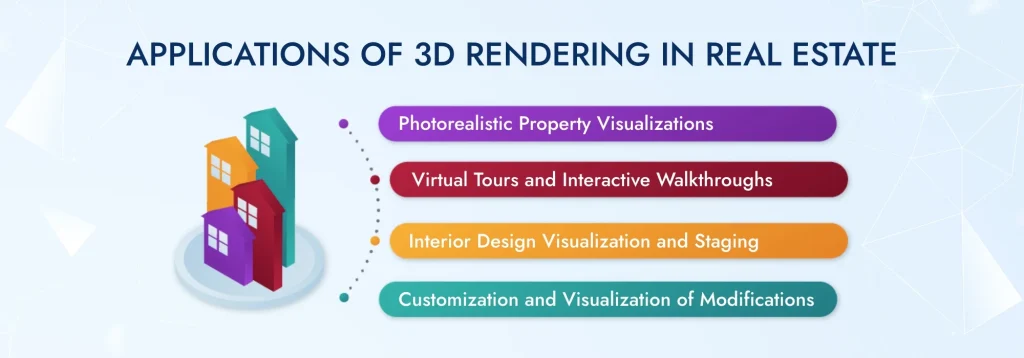
Applications of 3D Rendering in Real Estate

Photorealistic property visualizations

Real estate 3D rendering development is instrumental in creating visually striking marketing materials. From brochures to online listings, photorealistic renderings make properties appear as captivating as they are in reality.

Virtual tours and interactive walkthroughs

3D rendering real estate solution enables the creation of virtual tours, allowing clients to explore properties from the comfort of their homes. Interactive walkthroughs provide a sense of spatial awareness that traditional photographs cannot.

Interior design visualization and staging

For vacant or unfinished properties, 3D rendering real estate solutions can be used to stage and decorate spaces, helping buyers envision the potential of the property.

Customization and visualization of modifications

Prospective buyers can request specific modifications to a property and 3D rendering real estate app development can illustrate these changes before construction, allowing for customization and reducing misunderstandings.

Its ability to provide immersive and detailed visualizations has transformed the way real estate professionals operate, ultimately benefiting both property developers and prospective buyers or renters.

Challenges and limitations of real estate 3d rendering development

Challenges and Limitations in 3D Rendering for Real Estate Marketing and Sales.

While 3D rendering real estate app development is undoubtedly a game-changing tool for real estate marketing and sales, it comes with its fair share of challenges and limitations. Here’s a brief overview:

  1. Costs: Creating high-quality 3D renderings can be expensive. It requires skilled professionals, powerful hardware, and software licenses, which may not be feasible for all real estate businesses.
  2. Time-Consuming: Producing detailed 3D rendering real estate app development can be time-consuming. This can lead to delays in marketing campaigns and potentially longer listing times.
  3. Complexity: 3D rendering is a specialized skill. Finding or training professionals to create these renderings can be challenging, particularly for smaller real estate agencies.
  4. User Experience: While interactive 3D tours are captivating, not all potential buyers or investors may have the necessary devices or internet connections to experience them fully.
  5. Data Privacy and Security: Handling sensitive property data in the digital realm raise concerns about data security and privacy, necessitating robust measures to protect information.

Understanding and addressing these challenges is essential for real estate professionals looking to fully harness the potential of 3D rendering in their marketing and sales strategies.

Real estate 3d rendering development

As the demand for 3D rendering in real estate grows, so does the need for specialized apps. These apps can streamline the process of creating, sharing, and viewing 3D renderings.

The development process involves designing user-friendly interfaces, integrating rendering engines, and ensuring compatibility across various devices.

Enhanced visualization

3D rendering development allows potential buyers or investors to visualize the property’s layout, design, and features in detail before construction or renovation.

This can help them make informed decisions about the property and increase their confidence in the project.

Realistic lighting and textures

3D rendering development allows for realistic lighting and textures to be applied to the property.

This provides a more realistic representation of the property’s appearance and helps clients visualize the space better.

The cost of development

The cost of developing a real estate 3D rendering development can vary significantly based on the features, complexity, and platform chosen.

It’s important to consider these factors when budgeting for app development.

Conclusion

Real estate 3D rendering is a transformative tool that has the potential to redefine how properties are marketed and sold.

ViitorCloud Technologies has been delivering cutting-edge solutions across various industries for years and it extends to the Real Estate industry as well.

We have expertise in creating immersive and visually stunning applications and websites for Real Estate 3D Rendering Development that provide the specific requirements with the most seamless and engaging experience.

Don’t miss the opportunity to leverage the power of 3D rendering in your real estate business and stay ahead of the game.

Frequently asked questions

3D rendering is the process of creating two-dimensional images or animations from 3D models. It works by simulating the interaction of light with objects, textures, and camera angles to produce realistic visual representations.

The cost of 3D rendering for real estate can vary widely depending on factors like complexity, quality, and the service provider. Basic renders may start at a few hundred dollars, while high-end, photorealistic renders can cost several thousand.

To find a good 3D rendering solution for real estate, research reputable rendering companies, check their portfolios, read client reviews, and request quotes to compare pricing and quality before making a decision.
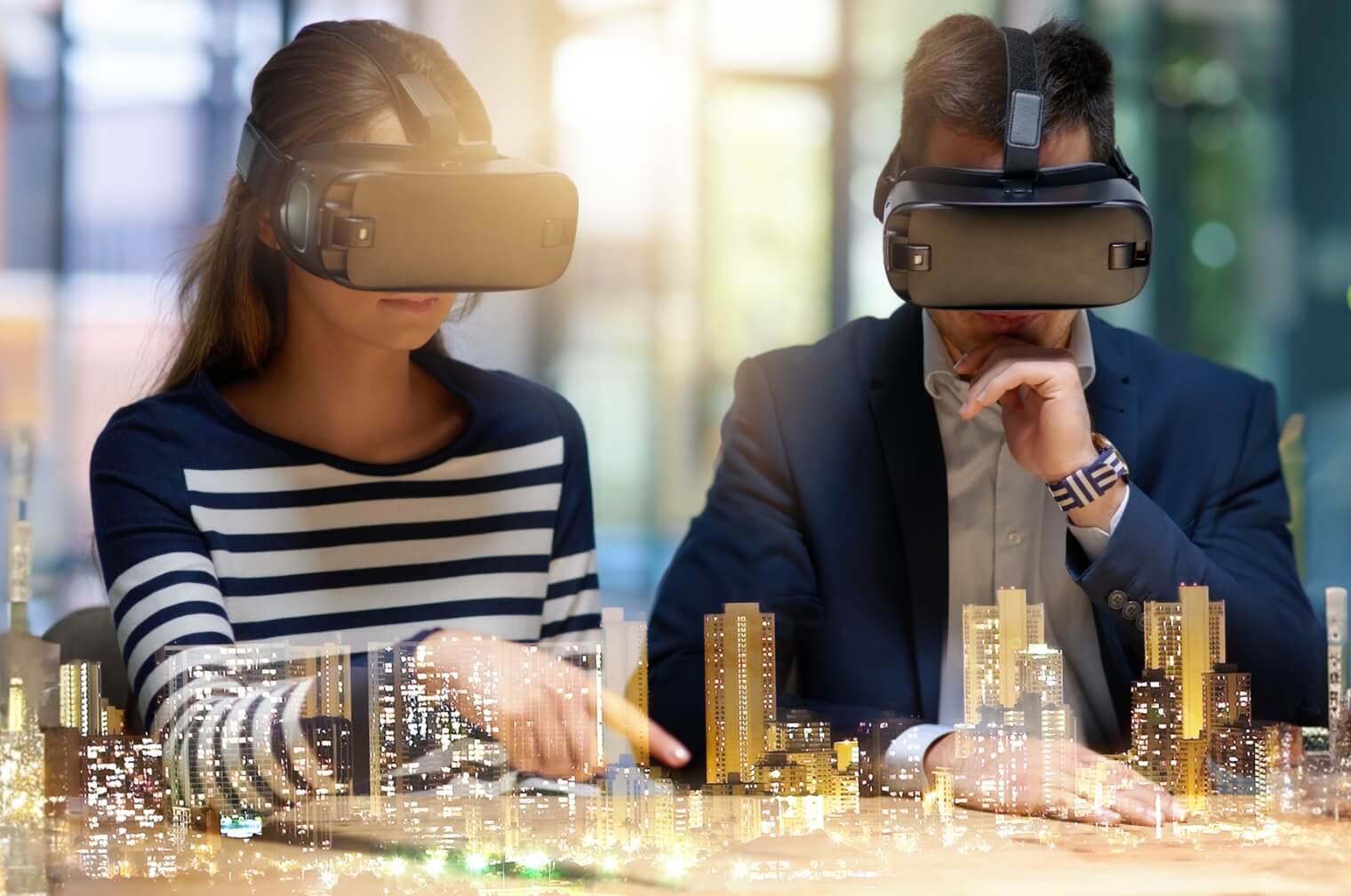
How immersive technologies can save real estate during the present crisis?

Owing to the current ongoing pandemic of COVID-19 and the resulting lockdown, potential buyers are stuck at home and the way to move outside from home, which has vastly affected the relationship between buyer-seller in all business domains.

But this turning situation has needed both the demand and supply sides to adapt to the best and newer ways to look at the real estate sector. The current crisis has also forced stakeholders, vendors, and business owners to increase the use of technology and other digital platforms to improve sales in this sector.

Undoubtedly immersive vr for real estate developers are facing a very challenging situation and working around it to attract buyers, mainly using tech-based solutions in the current situation.

Indeed, the lockdown has vastly impacted site visits and physical communication with real estate developers; real estate businesses are investing massive amounts in digital platforms incorporating modern ways to provide the physical experience of the property and book that online with comfort at home.

Online booking platforms, drone shoots, and virtual tours are getting more attention and prominence due to the increasing number of online buyers.

Role of immersive technologies in real estate

Immersive technologies such as virtual and augmented reality offer the real estate industry a unique opportunity to provide potential buyers with an engaging and interactive experience. These technologies offer an alternative to traditional open houses and property viewings, enabling prospective buyers to view properties worldwide.

Using immersive technologies in real estate has several benefits. They offer a more immersive and engaging experience that can save time, effort, and money for both buyers and sellers. They can also help real estate businesses to stand out in a crowded market, differentiate themselves from competitors, and cater to a broader range of clients.

Real estate and the AR/VR market

According to research from Goldman Sachs, Augmented Reality (AR) and Virtual Reality (VR) are expected to be an $80 billion market by 2025. VR is expected to generate $2.6 billion by 2025 alone in the real estate market. In the same year, more than 1,25,000 real estate agents will utilize VR to showcase homes to buyers with annual spending of $5,000, and it will grow yearly by 10%.

Step into the Future of Real Estate Business With
Immersive Technologies!

Get A FREE Quote!

Start-ups and well-established companies are eagerly adopting immersive technologies to support their businesses and make them durable during the current crisis. Additionally, the real estate sector will be one of the biggest recipients of VR-like technologies such as virtual showcases, virtual property tours, 3D- designs of interiors, exteriors, and engineering visualization.

One of the core benefits of VR technology is it ensures virtual co-locations of teams. When there is no space for physical meetings to ensure the primary messages, immersive technologies make it easy to transfer our best work cultures and project designs into the virtual world, to retain efficiency and reliability.

All such benefits are related to the lockdown period: up to 2/3 of all real estate projects suffer from cost and time overruns due to several issues like communication gaps, and it has become a big challenge for realtors. It is also a painful condition for all architects and designers – the gap between on-paper and end-product designs.

One of the simple reasons for this gap is the incompetence of clients to observe space and designs from the 2D media of renderings and drawings, and rapid iterations to meet their expectations become a highly chargeable tool for the industry resources.

The impact of immersive vr on real estate marketing and sales

The impact of immersive virtual reality (VR) on real estate marketing and sales has been significant. VR has revolutionized the way properties are showcased, allowing potential buyers to experience them in a more engaging and realistic manner. Here are some key ways in which VR has influenced the immersive VR for real estate industry

How VR is transforming real estate marketing

VR is changing the way properties are marketed to potential buyers. With Immersive VR for real estate, potential buyers can take virtual tours of properties without physically visiting them. This is especially useful in the current climate, where in-person tours may not be possible or safe. VR also allows buyers to experience a property’s spatial layout and scale in a way that traditional photographs cannot.

Case studies of VR adoption in the real estate industry

Several real estate companies have successfully adopted VR technology to improve their marketing and sales efforts. For example, Sotheby’s International Realty uses VR to give potential clients virtual tours of luxury properties. Zillow offers a virtual staging service that allows sellers to transform an empty home into a fully furnished one. These success stories show that VR can be a powerful tool for real estate businesses solution.

Benefits of immersive technologies

Immersive technologies can play a significant role in making the real estate sector more powerful and profitable. – by empowering virtual tours, empowering the stakeholders to make better decisions, offering a global reach and saving time and money through a modern transformative way of feeling, experiencing, reviewing, and updating projects even before the development phases.

Convenience

It is predicted that buyers want the technology to look at homes independently in the current situation. While agents need the technology to showcase their projects to buyers and generate demand on both sides.

Here VR-like immersive technology offers a more immersive and real-life experience without the time commitment and inconvenience of physically visiting the real estate properties for customers looking to purchase.

Feedback

The VR-like immersive technology solutions capture and record the specific areas of the property where buyers spend most of their time. Also, it can offer more valuable feedback to realtors about user preferences.

Confidence

Virtual visits to homes could boost the buying process by enhancing the confidence of potential home buyers. Virtual visits enable buyers to experience the property and make quick decisions if it fits with their requirements.

The confidence that comes from immersive technology is vital to customers, as indicated by the Forbes survey. The Forbes survey shows that 77% of all home buyers affirmed that virtual tours play a vital role in making quick buying decisions.

Challenges for immersive technologies in real estate

Challenges in implementing immersive technologies in real estate can include cost, technical expertise, and user adoption. However, the benefits of using immersive technologies to market and sell properties can outweigh these challenges.

By creating a compelling and engaging experience for potential buyers, real estate businesses can increase sales and gain a competitive advantage in their markets.

Immersive technologies have the potential to revolutionize the real estate industry, offering new ways to market, sell and showcase properties to prospective buyers. While there are still some challenges to overcome, the benefits of immersive technologies in real estate are clear. As we navigate the current crisis, embracing these technologies can help real estate businesses adapt to the new normal and stay ahead in a rapidly changing industry.

Conclusion

Before adopting immersive technologies factors, real estate businesses should consider their target market and the technology’s cost-effectiveness. Our immersive technology solutions include using the technology effectively according to the client’s willingness to adapt the technology.

In the future, intelligent, sophisticated, and immersive technologies will significantly drive more sales and potential buyers to real estate developers. Innovations and virtual technologies create more possibilities, improve customer experience, offer worldwide reach, save money, and bring more efficiency to the real estate sector.

Frequently asked questions

Immersive technologies are advanced technologies that create a highly interactive and engaging experience for the user, such as virtual or augmented reality.

Immersive technologies can provide virtual property tours, virtual staging, and even virtual reality property viewings, all of which can be done remotely, making buying and selling the property even during social distancing.

To integrate immersive technologies into your real estate business, you will need to research and invest in the necessary hardware and software and develop a strategy for implementation and marketing.

While immersive technologies can significantly reduce the need for in-person visits and make the process more efficient.