How AI museum tour app solutions can change visitors’ experience

Imagine walking into a museum and being greeted by a personalized tour guide who knows your interests such that they can tailor the tour experience for you. Well, this is the future of museum tours, thanks to AI museum tour app solutions.

AI development solutions are transforming museum tours, creating unique and engaging experiences for each visitor. By leveraging machine learning (ML) to analyze visitor data and preferences, these AI-powered museum tour apps personalize the journey, allowing visitors to explore at their own pace.

How AI museum tour apps work

AI museum tour apps typically work by collecting data on visitors’ interests, such as the types of art they like, the historical periods they’re interested in, and the amount of time they have to spend at the museum.

Collecting this data enables these apps to create an itinerary that includes the exhibits that the visitor is most likely to enjoy. Such apps for museum tours can also provide information about the exhibits, such as their history and significance.

Key features of AI museum tours apps

AI museum tour app solutions come with a range of features to enhance the visitor experience:

  • Interactive maps: AI museum tour apps can help visitors navigate the museum and find the exhibits they’re interested in.
  • Audio and video guides: AI museum tour apps can provide visitors with audio and video guides that provide information about the exhibits.
  • Gamification: AI museum tour apps can include gamification elements to make the experience more fun and engaging for visitors.

Benefits of navigating museums through AI apps

Art venues that embrace AI for museum tours can reap numerous benefits:

  • Enhanced Visitor Engagement: Personalized experiences captivate visitors, making them more likely to explore the museum’s offerings.
  • Data Insights: AI can collect data on visitor behavior, helping museums understand their audiences better.
  • Cost Efficiency: AI apps can reduce the need for guided tours and printed materials.

Developing an AI museum tour app solutions

Museums play a significant role in preserving our cultural heritage. They house invaluable collections of art, artifacts, and objects that may offer a glimpse into the past, present or future. AI-backed museum tour apps provide a range of features and functionalities that cater to the unique needs of museum visitors and businesses.

Understanding the unique needs of AI museum tours

AI museum tours have many unique needs that must be considered when developing an app solution. These include:

  • Personalization: AI museum tour apps should be able to personalize the tour experience for each visitor based on their interests, preferences, and time constraints.
  • Accuracy: AI museum tour apps should provide accurate and up-to-date information about the museum’s collection and exhibits.
  • Accessibility: AI museum tour apps should be accessible to all visitors, regardless of their age, abilities, or language skills.

Key features required for an effective AI museum tour app

Some of the key features required for an effective AI museum tour app include:

  • Personalized tour recommendations: The app should be able to recommend exhibits and tours based on the visitor’s interests and preferences.
  • Gamification elements: The app can include gamification elements, such as quizzes and challenges, to make the experience more fun and engaging for visitors.
  • Multilingual support: The app should be available in multiple languages to accommodate a global audience.

As an AI developer, the alchemy of code transforms museum visits into personalized odysseys, enhancing the exploration of art and culture with precision and innovation.

Importance of user-friendly interfaces and accessibility features

User-friendly interfaces and accessibility features are crucial components of an effective AI museum tour app.

Here’s why they are important:

  • Enhanced usability: A well-designed interface enables visitors to navigate the app effortlessly, find relevant content, and make the most of their museum visit.
  • Accessibility for all: Incorporating accessibility features such as text-to-speech capabilities for visually impaired users, adjustable font sizes, and compatibility with assistive technologies ensures that everyone can access and enjoy the app’s content.

Case study of top museum app

Today, AI-driven solutions are reshaping the way visitors engage with art and history. Explore the transformative journey of museums into the digital era through personalized and innovative technologies.

Louvre museum app case study

The Louvre Museum app is a comprehensive guide to the Louvre Museum located in Paris, France. This AI Museum tour app solutions provides visitors with personalized recommendations, real-time navigation, and in-depth information about the museum’s vast collection.

The app uses a variety of factors, such as the visitor’s interests, past visits, and current location, to recommend exhibits that they are likely to enjoy. The app also allows visitors to create their own custom tours, which can be saved and shared with friends and family, resulting in more personalized museum tours with AI.

Benefits for museum visitors

The app has benefited museum visitors in several ways, including:

  • Increased engagement
  • Improved learning
  • Improved accessibility

Benefits for business owners

The app has also benefited the museum financially by:

  • Increasing visitor satisfaction
  • Improving visitor spending
  • Collecting data on visitor behavior

Empower your museum’s journey into the future with ViitorCloud’s expertise in AI-driven museum tour app development. Let’s embrace the future!

How to get started with AI museum tours

If you’re a museum owner interested in AI-driven museum tour app development, here are some key tips to consider:

  1. Define Your Objectives: Clearly outline your goals and expectations for building an AI-backed app for museum tours.
  2. Research and Partner: Explore Museum tour app development companies that can leverage their mastery in AI and app development to bring your vision to life.
  3. Training and Maintenance: Ensure that your staff is well-trained in using and maintaining the app to provide seamless experiences for visitors.
  4. Promotion and Education: Inform your visitors about the new AI-powered features and educate them on how to use the app effectively.

Take the first step towards an immersive AI-powered museum experience with ViitorCloud. Partner with us to craft personalized, cutting-edge museum tours and captivate your audience.

Summing up

Latest tech Innovations in museum apps have redefined how visitors engage with cultural heritage, offering personalized, immersive experiences. Museum owners who wish to stay ahead of the curve should seriously consider adopting AI museum tour apps. With the right strategy and technology, you can create tailored journeys that captivate visitors and leave a lasting impression.

Take the first step toward a more engaging and informative museum experience – collaborate with ViitorCloud today. The right AI museum tour app solutions can bring numerous benefits, including increased engagement, data insights, and cost efficiency. Start your journey into the world of AI museum tour apps and witness the transformation for yourself. It’s time to revolutionize the way your visitors explore your museum’s treasures.

Frequently asked questions

It is a museum that uses AI to enhance the visitor experience by offering personalized recommendations, real-time navigation, and in-depth information about the museum’s collection.

You can use AI to analyze the visitor’s interests, past visits, and current location to create custom tours that allow visitors to explore the museum at their own pace and discover new things.

AI is constantly evolving and so are the possibilities it could bring. In the future, AI museum tours could become more personalized and engaging.

AI can be used in museums to provide personalized recommendations, real-time navigation, in-depth information, custom tours, visitor behavior analysis, and new ways for visitors to learn and experience.

Role of artificial intelligence in art preservation and restoration

Art preservation stands as a fundamental pillar in safeguarding our cultural heritage, ensuring that the legacy of humanity’s creativity endures through the ages. Using Artificial intelligence in art preservation brings new and innovative ways to safeguard our cultural treasures. Let’s learn more about the impact and benefits of AI-driven art preservation.

AI’s role in art conservation: digitizing and documenting art

By creating digital copies of art, we can ensure that it is accessible to future generations, even if the original artwork is lost or damaged. What’s more, digital documentation can help us to better understand and appreciate art.

Having digitized and documented art offers many benefits, including:

  • Increased accessibility: Digital art can be accessed by anyone with an internet connection, regardless of their location.
  • Improved security: Digital art can be easily backed up and stored in a secure location. This helps to protect art from theft, loss, and damage.
  • Better understanding of the art: Digital documentation can provide us with a wealth of information about art, such as its provenance, materials, and condition.

AI for detecting and assessing damage to art

Many different types of damage can occur to art, including:

  • Physical damage: Such as tears, punctures, cracks, and scratches caused by accidents, mishandling, or any other environmental factors.
  • Chemical damage: Fading, discoloration, and corrosion can be caused by exposure to pollutants, acids, or alkalis.
  • Biological damage: Damage caused by insects, mold, and fungi due to poor storage conditions or exposure to pests.

Detecting damage to art can be challenging for some reasons. For instance, chemical damage can be very subtle and difficult to spot with the naked eye. Also, art can be very delicate and can be easily damaged by improper handling.

AI can be used to detect and assess damage to art more accurately and efficiently than traditional methods.

AI-powered tools can be used to:

  • Identify and classify damage: They can be used to automatically identify and classify damage to artworks, reducing the time and effort required to detect and assess damage.
  • Quantify damage: They can be used to determine the size and depth of cracks or the amount of fading to make informed decisions about conservation treatments.
  • Predict future damage: They can be used to predict future damage to artworks based on their condition and environment.

Using AI to detect and assess damage to art offers many benefits, including:

  • Early detection of damage: AI-powered tools can help to detect damage to art earlier than traditional methods.
  • Improved decision-making about conservation treatments: They can provide art restorers with more information about the damage to an artwork.
  • Reduced costs: Automated art conservation, powered by AI, helps to reduce the costs of detecting and assessing damage to art by automating some of the tasks involved in the process.

AI for restoring and repairing art

Art restoration with AI is the process of restoring damaged or deteriorated artworks to their original condition. There are many different types of art restoration and repair treatments, depending on the type of damage and the materials used in the artwork.

AI can be used to restore and repair art with greater precision and accuracy than traditional methods.

AI-powered tools can be used to:

  • Identify and map damage: AI art restoration tools can be used to automatically identify and map damage to artworks. This information can then be used to develop targeted restoration treatments.
  • Guide inpainting: Art restoration with AI tools can be used to guide inpainting by suggesting colors and patterns that are consistent with the original artwork.
  • Reverse-engineer painting techniques: Analyzing the brushstrokes and colors used in the artwork can then be used to develop more effective restoration treatments.

Using AI to restore and repair art offers many benefits, including:

  • Improved quality of restoration treatments: By providing more precise and accurate information about the artwork.
  • Reduced risk of damage to the art: By guiding inpainting and reverse-engineering painting techniques.
  • Increased accessibility to art restoration services: By automating some of the tasks involved in the process.

AI for creating virtual reconstructions of art

Virtual reconstructions of art are digital representations of artworks that can be viewed and interacted with in a virtual environment. Virtual reconstructions can be used to preserve art by creating a backup of the artwork in case it is lost or damaged.

Virtual reconstructions can also be used to make art more accessible by allowing people to view and interact with artworks from anywhere in the world.

Using AI to create virtual reconstructions of art offers several benefits, including:

  • Increased accessibility to art: It can make art more accessible to people by allowing them to view and interact with artworks from anywhere in the world.
  • Improved understanding of art: It can help people to better understand art by providing them with different perspectives on the artworks.
  • Preservation of art that is at risk of loss or destruction: It can be used to preserve art that is at risk of loss or destruction by creating a backup of the artwork.

Case studies of artificial intelligence in art preservation

Preserving artwork using AI has led to several remarkable successes, reshaping the way we perceive the restoration process. For instance, the “Rembrandt Project” utilized AI algorithms to analyze and reconstruct a new Rembrandt painting, imitating the style and technique of the renowned artist.

Similarly, the Louvre Museum in Paris employed AI to restore “The Virgin and Child with Saint Anne,” effectively reconstructing damaged portions and enhancing the overall viewing experience.

These instances demonstrate the potential of artificial intelligence in art restoration, recreating lost elements, reviving the original charm of the artworks, and expanding our understanding of the artists’ techniques.

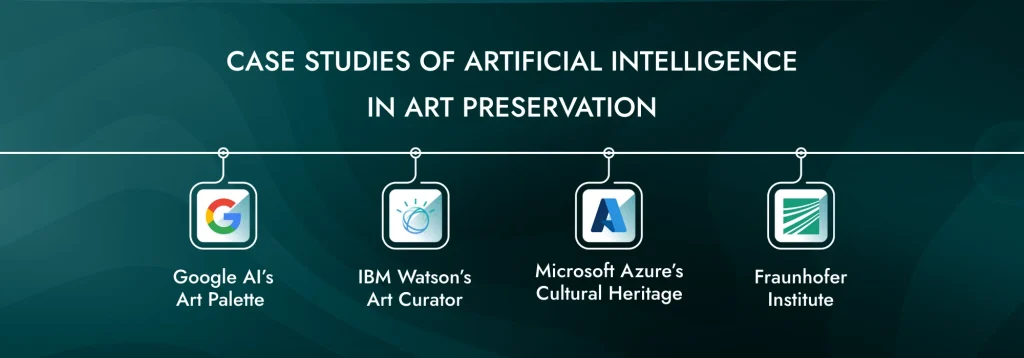
Case Studies of Artificial Intelligence in Art Preservation

Here are a few examples of artificial intelligence in art preservation:

  • Google AI’s Art Palette project uses AI to identify and analyze the pigments used in paintings. This information can be used to better understand the painting’s history and provenance, as well as to develop more effective conservation treatments.
  • IBM Watson’s Art Curator project uses AI to help museums catalog and manage their collections. AI can be used to automatically identify objects in photographs, transcribe handwritten documents, and generate descriptions of artwork.
  • Microsoft Azure’s Cultural Heritage Imaging project uses AI to digitize and restore historical photographs. AI can be used to remove noise from images, correct color fading, and even fill in missing pixels.
  • Fraunhofer Institute for Secure Information Technology’s AI-powered art restoration system uses AI to restore paintings with greater precision and accuracy than traditional methods. AI can be used to identify and remove damaged areas of a painting, and to reconstruct the original image using data from other similar paintings.

Utilizing AI in art preservation revolutionizes the conservation process, offering advanced tools for digitization, damage detection, and restoration.

To conclude

AI can be used to digitize and document art, detect and assess damage to art, restore and repair art, and create virtual reconstructions of art. In short, it has changed the way we preserve art and cultural treasures. In the future, we can expect to see AI-powered tools that are even more sophisticated and effective at preserving art.

Several organizations are working to develop and implement AI-powered solutions for art preservation. If you are looking for one, ViitorCloud makes the right choice. Experience the transformative power of AI art preservation solutions with us. Connect for a visionary approach to safeguarding art!

Frequently asked questions

AI in art preservation involves digitizing, documenting, detecting, and restoring artworks, ensuring their accessibility, security, and longevity.

AI art restoration aids in identifying, mapping, and guiding inpainting, enhancing precision and reducing the risk of damage to artworks.

Automated art conservation with AI offers early detection of damage, improved decision-making for restoration treatments, and cost reduction in the detection process.

Yes, AI can create virtual reconstructions, increase art accessibility, enhance understanding, and preserve artworks at risk of loss or destruction.

Yes, projects like the “Rembrandt Project” and the Louvre Museum’s restoration of “The Virgin and Child with Saint Anne” showcase the success of AI art restoration and preservation.

AI transportation solution transforming the industry in 5 ways

Transportation has always played a vital role in shaping societies and economies from the earliest days.

However, as we look towards the future, the transportation industry is on the verge of a technological revolution.

AI transportation Solution is the driving force behind this transformation, with the AI transport industry set to redefine the way we move and connect.

Autonomous vehicles: redefining mobility

Autonomous vehicles, often referred to as self-driving cars, are ready to improve the way we move from point A to point B.

These vehicles, equipped with artificial intelligence, sensors, and powerful algorithms, can drive themselves with minimal human intervention.

ChallengesSolutions
RegulationsImproved Safety
Public TrustReduced Accidents
Ethical ConsiderationEnhanced Accessibility

Benefits of AI in transportation

AI (Artificial Intelligence) is offering numerous benefits that are reshaping the way we move people and goods.

Here are five benefits:

  1. Improved Safety: AI plays a pivotal role in enhancing safety on our roads.
    • Advanced driver-assistance systems (ADAS) powered by AI can detect potential collisions, assist with lane-keeping, and even facilitate autonomous driving.
  1. Efficient Traffic Management: AI-driven traffic management systems are making our road networks more efficient.
    • AI algorithms analyze traffic patterns and adjust signal timings in real-time to reduce congestion.
  1. Enhanced Predictive Maintenance: It can predict when maintenance is needed, preventing breakdowns and ensuring vehicles are in optimal working condition.
    • This predictive maintenance reduces downtime, increases vehicle lifespan, and lowers operational costs.
  1. Optimized Logistics and Supply Chain: Route optimization, load planning, and demand forecasting are made more efficient with AI.
    • Companies can deliver goods faster and with less environmental impact, as AI helps in optimizing delivery routes and schedules.
  1. Eco-Friendly Transportation: Electric and autonomous vehicles, which often rely on AI for navigation and decision-making, are reducing the carbon footprint of transportation.
    • AI can also encourage the adoption of ride-sharing and public transit, further reducing emissions.

Smart infrastructure and traffic management

Smart infrastructure takes traffic management to the next level, bringing benefits for both urban planners and commuters.

Here’s what makes Smart Transportation and AI an important element in modern traffic management:

  • Smart infrastructure, equipped with advanced technologies and AI, combines the power of real-time data analysis and predictive modeling to reshape our daily commutes.
  • It enables real-time traffic analysis, allowing authorities to predict traffic patterns, identify congestion points, and optimize traffic signals. This data-driven approach ensures a smoother, more efficient flow of vehicles on the road.
  • By reducing congestion and optimizing routes, it minimizes vehicle idling, subsequently decreasing emissions and promoting eco-friendly transportation practices.
  • Cities like Singapore, Amsterdam, and Barcelona are embracing smart traffic management systems, resulting in less environmental impact by reducing emissions and promoting eco-friendly practices.

Artificial intelligence in transportation is not just about efficiency, but it’s a significant step toward greener and healthier urban development.

Logistics and supply chain optimization

Artificial intelligence has found a home in logistics and supply chain management.

  • Efficient Routes and Reduced Costs: AI algorithms calculate the most efficient routes for shipping, reducing transportation costs and ensuring goods reach their destination swiftly.
  • Predictive Analytics: AI-driven predictive analytics are indispensable in inventory management, accurately forecasting demand and optimizing stock levels.
  • Sustainability in Logistics: Embracing green transportation initiatives powered by AI helps in reducing the carbon footprint. This environmentally responsible approach aligns with modern expectations of businesses to operate in an ecologically friendly manner.

The integration of AI is a necessity in the dynamic world of logistics and supply chain management.

Public transportation 2.0: enhancing commuter experience

Public transportation is getting a much-needed upgrade through AI solutions.

  • AI transportation solution in public transportation are changing the game by predicting ridership patterns and optimizing schedules, making the daily commute more efficient and convenient.
  • The user experience has been vastly improved with real-time updates, digital ticketing, and personalized services tailored to individual preferences.
  • Beyond convenience, there are significant environmental benefits as AI-driven public transportation initiatives are encouraging more people to choose buses and trains over individual cars, ultimately reducing carbon footprints.
  • These enhancements of Artificial Intelligence transportation solution have a profound social impact, especially for differently abled individuals and seniors who now have greater accessibility and ease of use, ensuring that public transportation truly serves everyone in the community.

Future challenges and ethical considerations

As AI reshapes the transportation landscape, ethical considerations and challenges emerge. Privacy concerns arise as vast amounts of personal data are collected for various transportation solutions, requiring a careful balance between convenience and privacy.

There are also fears of job displacement as automation and AI threaten traditional roles, raising questions about the impact on the workforce.

Different countries have varying sets of rules, and ensuring consistency and adherence across borders is no small task.

Establishing a sticking framework that governs the operation and safety standards for autonomous vehicles globally is essential

Governments and international organizations play a vital role in shaping the future of transportation.

They are responsible for drafting and implementing the regulatory frameworks that will define the rules of the road for AI-driven transportation systems.

By collaboration and setting ethical guidelines, they can ensure that technology evolves in a safe, reliable, and efficient manner, paving the way for a transportation landscape that benefits all.

Conclusion

AI transportation Solution is not just about making our commutes easier; it’s about creating a future that is more sustainable, efficient, and inclusive.

To harness the full potential of AI in transportation, continued research, innovation, and collaboration is imperative. Together, we can build a brighter and more connected world.

Frequently asked questions

How is AI changing transportation?

AI is revolutionizing transportation by enabling the development of autonomous vehicles, optimizing traffic management systems, enhancing safety measures, and improving overall efficiency.

How is AI used in transportation?

AI transportation solution are used through autonomous vehicles, traffic management systems, and predictive maintenance to prevent breakdowns and enhance reliability.

How does AI enable autonomous vehicles?

AI enables autonomous vehicles by using sensors, cameras, and machine learning algorithms to perceive and interpret the environment, make decisions, and navigate without human intervention.

What are some examples of AI transportation solutions that are currently in use?

Some of examples of AI transportation solutions are Self-driving cars and trucks, Traffic management systems, Vehicle maintenance and diagnostics, Fleet management, and public transportation:

How can AI transportation solution help transportation industries?

Artificial Intelligence transportation solutions can help the transportation industry improve efficiency, reduce costs, and enhance safety.

How AI in video production is changing the conventional ways

In recent years, AI-powered video analysis and processing techniques have made it possible to automate tasks that were once time-consuming and labor-intensive.

From content recommendations tailored to individual preferences to the creation of hyper-personalized video content, AI has opened up a world of possibilities.

Let us dive into the blog and learn how AI video production is changing the content creation industry.

Understanding traditional video interaction

Traditional methods of video interaction have formed the foundation of video consumption for years and have become deeply ingrained in our viewing habits.

Exploring conventional methods of video interaction

Traditional video interaction allows users to click on a video thumbnail and press the play button to start playing the video, providing both visual and auditory experience.

While watching a video, users can pause or stop it at any time, and they also have control over the volume to adjust their viewing experience based on their preferences.

Users can manually scrub or drag the video timeline to navigate to specific points within the video, allowing them to skip forward, rewind, or find particular scenes.

As the benefits are going ahead, traditional video interactions also have limitations.

Limitations of conventional methods

Traditional methods provide limited options for personalization, often relying on platform recommendations or manual searches based on titles or keywords.

Determining the content of a video requires manual analysis and reliance on metadata. Users have to rely on titles, thumbnails, and video descriptions to determine if a video matches their interests, which can be time-consuming.

As technology evolves, these limitations are being addressed by integrating AI-driven advancements in video interaction. AI-driven recommendation systems offer personalized content suggestions, making video discovery more efficient and tailored.

The integration of AI in video interaction

Artificial Intelligence (AI) integration has brought about transformative changes in video interaction, significantly enhancing how users engage with video content.

AI’s capabilities enable real-time video analysis, recognition, and interpretation, revolutionizing the traditional video consumption experience.

AI’s role in enhancing video interaction

  1. Personalized Content Recommendations: AI-powered recommendation systems analyze user behavior, preferences, and viewing history to suggest videos aligned with individual interests.

This level of personalization enhances engagement and aids in discovering new content.

  1. Automated Content Tagging and Metadata: AI algorithms automatically analyze video content to generate descriptive tags, captions, and metadata.

This simplifies content search, making videos more accessible and discoverable.

  1. Enhanced Search Accuracy: AI enables semantic search, allowing users to find videos based on their actual content rather than relying solely on metadata.

This improves search accuracy and relevance.

  1. Video Summarization: AI-driven video summarization extracts key highlights and important moments from videos, offering users a quick overview without watching the entire content.

AI video production tools example

Several AI video production tools and technologies were used to automate and enhance various aspects of the process.

Pictory

Pictory is an AI in video production that allows you to easily create and highlight high-quality videos without any experience in video editing or design.

All you have to do is provide a script as the base for your video content, and that’s it. You can create captions, summarize videos, edit videos by changing your texts, and save, download, and share videos.

Synthesys

Synthesys is a leading company developing algorithms for text-to-voiceover and videos for commercial use. Synthesys helps in enhancing video content by providing 69 lifelike human avatars, 140+ languages and 254 unique styles, and an easy-to-use interface.

You can produce a high-quality video by typing your script and choosing an avatar and style.

Deepbrain AI

The Deepbrain AI video production tool can easily create your AI-generated videos using script and Text-to-Speech features in 5 minutes or less.

You can create a new project and start with your own PPT template or choose one of the starter templates. Manually type in or copy-paste your script, select the appropriate language, AI model, and finish editing.

You can export and share the created video.

HeyGen

HeyGen is a video platform that will help you create engaging business videos easily with generative AI.

This AI product video generator allows users to turn text into professional video directly from the browsers in a few minutes.

You can record and upload your real voice, choose from 300+ voices to create a personalized avatar or type in your desired text.

Rise of AI and its impact on various industries

Artificial Intelligence (AI) has emerged as a transformative force, revolutionizing numerous industries across the globe.

Its ability to analyze vast amounts of data and make informed decisions has led to significant advancements and improvements in various sectors. Here’s a glimpse of the impact of AI on different industries:

Healthcare

Diagnosis and Treatment: AI aids in diagnosing diseases and conditions by analyzing medical images, such as X-rays and MRIs, with high accuracy.

Medicine Discovery: AI expedites medicine discovery by analyzing complex molecular interactions and predicting potential drug candidates.

Patient Care: AI-powered tools assist in personalized patient care, treatment recommendations, and remote monitoring.

Finance

Risk Assessment: AI enhances risk management by analyzing vast financial data and predicting market trends.

Fraud Detection: AI algorithms identify unusual patterns to detect real-time fraudulent activities.

Algorithmic Trading: AI-driven algorithms execute trades based on real-time market data and complex trading strategies.

Manufacturing

Predictive Maintenance: AI in Manufacturing monitors equipment data to predict maintenance needs, minimizing downtime.

Quality Control: AI systems inspect products for defects with precision, ensuring high-quality production.

Supply Chain Optimization: AI optimizes supply chains by analyzing demand patterns and providing efficient logistics.

Entertainment and media

Content Recommendation: AI recommends movies, music, articles, and other content based on user preferences.

Content Creation: AI generates news articles, artwork, and music compositions.

Video and Audio Analysis: AI identifies copyrighted material and monitors content distribution.

The impact of AI extends far beyond these examples. AI solutions are now permeating nearly every industry, driving innovation and progress. As AI technology continues to advance, its influence is expected to deepen even further, creating new possibilities and fundamentally reshaping how we live and work.

Conclusion

Automated content tagging and transcription enhance accessibility by providing captions and searchable metadata. AI can also analyze video content to extract key moments, reducing the need for manual content analysis.

These advancements are ushering in a new era of video interaction that is more personalized, accessible, and efficient than ever before.

Frequently asked questions

No, ChatGPT cannot create videos. It is a language model designed to generate text-based responses.

AI and ML can potentially automate and enhance various aspects of video editing, including color correction, scene detection, and even automated storytelling.

Yes, AI can make videos with the help of deep learning algorithms and computer vision techniques.

As AI algorithms continue to improve, they can generate realistic and high-quality videos, automate repetitive tasks in the production process, and even assist in creative decision-making.

AI is changing video editing in several ways. It can automate time-consuming tasks, such as video summarization, object tracking, and removing unwanted elements from footage.

10 ways AI in manufacturing is transforming the industry

In the ever-evolving world of modern manufacturing, Industry 4.0 is a transformative approach that aims to revolutionize how we make, distribute, and use goods. Also referred to as the Fourth Industrial Revolution, it represents the coming together of advanced digital technologies to create smart factories and automated systems that work together seamlessly. And using AI in manufacturing is at the heart of this revolution.

In this blog, we will delve deep into the multifaceted role of Artificial intelligence technologies in manufacturing, exploring how they serve as the driving force behind the future of Industry 4.0 and unlock a realm of untapped possibilities.

Role of AI in manufacturing

The integration of AI into manufacturing processes has far-reaching implications for the industry’s future. Its predictive capabilities, process optimization, and collaborative robotics are reshaping traditional practices, propelling manufacturing into a new era of efficiency and precision.

In the context of Industry 4.0, AI serves as the catalyst for achieving the revolution’s objectives of enhanced productivity, increased flexibility, and more sustainable manufacturing practices. As the technological landscape continues to evolve, AI’s role in manufacturing is set to expand, unlocking a world of untapped possibilities and leading the way toward a smarter and more connected industrial future.

How AI solutions are transforming the realm of manufacturing

In the last decade, AI technology has emerged as a prominent term in the manufacturing industry, and it has gained further momentum with the recent release of the GPT-4 App and other notable AI technologies. Companies are increasingly investing in AI in manufacturing to harness the power of predictive maintenance, minimizing costly machine downtimes.

AI-based solutions are a powerful tool to overcome various internal challenges faced by the industry, including expertise shortages, complex decision-making, integration issues, and information overload.

By incorporating AI technologies in manufacturing plants, businesses can undergo a complete transformation of their operations. Let’s take a closer look at how AI is playing a crucial role in helping the manufacturing sector achieve its goals.

AI-powered data analysis: real-time decision making

AI-enabled data forecast in manufacturing is a game-changer. It empowers manufacturers with real-time insights, enabling them to make informed decisions that optimize production processes and boost profitability. By harnessing the potential of AI, manufacturers can drive their operations forward into a more efficient, agile, and competitive future.

Predictive maintenance: anticipating equipment failure

AI-powered predictive maintenance revolutionizes traditional maintenance practices by utilizing real-time data from connected equipment to predict maintenance needs. Manufacturers can identify potential equipment failures in advance, avoiding costly downtime and reducing maintenance expenses.

Quality control: enhancing product standards

Artificial intelligence technologies, such as computer vision and machine learning algorithms, have revolutionized the quality control process. By leveraging computer vision, AI systems can quickly and accurately identify defects in products, ensuring compliance with stringent quality standards.

Demand forecasting: meeting customer needs

Accurate demand forecasting is crucial for manufacturers to optimize production, minimize inventory costs, and meet customer expectations. AI algorithms can analyze historical data, market trends, and customer behavior to predict future demand accurately.

By leveraging these insights, manufacturers can adjust production schedules, optimize inventory levels, and ensure that the right products are available when customers need them. AI-powered demand forecasting also allows manufacturers to respond quickly to changing market conditions.

Process optimization: streamlining manufacturing operations

By analyzing data from various sources, including sensors, IoT devices, and production equipment, AI algorithms can identify bottlenecks, optimize workflows, and streamline operations. This leads to reduced cycle times, improved resource utilization, and enhanced overall performance. Manufacturers can leverage AI solutions to automate complex tasks, freeing up human workers to focus on more strategic and value-added activities.

Supply chain optimization: transforming manufacturing efficiency

In manufacturing, a compelling example of AI implementation lies in supply chain management. Dealing with millions of orders, purchases, materials, and ingredients manually consumes valuable time and resources. As a result, many companies are turning to AI companies to enhance their supply chain processes. The impact of AI-driven supply chain optimization is significant, leading to reduced costs, increased productivity, and improved customer satisfaction.

Autonomous vehicles: revolutionizing manufacturing logistics

Another exciting application of AI in manufacturing is the use of autonomous vehicles. Self-driving cars and trucks, equipped with AI algorithms and sensors, can automate and optimize logistics processes in manufacturing facilities. These autonomous vehicles can navigate production floors, transport materials, and optimize delivery routes, leading to increased efficiency and cost savings. By leveraging AI, manufacturers can achieve round-the-clock operations, minimize transportation costs, and improve delivery speed and accuracy.

Autonomous systems and robotics in smart factories

AI is powering the rise of collaborative robots, often known as Cobots, which play a crucial role in supporting human workers. Unlike traditional automated robots limited to repetitive tasks, they are designed to learn and adapt to various tasks.

Another area where these robots shine is in large warehouses, where they assist in locating and retrieving items efficiently. While Cobots take care of physically demanding and repetitive tasks, human workers can concentrate on complex decision-making and problem-solving.

Sustainable manufacturing

AI-based applications can help predict future energy consumption and emissions, even for upcoming shifts. Moreover, AI optimizes production processes by determining the most efficient process parameters and production sequences, further contributing to emission reduction efforts.

In the context of sustainable processes, our Co4 common platform stands as an exemplary solution. The platform predicts future energy consumption and emissions, even for upcoming shifts, enabling proactive measures for sustainability.

This futuristic solution has access to a range of common services such as electric vehicle charging, water management, energy monitoring, and carbon emissions tracking. It also includes a range of features to help users manage their energy usage and generation and ensure that everything is running smoothly.

The impact of AI in generative designs

AI has emerged as a game-changing technology in the field of generative design. By leveraging machine learning algorithms, generative design software can rapidly generate and evaluate thousands of design options, allowing manufacturers to optimize for multiple objectives such as cost, performance, and manufacturability. Furthermore, AI can also help identify and mitigate potential design flaws before production, saving valuable time and resources.

AI-powered manufacturing – the next evolution has begun!

The future of AI in manufacturing sector is incredibly promising. Companies worldwide are adopting intelligent manufacturing solutions to enhance product quality and competitiveness in the global market. As the role of AI in manufacturing continues to evolve, we can expect to see even greater improvements in efficiency, productivity, and quality across the entire industry.

Real-world companies are increasingly using AI-based solutions to revolutionize manufacturing processes. For example, General Electric (GE) has implemented an AI-powered system that analyzes data from sensors on its gas turbines to identify potential issues before they become major problems, reducing unscheduled downtime by up to 5%.

The dawn of AI evolution has arrived, and it’s just the beginning of a vast world of untapped opportunities. In manufacturing, the possibilities are limitless, and we’re only scratching the surface of what AI can truly achieve. Get ready to witness the transformation as AI reshapes the future of manufacturing like never before.

Conclusion

The fourth industrial revolution, Industry 4.0, has ushered in a new era of advanced manufacturing, where modern-day digital technologies converge to create smart factories and automated systems. At the heart of this transformative approach lies the role of AI in manufacturing, acting as a powerful tool that drives efficiency, productivity, and innovation in the manufacturing industries.

At ViitorCloud, we stand at the forefront of AI application development, driving innovation and transformation in the manufacturing industry. Our expertise in leveraging AI-powered solutions helps businesses optimize their operations, increase efficiency, and achieve a competitive edge. Embrace the power of AI with Viitorcloud, and let’s shape the future of manufacturing together.

Frequently asked questions

Industry 4.0 refers to the integration of advanced digital technologies to create smart factories and automated systems. AI plays a central role in this transformation, driving efficiency, quality, and innovation in manufacturing processes.

AI, through technologies like computer vision and machine learning, revolutionizes quality control by quickly identifying defects in products. This helps reduce waste and enhance production efficiency.

Companies can do so by identifying critical pain points, integrating AI technologies like predictive maintenance and quality control, and gradually scaling up AI’s implementation.

AI technology is extensively used in manufacturing to automate tasks, improve quality, and reduce costs. It can also be used to personalize products and services for customers.

Yes, AI-powered predictive maintenance utilizes real-time data to anticipate equipment failures and prevent costly downtime, leading to improved operational efficiency.

AI-driven supply chain optimization leads to reduced costs, increased productivity, and improved customer satisfaction.

Collaborative robots, or Cobots, powered by AI, work alongside human workers, handling tasks like heavy lifting and repetitive activities, enhancing efficiency, safety, and productivity in manufacturing factories.

How AI is making video games more immersive, engaging, and realistic

Along with the changes taking place in all fields, Artificial Intelligence has also made a lot of changes in the gaming industry. Artificial intelligence has been used in the gaming industry for a long time. If we compare the game of about 10 years ago with today’s game even at our level, then we will feel a big difference. The game was improved based on performance, graphics, usability, customizing, and many more.

Artificial intelligence is a major contributor to the rapid changes taking place in the gaming industry. The demand of Hire AI developers is Increasing. The main purpose of using it in the gaming industry is to give a good user experience. In this, the main effort is made to give real experience to the customer. To a large extent, Artificial Intelligence and Machine Learning are also successful in this. Be it racing games, simulation key games, or any other type.

But Artificial Intelligence is also getting upgraded every day, due to which we have the possibility of getting better services. Not only the possibilities but it is also capable of doing so. In this rapidly changing technology-filled world, Artificial Intelligence has brought a huge change in the gaming industry, this change will soon reach a very high level.

Experts’ views on changes

Experts have done a lot of research on how Artificial Intelligence will change the gaming industry in the coming times. The market value of the gaming industry in 2019 was around $150 billion. The estimated market value of this is expected to go up to $250 billion by the year 2022 due to artificial intelligence and virtual reality. To bring a J curve in your business Hire an AI developer Today.

How can AI help in gaming

Are you also surprised to know how artificial intelligence can be helpful in improving the game field? The answer is quite simple. All data relating to the game is stored in an artificial intelligence environment using cloud technology. Each character present in the game takes action using this data according to his own. This information includes the collector’s actions, action objectives, scenarios, etc. Due to this the gaming industry is becoming more upgraded and realistic. What are the main changes that Artificial Intelligence has brought, let us now know about them:

Smarter game

With the help of artificial intelligence, the symbol game in which it has been used has become even smarter. Using techniques like reinforcement learning and pattern recognition, the game takes the game to an entirely different level. With the help of these techniques, the characters present in the game are able to learn their actions themselves. They learn it automatically according to the data stored in the game. With its help, the game becomes more exciting.

The present character takes action according to the need in the game and is capable of making intelligent decisions. It does not feel like we are playing a virtual game, but it feels like the real world. The main purpose of artificial intelligence is to give life to inanimate things or the ability to think, and the same thing we are seeing happening in the gaming industry.

Realistic feel

The gaming industry has completely transformed in the last decade. Where we used to play text games and 2D games earlier, but today we have 3D games present in high quality. The 3D environment itself is a great feeling, but artificial intelligence makes it even more spectacular and real. Not only does it have good graphics, but the collector’s way of responding and replying is also excellent.

Enhanced gaming experience

Big games like FIFA etc. have been upgraded a lot with the help of artificial intelligence. When you play it you feel like you are really playing yourself. Because artificial intelligence is getting updated and upgraded every day, then you can guess how much its quality will increase if it is increased by 1 step and above with the help of artificial intelligence.

Similarly, action games will also look very real with the help of artificial intelligence. Although the gaming experience is still very good according to the past, after a few years it will get even better. Artificial intelligence is getting upgraded so quickly and in such a good way that it is almost impossible to even imagine.

image

Transform developers skills

Game developers always have to work on their skills, so that they are able to make a better game. And while developing the game, he was able to write the code in an interesting and new way according to him. Artificial intelligence will also motivate game developers to learn new skills. They will also get a chance to see the new world of Artificial Intelligence.

A better mobile gaming experience

According to statistics, today the number of users playing games on mobile is much more than on computers. In such a situation it becomes very important that the game is mobile-friendly. To give a better experience, the game should have the capability to adjust itself according to the mobile screen. Artificial Intelligence helps us in this, in which it automatically adjusts the action and movement according to the screen size. Also, the user gets a better experience so that he can enjoy the game to the fullest.

High-level games

We are well aware of how well Artificial Intelligence can do all the tasks. Its main function is to give intelligence to the artificial object and make it capable of making decisions on its own, whether it is a machine or a player in the game. In the near future, we will soon see that with the help of artificial intelligence, so many great games will be made which are almost impossible to even imagine.

Also, the AI in video games will be a lot more fun to play. With the help of artificial intelligence, the gaming industry will touch a new dimension. Soon its market value will cross $500.

Real feeling

Famous games like GTA 5 have advanced so much that we feel like humans are actually walking. With the help of artificial intelligence, they are enabled to make decisions and are given the ability to perform some such actions which are actually done by humans. While playing these games, we do not realize at all that we are playing a game, rather it seems that it really is. This real-like experience in itself is very wonderful and good to feel. As its quality increases, it will become more and more fun to play it. Although it is still a very great game to play, with it, as technology becomes advanced, its quality will also increase. There are many games in which such improvements are happening and in a few years, all of them will completely metamorphose to another level of professional games.

Conclusion

Artificial intelligence solutions are rapidly transforming the gaming industry. From enhanced graphics and intelligent characters to personalized experiences, AI is making games more immersive and engaging than ever before. The future of gaming looks bright with AI at the forefront, pushing the boundaries of what’s possible.

Artificial intelligence’s role in space exploration

With the help of artificial intelligence, our life on Earth has become very easy. But what about those outside the boundaries of the planets? What if artificial intelligence could work in space too, have you ever thought about it? Many big companies such as NASA and Google have already deployed Artificial Intelligence to search for celestial bodies. Whether life on other planets is possible or not, tasks like organizing astronauts when they are in space, etc., are being done with the help of artificial intelligence. Let us now look at the technology of Artificial Intelligence which will be able to help us in space as well:

Personal assistants in space

If you like to watch movies then you must have seen in the movie that robots help their researcher scientist, in which they are searching for life in space or doing any other work like this. Interestingly, IBM has created the Crew Interactive Mobile Companion in partnership with the German space agency DLR and Airbus. It is also commonly known as CIMON.

It is primarily a spherical robot capable of interacting with astronauts on the space station. There are many other situations where this robot can help astronauts. Astronauts sometimes get stuck in a situation where they need to establish contact immediately, but due to circumstances, they are not able to do so. In such times, this robot will help them to establish contact immediately.

Mainly this robot will act as a personal assistant. This robot will analyze the information related to the astronaut and provide the necessary information to the user immediately to eliminate any kind of issues. For example, an astronaut is working on a project and needs some information about it. Now before that, he will have to go to his laptop to get the information, only after collecting the information there he will be able to go back to his workstation.

But now CIMON will do this work for you in a matter of seconds. All you have to do is ask a question using a virtual assistant like Alexa or Siri, and it will immediately tell you the correct answer.

Processing satellite images

The data produced by Earth satellites are huge. For example, if you look at the headquarter of any space technology company, they will have many petabytes of data stored. And hundreds of thousands of terabytes of data get added to it every day. You can imagine how massive and complex they would have storage data systems. Artificial intelligence is already being used in the search for radio galaxies and black holes.

Artificial intelligence is being used to analyze the data collected from space telescopes. With its help, efforts are being made to find new stars in our galaxy, so that we can understand our galaxy better. Before using artificial intelligence and machine learning, scientists were able to identify about 100 stars only. But you will be happy to know that after using Artificial Intelligence, now this number has increased to about two thousand.

Only satellite imagery of our planet gives us endless possibilities for using artificial intelligence. Without artificial intelligence, we have to process the data on a human basis in which there are chances that mistakes can be made. Apart from this, to keep receiving data continuously in the space institute, we must maintain a constant relationship with the satellite. It is almost impossible to do this because the satellite keeps rotating continuously. But this problem can be solved by using artificial intelligence.

Machine learning algorithms are so powerful that they can process thousands of images within a few seconds. He notices even the smallest change. Along with the movement of atmospheric sculptures, it also captures the small movement of a fly very easily. Artificial intelligence does not even need to take breaks like humans, it can work for 24 hours without stopping.

It works with concentration and is error-free, which is very beneficial in any disaster situation. It will automatically start taking photos. The more thanks to artificial intelligence and algorithms, the less it will be. With their help, our work has become very easy and error-free too.

AI in the development of satellites and spacecraft

Building spaceships and satellites is a very complex process. There are many repetitive operations involved in this task, which must be 100% error-free. According to a scientist, the biological pollution of the Moon, Mars, and other cosmic bodies can disturb our research. This is the reason why companies are trying to completely reduced human interaction to assemble spacecraft.

Artificial intelligence is now being used to do this work. This has not only helped us in reducing organic pollution but has also increased productivity. Simultaneously, Artificial Intelligence keeps evaluating performance by analyzing continuous actions.

image

Monitoring systems

Monitoring satellites and spaceships requires very complex monitoring systems. There are many problems in this, in which the smallest problem is what we can imagine, and the big problem can be an impossible and unpredictable situation. But with the help of Artificial Intelligence, now this task has become easier for scientists. Now they can easily monitor it with the help of sensors.

It does not send the news of any problem to the ground control room but fixes it. Because now the sensor is being used, it ensures that there is no conflict of any kind. Even outside our earth, Artificial Intelligence technology depends only on data, with the help of which it can make intelligent decisions.

Artificial intelligence’s role in space exploration

With each passing day, artificial intelligence development proves increasingly invaluable, not solely confined to Earth but extending its reach to other celestial bodies. Through the integration of artificial intelligence in space exploration, we effortlessly tackle intricate tasks, heralding a promising future for upcoming missions. The incorporation of AI promises to significantly enhance our success rates in future space endeavors. We eagerly anticipate the realization of successful space missions, envisioning substantial advancements in space exploration within the coming years.

Top 10 use cases of AI in the banking sector

Artificial Intelligence has entered almost all the fields and it is also growing rapidly. Artificial Intelligence is playing a big role in the banking sector. With the help of Artificial Intelligence, banks are becoming more efficient, reliable, helpful, and understanding. It is helping to modernize the banks in this digital age. With the help of Artificial Intelligence, the operational cost has been reduced and it has become much easier to provide customer support.

AI development is transforming the banking sector, making it easier to solve complex problems and offering customers improved financial services. For instance, AI-powered tools can recommend loans with the most favorable rates for each customer. In this post, we will explore how AI development is influencing various aspects of banking.

AI-enabled chatbots

Chatbots help us in many ways, they play a major role in providing a better experience for all services to customers. With the help of these, the customer can get all the information about his bank a/c immediately. Some chatbots also provide services on WhatsApp, where you can easily get all the information related to your account.

They are present 24 hours a day and are also capable of giving a customized experience to the user accordingly. In this way, many complex tasks have become easier by implementing Artificial Intelligence. Less man is required in this, which also saves the cost and there is no hope of making a mistake.

Automation

With the help of artificial intelligence, any task can be streamlined and automated. Its main advantage is that the work is done easily and it does not require much manpower to do it. In this way, the workload is less and the work is error-free. The customer can make a request any time of the day or night, and he will get the results instantly. Because all this process is happening automatically through artificial intelligence. If a human being was doing this work, then it would have taken more time and there would have been a risk of mistake.

image

Customer experiences

It is such a brilliant system that it changes itself according to the customer. In services like mobile banking, artificial intelligence automatically tracks user behavior. According to the behavior, he gives him experience in a customized way. Due to this, the customer feels very good and the work is being done accordingly, due to which he also feels comfortable. So this is a great way to increase customer satisfaction, and we can shortly give them a nice and comfortable experience.

Data analysis

There is no doubt that data is the currency of this digital age. But managing this data is not so easy. When we have huge databases, it becomes very difficult to manage them properly. If we want to remove any kind of details from our database, then there is a risk of error in it. But this task has also become very easy through artificial intelligence.

It automatically gives us the data that we need. Whatever command you give, It will work on that and you will get data on your screen within a few seconds. This has made it much easier to handle the data and analyze the data. You can present the data in any format you want.

Profile management

Artificial Intelligence is very helpful to manage your assets and portfolio. It is very beneficial for those people who are usually unable to go to the bank. Artificial Intelligence has become so advanced that with its help you can do all the work related to your bank sitting at home. Mobile banking has become so powerful with the help of artificial intelligence that almost all types of work are done with it. In addition, it keeps records of all debit and credit transactions and also stores the records automatically. So that another layer of security is increased and this work becomes even more secure.

Risk management

Nowadays people have a deep love for investing. Whether it is investing or taking any kind of loan, in both places you would like to make a profit. For this also Artificial Intelligence helps you a lot. It analyzes itself and tells you where you will get the loan at the lowest interest. And from which mutual fund you can get how much return on investment?

With the help of this, the banking system is becoming risk-free day by day. And it helps a lot in taking decisions for the customers as well. Artificial intelligence gives them results by doing critical thinking and analytical thinking.

Sentiments analyzing

Although this may sound a bit strange how can a machine have sentiments? But when we give all kinds of market inputs to the machine, it intelligently analyzes it and gives us a prediction with the help of which we can take our next decision. Nowadays the use of artificial intelligence has increased a lot in analyzing the market in fund management. As far as it has been seen, it gives us almost the right decision, it shows that its use will increase even more in the future.

Fraud & spam

Artificial Intelligence is a very powerful and strong system in which there is no risk of any kind of fraud. If something now feels normal activity from this, then it immediately gives you an alert message. If you still do not take any action on this, then it automatically closes your account for some time. All this happens only because of security reasons. If Artificial Intelligence feels that some activity is happening contrary to your behavior, then it can block your account for some time to keep it secure.

Next-gen is secured

As technology is increasing at a rapid rate, so is the process of online fraud. But Artificial Intelligence is such a powerful system that there will be no risk of any kind of fraud in it. In the coming few years, Artificial Intelligence will become so advanced and popular that it will make the banking system completely secure. All the banking systems are already very much secured but the up-gradation of artificial intelligence will make the banking systems more secure and trustworthy.

Compliance in banking

Artificial intelligence is growing very fast. In the coming few years, it will dominate almost all the sectors. Banking is one such area where we have to follow the rules and regulations continuously and keep updating them. Whether at the expense of our website or other internal management, it takes a lot of time to do all this. Along with the time, it also costs a lot.

In such a situation, Artificial Intelligence helps us a lot. It gives us all these things within no time by doing the right way. It is error-free and we can also save a lot of expenses with its help. This also saves time and also saves resources.

In this way, Artificial Intelligence can prove to be very useful for our banking sector. Artificial Intelligence is being used so far that it is completely useful and safe. We hope that soon shortly it will help us more and make our ecosystem secure.

Conclusion

After knowing all these things, you must have come to know a lot about Artificial Intelligence. But we should keep in mind that Artificial Intelligence is still in its starting stage. There is still a lot of improvement and growth to be done in this. As far as we have been able to see so far it is still helping us a lot and saving us a lot of resources and time.

Soon shortly, we will see that Artificial Intelligence is doing all the work automatically and without any errors. Machine Learning, Artificial Intelligence is increasing day by day and every big company is also studying it deeply. If you also want to start any project related to Artificial Intelligence then you can contact us.

8 helpful everyday examples of artificial intelligence

Nowadays, you must be constantly hearing all around you that there is the trend of Artificial Intelligence and Machine Learning. Many such tasks have become very easy due to artificial intelligence and machine learning. Both these technologies are gaining momentum very fast and are gaining strength in our day-to-day life. In such a situation it becomes very important that we have information about it. Do you know about Artificial Intelligence? Let us understand what is Artificial Intelligence after all.

What is artificial intelligence?

Before we talk more about Artificial Intelligence development, we should know what is Artificial Intelligence. And is mainly a computer system that is capable of performing human tasks, such as translation in languages, decision-making, etc. Artificial intelligence mainly works like artificial humans.

Artificial Intelligence is the method through which computers can make decisions based on data and statistical analytics. All this work is automatic and process-driven. Artificial Intelligence is capable of tracking behavior on its basis and responding accordingly. Mainly this is basic information about Artificial Intelligence which would have given you an idea about whom.

Artificial Intelligence is created with technologies like Machine Learning, Deep Learning, and Natural Language Processing. Machine learning is a process in which the computer determines how to respond according to the data. This process is completely based on the dataset.

8 everyday examples of artificial intelligence

Here is a list of some such daily tasks in which Artificial Intelligence helps us.

Face recognition or detection

We see the use of this feature in many devices around us. Our Face ID is scanned for unlocking in our mobile phones. Filters are present in many applications which are applied only after recognizing our face. All this is possible only with the help of Artificial Intelligence. Not only in mobile phones but it is also used as security. With the help of this technology at the airport and other places by the government, security is increased even more. This is reliable and also gives us many benefits.

Maps & navigation

With the help of maps and navigation, it has become much easier for us to move from one place to another. Where earlier we used to take the printed map for help, now we can roam anywhere in the whole world with the help of map in mobile phone. Through machine learning, it gives us information accurately. By understanding the corners of each building, place, mountain, etc., shows us the exact path.

Not only that, but day by day it is becoming more and more sensible. It understands the traffic and gives us updates on which way we will reach it soon. It tells us the best route to our destination. With the help of the map, we can also take traffic updates very easily.

Autocorrect & editors

You must have often seen that we have to face many problems like grammar and typing mistakes while writing. Mistakes in spelling also spoil the art and effect of our writing. Artificial Intelligence’s algorithm tries to learn languages on its own using deep learning and machine learning. And accordingly gives us the result. We have many such tools in which we can write easily and very fast. By highlighting the mistakes made in our writing, it automatically corrects them. This saves a lot of time and increases productivity significantly.

image

Chatbots

A chatbot is an artificial human who tries to solve your problem by talking to you. With the help of Artificial Intelligence, Chatbots have become so intelligent nowadays that they are capable of solving almost all kinds of problems. The customer has to face many difficulties to get in touch with the customer care representative. But since chatbots have come, there are many such options, with the help of which they are resolved immediately. Frequently asked questions, order tracking, and many other problems are solved in a jiffy, Chat GPT App is the best example of an Ai chatbot that provides solutions.

Search & recommendation

You must have often seen that a lot of content is recommended on YouTube and Netflix according to you. This recommendation comes only for the content that you like to watch. Have you ever wondered how this happens? After all, how do these platforms know what you like to watch? This has been possible with the help of Artificial Intelligence. Many algorithms are working in the back end that process the data and prepare a customized recommendation for you. It is prepared for you by tracking your behavior.

Digital assistant

Often you must have heard about Google Assistant, Alexa, Apple Siri, etc. It is our assistants who work for us. For example, you are driving and you have to call your home, you will say “Call home” and it will immediately dial your home number and will start calling. In this way, there are many other things that you can do with the help of a digital assistant. The working capacity of these assistants is increasing day by day, and they are being able to do the work with more precision. This is becoming possible only and only because of Artificial Intelligence and Machine Learning.

Social plateform using AI

Have you experienced that after some time you start seeing ads about something you search anywhere? How do you think this is happening? How do those platforms know what you were searching about? Along with this, you only get the kind of content recommendation on social media that you like to see. This is being done with the help of Artificial Intelligence.

E-Banking & payments

Till a few years ago, we had to make several rounds of the bank to do any kind of transaction. But Artificial Intelligence has taken the banking sector too far. Now we can not only send money sitting at home but also open a new bank account. Artificial Intelligence handles security and errors, which increases its reliability even more.

If any kind of activity is found in your profile then it notifies you through an alert. And if there is any more fault then your account is also blocked from the system automatically. In this way, with its help, it becomes easier for us to do our work.

Conclusion

After understanding all these things, you must have come to know how fast Artificial Intelligence is growing. Artificial Intelligence is spreading its wings in almost all fields. It is improving itself very fast and making our work, even more, easier by giving accurate results.