How AI museum tour app solutions can change visitors’ experience

Imagine walking into a museum and being greeted by a personalized tour guide who knows your interests such that they can tailor the tour experience for you. Well, this is the future of museum tours, thanks to AI museum tour app solutions.

AI development solutions are transforming museum tours, creating unique and engaging experiences for each visitor. By leveraging machine learning (ML) to analyze visitor data and preferences, these AI-powered museum tour apps personalize the journey, allowing visitors to explore at their own pace.

How AI museum tour apps work

AI museum tour apps typically work by collecting data on visitors’ interests, such as the types of art they like, the historical periods they’re interested in, and the amount of time they have to spend at the museum.

Collecting this data enables these apps to create an itinerary that includes the exhibits that the visitor is most likely to enjoy. Such apps for museum tours can also provide information about the exhibits, such as their history and significance.

Key features of AI museum tours apps

AI museum tour app solutions come with a range of features to enhance the visitor experience:

  • Interactive maps: AI museum tour apps can help visitors navigate the museum and find the exhibits they’re interested in.
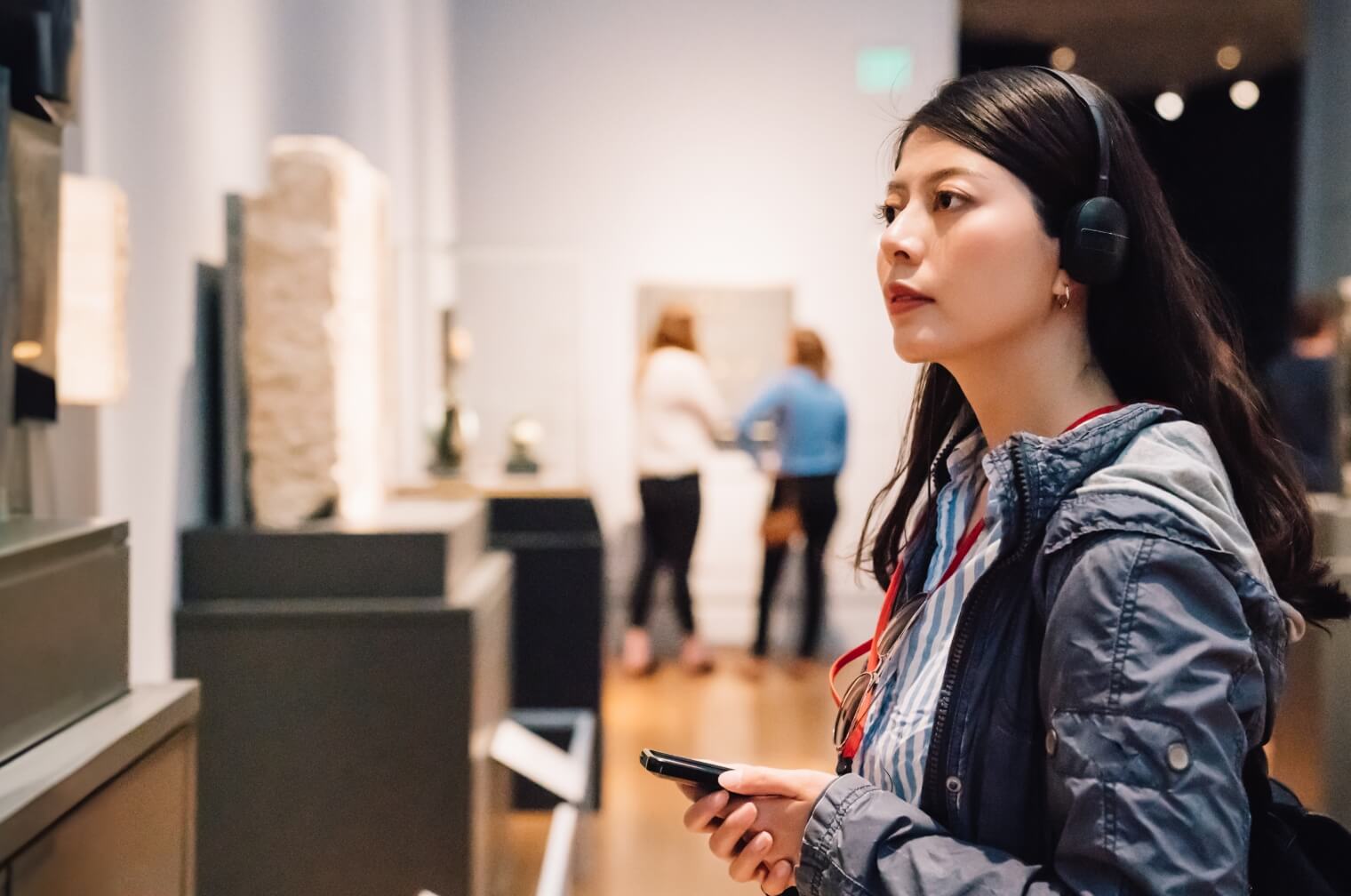
  • Audio and video guides: AI museum tour apps can provide visitors with audio and video guides that provide information about the exhibits.
  • Gamification: AI museum tour apps can include gamification elements to make the experience more fun and engaging for visitors.

Benefits of navigating museums through AI apps

Art venues that embrace AI for museum tours can reap numerous benefits:

  • Enhanced Visitor Engagement: Personalized experiences captivate visitors, making them more likely to explore the museum’s offerings.
  • Data Insights: AI can collect data on visitor behavior, helping museums understand their audiences better.
  • Cost Efficiency: AI apps can reduce the need for guided tours and printed materials.

Developing an AI museum tour app solutions

Museums play a significant role in preserving our cultural heritage. They house invaluable collections of art, artifacts, and objects that may offer a glimpse into the past, present or future. AI-backed museum tour apps provide a range of features and functionalities that cater to the unique needs of museum visitors and businesses.

Understanding the unique needs of AI museum tours

AI museum tours have many unique needs that must be considered when developing an app solution. These include:

  • Personalization: AI museum tour apps should be able to personalize the tour experience for each visitor based on their interests, preferences, and time constraints.
  • Accuracy: AI museum tour apps should provide accurate and up-to-date information about the museum’s collection and exhibits.
  • Accessibility: AI museum tour apps should be accessible to all visitors, regardless of their age, abilities, or language skills.

Key features required for an effective AI museum tour app

Some of the key features required for an effective AI museum tour app include:

  • Personalized tour recommendations: The app should be able to recommend exhibits and tours based on the visitor’s interests and preferences.
  • Gamification elements: The app can include gamification elements, such as quizzes and challenges, to make the experience more fun and engaging for visitors.
  • Multilingual support: The app should be available in multiple languages to accommodate a global audience.

As an AI developer, the alchemy of code transforms museum visits into personalized odysseys, enhancing the exploration of art and culture with precision and innovation.

Importance of user-friendly interfaces and accessibility features

User-friendly interfaces and accessibility features are crucial components of an effective AI museum tour app.

Here’s why they are important:

  • Enhanced usability: A well-designed interface enables visitors to navigate the app effortlessly, find relevant content, and make the most of their museum visit.
  • Accessibility for all: Incorporating accessibility features such as text-to-speech capabilities for visually impaired users, adjustable font sizes, and compatibility with assistive technologies ensures that everyone can access and enjoy the app’s content.

Case study of top museum app

Today, AI-driven solutions are reshaping the way visitors engage with art and history. Explore the transformative journey of museums into the digital era through personalized and innovative technologies.

Louvre museum app case study

The Louvre Museum app is a comprehensive guide to the Louvre Museum located in Paris, France. This AI Museum tour app solutions provides visitors with personalized recommendations, real-time navigation, and in-depth information about the museum’s vast collection.

The app uses a variety of factors, such as the visitor’s interests, past visits, and current location, to recommend exhibits that they are likely to enjoy. The app also allows visitors to create their own custom tours, which can be saved and shared with friends and family, resulting in more personalized museum tours with AI.

Benefits for museum visitors

The app has benefited museum visitors in several ways, including:

  • Increased engagement
  • Improved learning
  • Improved accessibility

Benefits for business owners

The app has also benefited the museum financially by:

  • Increasing visitor satisfaction
  • Improving visitor spending
  • Collecting data on visitor behavior

Empower your museum’s journey into the future with ViitorCloud’s expertise in AI-driven museum tour app development. Let’s embrace the future!

How to get started with AI museum tours

If you’re a museum owner interested in AI-driven museum tour app development, here are some key tips to consider:

  1. Define Your Objectives: Clearly outline your goals and expectations for building an AI-backed app for museum tours.
  2. Research and Partner: Explore Museum tour app development companies that can leverage their mastery in AI and app development to bring your vision to life.
  3. Training and Maintenance: Ensure that your staff is well-trained in using and maintaining the app to provide seamless experiences for visitors.
  4. Promotion and Education: Inform your visitors about the new AI-powered features and educate them on how to use the app effectively.

Take the first step towards an immersive AI-powered museum experience with ViitorCloud. Partner with us to craft personalized, cutting-edge museum tours and captivate your audience.

Summing up

Latest tech Innovations in museum apps have redefined how visitors engage with cultural heritage, offering personalized, immersive experiences. Museum owners who wish to stay ahead of the curve should seriously consider adopting AI museum tour apps. With the right strategy and technology, you can create tailored journeys that captivate visitors and leave a lasting impression.

Take the first step toward a more engaging and informative museum experience – collaborate with ViitorCloud today. The right AI museum tour app solutions can bring numerous benefits, including increased engagement, data insights, and cost efficiency. Start your journey into the world of AI museum tour apps and witness the transformation for yourself. It’s time to revolutionize the way your visitors explore your museum’s treasures.

Frequently asked questions

It is a museum that uses AI to enhance the visitor experience by offering personalized recommendations, real-time navigation, and in-depth information about the museum’s collection.

You can use AI to analyze the visitor’s interests, past visits, and current location to create custom tours that allow visitors to explore the museum at their own pace and discover new things.

AI is constantly evolving and so are the possibilities it could bring. In the future, AI museum tours could become more personalized and engaging.

AI can be used in museums to provide personalized recommendations, real-time navigation, in-depth information, custom tours, visitor behavior analysis, and new ways for visitors to learn and experience.


How virtual reality HSC training solution is increasing safety

Health, Safety, and Environment (HSE) training is necessary for protecting the integrity of organizations and the well-being of individuals in the evolving field of workplace safety.

Although these approaches have shown some success, they often struggle to deliver fully immersive and captivating learning environments. However, with the integration of a virtual reality HSE training solution, the landscape of learning experiences is revolutionized.

Digital experience solutions, specifically those powered by virtual reality (VR) technology, are revolutionizing HSE training. VR offers a whole new level of education, transforming how we approach workplace safety. Let’s delve deeper into the importance of immersive HSE training in VR and how it’s reshaping our perspective on safety in the workplace.

Importance of virtual reality for HSE training

Before we explore virtual reality in HSE solution development, let’s first understand why HSE training is important.

Health, safety, and environmental considerations are supreme in any industry.

A workplace that prioritizes these aspects is not only compliant with regulations but also fosters a culture of care and responsibility among its employees.

Here are some key reasons why HSE training is vital:

  • Safety First: The primary goal of Virtual Reality HSE Training Solution is to prevent accidents and injuries. Proper training equips employees with the knowledge and skills to identify and mitigate potential hazards, ensuring a safe working environment.
  • Compliance: Virtual Reality HSE training solution helps in ensuring compliance, which is not only a legal requirement but also essential for reputation management.
  • Risk Reduction: Comprehensive HSE training reduces the risk of accidents, which can result in financial losses, downtime, and damage to a company’s image.
  • Employee Well-being: When employees feel safe at work, their morale and job satisfaction improve. A safe working environment also reduces absenteeism and turnover rates.
  • Compliance with Regulations: Utilizing a Virtual Reality HSE Training Solution helps organizations comply with regulatory requirements by ensuring that employees are adequately trained in handling safety protocols, emergency response procedures, and environmental protection measures.

Limitations of traditional HSE training

Classroom-based HSE solution development with PowerPoint presentations has been the norm for decades.

While these traditional methods cover the required knowledge aspects, they have limitations when it comes to building skills and shaping behaviors.

Passively sitting through lectures and presentations often leads to low engagement and poor retention of information.

Additionally, classroom training lacks realism and makes it difficult for employees to apply learnings to real-life hazardous situations.

Traditional methods are unable to simulate risk scenarios like working from heights, confined spaces, fire hazards, chemical spills, etc.

This leaves employees underprepared to face dangers in the workplace.

Need for immersive VR HSE training

Virtual reality based HSE solution development provides highly realistic, interactive and engaging learning experiences.

VR training simulations expose employees to life-like hazardous scenarios and dynamic risk environments.

This helps imprint safe behaviors and build muscle memory on correct emergency response procedures.

VR technology offers complete flexibility and control over the training environment.

Various high-risk situations like working at heights, electrical accidents, fire hazards, etc. can be accurately simulated without any real danger.

This enables employees to prepare for emergencies and prevent accidents.

Research shows that VR training improves learning outcomes by up to 75% compared to conventional methods.

As employees retain more information, the ROI of VR training investments also becomes significantly higher.

Developing virtual reality HSE training solution

The first step is identifying the specific HSE training needs of employees based on work hazards.

For example, VR fire safety drills will be a priority for manufacturing units. On the other hand, construction companies may need VR training for elevation-related risks.

The training content must accurately replicate real work environments and standard operating procedures.

The VR simulators and scenarios have to provide realistic visuals, auditory and other sensory cues for maximum immersion.

It is crucial to integrate VR training with existing learning management systems (LMS) and e-learning programs.

This enables seamless training delivery and unified reporting. Tracking employee performance data across VR and other mediums provides vital insights.

Leading companies like ViitorCloud are pioneering VR solutions tailored to the HSE needs of different industries.

Our offerings like Immerse Virtual Reality Training provide video game-like immersion combined with real-world hazards for the best learning outcomes.

Success stories of organizations that used VR for HSE training

Ensuring a safe work environment is crucial for any business. This is where virtual reality (VR) comes in as a game-changing technology for HSE solution development.

Success Stories of Organizations that Used VR for HSE Training

TakeLeap

TakeLeap is using the Immerse VR training solution to deliver highly engaging fire safety drills across its manufacturing units.

Employees are put through emergency scenarios on the factory floor and taught how to operate fire extinguishers and hoses.

VR training is being credited for a 57% improvement in fire safety compliance.

Ttro

Ttro has deployed VR simulators to train its developers on handling radioactive isotopes and chemical spills in an R&D facility.

Employees appear for VR tests before getting lab access. This has led to 63% fewer accidents due to improved safety behaviors.

Strivr

Strivr has used Virtual Reality HSE Training Solution for construction crews on fall protection, trenching hazards, PPE usage and other critical safety topics.

Their proprietary 360-degree VR video training has reduced incidents by 52% across projects.

Conclusion

Virtual reality has proven to be a disruptive innovation for occupational safety and HSE compliance training.

The immersive simulations and life-like experiences lead to stronger learning outcomes.

Considering the immense benefits, investing in customized Virtual Reality HSE Training Solutions is highly recommended for businesses today.

Frequently asked questions

By using Virtual Reality for HSE Training, trainees can engage in hands-on training, making it more engaging and memorable.

Virtual reality can improve HSE training by allowing trainees to practice dangerous tasks without the risk of physical harm, reducing the likelihood of accidents in real-life situations.

The future trends for virtual reality HSE training solutions include advancements in technology, such as haptic feedback devices and full-body motion tracking, to create more realistic and interactive training experiences.

Virtual Reality HSE Training Solution enhances trainee engagement and retention by providing an immersive and interactive learning experience. VR training can be conducted remotely, allowing trainees to access training modules from anywhere, at any time.

How augmented reality travel solutions are changing the tourism industry?

The tourism industry is one of the largest and most dynamic economic sectors in the world. Technology has always played an important role in the industry, helping to make travel more convenient, affordable, and accessible. One of the most promising new technologies for travel is augmented reality travel solutions.

Augmented reality for tourists is revolutionizing the way travelers explore new destinations, offering immersive and interactive experiences that go beyond traditional guidebooks. In this blog, we will delve into the world of innovative AR travel solutions, uncovering the endless possibilities they offer to both travelers and businesses.

What is augmented reality (AR) in travel?

Augmented reality in travel industry refers to the integration of digital information into the real-world travel experience. Through the use of AR-enabled devices such as smartphones or smart glasses, travelers can overlay virtual elements onto their physical surroundings, creating an enhanced and immersive travel experience.

Whether it’s exploring historical landmarks, discovering hidden gems, or accessing real-time information, augmented reality travel app development helps elevate the way we interact with destinations.

How AR works in travel applications

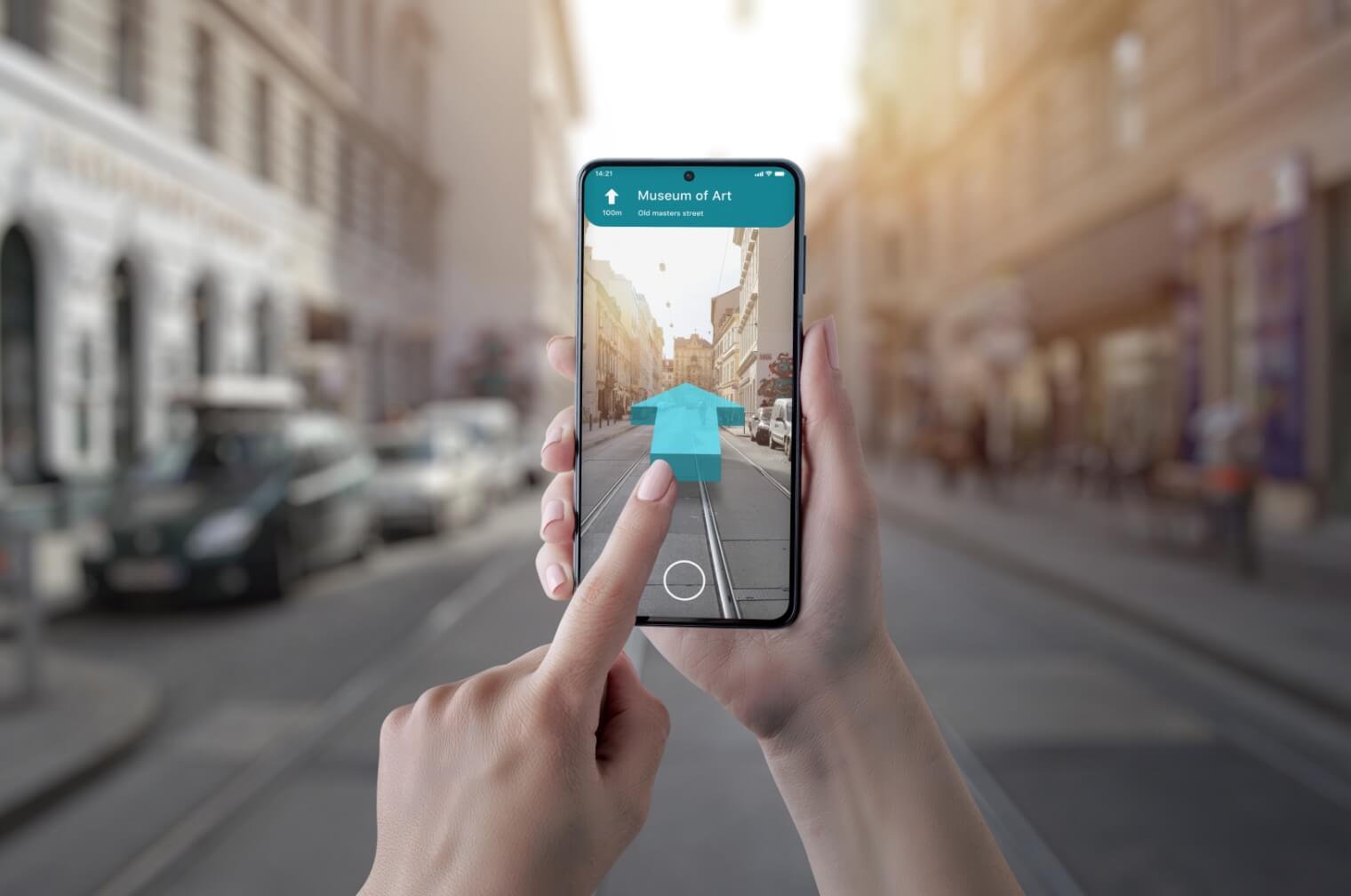
AR in travel applications utilizes the capabilities of smartphones, tablets, smart glasses, or headsets to deliver AR experiences. These devices are equipped with cameras, sensors, and GPS, enabling them to detect the user’s location and orientation in real-time.

Here’s how augmented reality travel apps are used:

  • Real-time Object Recognition: By analyzing the visual data from the device’s camera, AR technology can identify specific objects and trigger virtual content associated with them.
  • Digital Overlays: Once the real-world object is recognized, AR overlays digital information onto the user’s view.
  • Interactive Elements: AR allows users to interact with the virtual elements overlaid on their physical environment.
  • Real-time Data Integration: AR can integrate real-time data into the user’s view, enriching their travel experience.

Travel businesses can unlock a new dimension of exploration with augmented reality travel solutions, providing real-time information and interactive experiences at their fingertips. 

Applications of augmented reality for travel industry

Technology’s constant evolution is reshaping how we experience the world. In the travel industry, augmented reality (AR) is a game-changer, crafting innovative digital experiences that elevate your journeys.

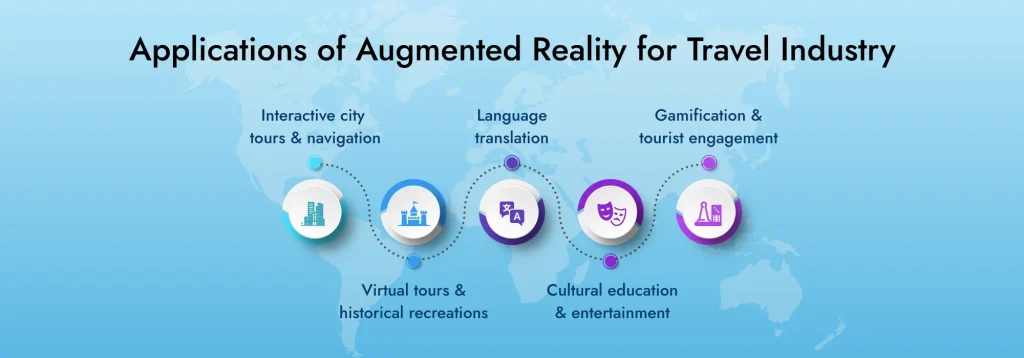
Applications of Augmented Reality for Travel Industry

Here are some of the key applications of AR in travel:

  1. Interactive city tours and navigation: AR apps can be used to help travelers to navigate unfamiliar cities and find their way around.
  2. Virtual tours and historical recreations: It can be used to transport travelers back in time or to visit places that are inaccessible or no longer exist.
  3. Language translation: It can be used to translate text and spoken language in real time, helping travelers to communicate with locals and overcome language barriers.
  4. Cultural education and entertainment: It can be used to create engaging and interactive educational experiences that teach travelers about different cultures and histories.
  5. Gamification and tourist engagement: It can be used to create fun and interactive games and experiences that can engage travelers and make exploring new places more enjoyable.

These augmented reality tourism trends redefine the way we explore, making travel an immersive and revolutionary experience.

Challenges and limitations of AR navigation in travel

Here is a table that discusses the challenges and limitations of augmented reality navigation in travel, as well as how businesses can overcome these challenges:

ChallengeLimitationHow to Overcome
Hardware LimitationsAugmented reality heavily relies on hardware such as AR glasses or smartphones with advanced capabilities, limiting accessibility for some travelers.Develop applications that are compatible with a wide range of devices, optimizing performance for various specifications to reach a larger user base.
Accuracy and ReliabilityAR navigation accuracy can be affected by factors like GPS signal accuracy, environmental interference, and technical limitations, leading to potential misguidance.Employ multiple sensors and technologies for better location accuracy. Integrate machine learning to improve location and direction accuracy over time.
Data Privacy and SecurityAR apps collecting location data raise concerns about user privacy and potential security vulnerabilities, impacting user trust and confidence.Allow users to control data sharing and offer clear opt-in/opt-out choices regarding location sharing.
User Experience ComplexityComplex user interfaces and overwhelming AR features can confuse or overwhelm users, hindering the adoption and ease of use for some travelers.Simplify user interfaces for intuitive navigation. Offer tutorials or onboarding sequences to guide users.  Implement user feedback mechanisms to refine and improve the app over time.

How to develop an AR travel app

AR travel apps are reshaping the way people navigate the world, offering immersive and personalized experiences. If you’re intrigued by the idea of creating your own augmented reality travel app, here is a step-by-step guide for you:

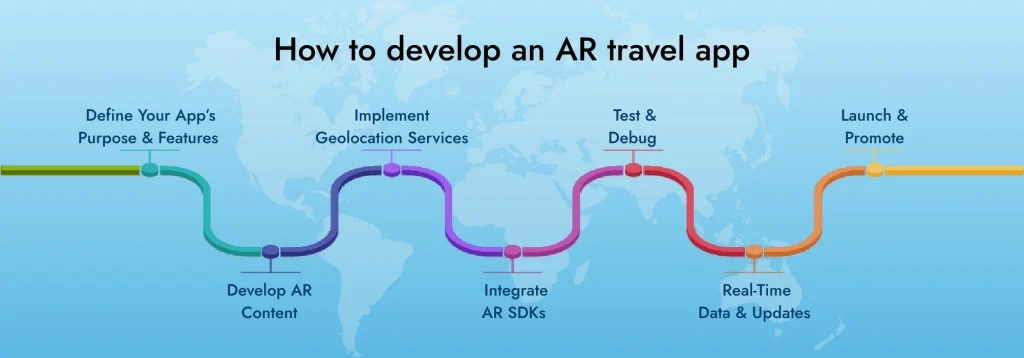
How to Develop an AR Travel App

Define your app’s purpose and features

Begin by identifying the primary goal of your augmented reality travel app. What unique value will it bring to users? Clearly defining your app’s purpose is the first and crucial step.

Develop AR content

This step involves creating the AR content that will be superimposed onto the real world. It may include 3D models, geolocation data, historical information, or any content relevant to your app’s purpose.

Implement geolocation services

For location-based AR features, you’ll need to integrate geolocation services. This allows your app to recognize the user’s position and provide context-aware information.

Integrate augmented reality SDKs

Incorporate the chosen AR development tools and SDKs into your app’s architecture. This will enable your app to recognize real-world objects and augment them with digital information.

Test and debug

Thoroughly test your app on various devices to ensure its functionality, stability, and performance. Address any bugs, glitches, or compatibility issues that arise during testing.

Real-time data and updates

Keep your app current by providing real-time data, updates on attractions, events, and travel-related information. Ensure that your content remains fresh and relevant.

Launch and promote

Once your augmented reality travel app is fully developed and thoroughly tested, launch it on the app stores. Promote it across marketing channels.

Are you ready to experience the future of travel with our cutting-edge augmented reality travel solution, seamlessly guiding you through unfamiliar destinations? At ViitorCloud, we specialize in creating immersive augmented reality solutions. Our expert team can help turn your vision of an AR travel app into reality.

Real-world examples of augmented reality travel solutions

Augmented reality travel solutions elevate your travel experience, by turning every step into a captivating story through interactive digital overlays. Here are some examples of travel businesses that have successfully implemented augmented reality navigation solutions:

  1. GuideAR is an app that provides users with real-time directions, turn-by-turn navigation, and information about nearby points of interest.
  2. Timelooper app allows users to explore the history of famous landmarks and locations, while the app AR Walking Tours provides virtual tours of popular tourist destinations.
  3. The app AR Museums allows users to scan artifacts and paintings to learn more about them, while the app AR Interactive History provides augmented reality experiences at historical sites.

To wrap up

Augmented reality navigation is revolutionizing the travel industry, offering innovative solutions that enrich the travel experience. Collaborating with AR app development experts like ViitorCloud opens the door to unlocking the full potential of this innovative technology for the travel industry.

From immersive virtual tours and seamless navigation to cultural insights, the potential for augmented reality in travel is vast. As this technology continues to shape the future of exploration, it’s imperative for travel businesses to harness these advancements. Partner with us and revolutionize your itinerary planning with our augmented reality travel solution, offering detailed insights and engaging visual aids for a memorable trip.

Frequently asked questions

It is the integration of digital information and virtual elements into the real-world travel experience, enhancing exploration and providing interactive and immersive content.

It utilizes cameras, sensors, and GPS on AR-enabled devices to overlay digital directions and points of interest onto the user’s real-time view, guiding them through their surroundings.

They include advanced AR wearables, seamless integration with voice assistants, personalized recommendations, and AI-driven content generation.

By offering virtual tours, 360-degree experiences, and real-time information about attractions, accommodations, and transportation, helping travelers make informed decisions and visualize their itinerary.