
How fintech blockchain solutions is revolutionizing businesses?

The world of finance is transforming with a drastic shift, driven by the integration of blockchain technology into financial technology, or fintech.

Blockchain, known for its connection with cryptocurrencies like Bitcoin, is proving to be a game-changer for the financial industry.

With Fintech Blockchain Solutions data becomes nearly tamper-proof, and safeguards sensitive information from fraud and manipulation.

It doesn’t matter if you’re a financial professional, an entrepreneur, a technology enthusiast, or simply curious about the collaboration of blockchain and fintech, this blog will guide you into understanding the future of finance.

Benefits of fintech blockchain solutions

At its core, blockchain is a distributed ledger technology that records transactions across a network of computers in a secure, transparent, and tamper-resistant manner.

In the fintech landscape, blockchain ensures data security and integrity in financial transactions, which eventually reduces the risk of fraud and errors.

With blockchain, fintech companies can build a foundation of trust that is fundamental to the finance industry.

Empowering security and trust:

Blockchain eliminates the need for intermediaries, putting users in direct control of their transactions.

It prevents unauthorized access and manipulation of financial data, ultimately fostering trust among users.

Transparency

Every transaction on a blockchain is recorded in a public ledger that is accessible to all participants in the network.

This transparency builds trust and confidence among users, as they can independently verify the integrity of transactions.

Smart contracts

Smart contracts are self-executing contracts with the terms of the agreement directly written into code.

They automate various financial processes, such as insurance claims, loan approvals, and trade settlements, reducing the need for intermediaries and the associated costs.

Auditability

The immutability of blockchain records makes audits more straightforward and trustworthy. Regulators and auditors can easily trace transactions and verify compliance with financial regulations.

Reduced fraud

Blockchain’s security features and transparency make it a less appealing target for fraudsters.

It becomes more challenging for bad actors to manipulate or alter financial records.

Financial inclusion

Blockchain technology can help extend financial services to underserved populations around the world.

By providing access to banking and payment services through mobile devices, it can bridge the financial inclusion gap.

Cost efficiency and reduction

Blockchain’s ability to eliminate intermediaries has significant cost-saving implications for both fintech companies and customers.

Companies can reduce operational costs, and customers benefit from lower transaction fees.

Fintech industry blockchain solutions

Fintech Industry Blockchain solutions are the driving force behind the fintech sector’s transformation, promising to make financial transactions more secure, efficient, and accessible than ever before.

This new way of financial services is unlocking new possibilities for financial inclusion and accessibility on a global scale. These fintech blockchain solutions are defining the future of finance.
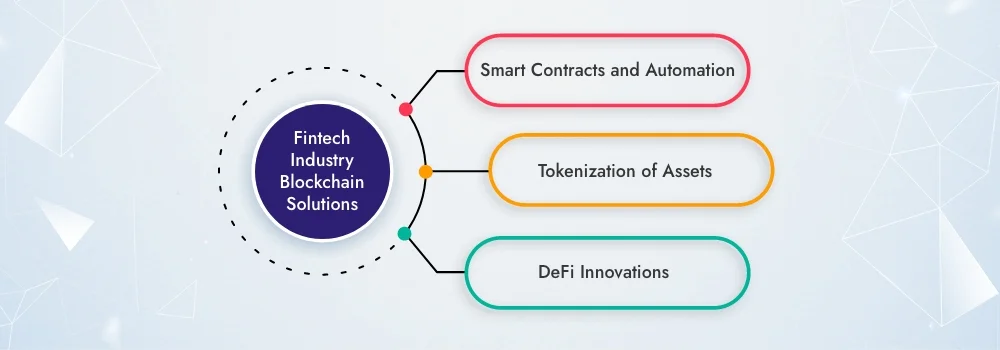
Fintech Industry Blockchain Solutions

Smart contracts and automation

Smart contracts have the terms of contracts directly written into code which makes them self-executing agreements.

In fintech, smart contracts automate financial agreements and transactions, reducing the need for intermediaries. They ensure efficiency and accuracy, as code is the law.

Real-life examples explain how smart contracts are changing fintech applications by simplifying complex processes.

Tokenization of assets

Asset tokenization involves converting ownership rights of physical assets into digital tokens on a blockchain.

This innovation allows fractional ownership, making assets more accessible and tradable. Real estate and stock tokenization examples showcase how this benefits investors and fintech companies alike.

Decentralized finance (DeFi) innovations

Decentralized finance (DeFi) is disrupting traditional financial services.

DeFi platforms offer decentralized lending, borrowing, and exchanges, democratizing access to financial services.

This innovation empowers individuals worldwide, eliminating barriers and intermediaries in finance.

Fintech’s efficiency with blockchain

Blockchain’s decentralized and immutable ledger system has proven to be a game-changer in streamlining financial operations.

The incorporation of blockchain technology in fintech is revolutionizing the way financial operations are conducted, offering a future where financial transactions are secure and also significantly more efficient.

Streamlining cross-border payments

Cross-border payments have long been marred by inefficiencies in traditional systems.

Blockchain resolves these challenges by enabling fast, secure, and cost-effective international transactions.

Cryptocurrencies and stablecoins play a significant role in this transformation, offering alternatives to traditional currencies.

Enhanced transparency and traceability

Blockchain’s transparency ensures real-time access to transaction histories for customers.

This transparency is particularly valuable in supply chain finance, trade finance, and fintech applications. It facilitates trust and accountability, reducing the risk of disputes and fraud.

Fintech’s transparency via blockchain

In the world of financial technology (fintech), transparency is a fundamental necessity. Blockchain technology emerges as a focal point in ensuring this transparency.

Fintech’s Transparency via Blockchain is paving the way for a more reliable, secure, and user-centric future in finance.

Building trust through transparency

Blockchain’s transparent nature fosters trust between fintech companies and their clients.

Case studies underscore how transparent financial operations positively impact customer satisfaction and loyalty.

When customers can independently verify transactions and data, trust naturally follows.

Financial inclusion and accessibility

Blockchain technology has the power to promote financial inclusion by providing banking services to the unbanked and underbanked populations.

Real-world examples of fintech blockchain solutions showcase how individuals worldwide gain access to financial services and opportunities previously out of reach.

Conclusion

The integration of blockchain consulting services into fintech is nothing short of a revolution. Fintech Blockchain Solutions empower security, trust, cost efficiency, and transparency.

Embrace Fintech’s Blockchain Revolution, and be a part of the future of finance, where transparency and efficiency reign supreme.

Contact ViitorCloud today to be a part in the Fintech’s Blockchain Revolutionary journey.

Frequently asked questions

What is blockchain in fintech?

Blockchain can be used to record transactions in a secure and temper-proof way. Blockchain is a distributed ledger technology.

How is blockchain used in fintech?

It is being used in fintech in a variety of ways, including Payments, Remittances, Asset management, and Identity management.

How does blockchain improve the efficiency of fintech businesses?

Blockchain improves the efficiency of fintech businesses by reducing costs, improving security, and increasing transparency.

What is the future of blockchain in the fintech industry?

The future of blockchain in the fintech industry is very bright. Blockchain for fintech has the potential to revolutionize the way financial services are delivered.

AI transportation solution transforming the industry in 5 ways

Transportation has always played a vital role in shaping societies and economies from the earliest days.

However, as we look towards the future, the transportation industry is on the verge of a technological revolution.

AI transportation Solution is the driving force behind this transformation, with the AI transport industry set to redefine the way we move and connect.

Autonomous vehicles: redefining mobility

Autonomous vehicles, often referred to as self-driving cars, are ready to improve the way we move from point A to point B.

These vehicles, equipped with artificial intelligence, sensors, and powerful algorithms, can drive themselves with minimal human intervention.

ChallengesSolutions
RegulationsImproved Safety
Public TrustReduced Accidents
Ethical ConsiderationEnhanced Accessibility

Benefits of AI in transportation

AI (Artificial Intelligence) is offering numerous benefits that are reshaping the way we move people and goods.

Here are five benefits:

  1. Improved Safety: AI plays a pivotal role in enhancing safety on our roads.
    • Advanced driver-assistance systems (ADAS) powered by AI can detect potential collisions, assist with lane-keeping, and even facilitate autonomous driving.
  1. Efficient Traffic Management: AI-driven traffic management systems are making our road networks more efficient.
    • AI algorithms analyze traffic patterns and adjust signal timings in real-time to reduce congestion.
  1. Enhanced Predictive Maintenance: It can predict when maintenance is needed, preventing breakdowns and ensuring vehicles are in optimal working condition.
    • This predictive maintenance reduces downtime, increases vehicle lifespan, and lowers operational costs.
  1. Optimized Logistics and Supply Chain: Route optimization, load planning, and demand forecasting are made more efficient with AI.
    • Companies can deliver goods faster and with less environmental impact, as AI helps in optimizing delivery routes and schedules.
  1. Eco-Friendly Transportation: Electric and autonomous vehicles, which often rely on AI for navigation and decision-making, are reducing the carbon footprint of transportation.
    • AI can also encourage the adoption of ride-sharing and public transit, further reducing emissions.

Smart infrastructure and traffic management

Smart infrastructure takes traffic management to the next level, bringing benefits for both urban planners and commuters.

Here’s what makes Smart Transportation and AI an important element in modern traffic management:

  • Smart infrastructure, equipped with advanced technologies and AI, combines the power of real-time data analysis and predictive modeling to reshape our daily commutes.
  • It enables real-time traffic analysis, allowing authorities to predict traffic patterns, identify congestion points, and optimize traffic signals. This data-driven approach ensures a smoother, more efficient flow of vehicles on the road.
  • By reducing congestion and optimizing routes, it minimizes vehicle idling, subsequently decreasing emissions and promoting eco-friendly transportation practices.
  • Cities like Singapore, Amsterdam, and Barcelona are embracing smart traffic management systems, resulting in less environmental impact by reducing emissions and promoting eco-friendly practices.

Artificial intelligence in transportation is not just about efficiency, but it’s a significant step toward greener and healthier urban development.

Logistics and supply chain optimization

Artificial intelligence has found a home in logistics and supply chain management.

  • Efficient Routes and Reduced Costs: AI algorithms calculate the most efficient routes for shipping, reducing transportation costs and ensuring goods reach their destination swiftly.
  • Predictive Analytics: AI-driven predictive analytics are indispensable in inventory management, accurately forecasting demand and optimizing stock levels.
  • Sustainability in Logistics: Embracing green transportation initiatives powered by AI helps in reducing the carbon footprint. This environmentally responsible approach aligns with modern expectations of businesses to operate in an ecologically friendly manner.

The integration of AI is a necessity in the dynamic world of logistics and supply chain management.

Public transportation 2.0: enhancing commuter experience

Public transportation is getting a much-needed upgrade through AI solutions.

  • AI transportation solution in public transportation are changing the game by predicting ridership patterns and optimizing schedules, making the daily commute more efficient and convenient.
  • The user experience has been vastly improved with real-time updates, digital ticketing, and personalized services tailored to individual preferences.
  • Beyond convenience, there are significant environmental benefits as AI-driven public transportation initiatives are encouraging more people to choose buses and trains over individual cars, ultimately reducing carbon footprints.
  • These enhancements of Artificial Intelligence transportation solution have a profound social impact, especially for differently abled individuals and seniors who now have greater accessibility and ease of use, ensuring that public transportation truly serves everyone in the community.

Future challenges and ethical considerations

As AI reshapes the transportation landscape, ethical considerations and challenges emerge. Privacy concerns arise as vast amounts of personal data are collected for various transportation solutions, requiring a careful balance between convenience and privacy.

There are also fears of job displacement as automation and AI threaten traditional roles, raising questions about the impact on the workforce.

Different countries have varying sets of rules, and ensuring consistency and adherence across borders is no small task.

Establishing a sticking framework that governs the operation and safety standards for autonomous vehicles globally is essential

Governments and international organizations play a vital role in shaping the future of transportation.

They are responsible for drafting and implementing the regulatory frameworks that will define the rules of the road for AI-driven transportation systems.

By collaboration and setting ethical guidelines, they can ensure that technology evolves in a safe, reliable, and efficient manner, paving the way for a transportation landscape that benefits all.

Conclusion

AI transportation Solution is not just about making our commutes easier; it’s about creating a future that is more sustainable, efficient, and inclusive.

To harness the full potential of AI in transportation, continued research, innovation, and collaboration is imperative. Together, we can build a brighter and more connected world.

Frequently asked questions

How is AI changing transportation?

AI is revolutionizing transportation by enabling the development of autonomous vehicles, optimizing traffic management systems, enhancing safety measures, and improving overall efficiency.

How is AI used in transportation?

AI transportation solution are used through autonomous vehicles, traffic management systems, and predictive maintenance to prevent breakdowns and enhance reliability.

How does AI enable autonomous vehicles?

AI enables autonomous vehicles by using sensors, cameras, and machine learning algorithms to perceive and interpret the environment, make decisions, and navigate without human intervention.

What are some examples of AI transportation solutions that are currently in use?

Some of examples of AI transportation solutions are Self-driving cars and trucks, Traffic management systems, Vehicle maintenance and diagnostics, Fleet management, and public transportation:

How can AI transportation solution help transportation industries?

Artificial Intelligence transportation solutions can help the transportation industry improve efficiency, reduce costs, and enhance safety.

AR ecommerce logistics development: the future is now

The eCommerce industry is growing exponentially, presenting challenges and opportunities for the logistics industry. In the digital world where speed and convenience are the two most important things, logistic companies constantly seek more efficient and innovative solutions to streamline their operations and enhance customer experiences. Here is when VR and AR eCommerce Logistics development comes into the picture.

Rise of virtual and augmented reality in e-commerce logistics

Virtual reality (VR) technology generates a computer-simulated environment, immersing users in a virtual realm usually via headsets or goggles. By substituting the physical world with a digital environment, VR endeavors to deliver a complete immersion digital experience service.

Augmented Reality (AR), on the other hand, overlays digital information onto the real-world environment. It enhances the physical world by adding a layer of virtual objects, images, or information onto the user’s view of the actual world. Simply put, AR does not replace the real world, as VR does, but it adds digital elements, offering a mix of the physical and virtual worlds.

Applications of Virtual Reality (VR) and Augmented Reality (AR) are no longer limited to the gaming and entertainment sector. These breakthrough technologies are making waves in almost every sector, and eCommerce logistics is no exception.

Both AR and VR have gained significant popularity in recent years. They can potentially address some of the key challenges witnessed in the eCommerce logistics sector. In this blog post, you will explore how AR and VR technology is benefiting the eCommerce logistics industry in a number of ways. Continue reading!

Applications of AR solutions for eCommerce logistics

AR technology is increasingly being adopted in eCommerce logistics for various benefits. Let’s explore what these 3d eCommerce development are.

Efficient order picking and packing

AR solutions can help optimize the process of order picking and packing in warehouses. AR-enabled smart glasses or mobile devices can overlay digital information onto the workers’ field of view and guide them on which items must be picked, in what quantity, and from which location.

So, basically, AR technology helps reduce picking time, enable fast shipment, and enhance the overall accuracy of the process. It can also be used to identify misplaced items in the warehouse, which ultimately helps in efficient inventory management.

Real-time inventory visualization and tracking

Warehouse managers can leverage AR interfaces to get real-time insights into inventory location, movement patterns and levels. AR can help you overlay digital labels onto all physical items, enabling you to track all product information easily and accurately.

Leveraging augmented reality in logistics will help you monitor stock movement and identify low stock levels more effectively. If there is any discrepancy in inventory management, the AR solution will help you spot it more quickly.

Improving last-mile delivery

Last-mile delivery us a significant part of eCommerce logistics, and AR assistance can help improve it in a number of ways, including:

Route optimization: Augment reality logistics can help delivery drivers find the most efficient routes to their destinations, considering factors such as traffic conditions, weather, and delivery windows. This can help save a good amount of time and fuel.

Navigation: AR navigation solutions provide turn-by-turn directions and highlight potential hazards or obstacles on the road. This helps drivers make informed decisions and choose the best routes to optimize delivery time and minimize fuel consumption. This helps reduce the chances of missed or failed deliveries.

Proof of delivery: AR devices can be used to capture digital signatures and photos of deliveries, proving that the package was delivered to the correct person at the correct time. This provides an indisputable record of successful delivery and assists in resolving any delivery-related disputes.

Customer communication: The AR interface can be used to communicate with customers about the delivery status, tracking information, and estimated delivery time of products. This can help to improve customer satisfaction and reduce the number of customer service inquiries.

AR eCommerce Logistics development is playing a vital role in streamlining supply chain management processes in this industry. By providing real-time information and enhancing navigation capabilities, AR solutions optimize route planning, navigation, and last-mile delivery.

Virtual try-on and product visualization

Investing in AR application development enables customers to try on products virtually and visualize them in real life. By using AR applications on their mobile devices, customers can overlay virtual images of products onto themselves and visualize how they would look or fit.

This virtual try-on feature is more valuable for industries such as fashion, eyewear, and cosmetics, where customers can visualize how clothing items, eyeglasses, or makeup products would appear on them before making a purchase. This feature reduces the need for physical try-ons, increases customer confidence, and reduces the possibility of product returns.

AR-enabled product information and reviews

This AR-enabled product information and reviews enhance the overall customer experience, reduce information asymmetry, and increase customer satisfaction. Customers can access detailed product specifications, user reviews, and ratings by scanning product labels or codes using AR applications.

AR overlays this information onto the physical product or displays it through the AR interface, allowing customers to make more informed purchasing decisions. They can learn about product features, compare different options, and read reviews without the need to search for information on separate websites or platforms.

VR advancements in AR eCommerce logistics development

There are several ways VR technology is reshaping the realm of ecommerce logistics. Let’s understand it in detail.

VR-based training and simulation for warehouse operations

One of the key applications of VR in e-commerce logistics is providing warehouse workers with immersive training and simulation experiences. With VR-based training, warehouse employees can practice order picking, packing, and inventory management tasks within a safe and controlled setting of the virtual world. Such training sessions help improve their skills, reduce errors, and enhance overall productivity.

Additionally, VR-driven simulations enable employees to familiarize themselves with complex machinery and equipment. They can learn how to operate forklifts, automated picking systems, and other warehouse technologies without the risk of accidents or damage to inventory.

Virtual layout planning and optimization

This is another application of VR in warehousing and fulfillment centers. Designing an efficient and ergonomic warehouse layout can involve factors such as product placement, picking routes, and storage capacity.

Using VR for eCommerce logistics enables businesses to visualize and simulate different layout configurations before implementing them physically. Warehouse managers can create virtual representations of their facilities and test various layouts to identify the most optimal arrangement.

VR solutions for supply chain visualization and analysis

In addition to its applications in warehousing, Virtual reality logistics is also harnessed to enhance supply chain visualization and analysis. Ecommerce businesses can leverage immersive VR environments to represent various supply chain metrics, such as inventory levels, transportation routes, and demand patterns.

VR for supply chain management facilitates a deeper understanding of the data, enabling decision-makers to identify trends, bottlenecks, and opportunities in the supply chain network.

By visualizing data more intuitively and interactively, organizations can make data-driven decisions more effectively, improving operational efficiency and responsiveness.

VR-based predictive analytics for demand forecasting

One of the biggest challenges for eCommerce businesses is accurately forecasting demand. This helps in inventory management as well as in supply chain optimization. VR-based predictive analytics leverages advanced AI algorithms and machine learning techniques to analyze historical data, market trends, and other relevant factors to forecast future demand patterns of the stocks.

VR for eCommerce logistics enables decision-makers to interact with demand forecasts more intuitive and immersive. They can explore different scenarios, simulate the impact of various factors on demand, and make informed decisions based on the insights provided by VR solutions.

Virtual showrooms and immersive shopping experiences

Virtual showrooms enable customers to explore and interact with products in a virtual environment, providing a more engaging and realistic shopping experience. Customers can visualize products in 3D, examine them from different angles, and even try them virtually before purchasing. VR-powered virtual showrooms help bridge the gap between online and offline shopping experiences, enhancing customer satisfaction and reducing the likelihood of returns.

Moreover, virtual showrooms can be customized based on individual customer preferences. By collecting and analyzing customer data, businesses can create virtual environments that showcase relevant products, recommend complementary items, and tailor the shopping experience to each customer’s preferences and needs.

Intelligent virtual assistants and chatbots

VR-driven virtual assistants and chatbots offer a new level of customer support and engagement. By integrating VR technology into chatbot interfaces, businesses can create virtual assistants capable of guiding customers through their shopping journey, answering queries, and providing personalized recommendations.

These virtual assistants can offer more interactive and immersive interactions with customers. They can showcase product features, provide demonstrations, and even simulate how products look and function in real-world settings. This enhances customer engagement and improves overall customer satisfaction.

Real-world examples: AR and VR-powered e-commerce logistics

In recent years, many companies have successfully implemented AR and VR solutions to revolutionize various aspects of their supply chain operations and enhance the overall customer experience. Let’s explore some real-world examples of how AR and VR are powering e-commerce logistics:

  • Amazon: One of the world’s largest e-commerce giants, Amazon, has implemented AR in its warehouses to improve order-picking efficiency. Workers wear AR glasses that display information about the items they need to pick, helping them locate and pack items more quickly and accurately. The company also uses AR to help its delivery drivers find the correct addresses in dense urban areas. They also use VR to train their warehouse workers to pick and pack orders.
  • IKEA: They have embraced both VR and AR solutions for eCommerce logistics. The IKEA Place app allows users to visualize how furniture will look in their homes before purchasing. And their VR experience app allows users to browse product catalogs and explore a virtual home in 3D where they can see how different products will look. These applications enhance the customer experience and reduce the likelihood of returns.
  • Walmart: The company’s AR app helps product delivery drivers navigate dense city areas; it provides directions to the specific apartment unit where they need to deliver the package.
  • FedEx: They use VR to train their employees for various tasks, including package handling, customer service, and safety. The company’s VR training program helps employees learn new skills and procedures in a safe and immersive environment.
  • L’Oreal: This global cosmetics brand has integrated AR into its e-commerce strategy. They offer virtual try-on experiences, allowing customers to test makeup products through their smartphones or computers before purchasing. This not only boosts customer engagement but also reduces the number of returns.
  • Lowe’s: The home improvement retailer employs AR in its stores to assist customers in finding products. The Lowe’s Vision app uses AR to guide customers to the location of items on their shopping lists, making the shopping experience more convenient.
  • UPS: They use AR to help their delivery drivers capture digital signatures and photos of deliveries. The company’s AR app allows drivers to scan a QR code on the customer’s smartphone to capture their signature and then take a photo of the package at the delivery location.

Future trends and innovations in AR and VR for eCommerce logistics

As augmented reality (AR) and virtual reality (VR) technologies continue to evolve, the potential for their application in eCommerce logistics is expanding. Looking ahead, here are some future trends that we can expect to see in this domain:

  • More immersive experiences: As AR and VR hardware and software continue to improve, we can expect to see more immersive and lifelike experiences for eCommerce logistics. This will allow customers to have a more accurate understanding of products and services before they buy them.
  • Wider adoption: We can expect to see more eCommerce businesses adopt these technologies. This will lead to a wider range of AR/VR applications in eCommerce logistics, such as virtual showrooms, AR-guided picking and packing, and VR-powered delivery drones.
  • More innovative solutions: As these immersive technologies continue to develop, we can expect to see new applications emerge in this space. For example, we may see AR/VR used to create virtual warehouses that can be used to store and manage inventory more efficiently. VR can be used to develop autonomous delivery drones that can navigate and deliver packages without the need for a human driver. This could revolutionize last-mile delivery.

Final thoughts

All the real-world examples and applications of AR and VR in the eCommerce logistics sector make it evident that these immersive technologies are transforming this niche from warehouse management and order fulfillment to customer experience and last-mile delivery.

These eCommerce AR advancements and VR-powered logistics will continue to redefine how the supply chain operates, making them more efficient, cost-effective, and customer-centric. Want to harness the power of VR and AR eCommerce Logistics development? Book a free consultation with our tech experts NOW!

Frequently asked questions

What are the future trends in AR for e-commerce logistics?

Future trends in the niche of AR eCommerce Logistics development include more immersive AR experiences, innovative AR applications, and wider adoption of this groundbreaking technology by eCommerce businesses.

How is AR being used in e-commerce logistics today?

Ecommerce businesses primarily use AR to improve customer experiences, optimize supply chain operations, and train workers.

How to use AR in eCommerce?

To use AR solutions for eCommerce logistics, integrate AR technology into product visualization, allow customers to virtually try products, and implement AR overlays for real-time product information and interactive shopping experiences.

Why big brands need 3d eCommerce development in 2024?

These days big brands like Lego, Samsung and IKEA are embracing 3D eCommerce development as a game-changing strategy. Many popular brands across the world are leveraging immersive technologies to transform their online presence and elevate customer engagement.

Why big brands need 3d eCommerce development?

As the technology landscape continues to evolve, brand owners are constantly finding new ways to engage their potential customers, boost sales and stay ahead of the market competition. Big brands are harnessing 3D eCommerce development to revolutionize their online presence and enhance customer engagement.

This comprehensive guide the significance of 3D eCommerce development in online retail, highlighting its various applications and benefits.

The rise of 3d eCommerce

3D eCommerce web development refers to the process of creating and deploying online shopping experiences that utilize three-dimensional (3D) technology to enhance the way consumers interact with products and make purchase decisions.

This innovative approach to eCommerce leverages various 3D technologies, including 3D modeling, augmented reality (AR), virtual reality (VR), and 3D visualization, to create immersive and engaging shopping environments. 3D eCommerce solutions involve the development of web and mobile applications that can support 3D content seamlessly. These applications should be responsive and user-friendly.

In the world of eCommerce, the desire to avoid buying a proverbial “pig in a poke” remains crucial for consumers. Buyers typically seek the opportunity to closely examine products, as in the case of offline shopping, before making a purchase decision. And this desire for confidence and a clear understanding of products amongst consumers is fueling the popularity of 3D commerce development.

Consumer engagement metrics: a steady upward climb

Big brands are increasingly investing in 3D eCommerce solutions, and the results are telling. As consumer engagement metrics steadily climb, the benefits of embracing this technology become increasingly evident.

Here are some interesting insights that reveal the trends of the eCommerce industry for 2023 & beyond.

  • The global ecommerce market is expected to total $6.3 trillion in 2023 and account for 21.2% of total retail sales.
  • According to a PR by Business Wire, Nextech AR is seeing e-commerce leaders accelerating their adoption of 3D models to drive their online sales growth.
  • “The global megatrend of shopping online with ecommerce is rapidly expanding towards highlighting products in AR through 3D models. Widespread adoption is happening, and I am excited to see what new industries we will work with next as we are currently quoting on quite a few new ones” comments Nextech AR CEO, Evan Gappelberg
  • 72% of consumers are interested in using immersive technologies to shop online and 62% of consumers are more likely to buy a product if they can see it in 3D, says a survey report by Accenture
  • By the year 2025, 75% of the global population will be frequent AR users. Combining 3D commerce with AR will increase the conversion rate by up to 94%.

How 3d eCommerce boost your business

Let’s explore the key benefits of using 3D eCommerce that brands can derive from incorporating 3D eCommerce solutions into their online platforms, enhancing customer experiences, and driving business growth.

Enhanced product visualization and engagement

A 360-Degree View: 3D eCommerce significantly improves product visualization. Shoppers can examine products with a 360-degree view, zoom in on intricate details, and scrutinize textures and features. This level of visual detail ensures that customers know precisely what they’re buying, reducing the likelihood of returns and boosting their confidence in your brand.

Improved Product Understanding: By offering lifelike visualizations, 3D eCommerce solutions provide customers with a better understanding of product features, textures, and dimensions. This leads to increased confidence in their purchasing decisions, reducing buyer remorse and returns.

Tailored Product Configurations: Another benefit lies in personalized shopping experiences. 3D eCommerce allows you to offer customized product configurations, enabling customers to personalize items to their unique preferences. Whether it’s choosing colors, sizes, or features, this level of interactivity fosters a sense of personalization and exclusivity, driving customer satisfaction and brand loyalty.

Differentiation and competitive advantage

Stand Out in the Market: In a crowded online marketplace, brands need to differentiate themselves from competitors. 3D eCommerce solution development allows brands to showcase their products in a visually stunning and innovative way, setting them apart from the competition.

Cutting-Edge Brand Image: By adopting 3D Commerce development, brands position themselves as forward-thinking and technologically advanced. This helps attract tech-savvy customers and positions the brand as an industry leader, boosting credibility and trust.

Enhanced user digital experience: The immersive nature of 3D eCommerce creates a memorable and enjoyable shopping experience. Brands that prioritize user experience gain a competitive edge, as satisfied customers are more likely to return and recommend the brand to others.

Increased conversion rates and sales

Improved Purchase Confidence: 3D eCommerce solution development provides customers with a realistic representation of products, allowing them to make more informed purchasing decisions. This reduces uncertainty and boosts customer confidence, leading to higher conversion rates.

Upselling and Cross-Selling Opportunities: With 3D Commerce solutions, brands can showcase complementary products or accessories alongside the main product, increasing upselling and cross-selling opportunities. This drives higher average order values and boosts overall sales.

Better Social Media Engagement: Compelling 3D product visualizations are highly shareable on social media platforms. Customers are more likely to share visually appealing content, generating organic reach and brand exposure, further driving sales potential.

Cost savings and efficiency

Reduced Product Returns: The detailed product visualization offered by 3D Commerce solution significantly reduces product returns resulting from misaligned customer expectations. Customers have a clearer understanding of product attributes, leading to more accurate purchases.

Streamlined Manufacturing and Production: By integrating 3D eCommerce with product development processes, brands can streamline manufacturing and production workflows. 3D models can be used for prototyping, reducing time-to-market and minimizing costs.

Analytics and Insights: 3D eCommerce platforms provide valuable analytics and insights into customer behavior, such as product engagement and customization preferences. Brands can leverage this data to optimize marketing strategies, product offerings, and inventory management.

The future of virtual shopping

Here are some of the ways that virtual shopping is evolving and how 3D eCommerce is reshaping the future of online retail:

Virtual try-on: This is one of the most popular virtual shopping features, and it allows customers to virtually try on clothes, accessories, and other products before they buy them. This can be done using AR or VR technologies. AR allows customers to see how a product would look on them using their smartphone or tablet, while VR allows them to immerse themselves in a virtual environment where they can try on products from all angles.

3D product configurators: These allow customers to customize products to their liking before they buy them. For example, a customer could use a 3D configurator to choose the color, size, and material of a piece of furniture. This can help customers visualize how a product will look in their home or office before they commit to buying it.

Virtual showrooms: These allow customers to explore a store or product line without having to leave their homes. Virtual showrooms can be accessed through a computer or mobile device, and they often offer features such as 360-degree views of products, product videos, and customer reviews.

Live shopping: This is a new trend in virtual shopping that allows customers to interact with a salesperson or other customers in real-time. Live shopping events are often held on social media platforms, and they can be a great way for customers to get personalized advice and make informed purchase decisions.

As technology continues to develop, we can expect to see even more innovative and immersive shopping experiences emerge.

How big brands are using immersive technology for their e-commerce business

Here are some examples of how big brands are embracing the future of virtual shopping:

IKEA: This leading furniture brand has a virtual reality app that allows customers to virtually explore its stores and products. The app also includes a 3D product configurator that allows customers to customize furniture before they buy it.

Amazon: This popular ecommerce giant has a feature called “Virtual Try-On” that allows customers to virtually try on clothes using their smartphone or tablet. The feature uses AR technology to overlay the clothes on the customer’s body.

Walmart: This globally known retailer has a virtual shopping assistant called “Sam’s Virtual Assistant” that can help customers find products, compare prices, and place orders. The assistant can also answer questions about products and provide recommendations.

Levi’s: This fashion icon has a 3D product configurator that allows customers to customize jeans before they buy them. The configurator allows customers to choose the fit, wash, and color of the jeans.

Nike: The legendary footwear brand has a virtual showroom called “Nikeland” that allows customers to virtually explore its products and services. Nikeland is available on the Roblox gaming platform.

These are just a few examples of how big brands are harnessing the power of AR/VR and 3D eCommerce development. As technology continues to develop, we will see even more brands adopt virtual shopping solutions.

Expanding horizons: the world of 3d ecommerce development

In the ever-evolving realm of eCommerce, innovation knows no bounds. As we delve deeper into the world of 3D eCommerce development, it’s essential to recognize the critical role played by web and app development in harnessing the full potential of this transformative technology.

3d ecommerce web development: bridging the digital and physical

3D eCommerce web development plays a pivotal role in creating seamless online shopping experiences. It’s all about crafting websites that effortlessly integrate three-dimensional technology, such as 3D modeling, augmented reality (AR), virtual reality (VR), and interactive 3D visualizations.

Creating Immersive Web Environments: Websites are transformed into virtual showrooms, allowing customers to explore products from every angle. The integration of AR and VR enhances engagement, offering shoppers the ability to virtually try on products, customize their choices, and interact with items as if they were in a physical store.

Responsive and User-Friendly Designs: A fundamental aspect of 3D commerce solution development is ensuring that these immersive experiences are accessible to users across various devices, from desktop computers to mobile phones. Responsive and user-friendly designs ensure that customers can easily navigate, explore, and purchase products, regardless of their preferred platform.

3d ecommerce app development: shopping in the palm of your hand

3D eCommerce app development brings the power of immersive shopping right to the palm of your hand. Mobile applications equipped with 3D technology provide consumers with an even more personalized and convenient shopping experience.

On-the-Go Shopping: 3D eCommerce apps enable customers to shop while on the move, delivering product visualizations and customization features directly to their mobile devices. Shoppers can explore and interact with products from the convenience of their smartphones or tablets, making the shopping experience incredibly flexible and accessible.

Seamless Integration: In today’s digital landscape, the synergy between 3D eCommerce web development and app development is crucial. Brands are seamlessly integrating their web and mobile experiences, ensuring consistency and accessibility for their diverse customer base.

Wrap up

3D eCommerce development is a multifaceted journey that encompasses web and app development as essential pillars. As the retail landscape continues to evolve, embracing 3D eCommerce becomes a strategic imperative for those aiming to thrive in the digital marketplace.

The latest immersive technologies (AR/VR) are not only transforming online shopping but also redefining the way brands engage with their customers. As we move forward, the possibilities within this dynamic field are endless, promising a future where immersive, interactive, and personalized shopping experiences are the new norm.

Frequently asked questions

3D ecommerce development is the use of 3D models and immersive technologies to create a more realistic and interactive online shopping experience.

Big brands are leveraging 3D eCommerce to enhance customer engagement, differentiate themselves in the market, increase conversion rates, and streamline production processes.

Examples include virtual try-ons, 3D product configurators, virtual showrooms, and live shopping events.

It can help reduce product returns by providing customers with a more accurate representation of products, which leads to more informed purchasing decisions.

3D eCommerce technology isn’t exclusive to big brands. SMBs can also benefit by providing more engaging and informative online shopping experiences, which can help level the playing field in the highly competitive e-commerce landscape.

Immersive Technology solution: The future of business

In the era of innovations, immersive technology is leading this with a promise of transformational experience.

At the very core, 3D immersive technology solution. Which is often referred to as Extended Reality (XR), includes Virtual Reality (VR), Augmented Reality (AR), and Mixed Reality (MR).

These technologies are blurring the lines between physical reality and virtual reality, as they provide us with a rich experience that once was only imaginable and not achievable.

Understanding Immersive Technology

Immersive technology XR (Extended Reality), offers a wide range of experiences, each with its unique blend of virtual and real-world elements. It includes three different categories:

Virtual Reality (VR): VR allows users to be completely transported in a digitally created environment, distancing themselves from the physical world completely.

This technology is usually accessed through a headset or goggles to be immersed in 360-degree digital experiences.

Augmented Reality (AR): AR overlays digital content onto the physical world, enhancing the user’s perception of reality.

It’s commonly experienced through smartphones, tablets, and AR glasses, enriching real-world environments with virtual elements.

Mixed Reality (MR): MR combines the best of both VR and AR, allowing users to interact with digital objects while still being aware of their physical surroundings.

This technology finds applications in industries where seamless integration of the virtual and real worlds is crucial.

History and evolution of Immersive Tech

The roots of immersive technology trace back to pioneering experiments in the mid-20th century, but it wasn’t until the late 20th and early 21st centuries that these technologies began to mature.

VR, for instance, emerged in the gaming and entertainment sectors before finding applications in fields like education, healthcare, and military training.

AR gained prominence with mobile apps and is now an integral part of navigation, gaming, and advertising. MR, on the other hand, is finding its stride in industries that demand intricate interaction between digital and physical elements.

Current and potential future applications in various industries

Immersive technology’s applications span across industries. In healthcare, surgeons use AR to guide complex procedures, while VR aids in pain management and therapy.

Education leverages these technologies for immersive learning experiences.

The gaming industry continuously pushes the boundaries of VR and AR. In architecture and real estate, prospective buyers can tour properties in 3D immersive environments.

Training and simulations are another fertile ground; industries like aviation and manufacturing use VR to train personnel for high-risk tasks.

3D Immersive Technology solution for business

In today’s rapidly evolving business landscape, staying ahead of the curve is imperative for survival and success.

One of the most revolutionary developments in recent years has been the integration of 3D immersive technology into various aspects of business operations.

From virtual reality (VR) to augmented reality (AR) and mixed reality (MR), these immersive technologies are reshaping the way companies engage with their customers, train their employees, and execute various business processes.

How businesses are integrating Immersive Technology?

Immersive technology is no longer a novelty but a strategic tool for businesses looking to thrive in the digital age.

Customer Engagement: Immersive technology has taken customer engagement to a whole new level.

Companies are using VR and AR to create immersive shopping experiences, allowing customers to visualize products before purchasing, leading to increased sales and reduced return rates.

Employee Training: Gone are the days of dull, text-heavy training manuals.

Businesses are using VR simulations for employee training, enabling them to practice real-world scenarios safely and effectively, ultimately improving performance and reducing training time.

Remote Collaboration: With the rise of remote work, MR technologies have become instrumental in enhancing remote collaboration.

Companies are leveraging MR headsets to conduct virtual meetings, collaborate on projects, and even conduct product design sessions with team members scattered across the globe.

Case studies of 3D Immersive Technology success

From virtual reality to augmented reality, these technologies have proven to be incredibly effective in a variety of industries.

Here are some case studies of 3D immersive technology success:

IKEA’s AR Furniture Shopping: IKEA’s mobile app allows customers to place virtual furniture items in their homes using AR, offering a realistic preview.

This has resulted in a significant increase in online sales and reduced returns due to mismatched expectations.

Ford’s VR Design Studio: Ford utilizes VR technology to design and refine new car models.

This has accelerated the design process and enabled engineers and designers to collaborate seamlessly in a virtual environment, saving time and resources.

University of Nebraska: The University of Nebraska Medical Center used virtual reality to train medical students on how to diagnose and treat sepsis, a life-threatening condition.

3D Immersive technology has been used to improve patient outcomes by allowing doctors and nurses to practice complex procedures in a safe and controlled environment.

Google’s Expedition Program: Google’s Expeditions program allows students to take virtual field trips to locations all over the world.

3D Immersive technology has been used to enhance the learning experience for students.

Advantages of Immersive Technology

Its application across industries is expanding rapidly, offering benefits that range from enhancing customer experiences to revolutionizing employee training.

  • Enhanced Customer Experience: Immersive technology offers customers a more engaging and interactive experience, boosting brand loyalty and increasing sales.
  • Improved Employee Training: VR and AR-based training programs are more effective, leading to quicker onboarding and better-skilled employees.
  • Increased accessibility: Immersive technology can make content more accessible to people with disabilities. For example, virtual reality (VR) can be used to simulate experiences for people with mobility impairments or other disabilities.
  • Cost-effective: Immersive technology can be a cost-effective way to create engaging content. For example, VR can be used to create virtual tours of real-world locations, which can be used for marketing or educational purposes.
  • Enhanced creativity: Immersive technology allows creators to explore new ways of storytelling and content creation. It provides a platform for experimentation and innovation, which can lead to new and exciting forms of media.

Areas of application in business

Companies that embrace these technologies are poised to lead the way in their respective sectors, offering a glimpse into the exciting future of business operations.

  • Retail: Virtual trial rooms, interactive displays, and immersive shopping experiences are transforming the retail sector.
  • Manufacturing: VR simulations and MR tools are improving product design, prototyping, and quality control processes.
  • Healthcare: Surgeons use VR for surgical planning, and medical professionals use AR for patient data visualization.
  • Real Estate: Virtual property tours and AR apps for property visualization are changing the way real estate is marketed.

Future of Immersive Technology in business

In the fast-paced world of technology, staying ahead of the curve is essential for businesses.

As we step into the future, the landscape of immersive technology in business is set to undergo groundbreaking changes.

Predictions for the future of Immersive Tech

Below are the listed predictions for the foreseeable future of immersive technology.

  1. Mainstream Adoption: Immersive technologies like augmented reality (AR) and virtual reality (VR) are poised to become household names, integrating seamlessly into our daily lives. This includes everything from shopping experiences to remote collaboration.
  2. Enhanced Customer Engagement: Businesses will increasingly leverage immersive tech to create unique and interactive customer experiences, enhancing engagement and brand loyalty.
  3. Education and Training: Immersive technology will revolutionize education and training, offering realistic simulations for hands-on learning, from medical procedures to flight training.

Emerging trends and technologies in the immersive space

Below are some of the top Immersive Tech Trends:

  1. Metaverse: The concept of the metaverse, a shared digital universe, is gaining momentum. Companies are investing heavily in creating interconnected virtual worlds that offer limitless possibilities for work, play, and socializing.
  2. 5G Connectivity: The rollout of 5G networks will provide the high-speed, low-latency connection required for seamless immersive experiences, enabling more widespread adoption.
  3. AI Integration: Artificial intelligence (AI) will play a pivotal role in personalizing immersive experiences, and adapting content in real-time to user preferences.
  4. Haptic Feedback: Innovations in haptic feedback technology will make virtual experiences feel even more real by providing tactile sensations.

How businesses can prepare for the next wave of innovation

To prepare for the next wave of the Immersive Tech Trends, Businesses should keep the following points in mind.

  1. Stay Informed: Keeping your head wrapped around emerging technologies and trends in the immersive space is crucial. Stay informed with regular updates and network with experts in the field.
  2. Experiment and Adapt: experiment with different immersive technology solutions. Pilot projects and prototypes can help you understand how these tools can benefit your business.
  3. Invest Wisely: Allocate resources strategically to develop or implement immersive solutions that align with your business goals.
  4. User-Centric Approach: Prioritize user experience. Ensure that immersive experiences add value and are intuitive for customers and employees alike.
  5. Security and Privacy: As immersive tech collects more data, prioritize security and privacy to maintain trust among users.

Conclusion

The future of immersive technology in business is filled with exciting possibilities.

As it becomes more integrated into our lives, businesses that embrace and adapt to these changes will be better positioned to thrive in the digital frontier.

Keep your eyes on the horizon and be ready to immerse yourself in the future of business technology.

Frequently asked questions

Immersive Technology includes different technologies such as Virtual Reality (VR), Augmented Reality (AR), and Mixed Reality (MR).

The future of immersive technology solutions offers multiple benefits such as enhancing customer experience, revolutionizing employee training and development, remote collaboration and communication.

Immersive technologies like AR and VR are offering virtual tours for product exploration, reducing risks with VR simulations, boosting engagements, and improving decision-making.

There are several types of immersive technology solutions. Some of the different types include Virtual Reality (VR), Augmented Reality (AR), Mixed Reality (MR), 360-degree Video, Haptic Feedback, Spatial Computing, etc.

To implement 3D immersive technology in your business, you can follow these steps:

  • Identify your business needs
  • Research available technologies
  • Set clear goals
  • Develop a strategy
  • Collaborate with experts
  • Pilot projects
  • Train employees
  • Monitor and evaluate
  • Scale up
  • Stay updated

How AI in video production is changing the conventional ways

In recent years, AI-powered video analysis and processing techniques have made it possible to automate tasks that were once time-consuming and labor-intensive.

From content recommendations tailored to individual preferences to the creation of hyper-personalized video content, AI has opened up a world of possibilities.

Let us dive into the blog and learn how AI video production is changing the content creation industry.

Understanding traditional video interaction

Traditional methods of video interaction have formed the foundation of video consumption for years and have become deeply ingrained in our viewing habits.

Exploring conventional methods of video interaction

Traditional video interaction allows users to click on a video thumbnail and press the play button to start playing the video, providing both visual and auditory experience.

While watching a video, users can pause or stop it at any time, and they also have control over the volume to adjust their viewing experience based on their preferences.

Users can manually scrub or drag the video timeline to navigate to specific points within the video, allowing them to skip forward, rewind, or find particular scenes.

As the benefits are going ahead, traditional video interactions also have limitations.

Limitations of conventional methods

Traditional methods provide limited options for personalization, often relying on platform recommendations or manual searches based on titles or keywords.

Determining the content of a video requires manual analysis and reliance on metadata. Users have to rely on titles, thumbnails, and video descriptions to determine if a video matches their interests, which can be time-consuming.

As technology evolves, these limitations are being addressed by integrating AI-driven advancements in video interaction. AI-driven recommendation systems offer personalized content suggestions, making video discovery more efficient and tailored.

The integration of AI in video interaction

Artificial Intelligence (AI) integration has brought about transformative changes in video interaction, significantly enhancing how users engage with video content.

AI’s capabilities enable real-time video analysis, recognition, and interpretation, revolutionizing the traditional video consumption experience.

AI’s role in enhancing video interaction

  1. Personalized Content Recommendations: AI-powered recommendation systems analyze user behavior, preferences, and viewing history to suggest videos aligned with individual interests.

This level of personalization enhances engagement and aids in discovering new content.

  1. Automated Content Tagging and Metadata: AI algorithms automatically analyze video content to generate descriptive tags, captions, and metadata.

This simplifies content search, making videos more accessible and discoverable.

  1. Enhanced Search Accuracy: AI enables semantic search, allowing users to find videos based on their actual content rather than relying solely on metadata.

This improves search accuracy and relevance.

  1. Video Summarization: AI-driven video summarization extracts key highlights and important moments from videos, offering users a quick overview without watching the entire content.

AI video production tools example

Several AI video production tools and technologies were used to automate and enhance various aspects of the process.

Pictory

Pictory is an AI in video production that allows you to easily create and highlight high-quality videos without any experience in video editing or design.

All you have to do is provide a script as the base for your video content, and that’s it. You can create captions, summarize videos, edit videos by changing your texts, and save, download, and share videos.

Synthesys

Synthesys is a leading company developing algorithms for text-to-voiceover and videos for commercial use. Synthesys helps in enhancing video content by providing 69 lifelike human avatars, 140+ languages and 254 unique styles, and an easy-to-use interface.

You can produce a high-quality video by typing your script and choosing an avatar and style.

Deepbrain AI

The Deepbrain AI video production tool can easily create your AI-generated videos using script and Text-to-Speech features in 5 minutes or less.

You can create a new project and start with your own PPT template or choose one of the starter templates. Manually type in or copy-paste your script, select the appropriate language, AI model, and finish editing.

You can export and share the created video.

HeyGen

HeyGen is a video platform that will help you create engaging business videos easily with generative AI.

This AI product video generator allows users to turn text into professional video directly from the browsers in a few minutes.

You can record and upload your real voice, choose from 300+ voices to create a personalized avatar or type in your desired text.

Rise of AI and its impact on various industries

Artificial Intelligence (AI) has emerged as a transformative force, revolutionizing numerous industries across the globe.

Its ability to analyze vast amounts of data and make informed decisions has led to significant advancements and improvements in various sectors. Here’s a glimpse of the impact of AI on different industries:

Healthcare

Diagnosis and Treatment: AI aids in diagnosing diseases and conditions by analyzing medical images, such as X-rays and MRIs, with high accuracy.

Medicine Discovery: AI expedites medicine discovery by analyzing complex molecular interactions and predicting potential drug candidates.

Patient Care: AI-powered tools assist in personalized patient care, treatment recommendations, and remote monitoring.

Finance

Risk Assessment: AI enhances risk management by analyzing vast financial data and predicting market trends.

Fraud Detection: AI algorithms identify unusual patterns to detect real-time fraudulent activities.

Algorithmic Trading: AI-driven algorithms execute trades based on real-time market data and complex trading strategies.

Manufacturing

Predictive Maintenance: AI in Manufacturing monitors equipment data to predict maintenance needs, minimizing downtime.

Quality Control: AI systems inspect products for defects with precision, ensuring high-quality production.

Supply Chain Optimization: AI optimizes supply chains by analyzing demand patterns and providing efficient logistics.

Entertainment and media

Content Recommendation: AI recommends movies, music, articles, and other content based on user preferences.

Content Creation: AI generates news articles, artwork, and music compositions.

Video and Audio Analysis: AI identifies copyrighted material and monitors content distribution.

The impact of AI extends far beyond these examples. AI solutions are now permeating nearly every industry, driving innovation and progress. As AI technology continues to advance, its influence is expected to deepen even further, creating new possibilities and fundamentally reshaping how we live and work.

Conclusion

Automated content tagging and transcription enhance accessibility by providing captions and searchable metadata. AI can also analyze video content to extract key moments, reducing the need for manual content analysis.

These advancements are ushering in a new era of video interaction that is more personalized, accessible, and efficient than ever before.

Frequently asked questions

No, ChatGPT cannot create videos. It is a language model designed to generate text-based responses.

AI and ML can potentially automate and enhance various aspects of video editing, including color correction, scene detection, and even automated storytelling.

Yes, AI can make videos with the help of deep learning algorithms and computer vision techniques.

As AI algorithms continue to improve, they can generate realistic and high-quality videos, automate repetitive tasks in the production process, and even assist in creative decision-making.

AI is changing video editing in several ways. It can automate time-consuming tasks, such as video summarization, object tracking, and removing unwanted elements from footage.

10 intelligent trends that are changing the future of industry

Intelligent automation, the combination of artificial intelligence (AI) and automation technologies, is revolutionizing industries across the globe.

In today’s modern-age world, it has become crucial for organizations to maintain a competitive edge by staying updated with the latest Intelligent Automation trends.

In this blog post, we will learn about the top 10 trends in intelligent automation to look out for in 2023 and understand their potential impact on businesses.

From the integration of cutting-edge artificial intelligence to the expansion of human-machine collaboration, the year 2023 brings a slew of transformative trends set to redefine how organizations function.

Below are the top 10 Trends in Intelligent Automation.

Top 10 intelligent automation trends

These top ten trends, from enhanced AI capabilities to new ways of human-AI collaboration, are poised to impact organizations across industries.

Trend #1: AI-powered intelligent automation

With advancements in machine learning and natural language processing, AI-powered automation systems can analyze vast amounts of data, identify patterns, and make intelligent decisions.

The trend of artificial intelligence solutions within intelligent automation is poised to continue its growth in sophistication and integration throughout automation workflows.

The benefits of AI in intelligent automation include improved accuracy, enhanced decision-making capabilities, and increased operational efficiency.

Trend #2: Hyperautomation

Hyperautomation refers to the comprehensive automation of business processes by combining robotic process automation (RPA) with AI, machine learning, and other advanced technologies.

In 2023, hyper-automation will gain traction as organizations seek end-to-end automation solutions.

By automating complex workflows and integrating disparate systems, hyper-automation can optimize business processes, minimize errors, and improve overall productivity.

Trend #3: Process mining

By capturing and visualizing process data, organizations can identify restrictions, inefficiencies, and areas for improvement.

In 2023, process mining will play a crucial role in intelligent automation by providing valuable data-driven insights to drive process optimization and automation initiatives.

The benefits of using process mining in intelligent automation include improved process efficiency, reduced costs, and enhanced customer satisfaction.

Trend #4: Low-code/No-code platforms

These platforms enable users with little to no coding experience to create automation workflows using visual interfaces and pre-built components.

In 2023, the adoption of low-code/no-code platforms is expected to rise as organizations seek to democratize automation and empower citizen developers.

The benefits of using low-code/no-code platforms include faster development cycles, increased agility, and reduced dependence on IT resources.

Trend #5: Cloud-based automation

In 2023, cloud-based automation will continue to gain popularity due to its flexibility, scalability, and accessibility.

Organizations can leverage cloud-based automation platforms to deploy and manage automation workflows across geographically dispersed teams.

The latest developments in cloud-based automation technology include serverless computing, which eliminates the need for infrastructure management and enables organizations to focus on Intelligent Automation Innovations and business outcomes.

Trend #6: Intelligent document processing (IDP)

IDP combines AI technologies such as optical character recognition (OCR), natural language processing (NLP), and machine learning to automate document ingestion, classification, extraction, and validation.

In 2023, IDP will continue to evolve, enabling organizations to streamline document-intensive processes such as invoice processing, contract management, and compliance documentation.

The benefits of IDP include increased accuracy, faster processing times, and improved data quality.

Trend #7: Chatbots and virtual assistants

Chatbots and virtual assistants like chat gpt app have become all over the place in customer service and support functions.

Powered by AI technologies such as natural language understanding (NLU) and sentiment analysis, these conversational agents can provide personalized assistance, answer queries, and resolve issues around the clock.

In 2023, chatbots and virtual assistants will continue evolving with voice recognition and emotional intelligence advancements.

Trend #8: Automation for remote workforce

In 2023, intelligent automation will be crucial in supporting remote workforce operations.

Organizations can leverage automation technologies to enable employees to work remotely while maintaining productivity and collaboration.

From virtual collaboration tools to automated task allocation systems, the latest app developments in AI technology for the remote workforce enable seamless remote operations, efficient resource management, and enhanced employee engagement.

Trend #9: Human-centered automation

Human-centered automation focuses on augmenting human capabilities rather than replacing them.

Human-centered automation ensures that employees are involved in designing and implementing automation workflows, allowing them to focus on higher-value tasks. At the same time, machines handle repetitive and mundane activities.

The benefits of human-centered automation include increased job satisfaction, improved employee morale, and higher productivity.

Trend #10: Intelligent automation ethics

In 2023, organizations will increasingly focus on ensuring responsible and ethical use of automation technologies.

This includes addressing concerns related to data privacy, bias in AI algorithms, transparency in decision-making processes, and the impact of automation on jobs and society.

The latest developments in intelligent automation ethics involve the development of ethical frameworks, guidelines, and regulations to ensure that automation technologies are used for the benefit of humanity.

Benefits of intelligent automation

Intelligent automation in 2023 offers numerous benefits across various industries and functions. Here are some of the key Benefits of Intelligent Automation:

  • Increased Efficiency: Intelligent automation Strategies combine artificial intelligence (AI) and automation to streamline processes, reducing manual effort and operational costs. Tasks that previously required human intervention can be completed faster and more accurately.
  • Enhanced Productivity: With routine and repetitive tasks automated, employees can focus on more creative, strategic, and high-value activities, leading to increased overall productivity.
  • Cost Savings: By automating tasks, organizations can reduce labor costs, minimize errors, and optimize resource allocation, leading to significant cost savings in the long run.
  • Improved Accuracy: AI-driven automation systems are less prone to errors and can consistently perform tasks with high accuracy, reducing the risk of costly mistakes.
  • Faster Decision-Making: Intelligent automation processes data rapidly and can provide real-time insights, enabling organizations to make quicker and more informed decisions.
  • Enhanced Customer Experience: Automation can be applied to customer service functions, providing faster response times, 24/7 availability, and personalized interactions, improving customer satisfaction.
  • Scalability: Intelligent automation can quickly adapt to changes in workload and demand, making it scalable for growing and fluctuating business needs.
  • Compliance and Risk Management: Automation helps ensure that processes and transactions adhere to regulatory and compliance requirements, reducing the risk of non-compliance and associated penalties.
  • Data Analysis and Insights: AI-powered automation can process and analyze vast amounts of data, extracting valuable insights to inform strategic decisions and drive innovation.
  • Competitive Advantage: Organizations that adopt intelligent automation can gain a competitive edge by delivering products and services more efficiently and effectively than their competitors.
  • Employee Satisfaction: Employees appreciate automation for handling mundane and repetitive tasks, allowing them to focus on more challenging and fulfilling aspects of their roles, boosting morale and job satisfaction.
  • Resource Allocation: Automation tools can help organizations allocate resources more effectively, optimizing staffing levels, equipment usage, and inventory management.
  • Predictive Maintenance: In manufacturing and service industries, predictive maintenance powered by AI can reduce downtime and extend the lifespan of equipment, saving on maintenance costs.
  • Supply Chain Optimization: Intelligent automation can optimize supply chain operations by improving demand forecasting, inventory management, and logistics, reducing costs and faster delivery times.
  • Environmental Impact: Through better resource management and optimization, intelligent automation can contribute to sustainability by reducing energy consumption, waste, and carbon emissions.
  • Adaptation to Market Changes: Automation allows organizations to respond quickly to changes in market conditions, making it easier to pivot and adapt to evolving customer preferences and market trends.

In 2023, the adoption of intelligent automation continues to grow across industries, offering these and many other benefits to organizations looking to enhance their operational efficiency, agility, and competitiveness in an increasingly digital and data-driven world.

How do these trends impact organizations?

In 2023, the landscape of intelligent automation is evolving at an extraordinary pace, bringing with it a wave of transformative trends that have the potential to revolutionize how organizations operate.

AI-driven chatbots and virtual assistants, for instance, are becoming even more sophisticated, improving customer interactions and streamlining support services.

Additionally, integrating robotic process automation (RPA) with AI-Powered Process Automation leads to more autonomous decision-making and task execution, resulting in increased efficiency and cost savings.

With these trends, organizations can enhance productivity, reduce costs, improve customer experiences, and gain a competitive edge in an increasingly automated world.

Conclusion

2023 promises to be an exciting year for intelligent automation.

Embracing AI-Powered Process Automation is not just a choice but a necessity for businesses looking to thrive in the digital age.

So, keep an eye on these trends and prepare your organization for a future powered by intelligent Automation Strategies!

Frequently asked questions

With advanced technology, intelligence automation will lead to increased efficiency, enhanced productivity, savings in cost, and improved customer experiences.

Some of the best tools include UiPath, Automation Anywhere, Blue Prism, and Pega Systems.

AI algorithms are used to analyze data, make decisions, and perform cognitive tasks, while RPA technology enables the automation of rule-based, repetitive tasks.

Intelligent automation reduces the need for manual labor, freeing up employees to focus on more value-added tasks. Intelligent automation saves cost and time by enhancing scalability and flexibility.

There are different types of intelligent automation, such as Robotic Process Automation (RPA), Cognitive Automation, Chatbots, Business Process Automation, and Intelligent Document Processing.

The role of AI in big data analytics: Unlocking insights

In the ever-evolving landscape of technology, the teamwork between Artificial Intelligence (AI) and Big Data Analytics has emerged as a transformative force with the potential to reshape industries, revolutionize decision-making, and drive innovation to new heights.

As the digital age continues to generate an unprecedented volume of data, understanding how AI harnesses and interprets this wealth of information is primary, as it fuels AI’s capabilities and the future of data-driven decision-making.

Understanding what is big data

Big Data refers to extremely large and complex sets of data that traditional data processing tools and methods are inadequate to handle effectively.

It encompasses a vast variety of data types, including structured (e.g., databases), semi-structured (e.g., XML, JSON), and unstructured (e.g., text, images, videos) data.

Big Data is characterized by its volume, velocity, variety, and veracity, often called the “4 Vs.”

This data is continuously generated from various sources, including social media, IoT devices, sensors, etc.

Characteristics of big data

Volume: Big Data involves massive amounts of data ranging from terabytes to petabytes and beyond.

Velocity: Data is generated and collected at incredible speeds, requiring real-time or near-real-time processing.

Variety: It encompasses a wide range of data types, from structured to unstructured, making it highly diverse.

Veracity: Data accuracy, quality, and reliability are challenging due to the diverse sources.

Importance in modern business

Informed decision-making: Big Data provides valuable insights that help organizations make data-driven decisions.

Competitive advantage: Businesses can gain a competitive edge by analyzing Big Data to identify trends, opportunities, and customer preferences.

Enhanced customer experiences: Understanding customer behavior through data analysis allows for personalized services and improved customer satisfaction.

Risk management: Big Data analytics helps identify and mitigate real-time risks, particularly in the financial and insurance sectors.

Innovation: It fuels innovation by enabling the development of new products, services, and business models.

In today’s data-driven world, Understanding the basics of Big Data is critical for businesses trying to capitalize on its potential for growth, efficiency, and competitiveness.

The collaboration: AI and big data technologies

The combination of Artificial Intelligence (AI) and Big Data in the world of cutting-edge technology has resulted in a new era in how we view and take advantage of data.

This dynamic combination is a powerful force in data analysis and decision-making.

Key AI technologies

  1. AI for Machine Learning: AI for machine learning allows systems to learn and grow from experience without being specifically programmed.

Algorithms change and evolve based on data patterns, producing predictions and recommendations.

  1. Natural Language Processing (NLP): NLP gives machines the ability to interpret and interact with human language.

It is the driving force behind chatbots, language translation, sentiment analysis, and various other applications.

  1. Deep Learning: An area of Machine Learning, Deep Learning uses artificial brains to process massive volumes of data and uncover complex patterns.

This technology is helpful in image recognition, speech recognition, and self-driving cars.

  1. AI for Data Mining: AI for data mining expedites the process and enhances the quality of insights derived from data.

It empowers organizations to make data-informed decisions, improve operational efficiency, and discover hidden opportunities that can drive growth and innovation across various sectors.

Big data technologies

  1. Hadoop: Hadoop is an open-source framework for distributed storage and processing of large datasets.

It uses a distributed file system (HDFS) and the MapReduce programming model to handle data-intensive tasks.

  1. Spark: Apache Spark is another open-source extensive data framework known for its lightning-fast data processing capabilities.

It provides in-memory data processing, making it suitable for real-time analytics and iterative algorithms.

Combining these AI for Big Data technologies has revolutionized various industries, from healthcare and finance to e-commerce and entertainment.

As organizations continue to embrace the Tools, they unlock the potential to extract valuable insights, optimize operations, and drive innovation in an increasingly data-centric world.

The use of AI in big data analytics

Artificial Intelligence (AI) has emerged as an innovative force in the constantly evolving field of data analytics, playing a critical role in realizing Big Data’s immense potential.

Here, we’ll look at the diverse use of AI in Big Data analytics, highlighting some of its most important contributions:

AI-powered data processing

  • AI algorithms excel at processing vast data with remarkable speed and accuracy.
  • They can handle unstructured data, like text and images, making them versatile for various industries.
  • AI-driven data processing automates mundane tasks, freeing up human resources for more complex analysis.

Automated data insights

  • AI systems are proficient in uncovering hidden patterns and trends within large datasets.
  • They automate the extraction of valuable insights, making data analysis more efficient.
  • By continuously learning from data, AI provides real-time insights that aid decision-making.

Real-time data monitoring:

  • AI enables organizations to monitor real-time data streams, which is crucial for fraud detection and cybersecurity applications.
  • Alerts and notifications can be generated instantly when anomalies or specific conditions are met.
  • Real-time monitoring ensures proactive responses to emerging issues or opportunities.

AI big data analytics is the key to unlocking the full potential of data, enabling organizations to make data-driven decisions, optimize processes, and gain a competitive edge in today’s fast-paced business landscape.

Benefits of AI in big data

Incorporating AI into Big Data programs isn’t an option; it’s a strategic need leading to more informed decisions, forward-thinking insights, and efficient, scalable operations.

Enhanced decision-making

  • AI-driven analytics provides decision-makers with data-driven insights, reducing reliance on intuition.
  • Predictive analytics and prescriptive recommendations aid in making informed, strategic decisions.
  • Enhanced decision-making leads to better resource allocation and improved outcomes.

Predictive analytics

  • AI’s ability to forecast future trends and outcomes is a game-changer in various domains.
  • Predictive models can optimize supply chains, anticipate customer behavior, and prevent equipment failures.
  • Businesses gain a competitive edge by acting on predictive insights.

Improved efficiency and scalability

  • AI automates repetitive tasks, enhancing operational efficiency and reducing errors.
  • Scalability is achieved by leveraging AI to handle growing data volumes and analytical demands.
  • With AI, organizations can efficiently process and analyze data at any scale.

The integration of AI with Big Data amplifies the capabilities of data analytics.

AI-powered data processing, automated insights, and real-time monitoring revolutionize data management, while the benefits of enhanced decision-making, predictive analytics, and improved efficiency drive innovation and competitiveness across industries.

The future of AI and big data integration

Big Data’s AI Solutions have the power of Artificial Intelligence to unlock the true potential of massive datasets, driving informed decision-making and innovative breakthroughs across various industries.

Predictions and trends

The future of AI and Big Data integration promises to be a transformative journey that will reshape industries, redefine processes, and unlock new opportunities. As we look ahead, several vital predictions and trends are set to shape this landscape:

  • AI-Powered Automation: AI algorithms will continue to automate data processing and analysis, making it more efficient and cost-effective.
  • Enhanced Decision-Making: Businesses increasingly rely on AI-driven insights to make data-informed decisions, improving accuracy and competitiveness.
  • Cross-Industry Collaboration: Expect more collaboration between AI and Big Data experts from different industries, leading to innovative solutions and knowledge-sharing.

Emerging technologies

The integration of big data and AI will be significantly influenced by emerging technologies such as:

  • Quantum Computing: Quantum computing’s immense processing power will enable faster data analysis and deeper insights.
  • Edge Computing: Edge computing will reduce latency and enable real-time AI analytics, particularly in IoT applications.
  • Explainable AI (XAI): With XAI, understanding AI decision-making processes will become crucial for transparency and trust.

Industry applications of AI for big data

Big Data’s AI Applications in the industry have been adapting in various areas, revolutionizing by driving innovations and efficiency.

AI and big data in healthcare

In healthcare, the integration of big data and AI holds the potential to revolutionize patient care, research, and operations:

  • Personalized Medicine: AI will analyze vast patient data to tailor treatments and medications for individual needs.
  • Early Disease Detection: Big Data analytics will identify disease patterns and outbreaks, aiding in early detection and prevention.
  • Administrative Efficiency: AI-driven administrative processes will achieve streamlined operations, reduced costs, and improved patient experiences.

AI-driven insights for retail

In the retail sector, big data and AI integration will reshape customer experiences and optimize operations:

  • Personalized Shopping: AI will provide customized recommendations based on individual preferences and behaviors.
  • Inventory Management: Big Data analytics will optimize inventory levels and supply chain efficiency.
  • Loss Prevention: AI-powered surveillance will enhance security, reducing theft and fraud.

Financial services and risk assessment

In financial services, big data and AI integration will revolutionize risk assessment and customer service:

  • Credit Scoring: AI algorithms will provide more accurate credit scores by analyzing extensive financial data.
  • Fraud Detection: Real-time Big Data analysis will detect and prevent fraudulent transactions.
  • Customer Support: Chatbots and virtual assistants will enhance customer support, improving response times and efficiency.

The future of Big Data Analytics and AI integration is poised for remarkable growth, driven by emerging technologies and applied across various industries, from healthcare to retail and financial services.

The transformative power of these technologies will redefine how businesses operate and innovate in the future.

Conclusion

The dynamic collaboration between Big Data Analytics and AI is undeniably reshaping the landscape of information analysis and decision-making.

It is an exciting journey that promises endless possibilities and underscores the pivotal role of AI as an indispensable tool in understanding the vast realms of Big Data and vice versa.

Frequently asked questions

AI can understand big data by advanced machine learning algorithms and techniques. It can process and analyze large volumes of data and identify patterns.

As technology continues to advance, AI will allow organizations to extract valuable insights and make data-driven decisions more efficiently.

AI algorithms can identify correlations and trends that lead to more accurate predictions and better decision-making.

Big data is essential in machine learning (ML) and AI applications. Big data provides training data for ML and AI systems to learn and improve performance.

Big data greatly enhances the capabilities and performance of AI systems. Big data provides the necessary raw material for AI algorithms to learn and generate valuable insights.

The role of AI in creating more immersive and engaging video games

The video game industry has always been at the forefront of technological innovation. With its ever-expanding reach and enormous economic impact, this sector is experiencing a groundbreaking transformation fueled by the advancement of artificial intelligence (AI). Technology companies are harnessing the potential of AI in video games to deliver more immersive experiences to their users.

From the early days of pixelated adventures to the lifelike virtual worlds of today, gaming apps have come a long way. In this blog post, we will delve into the role of artificial intelligence in video games and explore how it is revolutionizing the gaming landscape.

Role of artificial intelligence in gaming

According to a Statista report, the revenue derived from the global gaming market was estimated to reach a staggering 347 billion U.S. dollars. The mobile gaming sector alone claimed the majority, contributing an estimated 248 billion U.S. dollars to the total.

The advancement in AI is driving tremendous growth in this billion-dollar industry. Wondering how? Let’s dive deeper into how AI is reshaping the video gaming industry and how technology companies are using AI to elevate every aspect of the gaming experience.

So, here is how AI helps the gaming industry:

Player behavior analysis (PBA)

AI can analyze player behavior, preferences, and gameplay patterns to personalize the gaming experience. This analysis helps tailor game difficulty, provide personalized recommendations, and create targeted marketing strategies.

So, AI plays a crucial role in PBA in several ways, including:

  • Collecting data: AI can collect data such as tracking player movements, actions, and decisions. This data can be used to create individual players’ profiles and identify patterns in player behavior.
  • Analyzing data: AI can be used to understand player preferences, motivations, and challenges.
  • Predicting behavior: Machine learning can be used to identify patterns that can be used to predict the future behavior of the player.
  • Personalizing the game experience: This can be done by using data about player behavior to adjust the game difficulty, provide recommendations for content, or even create custom game levels.

Some examples of video games that use AI for PBA:

  • League of Legends: It uses AI to track player behavior and match players with opponents of similar skill levels. This enables them to deliver personalized content recommendations.
  • Call of Duty: This game also harnesses AI algorithms to track player behavior and use the information to balance the game and ensure that players have a fair and enjoyable experience.

PBA can be used to improve the design of video games, make them more engaging and challenging, and provide a better experience for players.

Proactive game testing

AI-driven testing tools can automatically run thousands of test cases, covering various aspects of a game, from graphics and physics to user interfaces. This accelerates the testing process and identifies issues faster than traditional methods.

Moreover, AI in video games can continuously monitor in-game metrics, such as server performance, matchmaking success, and player engagement, to ensure a seamless gaming experience.

In addition, AI can also help predict when game servers or hardware components might fail, allowing for proactive maintenance and minimizing downtime. By automating and enhancing various aspects of quality assurance, AI streamlines game design and development, resulting in more polished, stable, and enjoyable games for players.

Realistic graphics and physics

AI-driven algorithms can enhance graphics rendering and physics simulations in games. Techniques like machine learning-based upscaling, ray tracing, or physics-based animation create more realistic visuals and immersive gameplay.

Simply put, AI in the gaming industry is playing a transformative role. It enables developers to create visually stunning and physically accurate game worlds, pushing the boundaries of immersion and delivering more captivating and lifelike gaming experiences for players.

Preserving fair play: anti-cheat measures

In competitive gaming, keeping things fair and square is essential. That’s where AI in video games comes in as a vigilant protector against cheaters. AI-powered anti-cheat systems play a crucial role in finding and stopping players who try to cheat so everyone can have a fair and fun gaming experience without anyone having an unfair advantage.

Here are some ways that AI algorithms are used to develop anti-cheat systems AI in video games:

  • Machine learning can be used to identify patterns of behavior that are indicative of cheating.
  • Deep learning can be used to create more sophisticated models that can learn to distinguish between legitimate and cheating behavior.
  • Reinforcement learning can be used to create agents that can learn to identify and punish cheating behavior.
  • Game theory can be used to model the interactions between cheaters and anti-cheat systems. This will help design anti-cheat systems that are less likely to be circumvented by cheaters.

This teamwork between AI and gaming is changing the industry’s future, ensuring gamers can always enjoy fair and fun games.

How AI experiences adaptive gaming for you

The role of AI in video games for adaptive difficulty is tailoring the gaming experience to individual players. Here’s how it works:

Player Skill Assessment: AI algorithms continually assess a player’s performance in the game. They consider accuracy, speed, and decision-making abilities to gauge the player’s skill level.

Real-time Adjustments: Based on the assessment, the AI dynamically adjusts the game’s difficulty level. If a player finds the game too easy, the AI makes it more challenging by adding formidable enemies or obstacles. Conversely, if a player struggles, the AI eases up to provide a more manageable experience.

Balanced Gameplay: The goal is to keep players engaged and in a state of “flow,” where the game is neither too easy nor too hard. AI ensures that players consistently face challenges that match their skill level, maximizing enjoyment.

Adaptive Enemy Behavior: AI can alter the behavior of in-game enemies. For skilled players, enemies become more intelligent and strategic, while less experienced players face foes with more straightforward tactics.

AI-powered in-game assistance

AI-powered in-game assistance is a type of artificial intelligence (AI) used to help and support players in video games. This can be done in several ways, such as:

  • Providing hints and tips: AI gaming can be used to analyze the player’s gameplay and provide hints and tips on improving. This can be helpful for players who are stuck or who are looking for a challenge.
  • Giving advice: Artificial intelligence games can also be used to advise players on how to progress through the game or defeat certain enemies. This can be helpful for players who are new to the game or struggling to complete a certain task.
  • Personalizing the experience: AI in gaming can be used to personalize the game experience for each player. This can be done by considering the player’s skill level, preferences, and playstyle.
  • Enhancing the immersion: AI in the gaming industry can be used to create a more realistic and believable environment. This can be done by generating realistic dialogue for non-player characters (NPCs) or creating dynamic weather effects.

AI-powered in-game assistance is a rapidly developing field, and there are many new and innovative ways that AI is used to improve the gaming experience.

Benefits of AI in video games

Artificial intelligence has ushered in a new era of gaming, offering a wide range of benefits that enhance the player experience, streamline game development, and open up exciting possibilities. Here are the top benefits of AI in gaming:

  • More personalized gameplay
  • Immersive Graphics and Physics
  • Intelligent NPCs
  • Efficient content streaming
  • Improved in-game assistance
  • Dynamic storytelling
  • Real-time Analytics
  • Reduced cost & time of AI game development
  • Predictive maintenance

These benefits collectively contribute to more immersive, engaging, and enjoyable gaming experiences while streamlining development processes and maintaining the integrity of competitive gameplay. AI is reshaping the gaming industry, offering endless potential for innovation and growth.

The future of the AI-driven gaming industry

The future of AI in the gaming industry is incredibly promising and poised to bring about significant advancements and innovations. Here are some critical aspects of what the future holds:

Gaming in the Clouds: In this fusion of AI and cloud-based technology, players can experience the thrill of gaming without downloading or installing the game on their devices.

Blockchain-powered play: Together, AI and blockchain have the potential to reshape the gaming landscape, offering players more immersive and authentic gaming experiences while providing developers with innovative tools and revenue streams.

Voice Recognition: Players can now control their gaming experiences through voice commands, redefining interactivity and immersion in the gaming world.

Wearable Gaming: Utilizing AI in wearable and VR gaming enhances immersion by generating realistic environments and character behaviors, making virtual worlds come to life.

Wrap up

The impact of AI in video games is nothing short of revolutionary. As we’ve explored throughout this blog, AI in video games is reshaping the entire gaming landscape. From crafting intelligent NPC behaviors and procedural content generation to analyzing player behavior and enabling immersive natural language interactions, AI enhances every aspect of the gaming digital experience.

As technology companies continue to harness the power of AI gaming, we can expect a future where gaming becomes even more immersive, dynamic, and engaging than ever before. So, are you ready to become part of this multi-billion-dollar sector and contribute to the exciting future of AI in video games with our AI development services?


Frequently asked questions

AI in gaming helps enhance player experiences, create realistic NPCs, automate content generation, personalize gameplay, improve graphics, ensure fair play, and streamline game development processes.

AI gaming will revolutionize the gaming industry by delivering more immersive and personalized gaming experiences and improving game design and development efficiency.

AI stands for “Artificial Intelligence” in games, which refers to using intelligent algorithms and techniques to enhance various aspects of gameplay.

Artificial intelligence plays a crucial role in game design by enhancing non-player character behavior, automating content generation, and personalizing gameplay based on player behavior.

Yes, AI can make games by automating the process of generating game content, including levels, maps, quests, and gameplay mechanics, using procedural content generation (PCG) techniques.

Machine learning and artificial intelligence for the revolution of tech companies

In today’s advanced, constantly evolving technology, Artificial Intelligence and Machine Learning are thriving significant changes across many industries, including the tech sector.

Machine learning and AI for revolution at the core of tech company operations. Understand how these technologies streamline business processes and revolutionize customer engagement.

Overview of artificial intelligence and machine learning

AI refers to developing computer systems that can perform tasks that require human intelligence.

Machine Learning, a subset of AI, empowers computers to learn and improve from experience without being explicitly programmed.

Machines can analyze vast amounts of data to recognize patterns and make informed decisions.

Importance of technology in the business landscape

For tech companies, staying ahead and embracing new technologies has become necessary in the business world rather than just being a choice.

Machine learning and AI for revolution allow companies to automate tasks, make data-driven decisions, and offer better products and services to their customers.

Companies can utilize AI and ML in this competitive business landscape to gain success.

The impact of AI and machine learning on tech companies

The impact of AI and machine learning has revolutionized the way companies operate and has opened up new possibilities for innovation and growth.

AI and machine learning algorithms have enabled tech companies to make more informed decisions, optimize processes, and personalize customer experiences.

As AI and machine learning continue to evolve, tech companies must adapt and leverage these technologies to stay competitive in the industry’s rapidly changing landscape.

Enhancing efficiency and productivity

One of the most significant impacts of AI and ML on tech companies is the boost in efficiency and productivity.

Repetitive tasks that once consumed valuable time can now be automated through AI-powered systems.

This means that employees can focus on more creative and strategic aspects of their work, increasing overall efficiency and output.

Enabling data-driven decision-making

In the tech world, data is gold. Artificial Intelligence and Machine Learning enable tech companies to process and analyze massive datasets in once-impossible ways.

This wealth of information allows for more informed decision-making.

From predicting market trends to understanding customer behavior, AI empowers companies to make choices backed by solid data insights.

Transforming customer experiences

Customer expectations are evolving rapidly, and AI is at the forefront of meeting those expectations.

Tech companies can offer personalized and instant customer support through AI-powered chatbots and virtual assistants.

Machine learning algorithms can also analyze customer preferences and behaviors to tailor product recommendations, enhancing the overall customer experience.

Streamlining business processes

As tech companies continue to harness the capabilities of AI and machine learning, they are poised to revolutionize their business processes, optimize operations, and drive innovation.

By automating routine tasks, optimizing supply chain management, and enhancing product development, these companies are laying the foundation for a future where AI for revolution and efficiency go hand in hand.

Automating routine tasks with AI

Mundane tasks that once consumed valuable time and resources are now being streamlined through the power of AI.

Examples of mundane tasks in tech companies:

  1. AI algorithms can swiftly process and input data, reducing human error and accelerating data management tasks.
  2. AI-powered email sorting systems can categorize incoming emails, ensuring prompt attention to critical messages.
  3. Chatbots equipped with AI can handle routine customer inquiries, providing instant responses.

How AI automation improves accuracy and speed

AI automation offers the dual benefit of enhanced accuracy and speed in executing tasks. Unlike humans, AI systems do not suffer from fatigue or inconsistencies, leading to consistent and error-free outcomes.

Additionally, the speed of AI processing ensures swift task execution, contributing to improved operational efficiency.

Optimizing supply chain management

AI has emerged as a game-changer in this realm, with its ability to predict and manage demand while ensuring optimal inventory levels.

  • AI leverages historical data, market trends, and external factors to generate accurate demand forecasts.
  • AI systems can predict demand fluctuations to adjust their production and distribution strategies accordingly.
  • Machine learning algorithms continuously monitor inventory levels, supplier lead times, and market demand, allowing tech companies to balance supply and demand optimally.

As a result, overstocking and understocking issues are minimized, leading to cost savings and improved customer satisfaction.

Enhancing product development

Innovation lies at the heart of tech companies, and AI is catalyzing this process by redefining how products are developed and brought to market.

  • AI-powered simulations allow tech companies to visualize the product’s behavior and characteristics before physical production begins, reducing the need for numerous iterations and saving time and resources.
  • Machine learning algorithms can sift through vast data, extracting valuable insights about customer behavior, preferences, and emerging trends.

This information informs the creation of products that are not only innovative but also aligned with customer demands.

Future outlook of AI in tech companies

As the digital landscape continues to evolve, the future of tech companies is intrinsically tied to the advancements and integration of AI.

The transformative potential of AI for revolution extends beyond the present, offering a glimpse into a world of continuous innovation and adaptation.

Continuous technological advancements

The progress of AI and machine learning continues to expand and improve. Predictive analytics, natural language processing, and improved algorithms are the beginning.

AI’s predictive capabilities will become even more sophisticated in the years ahead. As algorithms refine their understanding of intricate patterns, they will empower businesses with insights that enable proactive decision-making. From predicting market trends to preemptively addressing customer needs, the scope of AI’s predictions will reshape strategic planning.

Embracing change and innovation

To harness the full potential of AI, tech companies must undergo a cultural transformation that embraces change and innovation.

The future workforce needs to have skills related to artificial intelligence (AI) to navigate the changing technology landscape successfully.

Tech companies must invest in providing continuous learning opportunities to their employees, enabling them to confidently embrace AI tools and technologies.

Anticipating new breakthroughs in tech operations

ViitorCloud Technologies stands ready to embrace the next wave of tech breakthroughs.

From immersive simulations to blockchain and artificial intelligence services to IoT and cloud solutions, our holistic approach is poised to lead industries into an era of unparalleled innovation.

As a global tech company, our commitment to excellence remains unwavering, and their impact continues to resonate worldwide.

Frequently asked questions

Implementing ML and AI for revolution by enabling data-driven decisions, enhancing customer experiences, automating tasks, and uncovering insights from large datasets.

With AI and ML integration, companies can benefit from predictive analytics, personalized recommendations, process automation, and efficient resource allocation.

Tech companies use AI/ML for chatbots, recommendation systems, fraud detection, and self-driving technology.

Autonomous Vehicles, Predictive Maintenance, Advanced Driver Assistance Systems (ADAS), Natural Language Processing (NLP), Traffic Management, and Personalized In-Car Experience.