How AI Is Revolutionizing Predictive Maintenance in Energy 

The integration of AI in energy is revolutionizing the way businesses approach equipment maintenance. At ViitorCloud, we offer cutting-edge AI solutions in energy that are designed to enhance operational efficiency and reduce costs. With predictive maintenance becoming increasingly sophisticated, our AI development services enable organizations to leverage predictive analytics for optimizing operations and extending equipment lifespan.

The global predictive maintenance market is projected to grow from USD 10.6 billion in 2024 to USD 47.8 billion in 2029, at a CAGR of 35.1% during the forecast period. ViitorCloud stands at the forefront of this transformation, providing tailored AI solutions that address the unique challenges faced by the energy sector. Our expert team collaborates closely with clients to develop innovative strategies that not only meet immediate needs but also align with long-term business goals.

What Is Predictive Maintenance?

Predictive maintenance is a proactive approach that leverages data analysis tools and techniques to identify potential equipment issues before they escalate into failures. Unlike traditional preventive maintenance, which is based on scheduled inspections, predictive maintenance harnesses real-time data to forecast the optimal timing for maintenance tasks. This strategy is particularly crucial in the energy and utilities sector, where the integration of AI in energy is transforming how we manage critical assets like turbines, transformers, and pipelines.

Even minor equipment failures can lead to significant outages and substantial revenue losses, making it essential to stay ahead of potential problems. By adopting predictive maintenance, energy companies can enhance reliability and efficiency, ultimately safeguarding their operations and bottom line.

Unlock Your Energy Potential

Discover how AI can transform your predictive maintenance strategy.

How AI Enhances Predictive Maintenance in the Energy Sector

1. AI-Powered Data Collection and Analysis

The integration of AI in energy has revolutionized predictive maintenance by streamlining data collection and analysis. In the past, monitoring equipment relied heavily on manual analysis of sensor data, which often led to missed insights. Today, AI systems can swiftly process massive datasets in real time, uncovering patterns that might elude human observers. This capability is particularly vital in the energy sector, where even minor deviations in equipment performance can signal significant issues.

By leveraging AI-driven predictive analytics for continuous equipment monitoring, energy companies can minimize downtime, prolong machinery lifespan, and enhance overall operational efficiency. For instance, machine learning algorithms can scrutinize vibration patterns in wind turbines, allowing companies to anticipate mechanical wear before it escalates into a major concern. This proactive approach not only safeguards assets but also fosters a more reliable energy supply for everyone.

2. Real-Time Monitoring and Alerts

The integration of AI in energy systems is transforming how companies track and enhance equipment performance. With the capability for real-time monitoring, AI technologies can alert technicians when the risk of a breakdown rises. This proactive approach allows for maintenance to be performed exactly when necessary, eliminating the need for disruptive scheduled downtimes.

Take, for example, power grids that utilize AI to assess the condition of vital components such as transformers. By analyzing data in real-time, AI delivers instant feedback, facilitating timely repairs or adjustments. This shift towards predictive maintenance not only helps avoid expensive breakdowns but also boosts the efficiency of energy distribution. Embracing AI in energy systems is not just a trend; it’s a smart strategy for maintaining operational excellence and reliability.

3. AI and Digital Twins in Predictive Maintenance

One of the most thrilling advancements in AI technology for predictive maintenance is the integration of AI in energy through the use of digital twins. A digital twin serves as a virtual counterpart to physical equipment, leveraging real-time data to simulate, predict, and enhance performance. In the energy sector, these AI-driven digital twins offer valuable insights into how assets respond under different conditions.

Energy companies are increasingly adopting AI-based digital twins to model the effects of various stressors on their equipment. By running these simulations, they can accurately forecast how equipment will age over time, allowing for more effective maintenance scheduling. This innovative technology not only boosts operational efficiency but also significantly lowers maintenance costs, making it a game-changer in the industry.

Benefits of Integration of AI in Energy for Predictive Maintenance

1. Reduced Downtime and Maintenance Costs

One of the primary advantages of using AI in energy for predictive maintenance is the reduction in downtime. Unplanned outages can be costly, not only in terms of repairs but also due to the loss of production. AI’s ability to predict equipment failures allows energy companies to schedule maintenance during off-peak hours, minimizing the impact on operations.

Additionally, AI technology helps companies reduce maintenance costs by ensuring that repairs are only performed when necessary. This targeted approach prevents unnecessary maintenance and extends the lifespan of expensive equipment, leading to significant cost savings over time.

2. Improved Safety and Reliability

Safety is a critical concern in the energy sector, and predictive maintenance using AI greatly enhances workplace safety. By predicting equipment failures before they happen, energy companies can prevent accidents and ensure the safety of their workers. For example, in oil and gas operations, AI-driven predictive analytics can detect irregularities in pipelines, preventing potential leaks or explosions.

Moreover, AI improves the overall reliability of energy systems by ensuring that equipment operates at peak performance. Reliable equipment means fewer outages and more consistent energy delivery, which is especially important as renewable energy sources like wind and solar become more integrated into the grid.

3. Sustainability and Environmental Impact

AI-powered predictive maintenance also contributes to sustainability efforts within the energy and utilities industry. Efficient equipment operation means less energy waste, which directly translates to lower carbon emissions. For instance, by predicting when a wind turbine’s components will wear out, companies can replace them before they cause efficiency losses. This proactive maintenance ensures optimal energy production, reducing waste and improving the overall sustainability of energy operations.

Furthermore, AI in energy supports the integration of renewable energy sources by improving the reliability of the grid. With AI’s ability to predict and manage the fluctuating power generation from renewable sources, the energy industry can more confidently rely on clean energy, reducing its dependence on fossil fuels.

Stay Ahead of Equipment Failures

Learn more about our tailored AI solutions for the energy sector.

How Are Energy Companies Implementing AI in Predictive Maintenance?

Many power plants have already begun integrating AI for predictive maintenance. AI systems in these plants monitor equipment like turbines, boilers, and generators to detect signs of wear or inefficiencies. By analyzing historical data and real-time information, AI can predict when a component is likely to fail, allowing technicians to address issues before they become critical.

For instance, General Electric (GE) uses AI technology in its power plants to monitor turbine performance and predict when maintenance is necessary. This system has led to improved operational efficiency and a reduction in unplanned outages, saving millions of dollars annually.

The renewable energy sector is also benefiting from AI-driven predictive maintenance. Wind and solar farms, for example, use AI to monitor the performance of turbines and solar panels, ensuring that these assets operate at maximum efficiency. AI-powered drones and sensors can also perform visual inspections, identifying potential issues that might not be detected during routine maintenance checks.

This technology allows renewable energy companies to schedule maintenance only when necessary, reducing costs and downtime while ensuring that green energy sources remain productive.

What Are the Challenges of Implementing AI in Predictive Maintenance?

While the integration of AI in energy offers numerous advantages, it also presents several challenges that must be addressed. One significant hurdle is the substantial initial investment required for AI systems and sensors. Smaller energy companies may struggle to justify this cost, even though the long-term savings from AI can be considerable.

Moreover, the effectiveness of AI technology hinges on having access to accurate and comprehensive data. If the data quality is lacking, AI systems may struggle to deliver precise predictions, which can result in suboptimal maintenance strategies.

Another critical factor is the need for workforce adaptation. The energy and utilities sector must prioritize training employees to effectively utilize AI systems. This training should encompass not only the technical aspects of these tools but also the skills needed to analyze and interpret the data they produce. By addressing these challenges head-on, companies can fully harness the potential of AI in predictive maintenance and drive significant improvements in their operations.

Optimize Your Operations Today

Join the revolution in predictive maintenance and enhance your efficiency.

Conclusion

The integration of AI in energy is transforming predictive maintenance, offering energy companies the tools to minimize downtime, reduce costs, and enhance safety. Through AI-powered predictive analytics, real-time monitoring, and digital twin technology, you can anticipate equipment issues before they occur and streamline your operations. As AI advances, these solutions will play an even more crucial role in making energy systems more reliable and sustainable.

Harness the power of AI solutions in energy. ViitorCloud’s AI development services are tailored to elevate your predictive maintenance strategy and future-proof your business. Partner with us and optimize your energy operations today! You can also send us a message on LinkedIn, and we will respond as soon as possible.


Frequently Asked Questions

ViitorCloud offers AI-driven predictive maintenance solutions that analyze real-time data from your energy assets to predict equipment failures. We help you minimize downtime, reduce operational costs, and improve the reliability of your infrastructure.

We use advanced AI technologies, including machine learning, predictive analytics, and digital twins, to monitor and predict the performance of critical energy assets, ensuring timely and efficient maintenance actions.

Yes, our AI solutions are fully customizable to meet the specific needs of your energy operations, whether you’re managing turbines, pipelines, or transformers.

ViitorCloud integrates AI-powered sensors and software into your existing systems without requiring a complete overhaul, ensuring a smooth and cost-effective transition to AI-driven predictive maintenance.

Innovative AI Use Cases in Finance Industries 

AI technologies have transformed the BFSI sector, impacting millions of lives globally by providing 24/7 access to accounts, seamless customer support, and smoother operations. With ViitorCloud’s AI finance solutions, your business can benefit from the power of AI to optimize efficiency and elevate customer experiences.

One of the key advantages of AI is its ability to analyze vast amounts of data in real-time. This capability allows financial organizations to identify patterns, predict market trends, and make informed decisions that drive business growth. Whether it’s fraud detection, risk management, or personalized financial advice, AI use cases in finance continue to unlock immense value for both banks and customers alike.

At ViitorCloud, we specialize in delivering AI development services tailored to the unique needs of financial institutions. Our AI-powered tools enhance operational efficiency, improve decision-making, and ensure smooth transactions, positioning your business to stay ahead of the competition. Whether you’re looking to streamline customer interactions, optimize financial processes, or safeguard against cybersecurity threats, our AI solutions can help you navigate the complexities of today’s financial landscape.

Explore how we can drive your business forward with cutting-edge AI finance solutions in the following blog. We focus on practical, scalable implementations that deliver measurable results, ensuring that your finance operations run efficiently and effectively.

READ: Benefits of AI in Finance: Transforming Financial Services

Why Finance Companies are Turning Into AI

The financial sector is at a point of change due to the development of artificial intelligence technologies, which are opening new avenues for value creation. However, distinguishing between temporary trends and sustainable AI use cases in finance can be challenging, with the market buzzing with AI advancements.

Nevertheless, according to Nvidia, 91% of financial companies report improvements from implementing AI. In simpler terms, machine learning (ML) and deep learning (DL) are making financial companies more profitable and helping them capture a larger market share. Many industry players are increasing the deployment of AI-powered applications. In 2023, 43% plan to continue investing in AI/ML and 42% in advanced predictive analytics, as per OneStream. AI drives a new generation of customer-facing products like personal finance use case apps, robot advisors, and lending tools.

For instance, RBC recently launched NOMI, an AI-powered personal financial management app described by 53% of users as a “powerful weapon” for their budgeting purposes. On the back end, AI in finance helps employees in finance services with intelligent process automation, advanced financial analytics, next-best-action recommendations, automated account reconciliation, and risk management. Such as JP Morgan Chase implemented an ML-powered platform for compliance management saving about 360k hours annually by its legal and lending teams. Through implementing AI in FinTech organizations can achieve four major results: higher profits; at-scale personalization; distinctive omnichannel experiences; and faster product innovation.

ALSO READ: Top Applications of AI in Finance Transforming the Industry

Uncover the Potential of AI Use Cases in Finance!

Leverage AI to improve your financial operations, minimize risk, and foster innovation. ViitorCloud’s AI Development Services can revolutionize your Banking, Financial Services, and Insurance business.

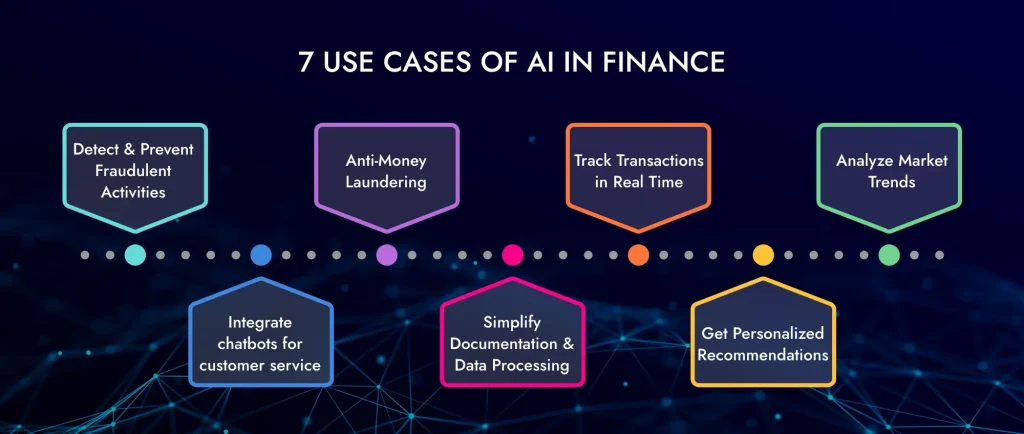
7 Innovative AI Use Cases in Finance

We provide you with insights into key market trends, helping you to concentrate your efforts on those areas where they will be most effective on AI use cases in finance. Learn how our AI solution can transform front-office (customer-facing) processes and back-end operations, making you the number one player in this market.

7 AI Use Cases in Finance

1. Detect and Prevent Fraudulent Activities

Traditional rule-based systems for fraud detection cannot keep pace with the growing volumes or increasing variety of transactions that need to be checked. These systems programmed by humans often result in high false positive rates, which causes users’ payments to decline in frustration. Consequently, merchants with high card decline rates switch payment service providers (PSPs) so that 33% of consumers won’t shop again with a business after a false decline.

In contrast, AI-powered fraud detection algorithms keep learning from transaction patterns and get better at distinguishing between genuine ones and fraudulent activities. For instance, Stripe Radar assesses over 1,000 transaction characteristics in seconds to gauge its likelihood of being fraudulent. This AI use case in finance systems evolves continually, thanks to its deep neural network (DNN) architecture, which can be re-trained in under two hours with new insights from all Stripe transactions.

For instance, as more than 90% of cards on the Stripe network were used more than once, it enables Stripe to make better decisions and reduce false positives. Thus only 0.1% of legitimate transactions are wrongly blocked by Stripe Radar. Looking at the payments sector’s hyper-growth rate, one can easily see how an investment in our solution for AI-based fraud detection pays off quickly as it minimizes financial losses while enhancing merchant satisfaction.

2. Integrate chatbots for customer service

Customer service is crucial for business success but satisfying diverse customer needs might be time-consuming and expensive. This is where our solution of Generative AI-driven chatbots comes into play. Generative AI-powered chatbots simulate natural human-like conversations allowing customers to instantly talk to them around the clock. Unlike simple rule-based systems, these bots comprehend context, sentiment, and language subtleties leading to smooth personalized interactions.

The generative model we build into the chatbot analyzes queries made by customers using generative AI before providing relevant responses or solutions they may require. These chatbots perform various tasks such as checking account balances, explaining transaction details, or assisting with account setup allowing human agents to deal with more complicated questions when asked by your clients.

Banks can improve customer satisfaction using generative AI-driven chatbots that we develop according to your needs and offer non-stop assistance to your customers. Moreover, these robots cut operational expenses while increasing response time. Furthermore, chatbots accumulate valuable data on customers and help the banks gain a better understanding of their clients and customize services based on customer’s needs. By focusing on improving overall customer experiences while driving operational efficiencies, our generative AI-powered chatbot solutions are transforming service delivery in banking.

3. Anti-Money Laundering

The highest concern of banks is to prevent money laundering and meet regulatory obligations. Combining with Generative AI, it has proved to be an influential tool in enhancing Anti-Money Laundering (AML) practices. Additionally, huge transaction datasets, consumer profiles, and historical patterns can be analyzed by generative AI models. These models can identify known money laundering methods and new, evolving schemes, helping banks stay ahead of criminals.

What makes Generative AI especially effective in AML is its ability to create predictive models that detect anomalies and patterns that suggest money laundering. These models learn from new data, allowing them to adapt to new threats.

For banks, using generative AI in AML means more accurate detection of illegal activities, fewer false positives, and better compliance with regulations. This helps banks protect their reputation, avoid large fines, and maintain trust with customers and regulatory authorities.

4. Simplify Documentation and Data Processing

AI simplifies document and data processing in the financial sector. Traditional methods of handling paperwork and data are time-consuming and prone to human error. AI-driven solutions, such as optical character recognition (OCR) and natural language processing (NLP), can efficiently extract and process data from various documents, including loan applications, contracts, and financial statements.

For example, AI can quickly scan and interpret mortgage applications, validating the information and ensuring compliance with regulatory standards. This reduces the processing time and minimizes errors, leading to faster and more accurate decision-making. Additionally, AI can analyze historical data to identify patterns and trends, providing valuable insights for future business strategies.

5. Track Transactions in Real Time

Data security in the banking and finance sector is crucial due to the sensitive nature of customer information. With the abundance of publicly available data and rising fraudulent activities, protecting usernames, passwords, and security questions has become increasingly difficult for organizations. The future may shift away from traditional security methods like passwords, usernames, and security questions toward more seamless and effective fraud prevention techniques.

Leading FinTech companies are gradually moving from traditional SQL databases to blockchain technology, which offers a more secure platform for storing sensitive information. Machine learning applications are set to elevate security in the finance sector through voice and face recognition, along with other biometric data. This approach enhances security, customer retention, and satisfaction by providing a secure and seamless authentication process.

Companies such as Adyen, Payoneer, and Stripe have invested heavily in machine learning-based security and are actively working towards this shift. From a more technical perspective, banking algorithms employ Natural Language Processing (NLP) to supervise the amounts of emails and other information entering their systems. These algorithms use supervised machine learning techniques like support vector machines (SVM) and random forest trees to detect patterns that may indicate malicious behavior or any customer information leakage.

6. Get Personalized Recommendations

AI-powered personalized recommendations improve customer experience by offering customized financial advice and product proposals. The personalized recommendations are enabled by machine learning algorithms that analyze data on clients, including transactional history, spending habits, and financial goals.

For instance, AI can suggest investment opportunities based on a client’s risk tolerance and objectives. Using AI technologies, robot advisors recommend offering customers tailored investment plans and providing continuous monitoring and adjustments. Thus, the degree of personalization helps clients to make informed choices relating to finance, hence leading them closer to the achievement of financial objectives.

7. Analyze Market Trends

AI analyzes massive amounts of market data in search of patterns and predictions. This could be done by real-time processing using machine learning models that collect data from stock markets, economic indicators, or news articles to identify emerging trends.

AI is used by financial institutions worldwide for predictive analytics that help with forward-looking decisions built on facts instead of intuition. For example, through historical data analysis alongside market sentiment reviews, artificial intelligence algorithms predict future movements in stock prices.

Based on these insights, traders/investment managers can thus optimize trading strategies for better returns. Moreover, global economic indicators and geopolitical events can be monitored through AI, giving a comprehensive overview of the market dynamics within which banks operate, increasing certainty around strategic planning processes, reducing risks, and ensuring better client outcomes.

SEE: Finance Cost Optimization with AI Solutions

Supercharge Your Financial Services with AI!

Explore innovative AI use cases in finance to optimize decision-making, improve customer experiences, and boost efficiency. Let ViitorCloud’s AI experts craft solutions tailored to your needs.

How does ViitorCloud Reshape Finance Operations With AI?

AI is revolutionizing the finance sector, offering transformative solutions that enhance every aspect of financial operations. With advanced AI use cases in finance, such as fraud detection, risk management, personalized financial recommendations, and market trend analysis, businesses are empowered to improve efficiency, accuracy, and customer experience. As AI continues to evolve, financial institutions must stay ahead of the curve by embracing innovative AI finance solutions that drive competitiveness and operational success.

At ViitorCloud, we specialize in providing cutting-edge AI finance solutions tailored to your business needs. Our team delivers customized AI development services that go beyond the basics, offering sophisticated tools like AI-powered chatbots, video analytics solutions, and intelligent AI assistance. By integrating these AI-driven tools into your financial ecosystem, you’ll achieve seamless operational improvements, streamline decision-making, and unlock the full potential of AI solutions for maximum ROI.

Choosing us as your AI partner means tapping into our expertise and proven track record in transforming financial operations. Whether you’re looking to enhance risk management, personalize customer experiences, or optimize your market analysis, our AI-driven strategies ensure your business remains competitive in an ever-evolving landscape. Let us help you stay ahead by implementing AI finance solutions that truly make a difference.

Partner with us today and take your financial operations to the next level with our world-class AI solutions. Maximize your growth, streamline your processes, and secure a future of innovation. Also, reach out to us on LinkedIn and we will help you to achieve your business goals faster than ever!


Frequently Asked Questions

AI has disrupted finance by improving its efficiency, fostering risk management, allowing personalized customer service, and automating routine tasks. It leads to cost savings, better decision-making, and increased customer satisfaction.

AI may be used in finance for fraud detection, credit scoring, personalized financial advice, algorithmic trading, and process automation among others. This enables it to analyze data sets giving insights into predicting trends or optimization of financial operations.

JPMorgan Chase uses artificial intelligence to manage regulatory compliance among other areas. The company’s artificial intelligence platform saves its legal teams 360000 hours annually through automation of document review as well as compliance processes related to regulations applicable within the lending divisions of JPMorgan Chase bank amongst others.

How AI is Helping Finance to Reduce Costs and Improve Efficiency

In the finance sector, achieving efficiency and reducing costs are more necessary than ever. ViitorCloud’s AI solutions are designed to help your business unlock new levels of productivity and profitability. With our cutting-edge AI development services, we help finance organizations streamline operations, optimize costs, and make data-driven decisions with excellent accuracy.

AI finance cost optimization is not just about automating repetitive tasks. We use advanced AI techniques like Generative AI to transform your financial processes. These solutions delve deep into your data, uncovering valuable insights, forecasting trends, and making intelligent recommendations that enhance decision-making. Whether it’s identifying patterns in large datasets or predicting future market behaviors, our AI solutions work tirelessly to maximize your financial outcomes.

With finance cost optimization with AI solutions from us, businesses can reduce operational costs, increase efficiency, and stay ahead of the competition. Our AI experts team developed AI tools that are designed to evolve with your needs, ensuring that as your business grows, so do the benefits of your AI infrastructure. We take pride in offering customizable AI finance solutions that can adapt to your unique challenges and goals.

With ViitorCloud, you’re not just adopting AI; you’re investing in the future of your financial success. Our finance cost optimization with AI services is tailored to ensure you see tangible results, from cost reduction to improved strategic decision-making. Let us help you turn AI potential into real-world performance.

Revolutionize your finance operations! In the following blog, discover how our AI development services can drive your business forward with AI solutions specifically crafted for the finance sector. Let’s unlock the future of finance together!

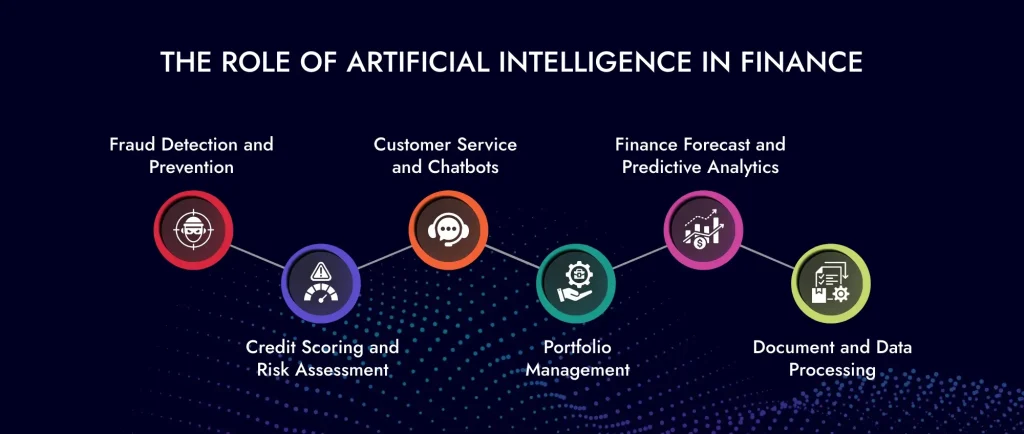
The Role of Artificial Intelligence in Finance

ViitorCloud provides innovative AI solutions that can greatly improve the operational capabilities of financial institutions, helping them better serve their clients. We offer tailored AI development services designed specifically for the finance sector, leveraging advanced technologies. Effective finance cost optimization with AI solutions is essential for staying ahead. Our expertise in AI finance cost optimization enables financial organizations to streamline their processes, reduce operational costs, and enhance overall efficiency.

Let’s have a look at how finance cost optimization with AI works and the role of AI in finance:

The Role of Artificial Intelligence in Finance

1. Fraud Detection and Prevention

The banking and investment sectors continually deal with fraud on a daily basis, one of them being money laundering. Financial institutions have traditionally used expert-written rules coded into software. Though efficient, criminals often avoid these rules. By creating an artificial intelligence system that “learns” to identify suspicious behavior without fixed rules, we have AI.

Machine learning is used by about 70% of financial organizations for fraud detection. Besides detecting fraud, AI-powered chatbots act as a first line of defense during digital transactions, verifying identities with advanced techniques like biometric analysis or multi-factor authentication (2FA).

These virtual assistants handle tasks usually done by human agents, such as identity verification, and answer queries 24/7 without fatigue or bias. It also leads to improved customer service quality and reduced operational costs.

2. Credit Scoring and Risk Assessment

Fintech firms are already leveraging machine learning’s abilities to exploit information not usually tapped into by traditional financial companies. Rather than sticking with basic credit data, they access alternative sources such as online activities, social media content, or smartphone usage patterns. This advanced analysis paints a more detailed picture of an individual’s financial habits, helping lenders manage risks more effectively and possibly offering borrowers lower interest rates.

A Wells Fargo study highlighted that AI implementation resulted in fewer loan defaults than conventional methods used by major financial corporations. Besides aiding decisions on asset allocation, AI plays a crucial role in efficiently managing investment risks. It does this by analyzing complex datasets from different sources like economic indicators and social media sentiments, identifying possible threats before they cause significant impacts on portfolio performance.

Fintech organizations utilize advanced ML algorithms to forecast future trends based on past behavior patterns and anomalies uncovered during analysis. Thus, proactive risk mitigation strategies can be employed instead of reactive measures taken after incurred losses.

3. Customer Service and Chatbots

AI-powered chatbots are now indispensable when it comes to automating customer service processes. These virtual assistants use machine learning algorithms to improve continuously based on user interactions. Beyond handling queries 24/7, these chatbots provide tailored financial advice by analyzing an individual’s financial data and patterns and suggesting better-saving strategies or suitable investment opportunities.

Another strong application of AI in fintech is that predictive analytics helps predict future behaviors based on past trends and customer feedback, thus allowing companies to anticipate solutions even before clients express needs. Major corporations like Wells Fargo use this technology to predict possible issues affecting their customers’ accounts or transactions, thus enabling them to act promptly and fostering trust between the institution and its clientele within the finance and banking industry.

4. Portfolio Management

AI and machine learning algorithms are now critical for improving decision-making processes and optimizing investment portfolios towards maximum returns with minimum risk.

It is also vital in assessing the performance of an investment portfolio and asset allocation. Today’s Fintech companies use AI instead of traditional methods, which rely on financial advisors using past data and personal experience.

This innovative method allows for a flexible asset allocation, which changes investments depending on market conditions instead of sticking to a particular strategy. This way, it enhances returns while effectively reducing risks.

5. Finance Forecast and Predictive Analytics

Predictive analytics is a crucial tool in the fintech world. It applies statistical techniques such as modeling and machine learning to analyze facts plus historical information. Therefore, this kind of deep analysis makes it possible to forecast future events or behaviors within the finance sector accurately. These technologies enable financial institutions to have factual insights rather than relying on speculation or gut feelings, leading to better outcomes.

Many advantages accrue to fintech firms that integrate AI into their systems. One is improved operational efficiencies; automated systems can perform complex calculations much faster than humans, driving traditional financial services to such technological advancements.

Also, AI is essential in predicting future happenings based on previous and current data. This attribute is vital to financial achievement, such as saving for personal assets or increasing a company’s profitability while cutting expenditures.

6. Document and Data Processing

Artificial intelligence in document and data processing has transformed the finance industry. In the past, dealing with large amounts of financial information and paperwork used to take time and was usually prone to mistakes. Conversely, AI automates this operation by automating it, avoiding errors due to human involvement.

AI-powered tools can quickly extract, categorize, and analyze data from different documents, such as invoices, contracts, and financial statements, to aid in faster processing time, lower error risk, and higher data accuracy. To this end, machine learning algorithms improve their performance over time by gaining knowledge of new data, consequently boosting their ability to identify trends and abnormalities.

For instance, AI can automate extracting relevant information from a large volume of unstructured data that converts into structured formats that are easier to analyze and report. For compliance purposes in particular, where accurate and timely reporting is important the capability is helpful.

READ: AI in Finance – Transforming Banking with AI Solutions

Optimize Your Financial Operations with AI!

Discover how our AI solutions drive finance cost optimization and boost efficiency in the BFSI sector. Let’s transform your business now!

Finance Cost Optimization with AI Solutions

AI plays an important role in driving finance cost optimization with AI solutions. These advancements not only lead to reduced costs but also significantly enhance the efficiency of financial activities.

By implementing AI finance cost optimization, organizations can streamline their processes, allowing finance teams to focus on strategic initiatives rather than routine tasks. This shift fosters a more agile and responsive financial environment, ultimately resulting in better decision-making and improved overall performance. Embracing these innovations is a confident step toward a more efficient future in finance.

Let’s discuss how finance cost optimization with AI solutions works:

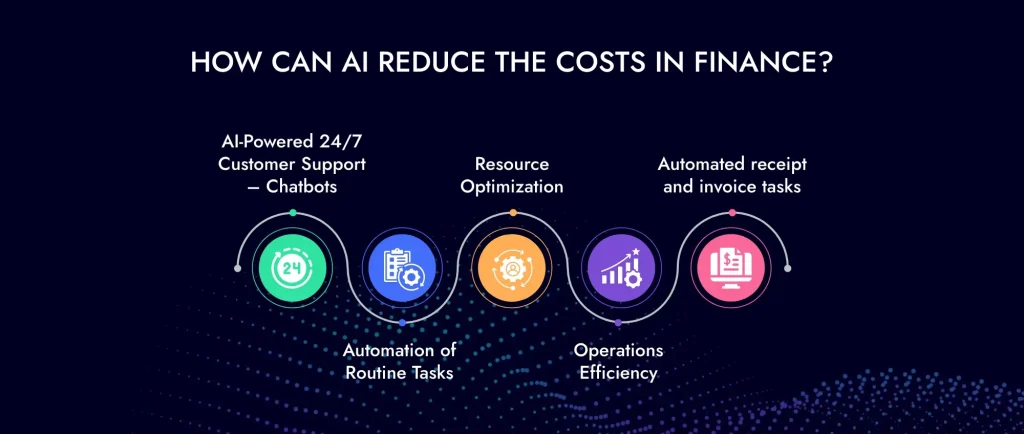
Finance Cost Optimization with AI Solutions

The majority of consumers believe that customer service is crucial for brand loyalty. Time and resource constraints can frustrate customers and mar their experience. Many customers expect banks to provide 24/7 customer service, regardless of time zones. However, difficulties associated with 24-hour service include hiring, training, and scheduling staff. These challenges require significant financial investment, thus consuming much of banks’ budgets.

This is where AI chatbots come in handy, helping with any task at any given time. One of the major benefits of finance cost optimization with AI is an expansion of access to self-service for customers; however, they must be able to understand instructions delivered via texts or sound prompts generated by an interactive voice response (IVR) system. Chatbots can interpret context, detect emotion in text messages, and respond appropriately.

Chatbots are best suited for determining account balances or knowing fixed deposit rates. Millions are saved by these artificial intelligence bots, freeing up resources and saving time for the banking industry. Additionally, chatbots overcome language barriers since training them involves teaching them how to answer queries and converse using any language.

Finance cost reduction may be achieved by automating routine tasks as part of an artificial intelligence integration strategy, with machines taking over such tasks as entering information into databases, making transactions go through, or verifying whether regulations have been complied with, which used to be done manually, taking much time.

Thanks to powerful AI systems that can do these operations with high precision and speed, human involvement may be minimized. This, in turn, will save labor costs and minimize the chances of making costly mistakes.

For example, AI can do account reconciliation automatically, while payroll management, invoice processing, etc., become much simpler. These developments, therefore, mean that finance cost optimization with AI is a reality all over the world.

By providing actionable insights through advanced data analytics, AI helps financial institutions to optimize resources within their reach. For instance, using artificial intelligence makes it possible to detect inefficiencies from huge amounts of information available to understand market trends and make better decisions about investing for the future. Financial institutions must use their assets efficiently by allocating them properly among capital equipment, employees, and technology.

For instance, predictive analytics based on AI can anticipate customer behaviors hence helping financial companies know where they should put more money into or remove such services – this approach is known as strategic resource allocation. Through this method, desired results are achieved at the minimum costs possible.

AI simplifies processes and reduces time taken in executing complex tasks thus enhancing operational efficiency for an organization. Such measures can be implemented by using artificial intelligence in workflow management hence optimizing customer service especially when it comes down to decision-making processes for financial-related issues.

The AI integration strategy of chatbots into an organization’s operations ensures that customers have access to support every day of the week including weekends even during odd hours of the night. Therefore this results in improved satisfaction levels among clients who no longer have to wait in long queues at any banking hall looking for someone capable enough answering even simple queries made by text messages or through pressing buttons on their phones; thus saving millions each year on maintaining large call center teams only ready assist you 24/7.

Additionally, real-time fraud detection is more efficient than conventional techniques because it allows monitoring and analysis of actual transactions carried out by AI-powered cost reduction in finance. To prevent further damage from fraud and protect the institution’s reputation, this proactive approach to fighting fraud saves money by reducing losses associated with fraudulent activities.

According to a study conducted by Harvard Business Review Analytic Services, 67% of C-suite executives agree that their teams’ major activities include chasing receipts and invoices. Again, 64% think that financial departments should concentrate on examining financial information to guide business decisions. This gap shows how vital strategic obligations differ from regular operational roles.

With built-in automation, AI provides real-time data and simplifies the month-end close process. AI solution automates chasing missing receipts and invoice information, saving you time, improving accuracy, and speeding up spend visibility without constantly asking colleagues for information.

ALSO READ: Benefits of AI in Finance: Transforming Financial Services

Cut Costs and Enhance Efficiency with AI Solutions

Leverage the power of AI for finance cost optimization and unlock unparalleled operational efficiency. Partner with ViitorCloud today!

Examples of Successful Enterprises in the Finance Industry

AI applications in finance, ranging from credit scoring to fraud detection, have maintained efficiency and accuracy. Industry reports reveal that nearly 70% of financial institutions use machine learning for essential functions like risk management and customer service automation. This adoption improves decision-making processes and optimizes operational costs, paving the way for significant financial gains.

Moreover, AI’s impact extends beyond operational efficiency to economic contribution. Forecasts indicate that AI could inject $15.7 trillion into the global economy by 2030, exceeding the combined current outputs of China and India. This economic windfall highlights AI’s pivotal role in driving global growth and competitiveness across financial enterprises. In parallel, regional insights highlight India’s burgeoning AI market, projected to reach $3.9 billion by 2028, fueled by rapid digitization and AI’s transformative capabilities in the banking, healthcare, and telecommunications sectors.

Innovative AI tools like ChatGPT exemplify AI technologies’ rapid adoption and scale within financial enterprises. With ChatGPT collecting over 100 million active users within months of its launch, the application highlights AI’s potential to improve customer interaction and operational productivity. Enterprises are using ChatGPT to enhance customer service, generate multilingual content, and improve workforce productivity. As financial institutions continue to use AI’s capabilities, they are on the way to unlock new opportunities for growth, efficiency, and customer satisfaction.

SEE: Top Applications of AI in Finance Transforming the Industry

Transform Finance with Smart AI Solutions

Our AI expertise helps you achieve finance cost optimization while improving performance in the financial sector. Get started with us!

How Can ViitorCloud Help Finance Companies with AI Solutions?

In the finance industry, staying ahead of the competition means adopting innovation—and AI is at the forefront of that transformation. From finance cost optimization with AI solutions to streamlining routine tasks, AI is revolutionizing how financial institutions operate. It’s not just about reducing costs; it’s about creating new efficiencies, optimizing investment decisions, and delivering superior customer service. For companies that are serious about AI finance cost optimization, now is the time to adopt AI solutions that can future-proof your operations and drive business growth.

AI development companies like us understand the unique challenges faced by financial institutions. That’s why our AI development services are designed specifically to meet your needs. Whether you’re aiming to cut costs, enhance operational efficiency, or explore AI-driven insights for better decision-making, we offer AI solutions that will empower your business to succeed in this growing market. Our team of AI experts works closely with you to deliver customized solutions that align with your goals, ensuring a seamless integration of AI into your financial operations.

Why wait? The future of finance is AI-driven, and ViitorCloud is here to help you harness that potential. From automating back-office tasks to implementing refined algorithms for financial analysis, our AI finance cost optimization solutions are built to deliver results. Contact us today and let us lead the way in transforming your finance operations with innovative AI technologies.

Don’t miss the opportunity to stay competitive! Partner with ViitorCloud and unlock the true power of AI for your business.


Frequently Asked Questions

AI automates routine tasks, enhances operational efficiency, and minimizes errors, reducing overhead costs significantly.

AI optimizes finance by enhancing decision-making with predictive analytics, improving risk management, and automating processes for faster transactions.

AI simplifies workflows, speeds up data processing, and enables faster customer service through automation and predictive insights.

Top AI Applications Transforming Finance

Artificial Intelligence is already transforming industries, and finance is no exception. While blockchain, cryptocurrencies, and Robo-advisors often make headlines, AI is the true game-changer in the finance sector. The future of finance lies in smart, AI-powered solutions that drive efficiency, enhance customer experiences, and reduce operational costs.

The financial services are vast and complex, from retail banking and investment management to insurance and accounting. This is where our AI development services step in. Our AI solutions streamline processes, improve decision-making, and cut costs, empowering your business to stay ahead in a competitive market.

The applications of AI in finance are extensive, whether it’s fraud detection, personalized banking experiences, or automated investment strategies. AI simplifies operations and enables your team to focus on growth, not just maintenance.

If you want to elevate your business with AI, ViitorCloud is here to help. Our expertise in AI development ensures that your finance operations will not only be more efficient but also future-proof. We provide tailored AI solutions that can transform your financial services!

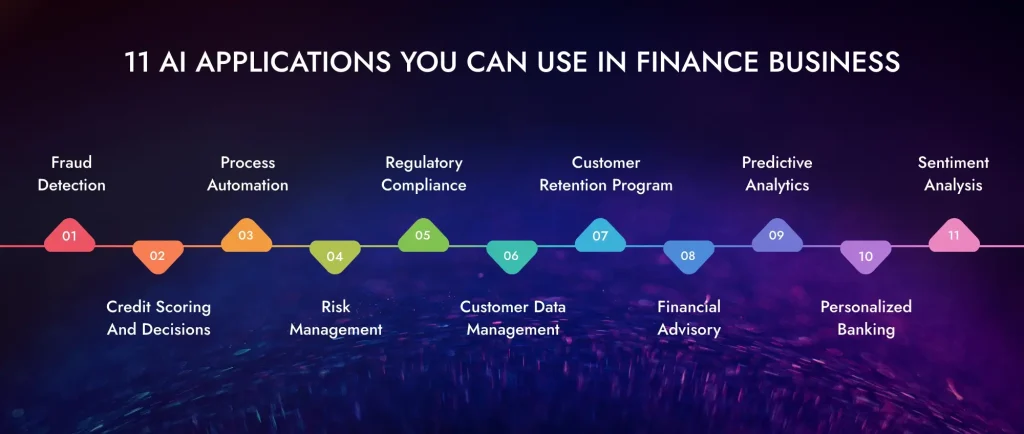
Top 11 Applications of AI in Finance Business

By integrating AI into finance, companies can significantly reduce operational costs and increase profit margins. This technological advancement also grants customers the convenience of accessing their accounts on their smartphones, allowing for seamless mobile banking experiences.

Top 11 Applications of AI in Finance Business

1. Fraud Detection

AI has become an integral tool for detecting and preventing frauds, especially within Fintech due to its ability to analyze large amounts of data quickly and accurately.

Machine learning algorithms are crucial for improving how financial institutions detect fraud. AI applications in finance algorithms learn from past financial transactions to spot patterns that may indicate fraudulent behavior. This predictive analytics approach helps companies proactively identify threats before they cause damage, offering extra protection for customers’ private data.

Also, Artificial Intelligence-powered chatbots serve as gatekeepers during digital transactions. Scammers use these as their first defense through methods like biometric analysis or multi-factor authentication (2FA) that verify the identity of individuals who could be thieves. Such technology keeps malicious people away from innocent customers.

2. Credit Scoring and Decisions

Credit scoring has been transformed by Artificial Intelligence (AI) in financial services where traditional models have been replaced with more accurate and sophisticated ones. For instance today, fintech firms use AI-driven machine learning algorithms that consider more variables than traditional financial institutions do.

These algorithms make use of both standard credit data along non-traditional sources such as online behavior, social media interactions, or even phone usage patterns. This is because AI in finance applications gives lenders a better view concerning borrowers’ reliability in terms of finances other than just relying on regular credit data only which means they can assess risk better leading to lower interest rates.

According to a Wells Fargo study based on fewer loan defaults following the adoption of artificial intelligence than conventional methods applicable among major financial institutions, it is evident that AI effectively enhances risk management within the finance industry.

3. Process Automation

Machine learning solutions enable financial services companies to automate repetitive tasks thus increasing productivity through intelligent process automation. Examples of such innovations include chatbots, automated paperwork handling, and gamified employee training. The result – enhanced customer experience, reduced costs, and improved service scalability.

Furthermore, machine learning technology is also effective in accessing and interpreting data to identify patterns and trends. In this regard, AI in finance application chatbots are used by customer support systems to deal with a wide range of issues as if they were real people.

For example, Wells Fargo has a chatbot on Facebook Messenger driven by machine learning that interacts with users seamlessly helping them find account information or recover passwords; this illustrates how artificial intelligence can improve customer service in the banking sector.

4. Risk Management

Banks and other financial institutions can use machine learning techniques that analyze huge amounts of data to reduce risk factors greatly. Thus, unlike traditional methods, which only consider limited details like credit scores, ML appraisals better understand an individual’s personal information, which is widely available for assessing their real risk capacity.

Machine learning-based insights into banking and financial services simplify informed decision-making. For instance, ML programs may draw from multiple data sources while assessing loan applications before giving them risk scores. This way, the algorithms will give possible defaulters, prompting companies to adjust terms or rethink their approach towards each client individually.

READ: Benefits of AI in Finance: Transforming Financial Services

5. Regulatory Compliance

Keeping pace with regulatory changes across different locations constitutes a challenge to Fintech companies. This is made easier with constant monitoring and interpretation of new rules by Artificial intelligence in finance application. It updates the system’s rules on time for compliance purposes, reducing the chances of penalties and improving trust between customers and regulators alike.

6. Customer Data Management

Regarding banks and financial institutions, data is crucial for their operations and success. Efficiently managing volumes of diverse financial data—from mobile communications and social media activity to transaction details and market data—is a significant challenge even for financial experts.

By using machine learning approaches, organizations can increase processes’ efficiency and capacity to get valuable information from data. Among these AI and ML tools are analytics, data mining, and natural language processing that help derive actionable Intelligence from this huge number of records, which essentially enhances business profit.

For example, customer financial data can be evaluated by machine learning algorithms to assess the influence of market changes and specific financial trends. This enables institutions to make informed decisions and offer customized services that cater to customer requirements in a better way.

7. Customer Retention Program

ML technology used by credit card companies determines which customers are in danger of becoming dormant and works on retaining them proactively. Their system helps them accurately forecast the behavior of their customers based on user demographics and transaction history and adaptively create custom-made offers.

During this operation, predictive models are used to spot at-risk customers using binary classification. In turn, the recommender model provides personalized card offers for effective customer retention from dropping off.

8. Financial Advisory

Machine learning-driven budget management apps provide customers with specialized financial advice and guidance. These apps enable users to track daily spending and analyze data to pinpoint spending patterns and areas for potential savings.

Another emerging trend is the rise of Robo-advisors. These AI-powered tools work like human advisors but target individuals and small and medium-sized enterprises with limited resources. Robo-advisors use machine-learning algorithms to build investment portfolios advising on trading, investments, or retirement issues among other needs.

9. Predictive Analytics

In Fintech companies predictive analytics is an important thing to consider. It uses methodologies like modeling, and machine learning to enable deep analysis of both present and historical datasets. This kind of analysis makes it easier to predict events happening in the future or behaviors taking place in the finance sector more precisely.

Factual insights rather than speculation or intuition are obtained by financial institutions using these beneficial technologies. Hence, more informed decision-making is possible leading to better overall outcomes. Various advantages come with Fintech firms integrating AI capabilities within their systems.

One such benefit is increased operational efficiency; traditional financial service providers prefer this technology since automated systems perform complex calculations much faster than humans. Moreover, AI enhances risk management strategies particularly in hedge funds and asset management firms by enabling more sophisticated risk assessment mechanisms and mitigation measures.

10. Personalized Banking

Financial advice does not fit all because its unique circumstances differ from each client’s. In this way, AI helps financial institutions provide personalized guidance and “advice engines” that use machine learning to suggest customized investment decisions, taxation, insurance, etc.

Similarly, AI adaptive capabilities go beyond simple automation providing highly targeted advice on the other hand.

11. Sentiment Analysis

Through using advanced AI systems Fintech companies are now able to handle amounts of data from social media posts and news articles. By using machine learning algorithms, these systems can understand an investor’s sentiment towards a specific security or the entire market and differentiate between positive, negative, and neutral sentiments.

AI uses NLP for interpreting human language. It mainly focuses on identifying emotional words in text data and assigning scores based on positivity or negativity. NLP analyzes sentiment in text data for personalized financial services provided by Fintech platforms.

For example, when algorithmic trading approaches discover similar investors demonstrating increased optimism around certain stocks algorithmic trading methods like this sentiment analysis can be used as a signal toward investing some of your money into them.

Enhance Financial Performance with AI

Use AI applications in finance to drive efficiency and innovation. Our expert AI development services deliver customized solutions to meet your unique needs.

What is the Potential of AI to Reduce Finance Costs

AI, especially Generative AI powered by Large Language Models (LLMs), is transforming the finance industry by automating tasks, increasing efficiency, and significantly reducing manual work. Financial companies can stay updated and enhance customer experiences by using these disruptive technologies with tailored AI solutions from ViitorCloud.

By investing in AI development services, businesses can implement AI applications quickly and see immediate benefits. For example, AI can streamline coding processes, helping developers launch new financial products and services faster and with greater accuracy. Imagine reducing your operational costs while boosting performance—AI makes this possible.

A recent global survey revealed that 36% of financial professionals reported cost reductions of over 10% after integrating AI. According to the study, several hundred Nvidia’s financial customers have been found implementing them. Nearly half saw noticeable improvements in customer service. At ViitorCloud, we offer AI-driven solutions that not only enhance customer interactions with multilingual support but also streamline compliance, risk management, and security efforts—drastically lowering costs in these areas.

ViitorCloud has already helped numerous businesses harness the applications of AI in finance, such as contract translations and seamless communication between diverse teams and customers. Our AI development services are designed to reduce costs, improve service, and transform financial operations.

Transform Your Financial Strategy with AI

Stay ahead in the finance sector by incorporating advanced AI applications. Our top-notch AI development services provide comprehensive solutions to enhance your financial processes.

How ViitorCloud Empowers Finance to Become Future-Ready

The finance industry is undergoing a rapid transformation with the integration of AI. Applications of AI in finance are driving efficiency, enhancing customer experiences, and improving decision-making. AI processes large volumes of data with remarkable speed and precision, enabling financial institutions to operate more efficiently while offering personalized services tailored to each customer’s needs.

At ViitorCloud, we empower financial institutions to become future-ready with our cutting-edge AI solutions. Our AI development services are designed to help your organization adapt to the evolving finance sector, improving compliance, optimizing financial strategies, and elevating customer service.

Hire AI developers and transform your finance operations with AI! Partner with ViitorCloud today and lead the way to a smarter, more efficient future. Contact us now to explore how our AI solutions can revolutionize your business.


Frequently Asked Questions

Applications of AI in finance offer enhanced decision-making, risk management, and personalized services. It improves efficiency by automating routine tasks, analyzing many data sets for insights, and providing predictive analytics for better financial planning.

AI in finance examples include AI-driven chatbots for customer support, fraud detection systems, robot advisors for investment advice, credit scoring models, and automated compliance monitoring that streamline operations and improve service delivery.

AI in finance application solutions includes predictive analytics; machine learning algorithms used in spotting fraudulent activities; financial advisor personalization technologies; automatic compliance systems as well and customer interaction tools powered by artificial intelligence that boost efficiency and customer experience.

Building Secure Web Apps with React JS Best Practices and Strategies for Protecting Your Data

React JS is among the most used frameworks as nearly 40% of developers prefer it worldwide in 2024. Even top tech giants like Facebook and Netflix rely on React JS when building high-performance web apps. However, with the increasing popularity of React JS web apps comes an urgent need for strong security measures.

Cyber threats are on the rise, and an IBM report states that the global average cost of a data breach has reached 4.88 million. This clearly shows the urgent need to secure your applications for user privacy and data security. At ViitorCloud, we have expertise in developing secure React JS applications that ensure high-performance standards and data protection.

Our team of experts and engineers has experience in building secure Reach JS web apps according to the client’s requirements. We emphasize safeguarding sensitive information while making sure your applications are user-friendly and agile.

Web Security in React JS Development

Web security in React JS development is essential due to the framework’s widespread use and inherent vulnerabilities. One major threat is Cross-Site Scripting (XSS), where attackers inject harmful scripts into applications. To combat this, React’s data binding features automatically escape values, helping to prevent such attacks.

Another concern is Cross-Site Request Forgery (CSRF), which involves unauthorized commands being sent from trusted users. Implementing anti-CSRF tokens and validating requests can safeguard against this risk. Additionally, regular audits of dependencies and using security linters can catch potential issues early on.

By following these best practices—like validating URLs and sanitizing user inputs—developers can significantly enhance the security of their React applications.

Why is React JS Popular for Web Development?

React JS is popular for building dynamic and scalable applications due to its component-based architecture. This approach simplifies development by enabling reusable UI components, improving maintainability and performance. However, this flexibility also demands a strong focus on React JS security throughout the development lifecycle. Developers must prioritize security while creating user-friendly interfaces to protect user data and ensure application integrity.

What Are the Common Security Challenges in React Web Apps?

React web applications face several security risks:

  1. Cross-Site Scripting (XSS): Attackers inject malicious scripts due to improper handling of user input, leading to unauthorized access.
  2. Cross-Site Request Forgery (CSRF): Attackers trick users into performing unwanted actions on authenticated sessions, compromising user accounts.
  3. Insecure APIs and Data Exposure: Many React JS web apps rely on APIs. If not secured, these can expose sensitive data or allow unauthorized access.
  4. Secure Coding Standards: Adhering to secure coding practices in React JS development helps mitigate vulnerabilities and protects user data effectively.

READ: Use React for Web Development | React Web Development

Secure Your React JS Web Apps Today!

Partner with us to build secure web apps using React JS best practices. Our expert team will safeguard your data and ensure flawless functionality.

Best Practices for Building a Secure React JS Web App

Building a secure React JS web application is essential in today’s digital landscape, where cyber threats are increasingly sophisticated. To protect user data and maintain trust, developers should focus on best practices such as validating and sanitizing user inputs, implementing a strong Content Security Policy (CSP), and using trusted libraries. Additionally, ensuring robust authentication methods and regularly updating dependencies can significantly enhance security.

1. Implement HTTPS Everywhere

Using HTTPS is critical for securing data in a React JS web app. HTTPS encrypts the data exchanged between the browser and the server, protecting sensitive information from attacks. Setting up SSL/TLS certificates for React websites ensures data integrity and builds user trust, which is crucial for apps handling personal or financial information.

2. Use Secure Authentication and Authorization

Implement secure authentication and authorization in React JS security:

  • JWT: Use JSON Web Tokens for stateless, secure user authentication.
  • OAuth2: Simplify secure third-party logins without exposing credentials.
  • Role-Based Access: Secure authorization flows with role-based access controls and token validation.

3. Prevent Cross-Site Scripting (XSS)

To protect your React JS web app from XSS:

  • Input Sanitization: Validate and sanitize user inputs using libraries like DOMPurify.
  • JSX Protection: Leverage React’s built-in JSX escaping features and avoid dangerouslySetInnerHTML.
  • Escape Dynamic Content: Always escape dynamic content to prevent malicious script execution.

Data Protection in React JS Development

In React JS development, data protection is a critical aspect that developers must prioritize to safeguard user information. As web applications increasingly handle sensitive data, implementing robust security measures becomes essential.

Secure API Communication

When building a React JS application, it’s crucial to establish secure communication between the frontend and backend services.

Best practices include:

  • Use HTTPS for all API calls to encrypt data in transit.
  • Implement secure authentication mechanisms like JWT (JSON Web Tokens) to verify user identities.
  • Securely handle sensitive data such as tokens and personal information by encrypting it at rest and in transit.

Handle Sensitive Data in State Management

Managing sensitive data in React’s state management (useState, Redux) requires special care:

  • Avoid storing sensitive data like tokens or passwords in local storage or global state to minimize exposure.
  • Use secure storage options like HTTP-only cookies for storing authentication tokens.

Data Masking and Encryption in Forms

To protect sensitive data submitted through forms:

  • Encrypt form data before transmission to ensure privacy.
  • Implement secure form validation and submission handling practices within React websites to prevent unauthorized access and data leaks.

Protect Your Data with Expert React JS Solutions

Our React JS development services focus on creating secure, high-performance web apps that protect your business data. Get in touch today for custom solutions.

Securing Dependencies and Libraries in React

Securing dependencies and libraries in React is a crucial aspect of application development that often gets overlooked. As developers increasingly rely on open-source libraries to expedite their projects, the potential for introducing vulnerabilities grows.

Auditing Third-Party Dependencies

In React JS development, the use of third-party dependencies can introduce vulnerabilities if not properly managed.

To mitigate this risk:

  • Monitor for Vulnerabilities: Use tools like npm audit and Snyk to regularly scan your dependencies for known vulnerabilities. These tools provide insights into potential security issues and suggest fixes.
  • Keep Dependencies Up to Date: Regularly update your dependencies to ensure you are using the latest, most secure versions. This practice helps protect against known exploits in outdated packages.

Using Content Security Policies (CSP)

Implementing Content Security Policies (CSP) is crucial for enhancing security in a React JS web app:

  • Set Up CSP Headers: Configure CSP headers to prevent attacks such as XSS by specifying which sources are trusted for loading scripts and resources.
  • Configure a Secure CSP: A well-defined CSP restricts external resources and scripts, thereby minimizing the risk of malicious content execution. For example, you can specify default-src ‘self’; to allow content only from your domain, enhancing overall security.

Ongoing Web Security Maintenance

Ongoing security testing is vital for ensuring that web applications remain secure against emerging threats. Regular security audits help identify vulnerabilities and assess the overall security posture of React applications. Tools like OWASP ZAP, Burp Suite, and Snyk can be utilized to conduct thorough security audits, scanning for known vulnerabilities in dependencies and code.

Patching vulnerabilities in real-time is essential; developers should prioritize fixing identified issues promptly to minimize exposure to potential attacks. Continuous monitoring of security advisories for project dependencies is also crucial to maintaining a secure environment.

Keeping React versions updated is critical for security, as updates often include important security patches that address known vulnerabilities. Developers should regularly check for updates using tools like npm outdated and ensure they are using the latest stable versions.

Following OWASP’s security guidelines provides a comprehensive framework for web app security, helping developers implement best practices that protect against common vulnerabilities such as XSS and CSRF. Staying informed about the latest security developments in the React community is essential for maintaining robust application security.

Partner with ViitorCloud to Secure React Apps

Partnering with ViitorCloud for your React JS web app development means securing your application with expert-driven solutions. Our skilled React developers implement best practices to protect your app from common vulnerabilities like XSS and SQL injection. With our React JS Development Services, you’ll benefit from robust security measures such as advanced authentication protocols, end-to-end encryption, and proactive updates of dependencies. Our customized solutions ensure that your application remains resilient against cyber threats, safeguarding user data and maintaining the integrity of your web apps.

Contact ViitorCloud to enhance your app’s security and let us build a safer, more reliable solution for your business.

Build Secure Web Apps with ViitorCloud

Ensure the security of your React JS web apps with our cutting-edge development services. Leverage our expertise to create web apps that prioritize data protection.

Conclusion

At ViitorCloud, we understand that security is a fundamental part of the React JS development process. Our React JS Development Services ensure that security is integrated from the very start, helping you build secure and scalable web apps. By adhering to best practices—such as implementing HTTPS, using secure authentication mechanisms, preventing Cross-Site Scripting (XSS), and securely handling sensitive data—we help protect your users’ data and reduce the risk of vulnerabilities.

Our team continuously follows these security measures throughout the development lifecycle, from secure API communication to data encryption in forms. This ensures that your React JS web app remains robust and resilient against evolving cyber threats, providing strong protection for sensitive information.

With ViitorCloud’s expertise, you’ll not only deliver high-performance web applications but also foster user trust through stringent security practices. Let us help you prioritize security and performance in your React JS projects, so your business can scale confidently in today’s digital landscape.

Ready to build secure and scalable React JS web apps? Contact ViitorCloud today!


Frequently Asked Questions

HTTPS encrypts data transmitted between the user’s browser and the server, protecting sensitive information from eavesdroppers and man-in-the-middle attacks. Implementing HTTPS in a React JS web app ensures data integrity and builds user trust.

JSON Web Tokens (JWTs) enable secure user authentication by transmitting information in a compact, verifiable format. They allow for stateless authentication, meaning no session data needs to be stored on the server, enhancing security and performance in React JS development.

The applications practical in AI are hiring and recruitment, cybersecurity, market prediction, customer analysis, billing and invoice, and virtual assistant.

ViitorCloud offers expertise in implementing best practices for securing React JS web apps. By partnering with ViitorCloud, you can ensure that your application follows the latest security standards and is protected against common vulnerabilities.

How Can AI be Beneficial to The Finance Sector?

The finance industry has always been at the forefront of adopting cutting-edge technologies, and Artificial Intelligence is no exception. While AI is gaining traction across various sectors, its impact on finance is particularly transformative. From enabling banks and lenders to streamline operations, to making data-driven decisions, and delivering highly personalized customer experiences, the benefits of AI in finance are undeniable.

Recent innovations in AI are pushing the boundaries even further, helping financial institutions boost efficiency, improve decision-making, and optimize service delivery. But to truly capitalize on AI’s potential, businesses must look beyond the hype. Leveraging AI development services and tailored AI solutions can unlock new levels of productivity while significantly reducing costs.

At ViitorCloud, we provide comprehensive AI solutions designed specifically for the finance industry. Our expertise can help your business harness the full power of AI to not only stay ahead of the curve but also achieve tangible results that drive success. Let’s explore how our AI services can elevate your financial operations.

READ: AI in Finance – Transforming Banking with AI Solutions

Why Does AI Matter in the Finance Sector?

Imagine being able to predict market trends or make rapid financial decisions with ease—thanks to AI, that’s exactly what financial institutions can achieve today. With the benefits of AI in finance, massive amounts of data are processed at lightning speed, enabling quicker insights and more informed decisions. At ViitorCloud, our AI solutions are designed to help finance businesses optimize their processes, from risk management to market forecasting.

One of the biggest impacts of AI in finance is its ability to detect fraud in real-time. Our AI development services provide startups and established finance companies with advanced systems that continuously learn from data patterns, identifying suspicious activities as they occur. This proactive approach not only protects your institution from threats but also fosters trust with your customers.

With AI-powered chatbots, your business can offer seamless customer service, addressing queries instantly without human intervention. But don’t worry—AI solutions don’t replace human expertise. They enhance it. While AI handles data processing and automation, your team can focus on strategic decisions that require human insight. Our AI development services offer the perfect blend of cutting-edge technology and human expertise to help your business thrive in this competitive sector.

Unlock the Benefits of AI in Finance Today

Streamline your financial operations with cutting-edge AI solutions designed to enhance efficiency and accuracy. Partner with us for tailored AI development services that empower your business to stay ahead.

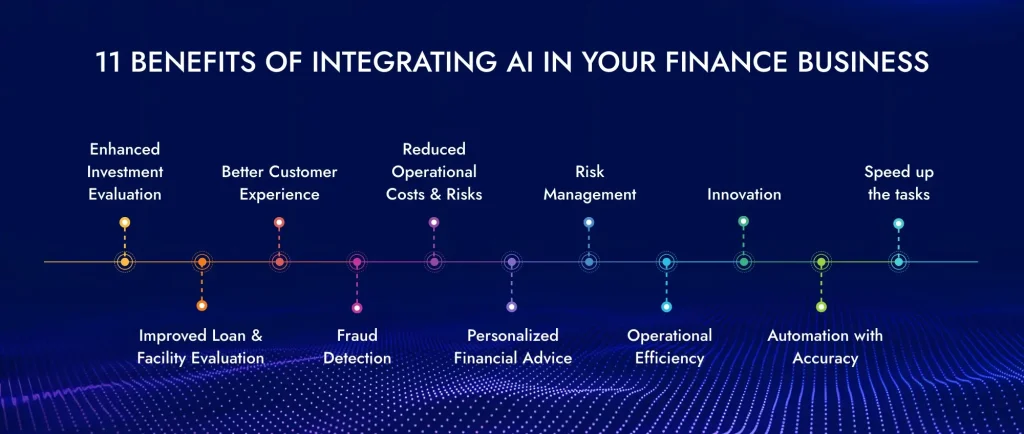
Benefits of AI in Finance Business: Integrating AI in Your Finance Business

Integration of Artificial Intelligence is an absolute game changer with many privileges.

Let us examine how the field of finance benefits from AI:

Benefits of AI in Finance Business - Integrating AI in Your Finance Business

1. Enhanced Investment Evaluation

Bank profitability isn’t only about earning interest. Banks are always looking for profitable investment opportunities that maximize returns.

The role played by sophisticated investment software must be considered since it offers custom-made financial institutions risk appetite-driven advice regarding investments. Further, AI tools can accurately evaluate customer proposals that involve complex industry-specific information.

Though human analysts have the final say on investment decisions, investing analysis software makes this process easier by juggling multiple variables and scenarios. Gathering and analyzing relevant data may be time-consuming and challenging, especially for organizations entering foreign markets. In such scenarios, AI-powered software provides a quick way to assess new markets and opportunities.

2. Improved Loan and Facility Evaluation

Often, financing eligibility based solely on credit scores relies on obsolete data, mistakes or misclassifications. However, today, abundant online information can lead to more accurate assessments of individuals or businesses.

AI-driven systems can now provide endorsements or refusals based on a wider range of factors, even if there are minimal documents available from applicants. The problem still needs to be solved in understanding why the system recommended it. While approved applications usually move forward with little questioning, rejections require clear explanations on why they could not lend from institutions to clients.

According to Accenture, “banks can increase the volume of interactions or transactions by 2-5 times without needing to increase staff” by utilizing AI-based tools. Although artificial intelligence systems may feature biases incorporated in their designs, developers eventually decide on them so that they can provide some form of objectivity. Nevertheless, with growing awareness of institutional prejudices and the heterogeneous nature of funding applications, software developers are now better placed to improve applications and updates by incorporating more pertinent variables.

3. Better Customer Experience

Customers today are all about convenience. The ATM improves the banking system by enabling access to critical services even when banks are closed, which, in turn, fuels innovation in finance startups through AI. Clients can now open smartphone bank accounts and complete verification while sitting on their couches.

This can be done using Decision Management Systems (DMS) to streamline the capture of Know Your Customer (KYC) information, significantly reducing errors and turnaround times. And because the business rules software is robust enough, the banks can quickly effectuate and deploy business decisions without long-established processes.

This ensures that new products and specials are available at the right time and changes made on business decisions or tariffs are incorporated seamlessly into the system. Automated eligibility checks mean clients aren’t frustrated by lengthy processes only to be rejected. This gives personalized service while serving a large number of customers.

4. Fraud Detection

An Enterprise Decision Management System enhances early fraud detection and ensures full audit documentation. Regular third-party audits can interrupt business operations when employees leave their workplace to explain or validate transactions. Software based on advanced technology often recognizes errors through precision data captured by the system itself.

Fraud tactics change as banks tighten controls. Today’s criminals do transactions under detection thresholds so as not to raise suspicion. Without deep-rooted analysis, such activities may slip past checks into compliance even though they satisfy basic requirements. This is where artificial intelligence outperforms humans.

AI scans huge amounts of records to identify suspicious deals accurately, while human attention may go astray in such volumes. Money laundering or funding illegal activities can thus continue undetected if there are no AI-driven mechanisms to detect fraudsters taking advantage of loopholes.

5. Reduced Operational Costs and Risks

Although banking mostly runs electronically, many people-centered practices necessitate lots of paperwork; hence, these processes become major cost centers and risks that lead to errors.

Robotic process automation (RPA) is software miming rule-based digital tasks that humans usually perform. With advancements in handwriting recognition, natural language processing, and other AI technologies, RPA bots can transform into intelligent automation tools capable of handling a wide range of banking workflows once done exclusively by humans.

This implies hyper-automation which combines AI alongside RPA thereby changing effective and reliable banking systems.

6. Personalized Financial Advice

Consider receiving instant financial advice customized to your personal needs and objectives. For instance, AI algorithms can analyze various factors to provide you with customized recommendations such as your financial background, spending habits, or even investment preferences.

AI-powered robo-advisors can recommend portfolios depending on an individual’s risk tolerance levels and financial goals, thus optimizing asset allocation for enhanced returns. Such customization leads to increased client satisfaction and better financial outcomes since investments are aligned with people’s likes and aspirations.

Furthermore, AI-driven financial advice is available around the clock, providing prompt responses to financial planning, budgeting, and investment strategy queries. Thus, clients are empowered by this accessibility to make informed decisions quickly outside of the limitations of traditional banks’ hours.

7. Risk Management

It is important in finance to employ effective risk management systems to ensure financial stability and minimize potential losses. AI is very helpful in managing risks using sophisticated algorithms that can process massive volumes of data concurrently.

By processing this information, AI systems can uncover patterns indicating future risks like fraud or unusual market movements. The early identification of risks enables banks to mitigate them to safeguard assets and preserve operational continuity.

8. Operational Efficiency

Individuals can redirect their attention to strategic initiatives by using AI to handle repetitive tasks. AI excels at automating tasks such as document verification, summarization, transcription of phone conversations, and responding to common customer queries such as operational hours.

This technology allows AI bots to take over mundane or low-engagement tasks previously done by humans thus increasing efficiency and productivity across various areas. It optimizes operations while freeing up human personnel for value-added jobs that drive innovation at the organizational level.

9. Innovation

AI drives innovation in finance, leading to radical changes in different industries. This ranges from improved customer experiences to optimized operational efficiencies; traditional banking is being redefined through the application of AI technologies that are also opening up new growth and development opportunities.

AI has enabled predictive analytics and forecasting models as another area where innovation occurs. Market behavior, asset performance as well as demands from consumers can all be accurately predicted using AI programs based on historical data together with real-time market trends.

In addition, startups spearheading Blockchain technology and smart contract applications have transformed finance Startups with AI which has made finance more transparent, secure, and efficient among others

10. Automation with Accuracy

Repetitive and time-consuming tasks have been transformed in financial institutions by AI-driven automation through increased precision. Document verification, compliance checks, and transaction processing are some of the complex processes that can be done swiftly and without any mistakes by AI-based automated systems.

Using machine learning algorithms, these systems can learn from past interactions and improve performance, ensuring consistent data handling and decision-making accuracy.

For instance, AI-based robotic process automation (RPA) bots can automate back-office operations like data entry and reconciliation, significantly reducing the manual effort required and minimizing the risk of human error.

11. Speed Up the Tasks

Speed is a critical advantage AI brings to finance, where timely decision-making and quick responses can make a significant difference. AI for finance startups accelerates tasks across various domains, from customer service to data analysis, enabling financial institutions to meet the growing demands for faster service delivery and operational responsiveness.

In customer service, AI-powered chatbots and virtual assistants respond instantly to customer inquiries 24/7. These bots can understand natural language, interpret queries, and promptly deliver accurate information or resolve issues.

Transform Your Finance Strategy with AI

Discover the full potential of the benefits of AI in finance. Our expert AI development services deliver innovative AI solutions that elevate performance and drive growth.

How does ViitorCloud Overcome Finance Challenges With an AI Solution?

AI solutions for finance present a game-changing opportunity for businesses in the financial sector. By streamlining operations, enhancing decision-making, and delivering personalized customer experiences, the benefits of AI in finance are undeniable.

With ViitorCloud’s AI development services, your financial institution can automate routine tasks like data entry and fraud detection, optimize investment strategies, and strengthen risk management. Our AI solutions not only help you stay ahead of the competition but also empower you to overcome complex industry challenges with ease.

Partner with ViitorCloud today to harness the full potential of AI and unlock new opportunities for growth in your financial operations. Let’s take your business to the next level!

Benefits of AI in Finance


Frequently Asked Questions

An example of AI in finance is AI-powered chatbots that handle customer inquiries and transactions, providing 24/7 service without human intervention.

AI is used in finance for fraud detection, risk assessment, automated trading, and customer service, enhancing efficiency and accuracy.

AI helps finance companies by improving decision-making with data-driven insights, automating repetitive tasks, and enhancing customer experiences through personalized services.

Maintainability & Long-Term Support for Enterprise Solutions

Nowadays most businesses depend on enterprise solutions to streamline operations, drive innovation, and scale effectively. According to a study by Gartner, the global enterprise software market is projected to reach $386 billion by 2024, emphasizing the growing reliance on these systems for business success. However, as companies adopt increasingly complex systems, ensuring software maintainability and securing long-term support becomes critical to keeping their infrastructure efficient and sustainable.

One of the most powerful tools for building maintainable and scalable enterprise software is Laravel development. Known for its modular architecture and active long-term support (LTS), Laravel is uniquely suited for crafting robust, future-proof enterprise solutions. Whether your business wants to streamline workflows, enhance security, or scale with growth, Laravel offers the flexibility and reliability required to achieve those goals. This blog will explore the importance of maintainability and long-term support in enterprise software and why Laravel is the go-to framework for building sustainable solutions.

What Are Enterprise Solutions?

Enterprise solutions refer to comprehensive software systems that are designed to meet the complex needs of large organizations and businesses. These solutions encompass a wide range of functionalities, from resource planning and customer relationship management to data analytics and project management. Unlike standard software applications, enterprise solutions are built to integrate various processes across different departments, ensuring that organizations can operate more efficiently and cohesively.

For businesses operating in a competitive environment, enterprise software provides the necessary infrastructure to manage large volumes of data, streamline workflows, and enhance collaboration. These solutions also support scalability, allowing businesses to grow without being limited by their software capabilities. By utilizing enterprise solutions, companies can optimize their internal processes, reduce operational costs, and make more informed decisions based on real-time data.

Ensure your enterprise solutions are built to last. Leverage our Laravel Development Services for long-term support.

Why Is Maintainability Important for Enterprise Software?

When it comes to enterprise solutions, maintainability is one of the most critical factors determining long-term success and operational efficiency. Software maintainability refers to how easily a system can be updated, modified, and scaled to meet evolving business requirements. Given that enterprise software often serves as the backbone of business operations, ensuring that it remains adaptable over time is crucial for business continuity.

Without effective software maintainability, enterprises risk facing significant challenges, including increased downtime, rising operational costs, and the inability to respond quickly to market changes. In fast-paced industries, this can lead to missed opportunities and a reduction in competitive edge. For example, if an organization’s enterprise software cannot be easily updated to support new business processes or integrate with emerging technologies, it may hinder growth and innovation.

At ViitorCloud, we emphasize maintainability as a core aspect of our enterprise solutions. We understand that businesses need software that not only meets their current needs but is also designed to be sustainable and flexible for future demands. This approach minimizes disruption, ensures smooth upgrades, and extends the lifespan of your enterprise systems. Properly maintained enterprise software also reduces the likelihood of costly errors, system failures, and technical debt, providing businesses with a reliable platform to drive ongoing success.

In neglecting maintainability, organizations risk becoming dependent on outdated systems that are costly and complex to fix. In contrast, prioritizing software maintainability allows companies to stay agile, mitigate risks, and ensure their enterprise solutions can adapt to industry advancements and new business models.

How Does Long-Term Support Impact Enterprise Solutions?

Long-term support plays a pivotal role in ensuring the sustainability and continued performance of enterprise software. For businesses relying on complex enterprise solutions, the longevity and efficiency of their software are crucial to maintaining smooth operations, competitiveness, and innovation. Without proper support solutions, even the most advanced software can become a liability as it ages, encountering compatibility issues, performance bottlenecks, or security vulnerabilities.

Long-term support ensures that enterprise software is regularly updated, patched, and optimized. This proactive approach allows businesses to address evolving industry needs, comply with regulatory changes, and mitigate emerging security risks. For instance, with consistent updates and maintenance, software systems can integrate with new technologies, support expanding user bases, and incorporate advanced features without compromising performance.

Strengthen your enterprise solutions with scalable and maintainable frameworks. Our expert Laravel Developers are ready to help.

When Should You Consider Long-Term Support for Enterprise Software?

Incorporating long-term support should ideally begin during the software development phase. This ensures that your enterprise software is built with future scalability, maintainability, and adaptability in mind. By planning early, you can align support strategies with business objectives, ensuring smooth updates, security patches, and performance enhancements from the outset.

However, if long-term support wasn’t included in development, it’s crucial to implement it post-deployment. At this stage, businesses rely heavily on their enterprise solutions to run efficiently. Having robust support solutions in place ensures your software remains secure, functional, and adaptable to future needs.

Whether during development or after deployment, investing in long-term support guarantees the continued success and sustainability of your enterprise systems.

Who Benefits from Long-Term Support and Software Maintainability?

Long-term support and software maintainability provide significant benefits to multiple stakeholders within an organization, ensuring that enterprise solutions deliver consistent performance over time. One of the primary beneficiaries is the IT team. With maintainable software and long-term support in place, IT professionals can focus on optimizing systems and driving innovation rather than spending excessive time troubleshooting, patching, or managing unexpected system failures.

For decision-makers, long-term support offers confidence in the sustainability of their enterprise solutions. It reduces the risk of costly disruptions and ensures the organization remains agile and responsive to market demands. Furthermore, having maintainable software aligns with long-term business goals by lowering total ownership costs and minimizing the need for frequent, large-scale system overhauls.

End-users, whether internal or external, also benefit significantly from software maintainability and long-term support. Stable, well-maintained enterprise systems provide a smoother, more reliable user experience, leading to higher productivity and satisfaction. At ViitorCloud, we ensure that our enterprise solutions meet the current needs of every stakeholder and also prepared to grow and evolve with the business over time.

Looking for sustainable enterprise solutions? Our Laravel Development Services guarantee maintainability and long-term support.

Where Can You Find Reliable Support Solutions for Enterprise Software?

Finding reliable support solutions for enterprise software is crucial for maintaining system performance, security, and scalability. One of the best approaches is to partner with a trusted technology provider who offers comprehensive support tailored to your business needs. ViitorCloud provide customized enterprise solutions along with ongoing support solutions that ensure your software stays up-to-date, secure, and optimized for performance.

When evaluating potential providers, it’s essential to consider their track record in delivering consistent, long-term enterprise software support. Look for partners that offer proactive services, such as regular software updates, performance monitoring, and security patches. Additionally, ensure they provide flexible support options, allowing for scalability as your business grows. Reliable support also includes having a responsive team that can quickly address any technical issues, minimizing downtime, and ensuring business continuity.

How to Ensure Long-Term Maintainability in Enterprise Solutions?

Ensuring long-term maintainability in enterprise solutions requires a strategic approach, and choosing the right technology stack is crucial. For organizations seeking robust, scalable, and maintainable software, Laravel emerges as one of the best frameworks to support these goals. Laravel, a powerful PHP framework, is well-known for its clean architecture, modular structure, and built-in tools that enhance software maintainability and long-term sustainability.

Let’s explore a few strategies to ensure long-term support and maintainability using Laravel for enterprise solutions:

  1. Modular and Scalable Architecture: Laravel’s modular structure allows developers to build applications in a way that components can be easily maintained and updated without disrupting the entire system. This ensures that your enterprise software remains adaptable to future needs and scalable as your business grows.
  2. Built-in Tools for Maintenance: Laravel offers built-in tools for caching, queue management, and database migration that simplify maintenance tasks. These tools allow your IT team to manage system upgrades and security patches more efficiently, promoting long-term support.
  3. Active Developer Community & Long-Term Support: Laravel has a thriving developer community and offers long-term support (LTS) versions, ensuring that your enterprise solution receives updates and security fixes over the years. This guarantees that your enterprise solutions remain secure, functional, and aligned with evolving industry standards.

At ViitorCloud, we leverage Laravel’s capabilities to create enterprise solutions that are not only high-performing but also designed for long-term maintainability. By using a framework that emphasizes clean code, scalability, and active community support, businesses can ensure that their software is built to last, reducing the total cost of ownership while fostering innovation.

Optimize your enterprise solutions for the future. Let our Laravel Development Services provide ongoing support.

What Are the Best Practices for Sustainable Enterprise Solutions?

Building sustainable enterprise solutions requires following a set of best practices that promote both software maintainability and long-term success.

Here are some key strategies:

  1. Choose Scalable Technologies: Opt for technology stacks like Laravel that are designed to grow with your business. Scalability ensures that your enterprise software remains adaptable as your company’s needs evolve.
  2. Implement Modular Architecture: Designing systems with a modular approach allows different components of the software to be updated or modified without disrupting the entire system. This greatly enhances software maintainability.
  3. Focus on Long-Term Support Solutions: Partner with a technology provider, like ViitorCloud, that offers comprehensive support solutions. Regular updates, security patches, and system monitoring ensure the ongoing performance and security of your software.

By following these best practices, businesses can ensure that their enterprise solutions remain sustainable, cost-effective, and capable of supporting long-term growth.

Why Partner with ViitorCloud for Enterprise Solutions?

Partnering with ViitorCloud for your enterprise solutions ensures you receive scalable, sustainable, and highly maintainable software tailored to your business needs. With a strong focus on software maintainability and robust support solutions, we provide long-term support to keep your systems secure, up-to-date, and adaptable as your business grows. Our expertise in frameworks like Laravel guarantees that your enterprise software is not only efficient but also future-proof, allowing you to focus on innovation and growth while we handle the technical complexities.

Boost the maintainability of your enterprise solutions. Partner with ViitorCloud’s expert Laravel Developers for tailored development services.

Conclusion

In conclusion, combining software maintainability and long-term support is crucial for future-proofing your enterprise solutions. By prioritizing these aspects, businesses can ensure their enterprise software remains scalable, secure, and adaptable to evolving needs. At ViitorCloud, we specialize in building sustainable, high-performing enterprise solutions using Laravel, designed to support your growth and innovation. If you’re looking to create future-ready enterprise software that evolves with your business, contact ViitorCloud today to discuss how we can help you achieve your goals.


Frequently Asked Questions

Software maintainability ensures your enterprise systems are easy to update, scalable, and cost-effective over time. ViitorCloud builds maintainable solutions that reduce downtime and simplify future upgrades.

Long-term support keeps your enterprise software secure and up-to-date, preventing issues before they arise. ViitorCloud provides ongoing support, including regular updates and performance optimizations, to ensure reliability.

Laravel offers a modular, scalable framework ideal for building sustainable enterprise software. ViitorCloud uses Laravel to create flexible, future-proof solutions tailored to your business needs.

ViitorCloud delivers custom, maintainable enterprise solutions with a focus on scalability and long-term support, ensuring your software stays efficient and adaptable as your business grows.

AI in Finance – How Artificial Intelligence is Used in Finance

Have you ever asked a chatbot about opening a savings account or received a call from your bank to verify credit card activity? This is just a glimpse of how Artificial Intelligence is revolutionizing the finance industry.

AI in finance has transformed operations by automating routine tasks, enhancing customer service, and driving business efficiency. With most banks (80%) recognizing the value of AI, the COVID-19 pandemic has accelerated its adoption, pushing more people to embrace digital solutions.

ViitorCloud’s AI development services are designed to help financial institutions harness the power of AI. From fraud detection and personalized banking to risk management and regulatory compliance, our AI solutions can streamline your operations, improve customer experiences, and enhance decision-making.

This article will explore how AI in finance is used, its benefits to financial companies, and the future of the finance sector.

What is AI in Finance?

Artificial intelligence in finance involves using advanced technologies, mainly machine learning algorithms, to improve various aspects of the finance industry.

AI finance helps generate insights for data analytics, performance measurement, predictions, real-time calculations, customer service, and smart data retrieval. It allows financial companies to understand markets and customers better.

According to Forbes, 70% of financial firms utilize machine learning to predict cash flow, adjust credit scores, & detect fraud.

Transform Your Financial Operations with AI Solutions

Discover how our tailored AI Development Services can drive efficiency in your finance strategy.

AI’s Impact On the Finance Industry

Have you ever wondered how artificial intelligence changes how we manage money and interact with financial institutions? AI in finance impact is nothing short of revolutionary and a topic worth diving into.

Let’s start with something we’re all familiar with—customer service. Remember the last time you interacted with a chatbot regarding your banking needs? That’s AI at work. These intelligent bots are available 24/7, quickly responding to your queries. They can assist with everything from opening a savings account to verifying suspicious activity on your credit card.

Financial institutions generate a lot of data every second, and AI-powered finance tools can analyze this data in real-time. This ability helps banks and other financial firms make more informed decisions. Have you noticed how financial advice is becoming more personalized? AI enables banks to offer customized services based on individual customer profiles. AI can provide personalized recommendations that suit your needs by analyzing your spending habits, investment preferences, and financial goals.

How is AI Driving Continuous Innovation in Finance?

AI has transformed the way financial firms interact with their customers. Chatbots and virtual assistants powered by AI provide instant responses to queries, helping you with everything from balance inquiries to loan applications.

This not only saves time but also improves the overall customer experience. Have you ever felt the convenience of resolving a banking issue at midnight? That’s AI at work, making financial services accessible round the clock.

AI enables banks and financial advisors to offer customized services to your unique financial situation. AI can recommend customized solutions by analyzing your spending habits, investment history, and financial goals. Whether suggesting the best investment opportunities or creating a personalized savings plan, AI ensures that the advice you receive is relevant and beneficial.

Boost Financial Performance with AI Development Services

Implement advanced AI technologies in your finance systems for optimized results.

Why Are Finance Companies Opting for AI?

Finance companies are opting for artificial intelligence (AI) to find more opportunities in the financial sector.

Let’s see why:

1. Personalized Financial Services

AI is changing how financial institutions serve customers by offering highly personalized services catering to individual needs and preferences. AI algorithms can provide recommendations, product offerings, and financial advice by analyzing customer data such as transaction history, spending habits, and investment choices.

For example, AI-powered finance robot advisors can create customized investment portfolios based on a person’s risk tolerance, financial goals, and investment timelines. AI-driven banking apps can also deliver personalized financial management tools, budgeting assistance, and product recommendations, enhancing customer experience.

2. Fraud Detection & Prevention

One of the most used applications of the AI finance industry is fraud detection and prevention. Have you ever wondered how banks avoid fraud activities? Traditional methods often struggle to keep up, but AI is changing the industry. AI in finance algorithms can analyze a lot of data in real-time, identifying patterns that may indicate fraudulent activities.

AI-powered fraud detection systems continuously learn and adapt. Isn’t it amazing how these systems can catch fraud attempts? By using machine learning techniques, AI can analyze relationships and correlations that humans might miss. This approach safeguards financial institutions and their customers and helps maintain trust and confidence in the financial system.

3. Smart Process Automation

AI is transforming the finance industry by automating various processes, streamlining operations, and minimizing the risk of human error. Have you noticed how quickly things get done these days? That’s thanks to intelligent process automation (IPA), which combines AI with robotic process automation (RPA) to handle complex and knowledge-intensive tasks.

For instance, AI can automate document processing, accurately extracting relevant information from financial statements, contracts, and other documents. Can you imagine how much faster and error-free these processes become? This speeds up operations and reduces the chances of errors and inconsistencies.

Furthermore, AI-powered chatbots and virtual assistants now handle routine customer inquiries and transactions, allowing human resources to focus on more complex tasks.

4. Credit Risk Assessment

AI is transforming how financial institutions assess credit risk and make lending decisions. Have you ever wondered why traditional credit scoring sometimes seems so limited? Traditional models often rely on a narrow set of data sources, missing the broader picture of an individual’s or business’s creditworthiness.

In contrast, AI algorithms can analyze diverse data, including social media activity, online footprints, and transactional data. How do you feel about your social media activity being part of a credit assessment? This comprehensive approach leads to more accurate and unbiased credit risk assessments, resulting in better lending decisions and lower default rates.

5. Trading & Portfolio Management

AI is also transforming portfolio management and trading in the finance industry. Imagine analyzing amounts of real-time data, such as market trends, news, & social media sentiment, to identify profitable trading opportunities. AI-powered trading algorithms do just that, executing trades with lightning speed.

Moreover, AI-driven portfolio optimization techniques are helping investors build and manage diversified portfolios that match their risk tolerance and investment goals.

These AI finance solutions continuously monitor and rebalance portfolios, ensuring optimal asset allocation and maximizing returns. Would you trust an AI to manage your investments? The efficiency and precision offered by AI in this domain are hard to overlook.

6. Loan Processing

AI technology has revolutionized loan processing by automating critical tasks such as risk assessment, credit scoring, and document verification. By analyzing extensive datasets, AI algorithms can swiftly evaluate borrower creditworthiness with a high degree of accuracy.

Artificial intelligence in finance has simplified the loan approval process in finance systems by reducing the time it takes for evaluation and decision-making. Banks can handle many loan applications efficiently, ensuring that borrowers receive timely responses through automated workflows.

7. Risk management

AI helps financial institutions examine complex data to find risk faster and more accurately than traditional methods. AI models can spot market trends, monitor what seems off, or warn about future risks using historical data and current market conditions.

Institutions using this approach have been able to mitigate risks promptly, enforce regulatory compliance, and maintain a stable financial environment.

8. Enabling 24/7 Customer Interactions

Using artificial intelligence, customers can now be attended to at any time without waiting for service from human being representatives.

Have you ever asked a virtual assistant a question at an odd hour? “It’s always about making the human interaction more efficient because, in many of these cases, there’s still a customer service rep,” says Rob Thomas, senior vice president of IBM’s Cloud and Data Platform, in a recent Yahoo! Finance video. “But AI is making them more productive and better at solving the problem.”

According to AI News, virtual assistants can respond to customer needs with minimal employee input. This straightforward approach increases productivity by reducing the time and effort spent on generic customer queries, allowing teams to focus on longer-term projects that drive innovation across the business. How do you feel about AI taking on these routine tasks? It is not just how efficient AI is but also how it enhances human interaction in customer service.

9. Innovation and New Business Models

Artificial intelligence in finance improved predictive analytics in insurance by enhancing customer experiences while maintaining a human touch, thus creating innovative products and services within the finance industry that outpace competitors.

10. Enhanced Data Analytics and Decision Making

Artificial Intelligence (AI) leverages advanced algorithms with computing power to handle huge datasets, surpassing human ability in terms of speed and scale.

This capability allows organizations to make data-driven decisions with more accuracy and foresight as AI systems analyze massive amounts of structured and unstructured data that human analysts may miss completely or take much longer to identify subtle patterns and correlations or trends.

Revolutionize Your Finance Strategy with AI

Partner with ViitorCloud’s AI experts to integrate customized AI Solutions in your finance workflows.

How to Implement AI Solutions in Finance?

Implementing AI solutions in finance requires careful planning and execution to ensure effectiveness and compliance.

Here’s a structured approach to implementing AI solutions in the financial sector:

  • Assessment and Planning: Determine areas where AI can add value, such as customer service, risk management, or operational efficiency. Set goals for implementing AI, such as improving customer experience, cost reduction, or decision-making enhancement.
  • Data Collection and Preparation: Ensure data quality and accessibility. Cleanse and preprocess data to enhance its suitability for AI algorithms. Implement robust security measures to safeguard sensitive financial data throughout its lifecycle.
  • Choose AI Technologies: Choose AI technologies such as machine learning, robotic process automation, or natural language processing based on their applicability to identified use cases. Evaluate AI solution providers or consider in-house development based on capabilities, scalability, and compliance with regulatory requirements.

Future of AI in the Finance Industry

AI has become part of every industry, even in finance, and has been pushed further by the changes brought about by COVID-19. The impact of AI on task simplification, fast analysis of data, and human-like ability to predict outcomes must be considered.

According to scholars, about $1 trillion could be saved by banks globally by adopting artificial intelligence by 2030. McKinsey & Company highlights how critical it is for banks to implement AI technologies extensively today, as failure will lead to a loss of competitiveness.

Achieving success requires a complete transformation at all levels within organizations. Moreover, rising digital expectations have increased financial institutions’ investments in IT and AI as millennials and Gen Z take over the largest customer segments within the US banking sector. Banks are, therefore, faced with an imperative need for change due to evolving preferences, as 78% of millennials prefer digital banking options over traditional ones.

Enhance Your Finance Systems with AI Solutions

See how our AI Development Services can transform financial processes and deliver smarter outcomes.

How is ViitorCloud Automate Finance Through AI?

Integrating AI in finance marks a transformative step toward enhancing operational efficiency, accuracy, and customer satisfaction. AI solutions like fraud detection, process automation, and predictive analytics are reshaping the way financial institutions operate, offering personalized services that elevate performance and strategic decision-making.

At ViitorCloud, we lead this transformation with cutting-edge AI development services tailored for the finance sector. Our AI solutions are designed to automate financial processes, optimize operations, and drive innovation. By partnering with us, you ensure your business stays ahead in a competitive landscape, leveraging AI to boost efficiency and scalability.

Ready to unlock the potential of AI in finance? Contact ViitorCloud today to explore customized AI development services that will revolutionize your financial operations.


Frequently Asked Questions

In finance, AI is used for fraud detection, customer service automation, personalized recommendations, and risk assessment.

AI can improve finance by automating processes, reducing errors, enhancing decision-making with data insights, and optimizing customer experiences.

AI for finance industry solutions benefits users by offering personalized services, faster transactions, improved security through fraud detection, and enhanced financial advice based on data analysis.

Build Advanced Recommendation Systems using Generative AI

Generative AI solutions can transform the way your business engages with customers. Our advanced image recommendation systems utilize Generative AI to deliver high-quality, personalized image suggestions, enhancing the customer experience while gathering valuable data to refine machine learning models. By leveraging these AI solutions, your business can achieve deeper customer insights and more accurate predictions, leading to next-level personalization and engagement.

At ViitorCloud, we offer customized AI development services designed to help businesses in the public sector unlock the full potential of AI and drive impactful results. Let us help you elevate your customer interactions and achieve your business goals.

Impact of Generative AI on Customer Experience

Businesses increasingly use advanced technologies like generative AI to enhance customer interactions. With 71% of customers expecting personalized experiences, traditional recommendation systems often fall short, causing frustration. Generative AI overcomes these limitations by analyzing complex user data to provide real-time, tailored suggestions. This approach boosts conversion rates by up to 915% and increases customer engagement by 6%-10% compared to conventional methods.

Generative AI is transforming industries by delivering unique use cases across sectors like retail, SaaS, and finance. Yet, its role in specific applications remains underexplored. At ViitorCloud, we’ve collaborated with numerous clients to uncover how Generative AI can drive value, especially when paired with traditional AI and machine learning.

In this blog, we’ll share insights from a service developed for a confidential client, where we tested the use of Generative AI for image recommendations based on user text or image input. The results? The concept was unproven—and that turned out to be a valuable discovery.

We walk you through these outcomes and explore how Generative AI has the potential to redefine recommendation systems, setting new standards for personalized customer experiences. Let’s dive in.

BUSINESS OBJECTIVES

Drive deeper customer interaction by delivering highly personalized image recommendations based on user text or image input, resulting in increased customer satisfaction and loyalty.

Generate higher-quality data through Generative AI, augmenting traditional machine learning models and enabling more accurate customer insights and predictive analytics for better decision-making.

Establish the company as a leader in AI-powered personalization by pioneering advanced recommendation systems, setting new standards for tailored customer experiences and differentiation in the market.

CORE TECH

  1. Image Captioning Models (e.g., FLORENCE)
  2. Image Embedding Models (e.g., CLIP)
  3. Vector Databases (e.g., Pinecone, Milvus, LanceDB)
  4. AI Frameworks (e.g., PyTorch, LlamaIndex)
  5. Data Preprocessing Tools (e.g., OpenCV, PIL)
  6. API Integration (e.g., FastAPI, Flask)
  7. Cloud Services for Model Deployment (e.g., AWS, GCP, Azure)
  8. Recommendation Algorithms (e.g., Cosine Similarity)

Generative AI to Build Advanced Recommendation Systems

Explore how our AI Development Services can transform your customer experience with cutting-edge recommendation systems.

ARCHITECTURE

Generative AI Architecture
  1. Collect Image Datasets

The process begins by gathering relevant image datasets, which serve as the foundation for training and generating recommendations.

  1. Set Up Image Captioning Model

Implement an advanced image captioning model to generate descriptive captions for each image. These captions enrich the dataset by adding contextual metadata, improving recommendation quality.

Image Captioning Model
  1. Set Up Image Embedding Model

Integrate an image embedding model to convert images into vector representations. These embeddings allow the system to calculate the similarity between images for more precise recommendations.

Image Embedding Model
  1. Prepare Image Datasets with Captions

Combine the images and their generated captions into a structured dataset, making it easier to process for downstream tasks.

  1. Build a Vector Store

Develop a vector store that holds the embeddings of images. This enables efficient similarity searches, which are crucial for generating recommendations based on user input.

  1. Index Dataset into Vector Database

Index the image embeddings and captions into a high-performance vector database (VectorDB), optimizing the search and retrieval of similar images.

  1. Generate Recommendations

Using the indexed dataset, the system can now generate personalized image recommendations based on user-provided text or image input.

  1. Evaluation and Refinement

Continuously evaluate the performance of the recommendation system, refining the models and dataset to improve accuracy and relevance in recommendations over time.

Use Cases

  • E-Commerce: Recommending product images based on textual descriptions & visual queries.
  • Content Creation: Helping bloggers, marketers, or designers find images that match the theme of their content.
  • Social Media: Suggesting relevant images or memes based on user-generated text.
  • Educational Platforms: Offering illustrative images to accompany educational content based on the topic or subject being discussed.

Challenges

  • Ambiguity in Text: Text can often be vague or contain multiple meanings, which makes precise image matching difficult.
  • Image Diversity: A wide variety of images can fit a single description, so the system needs to balance accuracy and diversity in its recommendations.
  • Contextual Understanding: Understanding the deeper context of the text (e.g., cultural or situational references) can be difficult for purely algorithmic systems.

Future Directions

  • Personalization: Enhancing the system by incorporating user preferences and browsing history to make more personalized recommendations.
  • Real-Time Recommendations: Increasing efficiency to provide instant recommendations as users type or search.

Build Advanced Recommendation Systems with Generative AI Expertise

Partner with us to leverage tailored AI Solutions that drive personalized experiences and business growth.

Conclusion

Generative AI is revolutionizing image recommendation systems, bringing a new level of personalization and accuracy to improve customer engagement and decision-making. As businesses, especially in the public sector, strive to deliver more tailored services, ViitorCloud’s AI development services provide the expertise you need to leverage this cutting-edge technology.

With solutions designed to address challenges like handling ambiguous inputs, our AI solutions ensure you stay ahead of the curve, enhancing customer experience and driving growth. Ready to transform your business? Partner with ViitorCloud today and unlock the full potential of Generative AI.


Frequently Asked Questions!

A Generative AI recommendation system utilizes advanced machine learning models to offer personalized suggestions, such as image recommendations, based on user data and behavior patterns. It customizes its suggestions by analyzing user inputs and preferences.

Yes, ViitorCloud can enhance existing recommendation systems by integrating sophisticated AI technologies that refine accuracy and personalization. We optimize these systems to better understand user behavior and improve the relevance of suggestions.

Absolutely! ViitorCloud specializes in developing tailored AI solutions that align with your unique business objectives. Our team works closely with clients to understand their requirements and create customized applications that drive results.

Yes, ViitorCloud supports cloud-based AI deployments by utilizing platforms like AWS and Azure. This ensures scalable, flexible, and efficient AI solutions that integrate seamlessly with your cloud infrastructure.

ViitorCloud offers customized AI integration services to enhance your existing systems. We provide custom solutions that ensure seamless implementation and optimization of AI technologies to meet your specific needs.

Cursor AI and Rules Directory

Cursor AI is transforming the way developers code by integrating advanced artificial intelligence into a familiar coding environment. Built on Visual Studio Code, Cursor AI utilized powerful AI models, like GPT-4, claude-3.5-sonnet, o1-mini, and others to help developers write, edit, and manage code more efficiently.

  1. Code generation and codebase Understanding
  2. Predictive Editing
  3. Natural Language Commands
  4. Real-Time Collaboration

Explore more features on their official site.

Who Can Benefit from Cursor AI?

Cursor AI is perfect for developers of all levels—whether you’re a beginner, a professional, or working in a team.

  1. Boosts productivity
  2. Easy to use
  3. Supports multiple languages (Python, PHP, Java, and more)
  4. Real-time error detection
  5. Context-aware assistance
  6. Code explanation
  7. Enhances code quality

Cursor AI Rules Directory: Optimizing Code with Custom Configurations

The Cursor AI Rules Directory elevates the Cursor AI experience by offering finely tuned configuration files and prompt lexicons tailored to various programming languages. These curated rules empower developers to code with greater precision and efficiency.

Supporting popular languages like Python, PHP, TypeScript, Angular, NodeJs, Next.js, React, etc., the directory enhances code completion and error detection, providing intelligent, context-aware suggestions that streamline development. By using these optimized rules, developers can enjoy a smoother, more intuitive coding process, with AI-driven assistance that understands their needs at every step. Here are some cursor rules snippets.

Cursor AI Rules Directory: Optimizing Code with Custom Configurations

Cursor AI Rules Directory: Transforming Development Efficiency

  • Accurate Code Management: Establish well-structured code architecture with precise rule definitions, ensuring a clean, maintainable, and scalable codebase that evolves seamlessly with project requirements.
  • Code Consistency: Enforce uniform coding standards across your entire project with predefined rules, ensuring consistency in style, structure, and logic, even in collaborative environments.
  • Reduced Code Duplication: Minimize redundancy by applying rules that prevent repetitive code blocks, optimizing both performance and maintainability while reducing technical debt.
  • AI-Driven, Rule-Based Code Generation: Empower AI to generate highly accurate, context-aware code by leveraging defined rules, leading to smarter, more reliable code suggestions and automation.
  • Boosts Developer Efficiency: Accelerate development by automating routine tasks and structure management, reducing coding time. With AI handling the heavy lifting, developers can focus on innovation, significantly enhancing productivity.

Impact of Cursor AI and Cursor Directory on Developer Efficiency

These statistics are based on data available online and developer experiences. Results may vary, as the ultimate impact depends on individual adoption of the tool and how effectively it is utilized, leading to these percentage increases.

StatisticsBefore Using CursorAIAfter Using CursorAI
Productivity IncreaseBaseline50-70% Increase
Code Cleanliness ImprovementBaseline30-40% Improvement
Error Reduction in CodeBaselineAvg. 10 Times Fewer Errors
Time-saving on Repetitive TasksBaseline20-30% Faster
Enhanced Team Collaboration EfficiencyBaselineImproved
Impact of Cursor AI and Cursor Directory on Developer Efficiency

Customization and Community Contributions

Developers can customize these prompts to fit their specific project needs, while community members can contribute new rules, improving the directory for all.

My Experience with Cursor AI and the Cursor Rules Directory

Using Cursor AI has been a game-changer. It’s truly an out-of-the-box tool, especially with features like the Cursor Composer. With just a well-crafted prompt, Cursor AI can generate functional code in mere minutes. I built my own website (using Laravel and Tailwind CSS) with responsive design, animations, and PWA support— all in less than a day, thanks to this incredible tool.

I also had the opportunity to contribute Laravel rules to the Cursor Directory. After creating two mini-apps using these rules, I gained confidence in their effectiveness. These contributions will undoubtedly assist many Laravel artisans in streamlining their workflow. The Cursor Directory is packed with well-defined rules for a variety of programming languages, further enhancing its value to the development community.

Cursor AI Rules Directory: Optimizing Code with Custom Configurations

At ViitorCloud, we’ve gradually embraced AI-driven tools, particularly in development, to boost both efficiency and productivity. By leveraging these tools, we’ve been able to significantly reduce development time, ultimately saving costs and delivering faster results—benefiting both our organization and our clients. Cursor AI is one of the key tools we’ve integrated into our workflow, and it’s already proving its value in accelerating projects and enhancing the quality of our code output.

Recent Updates

Cursor recently successfully completed its Series A funding, raising $60 million from investors including Andreessen Horowitz, Thrive Capital, OpenAI, and the founders of Stripe, GitHub, Ramp, Perplexity, and OpenAI.


Reference Websites