React.js is a top choice for building dynamic, scalable user interfaces. Its component-based architecture and virtual DOM make React web development ideal for creating fast, data-driven applications. Businesses adopting React for the web enjoy faster workflows, better performance, and reusable components.
As demand for React development grows, partnering with a React web development company ensures expert solutions. React technology’s evolving ecosystem offers unmatched versatility and efficiency, making it a key tool in modern web development.
What is React?
React is an open-source JavaScript library created by Facebook for building dynamic, interactive user interfaces. It’s widely adopted in React web development due to its efficient rendering and component-based architecture.
Importance of React in Web Development
React simplifies modern web development with React by enabling reusable UI components, speeding up workflows, and improving maintainability. This allows businesses to build high-quality, scalable applications faster, enhancing both user experience and engagement.
Key Features of React
Component-Based Architecture: React’s component-driven structure allows developers to create modular, reusable building blocks, which simplifies the process of developing and maintaining large-scale applications. This approach promotes cleaner code, easier testing, and faster development by focusing on isolated units that manage their own state and behavior.
Virtual DOM: React leverages a virtual DOM to optimize performance by minimizing direct updates to the real DOM. It selectively updates only the parts of the page that have changed, enhancing rendering speed and ensuring smoother user experiences in dynamic web applications.
These features make React a go-to choice for building high-performance, scalable, and maintainable web applications.
Transform your online presence with React Web Development. Get in touch with our experts today to build high-performing, scalable web solutions.
Why Use React for Web Development?
React is a top choice for web development with React due to its ability to boost performance and streamline productivity.
Key Reasons to Use React
Performance: React’s virtual DOM enhances rendering speed, delivering faster updates and smoother user experiences.
Reusability: Its component-based architecture enables reusable, modular code, making React app development more efficient.
Scalability: React supports applications of all sizes, from SPAs to complex solutions, making it ideal for growing businesses using React technology.
Flexibility and Fast Development with React
React’s flexibility allows seamless integration with various libraries, making React web development adaptable to different project needs. Its reusable components speed up development, helping teams iterate quickly and deliver products faster.
This makes React app development ideal for startups and businesses aiming for swift market entry without compromising quality. Its combination of fast rendering, modular design, and integration capabilities ensures both efficiency and a superior user experience.
Where to Use React?
React’s versatility makes it ideal for various React web development scenarios:
React excels in building SPAs with fast navigation and dynamic content updates, providing a smooth user experience.
For web development with React, its efficient rendering is perfect for data-heavy apps like dashboards, where real-time updates are crucial.
React’s modular design and frameworks like React Storefront enhance product listings, shopping carts, and checkout processes.
React is well-suited for PWAs, offering fast loading times and offline capabilities, providing a native app-like experience on the web.
Scenarios to Choose React Over Other Frameworks
Consider React for your project if:
High Performance: React’s virtual DOM enhances rendering speed and efficiency.
Complex User Interfaces: Its component-based structure is ideal for managing intricate UIs and frequent updates.
Rapid Development: Reusable components support fast iterations and development cycles.
SEO: Server-side rendering with React improves search engine indexing and visibility.
React’s flexibility and performance make it a strong choice for dynamic interfaces and quick development.
Looking for seamless Web Development with React? Partner with ViitorCloud to create dynamic, responsive websites tailored to your business needs.
Benefits of React for Web Development
React offers several key advantages for modern web development with React:
React’s component-based architecture and declarative syntax streamline development, allowing for reusable UI components and faster feature building.
A vibrant community and extensive ecosystem provide robust resources, tutorials, and third-party libraries, ensuring React stays current and relevant.
React’s flexible design allows seamless integration with libraries like Redux and Material-UI, enhancing functionality and speeding up development.
With React Native, developers can create cross-platform mobile apps, maintaining a consistent user experience across the web and mobile.
The React ecosystem includes tools for testing, performance optimization, and deployment, facilitating efficient and robust application development.
These benefits make React a powerful choice for creating dynamic, high-performance web applications.
React vs. Other Web Development Frameworks
Comparing React with Angular and Vue highlights its strengths in performance, ease of use, and scalability.
React’s virtual DOM optimizes rendering by updating only changed parts, leading to faster performance than Angular, which uses a real DOM. While Vue also uses a virtual DOM, React’s recent advancements, such as concurrent mode, enhance its performance further.
React’s simpler API and component-based architecture make it easier to learn compared to Angular, which has a steeper learning curve due to its complex structure and TypeScript requirement. Vue offers a gentler learning curve but still provides a robust feature set.
React is highly scalable and suitable for both small and large applications with its modular component structure. Angular also scales well but can be more complex and cumbersome. Vue is effective for smaller to medium-sized projects but can scale with proper planning.
React stands out for its performance, ease of learning, and scalability, making it a strong choice for modern web development.
Elevate your digital experience with expert React Development. Let us build the web application your business deserves.
Best Practices for React Web Development
To optimize web development with React, developers should follow several best practices and leverage essential tools and libraries that enhance productivity and application quality.
Tips for Optimizing Web Development with React
Component Reusability: Design components to be reusable across different parts of the application. This reduces redundancy and simplifies maintenance.
State Management: Use state management libraries like Redux or Zustand to manage application state efficiently. This helps in maintaining a predictable state across components, especially in larger applications.
Code Splitting: Implement code splitting using dynamic imports to improve initial load times. This allows loading only the necessary code for the current view, enhancing performance.
Performance Optimization: Utilize React’s memoization techniques, such as react.memo and useMemo, to prevent unnecessary re-renders of components and optimize rendering performance.
Prop Types Validation: Use PropTypes or TypeScript for type checking in components. This helps catch bugs early by ensuring that components receive the correct types of props.
Testing: Implement testing frameworks like Jest and React Testing Library to write unit and integration tests. This ensures that components function correctly and helps maintain code quality over time.
Tools and Libraries Commonly Used in React App Development
React Developer Tools: A browser extension for inspecting React component hierarchies, monitoring state changes, and debugging applications effectively.
Redux DevTools: Essential for applications using Redux, this tool allows developers to inspect actions, track state changes, and debug the Redux store.
Storybook: A powerful tool for developing UI components in isolation, allowing for better documentation and testing of components without needing the full application context.
Create React App: A boilerplate tool that simplifies the setup of new React projects by providing a pre-configured environment with sensible defaults.
Jest: A widely-used testing framework that enables developers to write unit tests with features like snapshot testing, ensuring components behave as expected.
Webpack: A module bundler that helps optimize assets and manage dependencies in React applications, facilitating features like hot module replacement for a smoother development experience.
Next.js: A framework for building server-rendered React applications that enhances performance with features like static site generation and API routes.
Unlock the full potential of Web Development with React. Collaborate with ViitorCloud to develop fast, scalable, and efficient web solutions.
Partner with ViitorCloud for React Web Development
ViitorCloud delivers expert React web development solutions customized to your business needs. With skilled developers, an agile approach, and end-to-end services, ViitorCloud ensures scalable, efficient, and high-performance applications. Collaborate with us for a seamless React development experience that aligns with your goals.
Conclusion
React is a powerful and efficient framework for building modern web applications, offering a scalable, component-based architecture and robust community support. Its ability to create dynamic, data-driven interfaces with minimal rendering makes it ideal for handling even the most complex projects. By partnering with a specialized React development company like ViitorCloud, you can ensure seamless project execution, allowing your business to focus on growth while delivering outstanding user experiences in today’s competitive digital landscape.
ViitorCloud provides expert React app development tailored to your project’s scale and complexity. Our team leverages advanced React techniques and tools to build scalable, high-performance applications that meet your specific business requirements.
ViitorCloud’s React development ensures agile delivery with customized solutions, enabling rapid adjustments to your project scope. We focus on creating scalable, efficient applications that align with your strategic objectives and enhance user experience.
ViitorCloud employs a thorough quality assurance process, including automated and manual testing, to guarantee the performance, security, and reliability of your React applications. Our rigorous testing protocols ensure that every application meets high standards before deployment.
ViitorCloud’s React development services are distinguished by our team’s deep expertise, flexible engagement models, and focus on scalability. We deliver customized solutions that prioritize performance and adaptability to meet evolving business needs.
In the public sector, businesses encounter many challenges that can hinder their growth and operational efficiency. These issues can significantly impact performance, from operational inefficiencies to complex decision-making processes. At ViitorCloud, we understand these pain points and are here to provide tailored AI solutions that drive improved performance and sustainable growth.
Our expertise in AI development services equips your organization with innovative tools to tackle these challenges head-on. By using AI Use Cases in the Public Sector, such as predictive analytics and automation, we streamline your operational processes, optimize resource utilization, and deliver valuable insights into market trends and citizen behavior. This proactive approach addresses existing problems and paves the way for sustainable advancement within your organization.
As the public sector increasingly turns to Artificial Intelligence initiatives, we stand ready to guide you through this transformation. Our solutions are designed to empower your business, ensuring you stay ahead of the curve while effectively addressing the unique challenges you face.
Let us partner with you to unlock the full potential of AI. Together, we can navigate the complexities of the public sector and achieve your business goals with confidence. Choose ViitorCloud for your AI development services and experience the difference that expert-driven solutions can make for your organization.
Unlock the Potential of AI in Public Sector Industries
Explore how AI use cases in the public sector drive innovation. Partner with ViitorCloud to implement tailored AI solutions that transform your operations.
Why the Public Sector Businesses Should Use AI
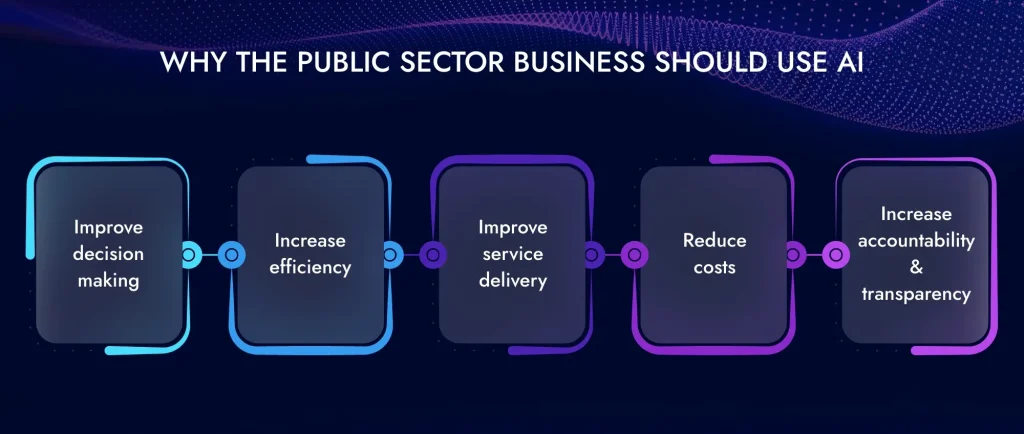
Public Sector Businesses Should Use AI to harness the power of technology for transformative change. At ViitorCloud, we specialize in providing tailored AI solutions that enhance efficiency, boost productivity, and improve decision-making processes within the public sector. According to the Grand View Research report, the AI market will reach $1,811.8 billion by 2030, up from $136.6 billion in 2022, with a 38.1% CAGR and now this is the perfect time to embrace this technological revolution.
Our AI solutions empower public sector organizations to analyze vast amounts of data, including legal considerations, socioeconomic factors, and public sentiment. This comprehensive analysis leads to informed policy formulation and budget-making, fostering transparency and accountability. By partnering with us, you can ensure your decisions are backed by data-driven insights.
Manual tasks can bog down your workforce. Our AI technologies automate routine administrative functions—like document processing and data entry—freeing up your staff to focus on more complex and impactful responsibilities. Let us help you streamline operations and maximize productivity.
With our advanced AI chatbots, we enhance service delivery by addressing citizen inquiries swiftly and effectively. Improved response times lead to higher citizen satisfaction and reduce the burden on your staff. Choose our AI solutions to elevate your service standards and foster a positive relationship with your community.
Adopting AI in the public sector can significantly reduce operational costs by automating time-consuming tasks. Our solutions not only increase efficiency but also provide significant savings that can be redirected toward critical initiatives.
Our AI tools enable real-time data analysis, providing valuable insights that build public trust and confidence in your organization. With us, you can ensure that your actions are transparent and accountable, reinforcing your commitment to serving the public effectively.
By integrating AI in the Public Sector with ViitorCloud’s expert services, you position your organization to meet contemporary challenges head-on while achieving your business goals. Let us guide you on this transformative journey towards innovation and excellence. Together, we can redefine what’s possible in the public sector!
Take advantage of cutting-edge AI use cases in the public sector to boost efficiency and decision-making. Let ViitorCloud design AI solutions that meet your unique needs.
AI in the Public Sector: Top 7 Use Cases
According to the Deloitte report, 70% of business leaders support AI government projects. Also, using AI in the public sector improves efficiency and productivity.
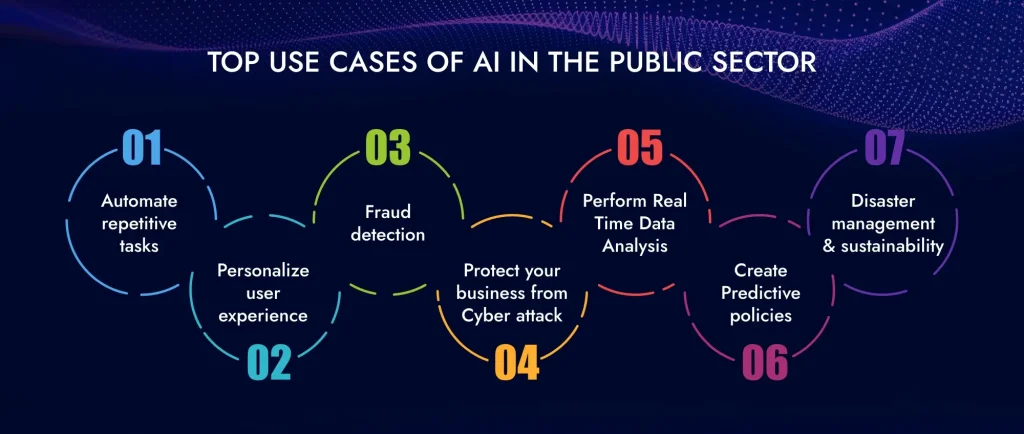
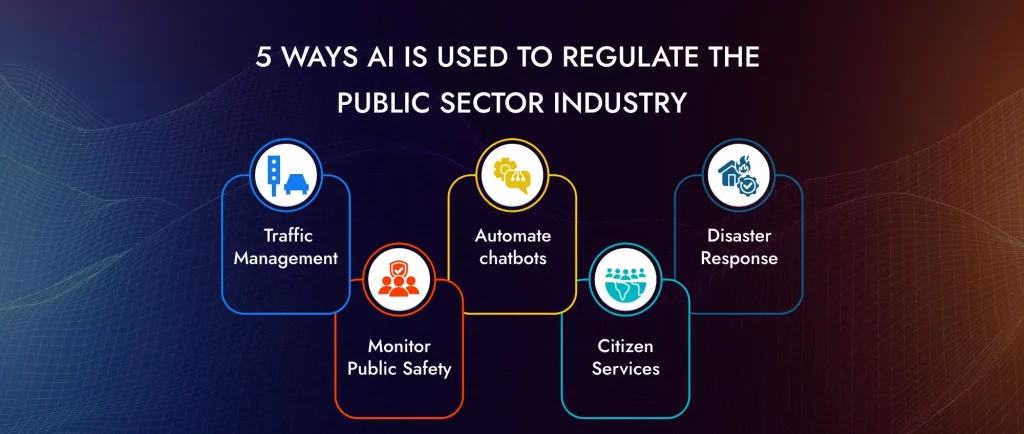
Let’s detail the 7 AI use cases in the public sector.
1. Automate Repetitive Tasks
AI assists the public sector in streamlining the operations process by automating repetitive tasks such as data entry and document processing. When a generative AI is implemented in the public sector, it manually reduces the time and waste of resources. Additionally, workers can focus on important tasks that require human judgment and expertise. AI automates the report generation process so that quick decisions can be made. AI in the public sector automates repetitive tasks to work smoothly through its application.
2. Personalize User Experience
AI chatbots provide personalized experiences to citizens in the area of public services. The chatbot is designed to respond quickly to citizen inquiries so public sector employees can focus on complex tasks. Additionally, chatbots are citizen-centric and provide seamless integration into public sector platforms such as communication channels or web portals. As a result, service delivery is efficient, and citizens are happy. It is one of the important AI public sector use cases.
3. Fraud Detection
In the public sector, fraud detection is reduced through AI and machine learning. Machine learning is used to identify irregularities and minimize false claims. AI is useful to analyze large datasets to find fraudulent activities and improve revenue collection. Additionally, AI helps detect real-time anomalies, prevent corruption, and ensure fair practices. This AI solution helps public sectors allocate resources, boost transparency, protect public funds, and create an equitable society.
4. Protect Your Business from Cyber Attack
In the public sector, AI solutions monitor network traffic, and machine learning algorithms help detect anomalies and threats. Also, AI is useful for analyzing behavior and patterns that identify cyber risks, mitigate them, and protect sensitive data in the public sector. This approach provides citizens privacy and integrates public service. Furthermore, AI public sector use cases in cybersecurity evolve the threats in the digital landscape to defend against cyberattacks in modern urban environments.
5. Perform Real-Time Data Analysis
AI in the public sector is useful for analyzing data for urban planning. It analyzes data such as demographics, environmental factors, and traffic patterns. This approach helps public sectors optimize resource allocation, formulate policies, and enhance infrastructure development. Additionally, it helps predict future trends, which helps make informed decisions and improves the quality of life for citizens. Furthermore, the public sector uses case data analytics to solve complex urban problems and foster development.
6. Create Predictive Policies
AI public sector solutions help in predicting policy. Advanced AI algorithms analyze crime data, demographic information, and social media trends to predict crime hotspots. Machine learning algorithms help law enforcement strategically allocate resources and prevent crimes before they occur. Additionally, AI technology anticipates crime activities and protects the communities from crime happening in their life.
7. Disaster Management and Sustainability
AI helps predict disasters, optimize rescue operations, and manage resources smoothly. AI helps analyze satellite images and environmental data to forecast natural disasters and resource deployment. This approach minimizes disasters and streamlines recovery. Additionally, AI analyzes data from various sources to detect pollution levels, illegal deforestation, and wildlife threats, which aid in conserving biodiversity and natural resources.
These AI use cases in the public sector help in operating smoothly and efficiently and increase productivity.
Learn how AI use cases in the public sector can revolutionize your organization’s processes. Collaborate with ViitorCloud for customized AI development services.
Transform Your Public Sector Operations with ViitorCloud’s AI Solutions
At ViitorCloud, we understand the transformative power of AI in the public sector. Our AI development services are designed to enhance your operations and drive efficiency through innovative AI Use Cases in the Public Sector.
Imagine automating administrative tasks, analyzing data for informed policy formulation, strengthening cybersecurity measures, and providing personalized support to citizens through intelligent AI chatbots. These advancements not only streamline processes but also foster deeper engagement with citizens and facilitate better decision-making in the public sector.
With our extensive experience in advanced AI technology, we are your trusted partner in integrating AI initiatives. Our expert consultants are dedicated to helping you navigate the challenges faced by public sector enterprises, ensuring that you use AI solutions effectively to meet your business objectives.
Don’t let your organization fall behind in this digital age. Reach out to ViitorCloud today and discover how our tailored AI solutions can propel your public sector operations into the future. Let us help you harness the power of AI to achieve your goals and create lasting impact!
Frequently Asked Questions
Artificial intelligence impacts the public sector by automating manual tasks and improving efficiency and data decision-making. Also, it helps solve the challenges of data privacy, ethical risks, and security.
AI analyzes complex data to find the public transit routes and predict how demographic changes will impact demand for public services. As a result, resources can be optimized.
The National Oceanic and Atmospheric Administration uses AI to analyze heat islands, where a community experiences warmer temperatures than other areas. With the help of analysis, NOAA can protect the public from heat.
Microsoft Power Platform is a suite of low-code tools designed to help users build custom business applications, automate workflows, and analyze data with minimal coding. Launched in 2018, it seamlessly integrates with Microsoft services like Azure, Dynamics 365, and Microsoft Teams, making it a key enabler of digital transformation within organizations.
What is Microsoft Power Platform?
Microsoft Power Platform is a low-code suite that helps organizations build custom applications, automate workflows, and analyze data efficiently. It has empowered users—regardless of technical skills—to create solutions that meet specific business needs, driving digital transformation across industries.
Power BI: Provides interactive data visualization and analytics, enabling real-time, data-driven decision-making.
Power Apps: Allows users to quickly build custom applications using a simple drag-and-drop interface, addressing unique business challenges without needing extensive coding knowledge.
Power Automate: Automates workflows between apps and services, reducing manual tasks and improving overall productivity.
Power Virtual Agents: Enables businesses to create intelligent chatbots to automate customer interactions, enhancing service efficiency.
Power Platform integrates seamlessly with Microsoft 365, Dynamics 365, Azure, and third-party apps, offering:
Unified Experience: Access Power Platform tools within Microsoft 365 for a smooth, familiar user experience.
Collaborative Workflows: Leverage integration with Teams and SharePoint for effortless collaboration and data sharing.
Embedded Insights: Power BI dashboards can be embedded into Microsoft 365 apps, enabling real-time insights directly in your workflow.
In short, Microsoft Power Platform accelerates business innovation by leveraging an organization’s existing Microsoft ecosystem, fostering growth and efficiency.
Unlock the Power of Microsoft Power Platform Today
Transform your business processes with our customized Microsoft Power Platform solutions. Let’s build smarter workflows and drive innovation.
Why Choose Microsoft Power Platform?
Microsoft Power Platform offers a comprehensive, user-friendly solution for businesses aiming to optimize operations and drive digital transformation. Its cost-effective and scalable design enables organizations to adapt quickly to changing demands, empowering both technical and non-technical users.
Cost-Effective: With low-code tools, businesses can develop custom applications and automate workflows without heavy IT investments or high development costs.
Scalable: The platform grows with your business, allowing you to use its components independently or together as your needs evolve.
User-Friendly: Power Apps and Power Automate are designed for users of all skill levels, enabling non-developers to build apps and automate processes with ease.
Seamless Integration: Power Platform works effortlessly with Microsoft 365, Dynamics 365, Azure, and third-party applications, helping businesses create efficient, end-to-end solutions.
Fast Deployment: Pre-built templates and a drag-and-drop interface allow for rapid development and deployment, reducing time-to-market for solutions.
Low-Code Development: Easily create apps and workflows without extensive coding, making the platform accessible to a wide range of users.
Enhanced Automation: Power Automate streamlines repetitive tasks, boosting productivity by freeing up employees for higher-value work.
Data-Driven Insights: Power BI provides robust analytics, offering real-time insights to support better decision-making.
Microsoft Power Platform is ideal for businesses seeking to improve efficiency, boost productivity, and foster innovation through a scalable and integrated toolset.
Who Can Use Microsoft Power Platform?
Microsoft Power Platform is designed for a broad audience, making it accessible to business users, IT professionals, and developers across various industries and business sizes. Its low-code nature and integration with Microsoft 365 allow users to create custom solutions customized to their specific business needs.
Power Platform empowers business users to develop applications, automate workflows, and analyze data without requiring coding expertise.
Key benefits include:
Quick App Development: With drag-and-drop features and templates, users can quickly create custom apps using Power Apps to streamline processes.
Automated Workflows: Power Automate simplifies repetitive tasks, reducing manual efforts and improving accuracy—especially valuable for HR, Finance, and Operations.
Data Insights: Power BI helps users visualize data through interactive dashboards, enabling informed, data-driven decisions.
Power Platform enhances efficiency for IT professionals and developers by providing tools to build scalable, robust solutions while ensuring governance.
Key advantages include:
Faster Development: The low-code environment speeds up solution development, helping IT teams deploy applications more quickly.
Seamless Integration: It integrates smoothly with Microsoft 365, Dynamics 365, Azure, and third-party apps, creating cohesive, end-to-end solutions.
Governance and Control: IT teams can maintain control over data security and compliance through role-based access and data protection policies.
Power Platform is applicable across various departments, helping them tackle specific challenges:
HR: Automate employee onboarding and streamline performance reviews.
Sales: Automate lead tracking, quote generation, and gain insights into sales pipelines.
Operations: Manage inventory, automate work orders, and monitor real-time metrics.
Power Platform’s versatility makes it an ideal solution for users across different roles and industries, supporting businesses in driving digital transformation and operational efficiency.
Maximize Efficiency with Microsoft Power Platform
Streamline operations and boost productivity with our tailored Microsoft Power Platform solutions. Discover how we can help your business thrive.
Where Can Microsoft Power Platform Be Implemented?
Microsoft Power Platform can be deployed across various industries, enabling businesses to automate workflows, enhance customer service, and build custom applications. Its flexibility makes it ideal for addressing specific operational needs in diverse sectors.
Power Platform’s adaptability allows it to serve a wide range of industries, including:
Healthcare: Improving patient management and operational efficiency.
Retail: Enhancing inventory management and customer engagement.
Manufacturing: Automating production workflows and boosting supply chain transparency.
Education: Streamlining student data management and improving digital learning experiences.
Finance: Automating compliance processes and improving financial reporting.
Government: Enhancing public services and citizen engagement through streamlined workflows.
Organizations use Power Platform in multiple scenarios, such as:
Automating Workflows: Power Automate simplifies repetitive tasks, improving efficiency across departments.
Improving Customer Service: Power Virtual Agents enables businesses to deploy chatbots that enhance customer interaction and response time.
Developing Custom Apps: Power Apps helps businesses build applications tailored to their specific operational challenges, enabling better data management and process improvements.
Several organizations have successfully used Microsoft Power Platform, including:
Accenture: Empowered over 700,000 employees to make data-driven decisions with Power BI.
Seattle Visiting Nurses Association: Optimized their vaccine delivery process during the pandemic using Power Apps and Power Automate.
Balfour Beatty: Streamlined project management processes by integrating Power Platform with Azure services.
Shell: Enabled 4,000+ citizen developers to build applications that saved costs and increased business value.
SNCF: Created hundreds of Power Apps to foster innovation and efficiency within their organization.
These examples show how Power Platform transforms businesses by automating tasks, enhancing customer experiences, and building customized solutions that drive operational improvements.
Leverage the Microsoft Power Platform for Your Growth
Accelerate your digital transformation with expert Microsoft Power Platform services. Start optimizing your business with innovative solutions.
How Does Microsoft Power Platform Work?
Microsoft Power Platform is a suite of tools designed to simplify data analysis, app development, and workflow automation. Its components—Power BI, Power Apps, Power Automate, and Power Virtual Agents—operate individually while integrating with Microsoft services like Dynamics 365 and Azure.
Power BI: A business intelligence tool that helps users create interactive dashboards and reports. It turns raw data into actionable insights, allowing organizations to make data-driven decisions.
Power Apps: A low-code platform that enables users to build custom applications. Users can create two types of apps: canvas apps, which offer full design control, and model-driven apps, which focus on data relationships and processes.
Power Automate: This tool automates workflows between different applications and services. It helps streamline repetitive tasks, such as data transfers, notifications, and approvals.
Power Virtual Agents: A no-code tool for creating intelligent chatbots. These chatbots handle customer inquiries and automate routine tasks without requiring advanced coding skills.
Power Platform integrates seamlessly with:
Dynamics 365: Enhances CRM and ERP solutions by enabling real-time data synchronization and automated workflows.
Azure: Leverages advanced services like machine learning and analytics for more robust applications.
Microsoft 365: Embeds Power BI reports into tools like Teams and SharePoint, promoting collaboration and easy access to data insights.
Power Platform’s low-code/no-code features enable users of all skill levels to create custom solutions:
Drag-and-Drop Interfaces: Simplifies app and workflow creation, making it accessible to non-developers.
Pre-Built Templates: Speeds up deployment with ready-to-use solutions for common business scenarios.
Connectors: Hundreds of connectors facilitate integration with various systems, allowing for streamlined automation and data flow.
With its powerful tools, seamless integration, and user-friendly features, Microsoft Power Platform enables businesses to enhance processes, boost productivity, and drive innovation.
Empower Your Business with Microsoft Power Platform
Simplify, automate, and scale your processes with our Microsoft Power Platform services. Let’s take your business to the next level.
Advantages of Microsoft Power Platform
Microsoft Power Platform brings numerous benefits to organizations, driving efficiency, innovation, and cost-effectiveness. Its key advantages center on empowering users, automating processes, and providing actionable insights, all while integrating seamlessly with existing systems.
Empowering Non-Developers: With a low-code/no-code interface, Power Platform enables non-developers, also known as “citizen developers,” to build custom apps and workflows, significantly reducing reliance on IT departments.
Automating Routine Tasks: Power Automate streamlines manual processes like data entry, approvals, and notifications, saving time and increasing productivity across departments.
Data-Driven Decision Making: Power BI’s advanced analytics and visualizations provide businesses with real-time insights, allowing for better decision-making based on current data trends.
Seamless Integration: The platform integrates effortlessly with Microsoft 365, Dynamics 365, and Azure, alongside other third-party apps, fostering an interconnected digital ecosystem.
Cost Efficiency: By enabling users to create their own applications, the platform reduces the need for costly development projects, lowering IT expenditure.
Microsoft Power Platform Benefits for Enterprises
Accelerating Digital Transformation: Power Platform enables businesses to quickly adapt to evolving market demands and customer needs by allowing rapid development and deployment of custom applications.
Enhancing Team Collaboration: Integrated with Microsoft 365 tools like Teams and SharePoint, Power Platform fosters real-time collaboration, data sharing, and workflow management, enhancing cross-departmental teamwork.
Scalability: The platform is highly scalable, allowing organizations to expand their solutions as they grow, ensuring it can adapt to future business challenges.
Maximizing Technology Investments: By integrating with existing Microsoft ecosystems, businesses can fully leverage their technology investments, streamlining operations without needing new infrastructure.
Fostering Innovation: Power Platform encourages innovation by allowing employees across departments to create custom solutions for their unique business challenges, driving innovation from within.
Microsoft Power Platform helps organizations accelerate innovation, streamline workflows, and make data-driven decisions. Its flexibility, user-friendliness, and cost-effectiveness make it an ideal choice for businesses looking to enhance productivity and drive digital transformation.
Partner with ViitorCloud to Integrate Microsoft Power Platform
Partner with ViitorCloud to integrate Microsoft Power Platform and enhance your digital capabilities. We specialize in Microsoft development, offering tailored solutions that automate workflows, improve data insights, and boost productivity. Their certified experts implement Power BI, Power Apps, Power Automate, and Power Virtual Agents for seamless integration and optimal performance. Whether streamlining operations or driving digital transformation, we have the expertise to help you achieve your business goals.
Transform with Microsoft Power Platform Solutions
Harness the full potential of the Microsoft Power Platform for your business with ViitorCloud’s expert services.
Conclusion
Transform your processes with ViitorCloud’s Microsoft Development Solutions. Adopting Microsoft Power Platform provides organizations with numerous advantages, including improved agility, collaboration, and scalability—key factors for thriving in today’s dynamic business environment. By empowering non-developers to build custom applications, automating routine tasks, and delivering actionable data insights, the platform helps streamline operations and enhance productivity. For enterprises seeking to accelerate their digital transformation, Microsoft Power Platform offers innovative solutions tailored to specific business challenges, fostering sustainable growth. Want to integrate the Microsoft Power Platform? Contact our experts now.
Frequently Asked Questions
Power Platform includes Power BI, Power Apps, Power Automate, and Power Virtual Agents for data analysis, app creation, automation, and chatbot development.
Power Platform integrates seamlessly with Microsoft 365, Dynamics 365, Azure, and many third-party applications to enhance productivity.
It enables custom app creation, workflow automation, enhanced data insights, and faster, cost-effective development.
ViitorCloud designs tailored Power Platform solutions, integrates them with existing systems and offers ongoing support and training.
Artificial Intelligence is transforming the public sector, bringing cutting-edge innovations that directly address the needs of modern governance. At ViitorCloud, we offer tailored AI solutions to help public sector institutions streamline operations, make smarter decisions, and deliver superior services to citizens—all while achieving AI Public Sector Cost Optimization.
Our AI development services harnesses technologies like machine learning, natural language processing, and robotic process automation to enhance resource allocation, minimize inefficiencies, and ensure that public sector organizations operate more effectively. This results in significant cost savings and promotes a more agile, responsive government that better serves its citizens.
At ViitorCloud, we understand the unique challenges the public sector faces and are here to deliver AI solutions that align with your goals. Whether you’re looking to reduce operational costs or improve service delivery, our AI in Public Sector expertise can guide you toward success.
Unlock Cost Optimization with AI in the Public Sector!
Streamline operations and cut costs effortlessly with ViitorCloud’s tailored AI Development Services.
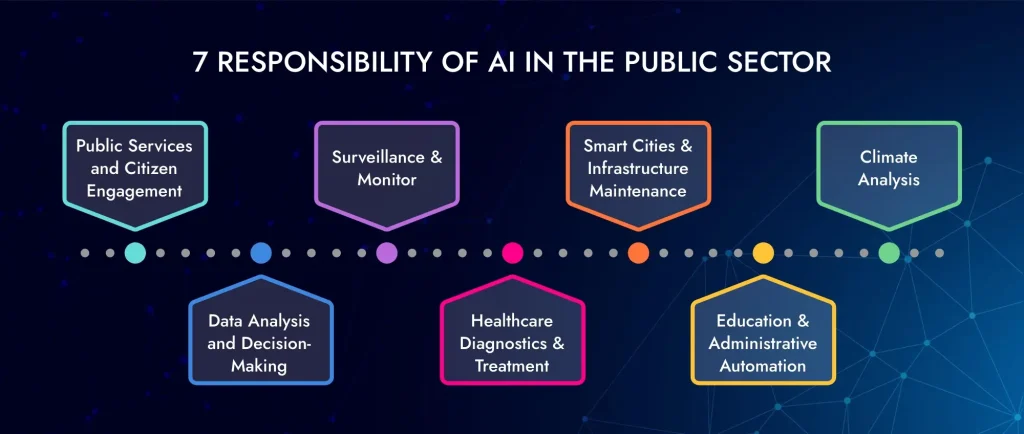
7 Responsibility of Artificial Intelligence in the Public Sector
In what ways does AI change government operations and service delivery to its people? Therefore, from automating administrative tasks to optimizing healthcare diagnostics, predicting crime, managing urban infrastructures, etc. AI transforms the landscape of public administration for AI public sector cost optimization.
1. Public Services and Citizen Engagement
Have you ever thought about long queues when you go for government services? Imagine chatbots instantly handling routine queries, reducing your wait time, and freeing human resources for more complex issues.
Artificial Intelligence (AI) transforms public services and citizen engagement by automating routine tasks and enhancing interaction efficiency. AI-powered chatbots and virtual assistants handle common queries, reducing wait times and allowing government employees to focus on more complex issues. The World Health Organization (WHO) estimates that 1.3 million people die in road crashes annually. Governments can significantly improve road safety and reduce these fatalities by effectively integrating AI into transportation systems.
Also, AI in public sector systems helps increase access to support systems since these types of AIs provide 24/7 support, eventually leading to higher satisfaction rates among citizens. Additionally, AI public sector cost optimization solutions can use these tools to analyze citizen feedback from various channels and help them understand community expectations.
2. Data Analysis and Decision-Making
Are you confident that every step officials make is based on accurate data? This means using computers over people gives users correct decisions even if not so safe.
Being able to do this makes it easier than relying on human beings, hence aiding in making informed choices on many things such as what one must buy or invest his money in according to his/her needs.
AI is more capable of analytical tooling than humans, thus making better decisions in the public sector. Governments collect much data from various sources, such as public records, surveys, and even social media.
Patterns, trends, and exceptions can rapidly be identified by AI public sector cost optimization algorithms that influence policy-making and resource allocation.
3. Surveillance & Monitor
Regarding public safety, AI improves surveillance and monitoring capabilities thus preventing crimes and ensuring security. AI cameras can detect strange activity or movements humans can see, but they raise an alarm for further investigation.
Therefore, these systems are used to quickly scan through hours of CCTV footage to identify potential threats and make it possible for immediate responses if emergencies arise. However, compliance with ethical guidelines will ensure public safety while maintaining privacy.
4. Healthcare Diagnostics & Treatment
In this sector, AI changes healthcare diagnostics and treatment by increasing the proficiency of medical personnel. Medical images including X-rays or MRIs are examined by artificial intelligence, and they detect or diagnose diseases quickly.
These models are trained with actionable health information from individual patients to predict patient outcomes and provide personalized care plans. They help in AI-driven cost reduction in the public sector associated with disease prevention and intervention programs delivered through the channel of local governments while ensuring better quality care.
AI-based telemedicine platforms also promote access since patients can receive medical consultations remotely. It is projected that by 2030 healthcare AI market will reach $187.95 bn. In addition, by 2026, the robot-assisted surgery market may amount to up to $40bn.
5. Smart Cities and Infrastructure Maintenance
Do you think your city could be more efficient and environmentally friendly? Can smart cities featuring AI optimize traffic flows, manage energy usage, and predict infrastructure maintenance needs?
Artificial intelligence solutions enabling urban optimization have become vital for smart city initiatives. Sensor-based AI systems monitor real-time data that reduces congestion and improves travel times.
6. Education & Administrative Automation
The education sector has been simplified by automating administrative processes, making teachers focus on teaching rather than paperwork due to artificial intelligence systems. For instance, teacher workloads have been reduced significantly by providing automated enrolment facilities and scheduling and grading functionality for schools handled through Artificial Intelligence technology.
Personalized learning platforms bring in an aspect of AI that allows educational content to be adapted for individual students’ needs, thereby improving learning outcomes. Moreover, it is possible to evaluate academic data with the help of artificial intelligence to identify challenges that affect different areas, thus making it easy to deal with them.
7. Climate Analysis
Are you worried about climate change and what it will do to us? Using AI technologies, we can analyze climate data to predict trends and develop strategies to mitigate the effects of climate change.
AI plays a crucial role in addressing climate change by analyzing environmental data and projecting future trends. Machine learning models based on massive datasets collected through satellites and weather stations, among others, can predict climate patterns while evaluating human activity’s impacts. This information helps policymakers develop ways to mitigate climate change, such as opting for resource use, planning for extreme weather events, or reducing greenhouse gas emissions.
Environmental conservation and sustainability become more effective due to insights driven by artificial intelligence (AI). Public sector AI integration strategy significantly enhances efficiency, service delivery, and decision-making.
Cut Costs and Enhance Efficiency with AI!
Let ViitorCloud’s AI Development Services help you optimize resources and improve performance.
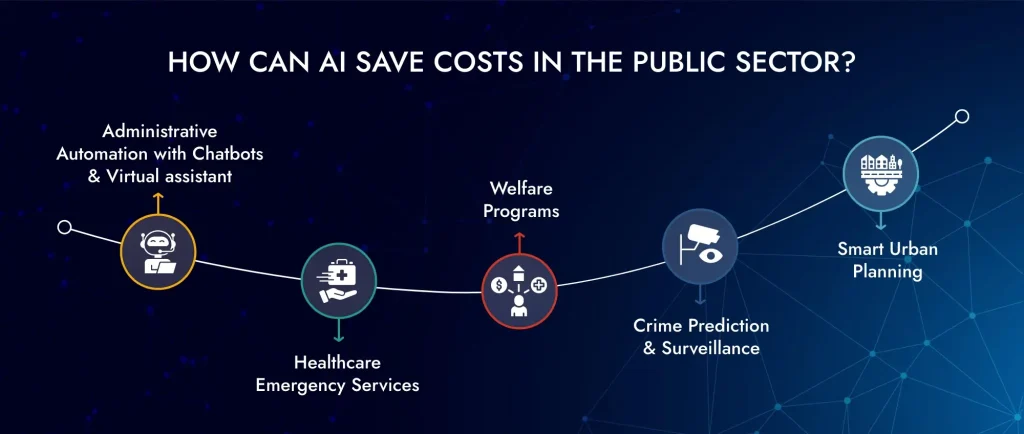
How can AI Save Costs in the Public Sector?
Artificial Intelligence (AI) possesses transformative potentialities in public services, which optimize operations, enable better provision of services, and save significant costs.
Here’s how AI is making a difference in various areas:
AI-enabled chatbots and virtual assistants can handle various administrative tasks, including answering citizens’ questions, managing appointments, and processing applications. This automation reduces the need for human intervention in routine tasks, resulting in significant AI-driven cost reduction in the public sector.
Assistance is available all day long via chatbots so people don’t have to wait for working hours. The use of AI to automate repetitive tasks lets employees spend more time on complex problems thereby increasing their overall productivity.
AI ensures that healthcare emergency services improve through predictive analytics and response times. These algorithms analyze data to predict potential health crises and allocate resources more efficiently. AI can forecast emergency service demands based on historical data, allowing better resource allocation and reducing unnecessary expenditures.
Faster diagnosis with higher accuracy through AI quickens treatment, thus resulting in fewer hospital stays and reduced costs. Regarding “Chatbots for businesses”, organizations achieve a 64% redirection of efforts by agents toward complex issues as opposed to 50% without AI.
Streamlined by AI, welfare programs include detecting fraud, automating eligibility checks, and optimizing resource distribution, to mention but a few. It is fostered that this will enable allocating funds where they are most needed to minimize waste.
Fraud prevention can also be enhanced by detecting irregular claims using AI systems, reducing costs. By analyzing huge amounts of data, AI ensures that resources are efficiently distributed so that appropriate benefits of AI in the public sector reach their rightful owners.
AI technology can boost public safety by predicting crime hotspots and enabling more effective surveillance. A proactive approach like this may help reduce crime rates and associated policing expenditures.
Furthermore, when analyzing criminal data, AI models can determine areas likely to experience crimes; hence, police resources can be distributed accordingly, and preventative measures can be implemented regarding such hotspots.
Additionally, AI-operated cameras and monitoring systems detect odd activities in real time, reducing the need for human surveillance extensively.
Another crucial area where AI could play a major role is in developing smart cities through optimal infrastructure management and effective use of resources. This helps save money while increasing the quality of urban life.
AI can study traffic patterns concerning optimizing traffic lights’ timing, thereby cutting congestion-related costs. In smart grids, AI systems take care of energy distribution, ensuring efficient resource utilization and reduced utility bills.
Achieve Cost Efficiency in the Public Sector with AI!
Empower your organization with advanced AI Solutions for unmatched cost optimization.
Examples of Successful Enterprises in the Public Sector Industry
This global trend represents a final great effort for governments towards more efficient, effective, and ethical designs involving various stakeholders.
These cases show different ways governments have used technologies in public administration. This includes some specific pilot projects and general strategies that might be adopted by government agencies working on AI implementation.
Modern governments insist on policies driven by people and services based on citizens’ inputs, thus necessitating large-scale civic engagement. The process usually takes too long because digital participation platforms generate huge amounts of citizen input that is difficult to analyze. As such, it becomes a complex and time-consuming process that may deter valuable citizen input from being effectively utilized.
Response: It uses machine learning augmented tools to efficiently analyze citizen input for civil servants at CitizenLab, a Belgian civic technology company. The public participation platform of the company utilizes Natural Language Processing (NLP) and Machine Learning algorithms to address thousands of contributions from citizens by summarizing trends, clustering ideas, and classifying them based on themes, demographics, or locations.
This system provides civil servants with real-time data-driven insights through user-friendly dashboards. CitizenLab facilitated a project called Youth4Climate early in 2019, in which young Belgians gave suggestions regarding climate change.
The AI-powered platform analyzed 1,700 ideas, 2,600 comments, and 32,000 votes, which resulted in a report containing 16 policy recommendations for elected officials. It demonstrates how AI facilitates citizen engagement and results in more informed government decisions.
Results and Impact: The platform has been successful for several municipalities, including Kortrijk City, whereby the administration interacts directly with its constituency through the platform that processes inputs from over 1,300 users.
Similarly, the city of Temse employs this tool for resource allocation based on crowdsourced ideas about mobility in the town. By automating data analysis, meaningful citizen participation is encouraged, and there is also an enhanced understanding of public requirements, thus leading to improved decision-making capacity.
Issue: Despite its small population of approximately five million, Finland aims to become an international leader in artificial intelligence applications. The technology-intensity economy of the country, together with digitized public services and highly educated people, creates a basis for such an ambition.
Research suggests accelerating AI and automation development could significantly boost Finland’s GDP and net employment. The challenge lies in determining the specific actions needed to achieve this potential.
Response: In May 2017, Finland’s Ministry of Economic Affairs and Employment launched an Artificial Intelligence Programme guided by a Steering Group comprising a network of experts. The group produced two key reports: “Finland’s Age of Artificial Intelligence” (December 2017) and “Leading the Way into the Age of Artificial Intelligence” (June 2019).
These reports outline 11 key actions to improve business competitiveness, effectively utilize data, ensure rapid AI adoption, attract top talent, make bold investments, and build world-class public services, among other goals. Unique to Finland’s approach is the emphasis on public sector efficiency and service effectiveness alongside economic growth.
Objectives include:
Developing new operating models.
Ensuring citizen data privacy.
Improving government data interoperability.
Creating AI-focused educational programs.
Fostering public-private partnerships.
Engaging in public discussions on AI ethics.
Transform Public Sector Operations with AI!
Boost efficiency and reduce costs using ViitorCloud’s proven AI Development Services.
How does ViitorCloud Help Public Sector Enterprises With AI Solutions?
Artificial Intelligence is revolutionizing the public sector, driving cost optimization and boosting efficiency across various operations. From administrative automation and healthcare to welfare programs and crime prediction, the integration of AI enables public sector organizations to operate more intelligently and cost-effectively. By leveraging AI Solutions, these institutions are not only improving service delivery but also staying ahead with cutting-edge technologies.
At ViitorCloud, we provide tailored AI Development Services to help public sector organizations streamline their processes, reduce costs, and enhance operational efficiency. Our expertise in AI in the Public Sector ensures that your organization can harness the power of AI for smarter governance and impactful outcomes.
Partner with ViitorCloud for AI Public Sector Cost Optimization and lead the way in modernizing public services with our AI Solutions. Let’s collaborate to achieve your goals for a more efficient, tech-driven future.
Ready to elevate your operations? Contact ViitorCloud today for customized AI Services that drive results.
Frequently Asked Questions
AI reduces costs in the public sector by automating routine tasks, improving resource allocation, and enhancing operational efficiency. This leads to significant labor, administrative expenses, and infrastructure maintenance savings.
AI optimizes public sector industries by providing data-driven insights for better decision-making, streamlining processes through automation, and improving service delivery. This results in enhanced productivity, reduced waste, and more effective use of resources.
AI improves efficiency in the public sector by automating repetitive tasks, enabling faster data processing, and offering predictive analytics. These advancements led to quicker response times, improved accuracy, and simplified operations.
The word ‘Metaverse’ was coined by Neal Stephenson in his sci-fi novel Snow Crash. FYI, it refers to a virtual shared space where the physical and digital worlds come together. As technology advances at lightning speed nowadays, the metaverse is not just a futuristic idea anymore – it’s here, and businesses need to embrace it to stay ahead of the game.
However, it takes work for businesses to use the Metaverse to their advantage. To fulfill such requirements, a metaverse consulting company would be a great help. Metaverse consulting companies help businesses to adopt metaverse solutions that enrich customer experience.
Here, we have discussed the role of metaverse consulting and why people in business should go to expert metaverse solution providers.
The Metaverse: What Is It?
So, before we explore the role of metaverse consulting companies, it is important to examine the metaverse’s current state. A report by Citi states that the metaverse economy could be worth between $8 trillion to $13 trillion by 2030. Major tech companies like Facebook, Microsoft, and Apple have already invested in developing their own metaverse platforms.
The metaverse is a big virtual world that combines different technologies like VR (virtual reality), AR (augmented reality), AI (artificial intelligence), and the IoT (Internet of Things). These technologies work together to create digital experiences that feel real and interactive, where everything is interconnected. It blurs the line between real physical and virtual worlds.
Transform your digital landscape today! Partner with us for tailored Metaverse Solutions that drive growth and innovation.
The Role of Metaverse Consulting Companies
Metaverse consulting companies play an important role as guides and enable businesses looking to embrace the metaverse. So, the best metaverse consulting company, like ViitorCloud, offers services to help businesses from various industries understand, strategize, and implement metaverse initiatives.
Here’s how they do it:
1. Strategy Development and Roadmap
One of the primary ways a metaverse consulting company can transform your business is by helping you develop a strategy and roadmap for your metaverse journey.
This involves:
Analyze your current capabilities
Metaverse goals
Create a proper implementation plan
For instance, a retail business might work with metaverse consultants to develop a strategy for creating virtual showrooms, which allow customers to try on clothes virtually or visualize furniture in their homes before purchasing.
2. Identify and Prioritize Use Cases
Metaverse consulting firms can help businesses identify use cases according to specific requirements and goals.
This might include:
Virtual collaboration and remote work solutions
Engaging customer experiences
Training and education platforms
Virtual product demos
A study by PwC estimates that VR and AR technologies, key components of the metaverse, have the potential to add $1.5 trillion to the global economy by 2030. By identifying the right use cases, Metaverse service providers can help you tap into this growth potential.
3. Technology Selection & Integration
With various metaverse platforms and technologies available, metaverse solutions providers help businesses choose the most suitable solutions for their needs.
They help in:
Evaluation and selection of appropriate technologies
Development, deployment, and integration of metaverse solutions with existing systems.
Addressing technical challenges
For example, a metaverse consulting company can help a manufacturing company implement digital twin technology. Creating virtual replicas of production facilities helps to optimize operations and train staff more effectively.
4. User Experience Design
It is obvious that metaverse enriches user experience, but to create such engaging experiences, metaverse consulting firms can help.
They develop:
Immersive design principles:
User journey mapping
Accessibility considerations
For instance, a real estate company can get metaverse consultancy services to design virtual property tours that are visually stunning and easy to navigate. Such things enhance user experiences.
5. Data Strategy and Analytics
The role of a metaverse consulting firm is not limited to the implantation of this technology. Since metaverse generates vast amounts of data, they help leverage this data for better decision-making.
Metaverse consulting companies can help you:
Develop a data strategy
Implement analytics tools
Data insights for decision-making
According to Gartner, by 2026, 25% of people will spend at least one hour a day in the metaverse for learning, recreation, work, entertainment, shopping, and social media. This will generate lots of data that can be used to gain competitive advantages.
6. Security and Privacy Considerations
Just like any digital platform, privacy and security should be fundamental in the metaverse.
Tech consulting companies can help in:
Development of security protocols
Ensure compliance
Implementation of identity management solutions
For instance, a financial institution can get help from a metaverse consulting agency to develop secure virtual banking environments that protect sensitive customer information while rendering immersive experiences.
7. Talent Development and Change Management
Adopting metaverse technologies often requires new skills and training within an organization.
Metaverse consulting companies can support:
Skills assessment and training
Change management strategies
Recruitment strategies
A survey by Accenture found that 71% of executives believe the metaverse will positively impact their organizations, but only 42% believe their organizations will be metaverse pioneers. This gap shows the importance of talent development and change management in metaverse adoption.
8. Continuous Support
Metaverse consulting firms offer ongoing support and guidance to help businesses adapt to the evolving metaverse landscape and optimize their virtual presence.
They offer:
On-going support
Technical help in metaverse operations
Future planning with this technology
For example, a furniture retailer can get help from a Metaverse consulting services agency to make changes or update their platform with Metaverse software development. Reputed consulting firms usually provide such continuous support.
Empower your business with cutting-edge Metaverse Solutions designed for success. Connect with our experts now.
How a Metaverse Consulting Company Transforms Business Operations
The Metaverse presents numerous opportunities for businesses to transform their operations and gain a competitive edge.
Here are some key areas where metaverse consulting companies can make a significant impact:
The metaverse allows businesses to create engaging and personalized customer experiences. Consulting firms can help develop virtual storefronts, product demos, and interactive customer service platforms. For example, a furniture store could let customers explore and customize their products in a realistic 3D environment before buying.
Virtual collaboration platforms in the metaverse can revolutionize how teams work together, regardless of their physical location. Consulting companies can assist in creating virtual offices, conference rooms, and training facilities that foster seamless communication and collaboration. This can lead to increased productivity, reduced travel costs, and better decision-making processes.
The metaverse can make supply chain operations more efficient by allowing real-time monitoring, simulation, and optimization. Consulting firms can help businesses create digital twins of their supply chain, allowing them to spot bottlenecks, test scenarios, and make decisions based on data. This can lead to lower costs, better efficiency, and more resilience.
The metaverse offers new ways to market and build a brand. Consulting companies can help businesses create engaging virtual experiences, such as branded games, events, and product launches. These experiences can create buzz, increase brand awareness, and build customer loyalty in ways that traditional marketing channels can’t match.
There are Some Challenges
While the metaverse presents numerous opportunities, businesses should consider some important things:
Technological Limitations: The metaverse relies on advanced technologies that may not be fully developed or widely available yet. Businesses must carefully assess the feasibility and scalability of their metaverse projects.
Privacy and Security: The metaverse involves collecting and processing a lot of data, so businesses must prioritize data privacy and security. Consulting firms can help develop strong security frameworks and ensure compliance with relevant regulations.
Ethical Concerns: The metaverse also raises ethical questions around issues such as identity, ownership, and governance. So, businesses understand these complexities and make sure their virtual presence follows their values and social responsibilities.
Take your business to the next level with ViitorCloud’s Metaverse Consulting Services. Let’s build your future together.
Conclusion
The metaverse represents a fundamental shift in how businesses operate and interact with customers, employees, and partners. Metaverse consulting companies are important in helping organizations embrace the latest technologies.
However, choosing the right companies becomes even more important. ViitorCloud has been offering consulting services to businesses since 2011. We have successfully completed metaverse projects for our clients and facilitate our services according to your requirements and goals.
Contact us to find out how your businesses can benefit from metaverse technology with our services.
Frequently Asked Questions!
The Metaverse offers businesses enhanced customer engagement, global reach, innovative marketing opportunities, immersive product demonstrations, virtual events, and new revenue streams through virtual goods and services.
Metaverse consulting services provide expertise in metaverse technologies, trends, and best practices to help businesses develop tailored strategies, unlock the metaverse’s potential, and gain a competitive edge.
A metaverse consultant like ViitorCloud provides strategic guidance to businesses looking to embrace the metaverse. It helps with technology selection, experience design, integration, monetization strategies, and navigating the complex metaverse world.
Challenges like inefficient resource allocation, limited citizen engagement, and bureaucratic red tape in the public sector often hold organizations back. These obstacles lead to a lack of public trust, delayed service delivery, and wasted resources. However, these issues can be addressed effectively with AI in the public sector.
At ViitorCloud, we provide tailored AI development services designed to automate administrative processes, optimize resources, and streamline operations. Our AI solutions boost productivity and offer personalized citizen services that enhance engagement and satisfaction, building a more transparent and responsive public sector.
With our expertise, ViitorCloud transforms public-sector organizations, making them agile and efficient. We understand the benefits of AI in the public sector, and we’re here to help you implement them successfully. If you’re looking to overcome public sector challenges and achieve meaningful digital transformation, let ViitorCloud be your partner in building the future.
Why Do AI Solutions for the Public Sector Matter?
Because they’re revolutionizing the way governments operate, and at ViitorCloud, we’re here to help your organization harness the benefits of AI in the public sector.
AI isn’t just about automation—it’s about making work smarter, cutting operational costs, and allowing governments to allocate resources with precision. With ViitorCloud’s AI expertise, you can drive efficiency, streamline decision-making, and create policies that truly make an impact.
Our AI solutions for the public sector empower you to make data-driven decisions, improve transparency, and ensure accountability through automated monitoring and compliance systems. Whether you’re looking to optimize resource allocation or enhance public service delivery, we provide the advanced tools your organization needs to stay ahead.
Partner with us for tailored AI Solutions that enhance efficiency and decision-making.
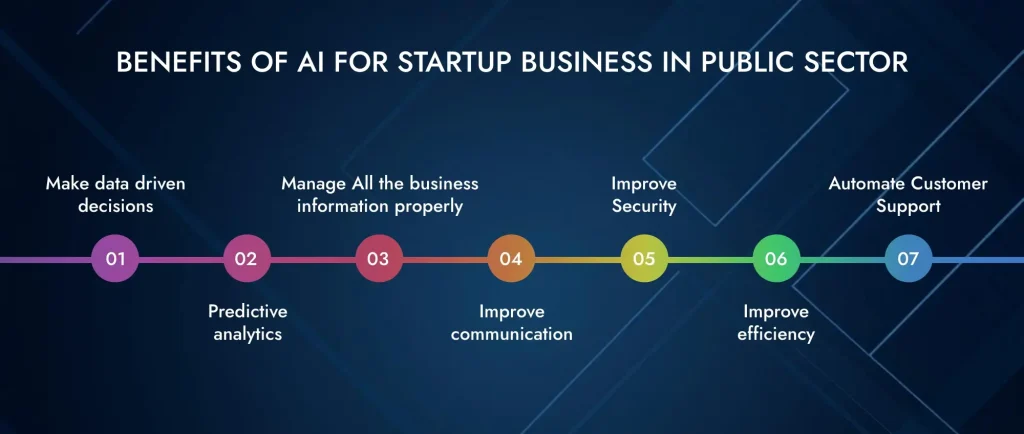
Top 7 Benefits of AI in the Public Sectorfor Startup Business
AI Solutions for Public Sector Startups offer benefits that automate labor tasks and minimize human errors, and AI empowers the public sector to work more intelligently. AI helps in decision-making and enhances public safety, among other benefits it offers.
Let’s understand in detail the Benefits of AI in the Public Sector:
1. Make Data-Driven Decisions
AI can collect and analyze data such as qualitative and quantitative data for the decision-making process. It analyzes historical data and uses surveys to understand the public needs and preferences. This approach to analyzing data ensures that the public sector provides things to citizens as per their desire, which satisfies the citizens. AI data-driven changes the way decisions take place in the public sector. It combined natural language processes and machine learning to analyze large datasets to provide meaningful insights, detect patterns, and make predictions related to the data. Also, this capability helps in policy formulation, allocation of resources, government procurements, and regulatory compliance.
2. Predictive Analytics
AI can collect and analyze large amounts of data to identify patterns, trends, and insights. The increased pattern identification helps public services to make informed decisions to serve the best public and avoid the wastage of resources. Advanced public service algorithms can predict service demand, manage risk, and prevent fraud. This approach helps budget planning, fosters citizen governance, and improves service delivery. AI benefits in the public sector include predictive analytics, anticipating needs, mitigating challenges, and enhancing effectiveness.
3. Manage All the Business Information Properly
Sensitive data has to be stored for essential purposes such as taxation, census, and public archives. In the public sector, physical documents are stored instead of digital copies. As a result, employees are required to store documents, maintain, secure the documents, and retrieve the information. AI is useful in the public sector for storing information effectively. Additionally, AI is effective with daily tasks that are too big and time-consuming for workers.
4. Improve Communication
One of the Benefits of AI in the Public Sector is improving communication. Good communication is important to keep a healthy relationship anywhere in the world. It is important in the public sector to maintain foreign and national relationships so that public workers cannot bear to take communication lightly. As a result, it become important for public workers to adopt AI for communication. AI tools help public workers communicate smartly and effectively with every individual. Also, a positive reputation is built in the eyes of the citizens and other people. Furthermore, AI helps detect misleading information, hate speeches, and propaganda.
5. Improve Security
Public workers must create a safe and secure community so people can live peacefully and happily. Security is required in the military, as well as surveillance, entry or exit of people in airports, public institutes, and internal communication. AI technology can help provide security in this place. It helps manage citizens’ identities, including birth information, thumbprints, education, resident and health records, and criminal or terrorist information. AI integration into government administration smooths the process, and the duties of public workers for security are automated. It is one of the essential Benefits of AI in the Public Sector.
6. Improve Efficiency
The benefit of AI in the public sector is that it improves efficiency. When the public sector uses AI technology, they will get updated technology in the system and become forward-thinking. Also, hiring skilled professionals in the department brings positive results in the public sector. Additionally, when AI solutions support departments and functions, they get insights into the problems, and problems can be solved easily. However, AI provides data-driven information to the public sector to help them make decisions for education, police work, political campaigning, and real estate to improve efficiency.
7. Automate Customer Support
AI virtual assistants and chatbots handle routine inquiries, provide information, and guide citizens through public services. This guides the public during the complicated process, improves efficiency, and reduces waste time. Also, it responds to the public in a personalized way. Additionally, it allows human staff to focus on complicated issues rather than normal queries. For instance, it solves citizen inquiries related to online tax filing, government benefits, etc. It is one of the AI solutions for public sector startups that satisfies customers with automation.
Integrate cutting-edge AI Solutions to optimize your workflows and public services.
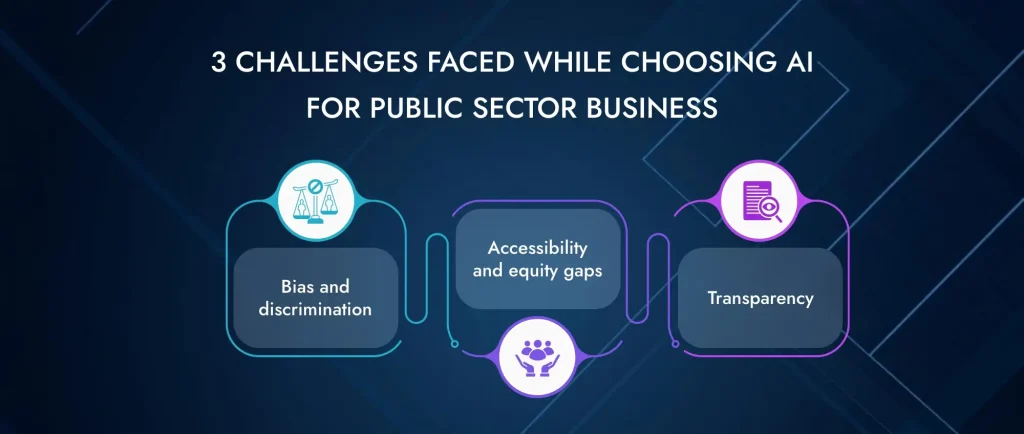
3 Challenges You Will Face While Choosing AI for Your Public Sector Business
The Challenges Faced when choosing AI in the Public Sector Startups are ethical considerations, regulatory complexities, and operations integration.
Let’s understand in detail the challenges the public sector faces:
AI algorithms work on the data trained; if the data contains biased and discriminatory data, then it will not provide an equal outcome. It provides unequal hiring processes, law enforcement, and social services outcomes. Ensures the representative training data and audits the data to mitigate the risks. Also, the transparent development and monitoring of AI processes are essential to working under ethical standards. Additionally, ensuring equitable treatment for citizens and not repeating discrimination is possible through AI systems.
AI in the public sector faces challenges related to accessibility and equity gaps, where communities lack access to AI services due to socio-economic disparities. Data biases can worsen disparities and affect service delivery and decision-making fairness. AI systems are adopted to address this issue and meet different requirements and capacities in public sectors. It is the way AI benefits in the public sector.
AI systems are complex and opaque, which makes the decision-making process challenging. Also, it generates a lack of trust among the public in accessing public services. The government has to be liable for explaining and accountable for everything done by AI systems.
Let ViitorCloud’s AI Development Services elevate your operational capabilities and impact.
How Does Viitorcloud Overcome Public Sector Challenges with AI Solutions for the Public Sector?
Innovation in public sector startups through AI is revolutionizing the way government services operate, driving efficiency and enhancing decision-making. From automating administrative tasks to predicting crime and aiding in policy formulation, AI’s potential is vast. Machine learning and natural language processing are the key drivers behind these transformative changes.
At ViitorCloud, we specialize in AI Solutions for the Public Sector, helping your organization harness the Benefits of AI in the Public Sector to streamline operations, ensure regulatory compliance, and improve service delivery. As a leading provider of AI Development Services, our skilled professionals are experts in creating tailored AI strategies that fit your unique needs.
Looking to integrate AI into your public sector systems?ViitorCloud has the solutions to make it happen. Contact us today to explore how our cutting-edge AI Solutions can drive success for your business.
Let’s take your public sector initiatives to the next level with AI innovation!
Frequently Asked Questions!
An example of AI in the public sector is using predictive analytics in law enforcement. Police use AI to analyze historical crime data, socioeconomic factors, weather conditions, and other factors to predict crime. As a result, resources are effectively allocated in the police department.
The leading AI Solutions for Public Sector Startups are NIRMAI, Rephrase.ai, Karya AI, Machinehack AI, and Yellow.ai.
AI benefits the Public Sector by handling customer queries in customer service and providing public safety. Also predicts fraud trends and helps in policy formulation and administrative efficiency.
AI helps the public sector by automating routine tasks like customer inquiries and data entry to improve efficiency and reduce costs. Also, it helps in the decision-making process, optimizes the allocation of resources, and enhances citizen’s services with personalized interactions.
Angular Dependency Injection (DI) is a fundamental feature of the Angular framework, enabling developers to create scalable, maintainable, and testable applications. As a design pattern, DI promotes the separation of concerns by decoupling components from their dependencies, allowing for greater flexibility and modularity in application architecture.
According to the 2023 Stack Overflow Developer Survey, Angular is one of the most popular frameworks, with approximately 20% of developers reporting using it. This widespread adoption highlights the importance of understanding its core features, including Dependency Injection. Let’s explore the article in detail.
What is Dependency Injection
Dependency Injection (DI) is a design pattern in software engineering that allows a class to receive its dependencies from an external source rather than creating them. This facilitates loose coupling and improves the modularity of the codebase, allowing for better maintainability and scalability.
Definition and Overview
Dependency injection (DI) is a way to give a class what it needs (a dependency) instead of the class creating it by itself. For example, if class A relies on class B, class B becomes class A’s dependency. DI supplies class B via an external injector, decoupling both classes.
Common dependency injection patterns include:
Constructor Injection: Dependencies are provided through a constructor.
Setter Injection: Dependencies are injected via setter methods.
Interface Injection: The dependency injects itself into any client that implements a specific interface.
Importance in Modern Development
Dependency injection plays a vital role in modern applications by:
Loose Coupling: Reduces interdependencies, simplifying component replacement or modification.
Testability: Enhances unit testing by allowing mock dependencies, improving test efficiency.
Maintainability: DI aligns with dependency injection principles like the SOLID framework, making code easier to maintain and update.
Flexibility: Enables runtime swapping of dependencies, useful in scenarios like angular dependency injection where different configurations may be needed.
Centralized Configuration: Frameworks like Angular provide centralized management, streamlining code, and applying changes consistently.
In Angular, DI is implemented using injectable Angular services, which can be easily configured through angular injection. This makes Angular’s dependency injection easier and improves how the app is built, making it more organized, easier to test, and maintain.
Optimize Your Angular Projects with Expert Dependency Injection Solutions
Unlock the full potential of Angular Dependency Injection with ViitorCloud’s tailored development services.
Core Principles of Dependency Injection
Dependency Injection (DI) is based on key principles that enhance software design and maintainability.
Dependency Injection Principles
Inversion of Control (IoC): Shifts the responsibility of managing dependencies to an external dependency injection container. This leads to a design that’s easy to change and adjust.
Separation of Concerns: Allows classes to focus solely on their responsibilities, while dependencies are handled externally, improving code clarity.
Single Responsibility Principle (SRP): By injecting dependencies, classes adhere better to SRP, avoiding direct management of external components.
Relevance of Basic Principles
Loose Coupling: DI decouples classes, enabling easy updates without altering dependencies—key for frameworks like Angular dependency injection.
Configurability: Supports different environments (development, testing, production) by externally configuring dependencies.
Benefits of Application Design
Testability: Easier to test classes in isolation by mocking dependencies, and aligning with core dependency injection patterns.
Flexibility: Applications can adapt quickly by swapping dependencies, as seen in Angular dependency injection.
Maintainability: Code remains focused on primary tasks, simplifying debugging and future updates.
Readability: Using DI improves code readability, as seen in dependency injection principles for clean and modular design.
Integrating these principles makes applications built on DI more flexible, maintainable, and easier to test, particularly in frameworks like Angular, where concepts like injectable Angular services are vital.
Understanding Angular Dependency Injection
Angular Dependency Injection (DI) is a core feature of Angular that manages dependencies efficiently, promoting modularity and enhancing testability.
What is Angular Dependency Injection
Angular dependency injection lets components and services get what they need from outside instead of creating it themselves. This design pattern supports modular, reusable, and maintainable applications. Dependencies in Angular are often services, but they can also include values like strings or functions.
Angular’s DI System Overview
Key components of Angular’s DI system include:
Injector: Manages the creation and lifecycle of dependencies.
Providers: Define how to create and supply dependencies, either at the component, module, or application level.
@Injectable Decorator: Marks a class as injectable Angular so that dependencies can be injected.
Benefits of Angular Dependency Injection
Modularity: Encapsulates functionality, making components and services reusable and independently testable.
Testability: Facilitates unit testing by allowing mock services to be injected in place of real ones.
Maintainability: Promotes loose coupling, simplifying updates and modifications.
Reusability: Decouples components and services, making them reusable across different projects.
How Does Angular Dependency Injection Work
Registration: Dependencies are registered using providers, ensuring the injector can resolve them.
Injection Tokens: Unique tokens help the injector identify and provide the right dependency.
Constructor Injection: Dependencies are declared in constructors, like with angular inject, and provided by the injector.
Singleton Instances: Services typically follow a singleton pattern unless otherwise configured.
Hierarchical Injectors: Dependencies are managed through hierarchical injectors, allowing for scoped or shared services.
Simplify Complex Angular Applications with Custom Dependency Injection
Leverage our Angular expertise to streamline your development process and enhance performance.
Patterns in Angular Dependency Injection
Angular offers various dependency injection patterns to manage dependencies efficiently, promoting modularity and testability.
Common Dependency Injection Patterns in Angular
Constructor Injection: The most common pattern where dependencies are provided via the constructor. It’s ideal for services needed during instantiation.
Setter Injection: Dependencies are injected via setter methods after object creation, useful for optional or changeable dependencies.
Interface Injection: Involves defining an interface to inject dependencies. Although less common in Angular dependency injection, it’s useful for enforcing contracts between classes.
Prefer constructor injection for required dependencies.
Use setter injection for optional or changeable dependencies.
Keep services focused on a single responsibility to ensure maintainability.
Implementing these dependency injection patterns in Angular helps developers build scalable, modular, and testable applications.
Angular Dependency Injection: Key Features
Angular’s dependency injection (DI) system simplifies the management of dependencies and enhances modularity. Here’s a concise overview of how it works and what sets it apart from general DI frameworks.
How Angular Injects Dependencies
In Angular, dependencies are injected via constructor injection using the @Injectable decorator. This marks a class as injectable, allowing Angular to create and manage instances, while resolving dependencies automatically.
Angular’s hierarchical injector system manages dependencies at various levels (root, module, component) for better control.
How Angular DI Differs from General DI
Hierarchical Injector System: Angular’s DI is hierarchical, offering more granular control over the injection scope.
Automatic Dependency Resolution: Dependencies are resolved automatically based on the constructor, streamlining setup.
Decorator-Based Configuration: Angular uses decorators like @Injectable for easy dependency configuration.
Lazy Loading and Tree Shaking: Optimizations like lazy loading and tree shaking help reduce bundle size by excluding unused dependencies.
Angular Ecosystem Integration: Angular DI is tightly integrated with modules, components, and services for seamless dependency management.
Specific Features of Angular DI
Injection Tokens: Allows flexibility by using tokens like classes, strings, or symbols to identify dependencies.
Optional Dependencies: The @Optional() decorator makes certain dependencies optional, providing defaults when unavailable.
Multi-Providers: Multiple instances can be registered under the same token for more complex dependency needs.
Aliasing: Dependencies can be injected under alternative tokens with the @Inject() decorator.
Lifecycle Hooks Integration: Angular DI integrates with component lifecycle hooks, injecting dependencies at specific stages.
Understanding Angular-specific features and patterns, such as Angular inject, Angular injectable, and dependency injection Angular, significantly improves application structure and maintainability.
Boost Your Angular Development with Advanced Dependency Injection Patterns
Partner with ViitorCloud to implement scalable and efficient Angular Dependency Injection solutions.
Practical Examples of Angular Dependency Injection
Angular’s Dependency Injection (DI) system improves app design by making it easier to maintain, organize, and test. Here are some practical scenarios where Angular DI is effectively used:
When to Use Angular Dependency Injection
Service Sharing Across Components: DI allows components to share a singleton service, ensuring a consistent state across the application.
Configuration and Environment Variables: Inject configuration or environment-specific dependencies for easy switching between environments (e.g., development, production).
Optional Dependencies: Use setter injection or optional dependencies when certain services might not always be required.
Testing and Mocking: DI simplifies unit testing by allowing real services to be replaced with mock services, focusing tests on isolated components.
This example demonstrates how dependency injection in Angular improves code reusability and testability by managing shared services like product management and authentication across different components.
Drive Efficiency with Angular Dependency Injection Best Practices
Work with our experienced developers to ensure your Angular projects are built for long-term success.
Conclusion
Understanding Dependency Injection (DI) in Angular is crucial for building scalable and maintainable applications. DI promotes loose coupling, enhances testability through mock dependencies, and increases component reusability. It also provides flexibility by allowing dynamic dependency management while centralizing configuration to minimize boilerplate code. As Angular’s DI system continues to evolve, it will bring performance improvements and expanded features, solidifying DI as a key aspect of efficient development.
Looking for expert Angular Development Services?
Our Angular development services encompass a wide range of capabilities, including Angular web development, application development, migration, as well as maintenance, and support. At ViitorCloud, our team of Angular developers specializes in creating compelling and adaptive websites that effectively boost traffic and drive sales. Elevate your Angular development endeavors by engaging a dedicated Angular programmer from our accomplished team.
Angular uses Constructor Injection, Setter Injection, and Interface Injection to manage dependencies in different scenarios.
Angular’s hierarchical injector system allows for global and scoped dependency management through a root injector and child injectors.
Use Constructor Injection for required dependencies, Setter Injection for optional ones, and register services at the appropriate levels for better performance.
The public sector faces significant challenges like corruption, lack of transparency, and excessive paperwork. As demands for efficiency and innovation grow, artificial intelligence in the public sector is emerging as a game-changer. While some early AI projects have been introduced in specific services, many governments still grapple with fully integrating AI solutions that meet both operational needs and citizen expectations.
At ViitorCloud, we understand these challenges and offer cutting-edge AI development services designed specifically for the public sector. Whether it’s automating processes, enhancing decision-making, or increasing transparency, our AI solutions can transform how public services operate—boosting efficiency while maintaining accountability.
Governments are already investing in AI and now is the time to take the next step with a trusted partner. ViitorCloud’s AI in the public sector services is tailored to meet your unique needs, ensuring that your transition to AI is seamless and impactful.
Let us help you redefine the future of public services with AI. Get in touch today and explore how our AI development services can power your digital transformation.
What is AI in the Public Sector?
Artificial intelligence in the public sector utilization within governmental operations and services is referred to as Artificial Intelligence, which is applied to a wide range of government activities to enhance efficiency and effectiveness.
The majority (70%) of business leaders back up governments’ efforts towards implementing artificial intelligence projects
By 2024, 75% of governments will have started or launched at least three enterprise-wide hyper-automation initiatives
Digital maturity level is low at 80% among government agencies
Artificial intelligence technologies would significantly reduce labor hours spent on manual processes within government administration units, allowing employees to focus on more essential tasks and making it easier for such agencies to provide services efficiently.
Impact of AI in the Public Sector
The use of artificial intelligence in the public sector allows for the provision of personalized, efficient citizen services like automated replies to queries or predictive analytics concerning resource distribution.
When AI supports data analysis and predictive modeling, better decision-making processes through evidence-based policy formulation can be achieved. The World Health Organization (WHO) estimates that 1.3 million people die in road crashes each year. Governments can significantly enhance road safety and reduce these fatalities by utilizing AI in transportation.
AI optimizes internal processes like resource management and fraud detection, reducing costs and improving accuracy. AI has become more common in government as a way to modernize public services and respond to complex societal challenges.
Optimize Public Services with AI
Ready to streamline operations with cutting-edge AI in the public sector? Connect with our experts today!
5 ways AI is Used to Regulate the Public Sector Industry
AI is increasingly used in the public sector for better governance and regulatory practices.
This is how it works:
1. Traffic Management
According to the World Health Organization (WHO), about 1.3 million people die annually from road traffic crashes. Governments can significantly mitigate road safety issues by effectively employing AI in transportation.
Technological advancements such as computer vision, object detection, drone tracking, and camera-based traffic systems enable government organizations to analyze crash data and pinpoint high-risk areas. They can proactively prevent future accidents by implementing additional road safety measures based on these analyses.
Furthermore, AI and machine learning algorithms provide data-driven insights that assist officials in managing traffic flow, reducing accidents and congestion, optimizing logistics, and enhancing overall road safety.
For instance, the U.S. Department of Energy has developed the Transportation State Estimation Capability (TranSEC), an AI tool that uses machine learning to analyze traffic patterns. Even with incomplete or limited traffic data, TranSEC provides real-time street-level estimations of vehicle movements, aiding in efficient traffic management.
2. Monitor Public Safety
By leveraging advanced technologies like computer vision, predictive analytics, and machine learning, AI is crucial in public safety monitoring. These systems offer real-time surveillance, threat detection, faster response times, and safety enhancements.
AI-powered public sector cameras and drones can monitor crowd activities and notify security agencies of suspicious occurrences. Therefore, this proactive approach helps in crime prevention. By evaluating past criminal records, AI algorithms can forecast future hotspots for crime so that law enforcement agencies distribute their resources efficiently and stop crimes before they happen.
Artificial intelligence systems can track congestion patterns, identify accidents, improve traffic flow, and enhance road safety. These systems also have features that enable automated penalties against traffic offenses, hence ensuring adherence to traffic rules.
3. Automate chatbots
Every day, government officials interact with citizens, answering their questions. With the help of artificial intelligence-based chatbots, these interactions can be automated, allowing employees to work on other complicated matters.
These chatbots provide citizens with extensive knowledge, offer multilingual assistance, and collect wide-scale feedback from the population. For example, the United States Army recruitment website has a virtual assistant called SGT STAR, with which members have made more than ten million interactions with the public. It acts like a guide through its platform and answers some basic questions until it leads users toward human attendants if needed.
In the US, the Department of Homeland Security also uses an EMMA, a virtual assistant for immigration services. On average, one million applicants contact her monthly to be shown some services in this department and given links to relevant pages and resources.
4. Citizen Services
AI-powered virtual assistants and chatbots can address multiple citizen inquiries, provide government service details, and assist with complicated processes. By doing so, they reduce human employee pressure and speed up response time frames.
Additionally, AI automates routine administrative tasks, including application processing, document verification, permit issuance, etc. This speeds up service delivery and reduces the chances of errors and fraud.
5. Disaster Response
AI can predict disasters such as floods, earthquakes, and hurricanes by analyzing data from diverse sources like weather patterns, seismic activity, and social media. Early warning systems are put in place for timely evacuations and preparations that will alert authorities and people before it happens.
During an incident, AI helps allocate resources more effectively by considering real-time information to determine areas that need the most help. This way, help can be provided to reach these distressed locations faster and more efficiently.
After a disaster, AI-enabled drones and satellite imagery detect the level of damage, which is important data for rescue operations. AI also aids in mapping out affected regions and manages the coordinated response on the ground.
Transform Public Sector Efficiency with AI
Discover how AI in the public sector can boost productivity and decision-making. Get in touch for tailored solutions.
What is the Role of AI in the Public Sector Industries?
AI automates tasks like data processing and citizen interaction. AI is changing public sector industries by improving efficiency as well as service delivery.
1. Healthcare Optimization
Medical science is an ever-evolving area with many opportunities for research & development. One highlighted recent Kubecon conference has been securing MLOps within the life sciences industry correctly: why?
However, artificial intelligence (AI) and machine learning (ML) have many other applications in healthcare besides this. For instance, governments can significantly improve their healthcare services using AI. Such improvements include tracking disease spread, monitoring patients’ health metrics continuously, and optimizing medicine planning and distribution.
These projects often involve working with highly sensitive content. Consequently, securing all artifacts ensures compliance standards are met while allowing multi-tenancy capabilities is important. There are abundant numerical figures available for AI/ML algorithms, including medical images, sensors, etc.
Some notable outcomes include:
Early detection of diseases via advanced analysis of medical images
Improved management of patient records through utilization of historical data insights
Facilitation of robot-assisted surgeries aimed at better precision and outcomes
2. Smart Urban Planning and Management
Urban planning & management today benefit greatly from AI, making cities more efficient, sustainable, and livable. Urban planners can make informed decisions to improve the quality of life with the help of AI-powered tools.
Smart cities use AI to optimize their consumption and manage resources like water, power, or waste. Sensors and IoT devices gather data, which is then optimized to reduce wastage through AI algorithms.
AI-driven simulations, in addition to predictive modeling, assist planners in developing infrastructure that meets the needs of a growing population. This involves optimizing the placement of utilities, public services, and green spaces.
3. Enhanced Public Safety and Security
Real-time computer vision and pattern recognition enable AI-powered surveillance systems to detect suspicious activities and potential threats. This helps prevent criminal activities by detecting them before they occur.
AI algorithms can identify patterns from historical crime data and predict future crime hotspots. In this way, law enforcement agencies can deploy resources strategically, thereby preventing crimes before they happen and improving community safety.
4. Efficient Public Administration
Citizens can access information and services via AI chatbots or virtual assistants. Such tools can handle a variety of queries – from questions about public services to guiding users through application processes – thus enhancing the user experience as a whole.
That aside, AI allows governments to generate decisions by analyzing large volumes of data for trends and insights. This helps in policy development, resource allocation, and performance evaluation to ensure public services are delivered effectively and efficiently.
5. Prevent Disease spread
AI in healthcare has made remarkable strides in medical science, ranging from early detection of diseases to prevention and clinical decision support.
Real-time monitoring of patients’ health is done by artificial intelligence, which tracks their weight, height, blood sugar levels, stress levels, and heart rate. Such information is then fed into an artificial intelligence healthcare system, which informs doctors about potential risks.
Governments can utilize AI to enhance public health services. For example, AI was crucial in detecting and controlling the COVID-19 virus during the pandemic. The NHS has developed an AI tool that can detect heart disease in just 20 seconds while the patient is still in an MRI scanner, a process that would typically take a doctor 13 minutes or more to analyze manually.
Explore AI’s impact on the public sector. Partner with ViitorCloud for seamless AI integration.
How to ViitorCloud Implement AI Solutions in the Public Sector?
Implementing artificial intelligence in the public sector requires more than just technology—it demands a tailored approach that aligns with your unique challenges and goals. At ViitorCloud, we offer comprehensive AI solutions that help you streamline operations, improve services, and deliver impactful results for citizens.
Here’s how ViitorCloud can lead your organization toward AI success:
Identify and solve key challenges: From optimizing administrative tasks to enhancing traffic management, ViitorCloud works closely with you to pinpoint specific problems that AI in the public sector can solve, such as boosting public health initiatives or streamlining service delivery.
Engage the right decision-makers: With our expertise in public sector collaborations, we help you bring together government officials, department heads, and policymakers to ensure full alignment and secure necessary buy-in for your AI initiatives.
Tailored AI technologies: Whether it’s machine learning, natural language processing, computer vision, or robotic automation, we design custom solutions to fit your organization’s objectives. ViitorCloud delivers cutting-edge AI tools to drive the outcomes that matter most.
Partner with ViitorCloud to implement transformative AI public sector solutions that deliver measurable results. Let’s discuss how we can bring your vision to life and make your organization a leader in the future of public services.
The future of AI in the public sector looks quite promising, thereby giving rise to transformative AI public sector solutions towards long-standing hurdles within this domain. Nevertheless, this journey is challenging. Public organizations need help with dealing with legacy systems and addressing data paucity. However, robotic process automation (RPA), computer vision, and natural language processing (NLP) are innovations that will make the department efficient and responsive.
So far, this has limited how much the wider corporate world has been able to adopt artificial intelligence and machine learning. However, RPA has changed everything about government paperwork handling by enabling digitization and automating repetitive tasks. This has led to efficiency in operations, thereby releasing major resources for superior strategic initiatives.
Public sector organizations can also benefit from NLP and computer vision. Where textual data is concerned, the AI public sector technology of NLP assists in extracting large volumes of such materials, while computer vision can interpret visual information from sources like surveillance cameras and medical imaging. The use of AI in the public sector industry is important as it helps to recognize patterns dealing with climate change and public health and predict and mitigate potential crises accordingly.
Redefine Public Sector Operations through AI
Learn how AI in the public sector drives innovation. Let us help you implement the right solutions.
Transform Your Public Sector with ViitorCloud’s Cutting-Edge AI Solutions
In today’s fast-paced world, leveraging artificial intelligence in the public sector is no longer optional—it’s essential. At ViitorCloud, we deliver transformative AI development services that enhance efficiency, streamline service delivery, and make data-driven decisions a reality. From smart urban planning to improved public safety, our AI solutions offer innovative ways to tackle longstanding challenges.
ViitorCloud is at the forefront of reshaping government processes with AI. Our advanced predictive tools empower law enforcement agencies to monitor and respond to potential threats in real-time, boosting community safety and reducing crime rates. With our AI-powered systems, you can elevate your operations, improve public administration, and ensure your city thrives in a digital-first world.
Partner with ViitorCloud to lead the change. Our AI expertise is the key to unlocking smarter, safer, and more efficient public sector services.
AI automates tasks, enhances decision-making, improves service delivery, and tackles complex issues such as healthcare access or transportation logistics using data analysis and predictive modeling.
AI in the public sector helps streamline its activities, boost efficiency, eliminate human errors, enhance the allocation of resources, and provide better services through the analysis of data as well as automated operations.
Through repetitive task automation, accuracy minimization, resource utilization optimization, and operational efficiency improvement, AI cuts down on expenses so that employees in public sectors may perform more crucial or even intricate work.
Yes, AI in the public sector can be safe if implemented with proper data security measures, ethical guidelines, and continuous monitoring to ensure compliance with regulations and protect sensitive information.
Node.js and Express have become essential tools in building scalable APIs, which are crucial for maintaining high performance and ensuring seamless user experiences. With its event-driven architecture, Node.js is highly efficient in managing the growing demands for real-time applications, making it a top choice for backend development. A study found that 68% of developers reported increased productivity with Node.js, largely due to its capability to use JavaScript on both the client and server sides, thus simplifying the development process. In this blog, we’ll provide a step-by-step guide with precise code examples to help you build scalable APIs using Node.js and Express.
Key Principles for Building Scalable APIs
Node.js is inherently asynchronous, allowing it to handle multiple requests simultaneously without blocking the event loop. This feature is crucial for scalability, enabling efficient resource management, particularly under high-load conditions.
Adopting a modular approach is essential. By breaking down the application into smaller, self-contained modules, developers can manage complexity and facilitate independent scaling. Each module should focus on a specific functionality, which allows for easier testing, maintenance, and scaling of individual components as needed.
Utilizing a microservices architecture can significantly enhance scalability. This approach allows different parts of the application to be scaled independently, optimizing resource use and improving overall performance. Each microservice can be developed, deployed, and scaled without affecting other services.
Express.js simplifies the creation of routes and the integration of middleware. Middleware functions can handle tasks such as authentication, logging, and error handling, making the API more robust and easier to manage. Properly organizing routes and controllers is vital for maintaining clarity and efficiency in the codebase.
Implementing comprehensive error handling and logging mechanisms is crucial for maintaining API stability. This ensures that issues can be quickly identified and resolved, minimizing downtime and enhancing user experience.
Using tools like Swagger for API documentation is recommended. Well-documented APIs not only facilitate easier onboarding for new developers but also ensure that the API is user-friendly for consumers, enabling better integration and usage.
Optimizing code for performance is critical. Techniques include minimizing synchronous operations, managing resource consumption, and leveraging caching strategies (e.g., using Redis) to reduce database load and improve response times.
Regular load testing is essential to identify potential bottlenecks and ensure the API can handle anticipated traffic spikes. Monitoring key metrics such as response times and error rates can guide necessary adjustments and scaling strategies.
Build Fast, Scalable APIs with Our Expert Team
Partner with ViitorCloud to drive efficiency through Node.js and Express APIs.
How to Build Scalable API with Node.js and Express
1. Setup Your Project
We created a scalable-api folder. Open this folder inside your code editor.
then follow the instructions below.
To Initialize a new Node.js project run the below command.
npm init -y
Once you run the above command, your package.json file will be created inside the folder.
Now, you have to run the below command to install Express.
npm install express
Once you run the above command, the node_modules folder & package-lock.json file will be created in the root folder.
2. Creating the Server
Now that you already installed Express, your next step is to create your server file and set up a basic Express server.
You have to create a file named app.js in the root folder.
Now, you created your file app.js and set up a basic Express server in app.js.
const express = require('express');
const app = express();
const port = process.env.PORT || 3000;

// Middleware to parse JSON bodies
app.use(express.json());

// Basic route
app.get('/', (req, res) => {
    res.send('Hello World!');
});

// Start the server
app.listen(port, () => {
    console.log(`Server is running on port ${port}`);
});
Now, once you are done, run your server by executing the following command in your terminal.
node app.js
Once you run the above command, you’ll see the below message in your terminal
Starting the server…
Middleware set up.
Route set up.
Server is running on port 3000
And to access the server, open your Chrome browser or whichever you’re using and navigate to “http://localhost:3000”, You’ll see the “Hello World” message.
As shown in the above screen.
The next steps for building scalable APIs with Node.js and Express typically involve.
3. Defining & Adding More Routes
You have to define additional routes to handle different endpoints. For example, let’s add routes for /api and /users.
// ... existing code ...

// New route for /api
app.get('/api', (req, res) => {
    res.send('API endpoint');
});

// New route for /users
app.get('/users', (req, res) => {
    res.send('Users endpoint');
});

// ... existing code ...
You can add the above code in your app.js file and update your app.js file.
app.get(‘/api’, (req, res) => { … }): This defines a new route that listens for GET requests on the /api endpoint. When a request is received, it sends back the response “API endpoint”.
app.get(‘/users’, (req, res) => { … }): This defines another route that listens for GET requests on the /users endpoint. When a request is received, it sends back the response “Users endpoint”.
Now, let’s test the new routes.
start your server by running:
node app.js
Now, open your browser, and go to “http://localhost:3000/api”, you’ll see the message “API endpoint”
Now, you should navigate to “http://localhost:3000/users”, you’ll see the message “Users endpoint”, shown in the below screen.
Now, your next step will be to connect to a database. For this, we’ll use MongoDB with Mongoose, a popular ODM (Object Data Modeling) library for MongoDB and Node.js.
4. Connecting to a Database.
You’ve to run the following command to install the Mongoose.
npm install mongoose
Let’s see how you can update your app.js file to connect to the MongoDB database.
  const mongoose = require('mongoose');

   // Connect to MongoDB
   mongoose.connect('mongodb://localhost:27017/mydatabase', { useNewUrlParser: true, useUnifiedTopology: true })
       .then(() => console.log('Connected to MongoDB'))
       .catch(err => console.error('Could not connect to MongoDB', err));

   // ... existing code ...
Connect to MongoDB: Use mongoose.connect to connect to your MongoDB database. Replace ‘mongodb://localhost:27017/mydatabase’ with your actual MongoDB connection string if it’s different.
Now, for that, You must first set up your MongoDB. If you haven’t, let’s set it up now. Use MongoDB Atlas (Cloud Database). You have to create a MongoDB Atlas account, Go to MongoDB Atlas and sign up for a free account.
Once you sign up via Google or GitHub Account, You’ll see the below screen after login.
You’ll to click on Visit MongoDB Atlas, Click on Create a New Cluster.
Once you click on Create as shown in the above screen, you’ll be redirected to the below screen, select M0 free version.
You have to keep your configuration as it is by default, now click on Create Deployment.
Once you click on that, you’ll come to this screen.
You’ve to note down, your username and password, once you click on “Create Database User”
Once you click on “Choose a connection method”
Now, choose “Connect to your application”, You’ll see the screen below.
replace it with your username and password you noted down earlier.
Now, you have to copy your MongoDB string and replace it in your app.js code, and you have to update it.
Now, you can run your node app.js file again in your terminal. You’ll see the message “Connected to MongoDB”
5. Implementing Middleware
So, now you see the above successful message, now, the next step is to add simple logging middleware using Morgan which is a popular HTTP request logger middleware for Node.js.
To install Morgan, run the below command.
npm install morgan
Now, you’ve to update your app.js file to use Morgan.
const express = require('express');
   const morgan = require('morgan'); // Import morgan
   const app = express();
   const port = process.env.PORT || 3000;

   console.log('Starting the server...');

   const mongoose = require('mongoose');

   // Replace with your actual MongoDB connection string
   const mongoURI = 'mongodb+srv://<username>:<password>@cluster0.mongodb.net/myFirstDatabase?retryWrites=true&w=majority';

   mongoose.connect(mongoURI, { useNewUrlParser: true, useUnifiedTopology: true })
       .then(() => console.log('Connected to MongoDB'))
       .catch(err => console.error('Could not connect to MongoDB', err));

   // Middleware to parse JSON bodies
   app.use(express.json());

   // Use morgan for logging
   app.use(morgan('tiny'));

   console.log('Middleware set up.');

   // Basic route
   app.get('/', (req, res) => {
       console.log('Received a request on /');
       res.send('Hello World!');
   });

   // New route for /api
   app.get('/api', (req, res) => {
       res.send('API endpoint');
   });

   // New route for /users
   app.get('/users', (req, res) => {
       res.send('Users endpoint');
   });

   console.log('Route set up.');

   // Start the server
   app.listen(port, () => {
       console.log(`Server is running on port ${port}`);
   });
Now, run your node app.js, go to “http://localhost:3000/” and you’ll see a log entry for the request in the terminal. This step will add basic logging to your application.
Your next step is to define a schema and model for your MongoDB collections using Mongoose. This will allow you to interact with your database in a structured way.
6. Define a Schema and Model
You have to create a new file named user.js in a models directory you may need to create the models directory if it doesn’t exist). You’ve defined a User Schema and model for users.
  const mongoose = require('mongoose');

   // Define the User schema
   const userSchema = new mongoose.Schema({
       name: {
           type: String,
           required: true
       },
       email: {
           type: String,
           required: true,
           unique: true
       },
       password: {
           type: String,
           required: true
       }
   });

   // Create the User model
   const User = mongoose.model('User', userSchema);

   module.exports = User;
Now, you’ve to update the app.js to Use the User Model:
In app.js, import the User model and create a route to add a new user:
const express = require('express');
   const morgan = require('morgan');
   const mongoose = require('mongoose');
   const User = require('./models/user'); // Import the User model
   const app = express();
   const port = process.env.PORT || 3000;

   console.log('Starting the server...');

   // Replace with your actual MongoDB connection string
   const mongoURI = 'mongodb+srv://<username>:<password>@cluster0.mongodb.net/myFirstDatabase?retryWrites=true&w=majority';

   mongoose.connect(mongoURI, { useNewUrlParser: true, useUnifiedTopology: true })
       .then(() => console.log('Connected to MongoDB'))
       .catch(err => console.error('Could not connect to MongoDB', err));

   // Middleware to parse JSON bodies
   app.use(express.json());

   // Use morgan for logging
   app.use(morgan('tiny'));

   console.log('Middleware set up.');

   // Basic route
   app.get('/', (req, res) => {
       console.log('Received a request on /');
       res.send('Hello World!');
   });

   // New route for /api
   app.get('/api', (req, res) => {
       res.send('API endpoint');
   });

   // New route for /users
   app.get('/users', (req, res) => {
       res.send('Users endpoint');
   });

   // Route to add a new user
   app.post('/users', async (req, res) => {
       try {
           const user = new User(req.body);
           await user.save();
           res.status(201).send(user);
       } catch (error) {
           res.status(400).send(error);
       }
   });

   console.log('Route set up.');

   // Start the server
   app.listen(port, () => {
       console.log(`Server is running on port ${port}`);
   });
Now, that you’ve to open Postman, remember that you have to use the desktop Postman agent, click on a new request, select request type to “Post”, and Enter the URL – “http://localhost:3000/users” Now, select the body tab, select row, and json there.
Once you send the request, it will reflect in your MongoDB Atlas account, you must go to the database and select cluster0, find the database you’ve created, go to the user, and here you’ll find the information you send via a request. just like the screen below.
7. Implemented CRUD Operations:
As we successfully added users to your MongoDB database, the next step is to implement additional CRUD (Create, Read, Update, Delete) operations for your User model. This will allow you to manage users more effectively.
Let’s start by adding routes for reading, updating, and deleting users.
Add a route to get all users and a route to get a user by ID.
// ... existing code ...

// Route to get all users
app.get('/users', async (req, res) => {
    try {
        const users = await User.find();
        res.send(users);
    } catch (error) {
        res.status(500).send(error);
    }
});

// Route to get a user by ID
app.get('/users/:id', async (req, res) => {
    try {
        const user = await User.findById(req.params.id);
        if (!user) {
            return res.status(404).send('User not found');
        }
        res.send(user);
    } catch (error) {
        res.status(500).send(error);
    }
});

// ... existing code ...
Add a route to update a user by ID.
// ... existing code ...

// Route to update a user by ID
app.put('/users/:id', async (req, res) => {
    try {
        const user = await User.findByIdAndUpdate(req.params.id, req.body, { new: true, runValidators: true });
        if (!user) {
            return res.status(404).send('User not found');
        }
        res.send(user);
    } catch (error) {
        res.status(400).send(error);
    }
});

// ... existing code ...
Add a route to delete a user by ID.
// ... existing code ...

// Route to delete a user by ID
app.delete('/users/:id', async (req, res) => {
    try {
        const user = await User.findByIdAndDelete(req.params.id);
        if (!user) {
            return res.status(404).send('User not found');
        }
        res.send(user);
    } catch (error) {
        res.status(500).send(error);
    }
});

// ... existing code ...
once, you update the above code in your app.js file,
start your server using the node app.js command,
now, send a request to get all users: You’ll see the below screen, in your “http://localhost:3000/users”
When you run get user by ID, you’ll see it in the terminal as well on the local host as well.
When you update any information, you’ll be able to see it here. we changed the name from John Doe to Ethan Lee,
When you run a delete request, one user will be deleted.
So, we successfully implemented and tested all the basic CRUD Operations for your API.
Add the following code to your app.js file to set up Swagger:
update your app.js file
require('dotenv').config();
const express = require('express');
const morgan = require('morgan');
const mongoose = require('mongoose');
const cors = require('cors');
const User = require('./models/user');
const setupSwagger = require('./swagger'); // Import the Swagger setup function
const app = express();
const port = process.env.PORT || 3000;

console.log('Starting the server...');

mongoose.connect(process.env.MONGODB_URI, { useNewUrlParser: true, useUnifiedTopology: true })
    .then(() => console.log('Connected to MongoDB'))
    .catch(err => console.error('Could not connect to MongoDB', err));

// Middleware to parse JSON bodies
app.use(express.json());

// Use morgan for logging
app.use(morgan('tiny'));

// Use cors for handling CORS issues
app.use(cors());

console.log('Middleware set up.');

// Basic route
app.get('/', (req, res) => {
    console.log('Received a request on /');
    res.send('Hello World!');
});

// CRUD routes
// ... existing CRUD routes ...

// Setup Swagger
setupSwagger(app);

// Error handling middleware
app.use((err, req, res, next) => {
    console.error(err.stack);
    res.status(500).send({ error: 'Something went wrong!' });
});

console.log('Route set up.');

// Start the server
app.listen(port, () => {
    console.log(`Server is running on port ${port}`);
});
Add comments to your routes in app.js to document them with Swagger. Let’s see an example for the GET /users route:
/**
 * @swagger
 * /users:
 *   get:
 *     summary: Retrieve a list of users
 *     responses:
 *       200:
 *         description: A list of users
 *         content:
 *           application/json:
 *             schema:
 *               type: array
 *               items:
 *                 type: object
 */
app.get('/users', async (req, res) => {
    try {
        const users = await User.find();
        res.send(users);
    } catch (error) {
        res.status(500).send(error);
    }
});

/**
 * @swagger
 * /users/{id}:
 *   get:
 *     summary: Retrieve a single user by ID
 *     parameters:
 *       - in: path
 *         name: id
 *         required: true
 *         schema:
 *           type: string
 *         description: The user ID
 *     responses:
 *       200:
 *         description: A single user
 *         content:
 *           application/json:
 *             schema:
 *               type: object
 *       404:
 *         description: User not found
 */
app.get('/users/:id', async (req, res) => {
    try {
        const user = await User.findById(req.params.id);
        if (!user) {
            return res.status(404).send('User not found');
        }
        res.send(user);
    } catch (error) {
        res.status(500).send(error);
    }
});

// Add similar comments for other routes...
Now, when you go to “http://localhost:3000/api-docs”, use your username and password which is in app.js
You’ll get this, you should be able to access the Swagger UI and see the documentation for your API.
You have successfully built a scalable API with Node.js and Express, complete with CRUD operations, basic authentication, and API documentation using Swagger. You can deploy your API over the cloud which makes it accessible to all people on the internet, you can use services like Heroku for deployment.
Scale Your Business with Custom API Solutions
Discover how we deliver robust APIs with Node.js and Express that grow with your business.
Conclusion
Building scalable APIs with Node.js and Express requires a strategic approach, including modular architecture, optimized performance with non-blocking I/O, clustering, efficient database management, and robust security measures. By implementing caching, monitoring tools, and auto-scaling, your API can handle thousands of requests per second, ensuring reliability and performance under heavy loads.
Ready to scale your API with Node.js and Express?Contact us today to build a future-proof API solution for your business needs!
Frequently Asked Questions
Node.js offers several advantages for API development, including its asynchronous, non-blocking architecture that allows for the simultaneous handling of multiple requests. This leads to improved performance and scalability. Additionally, Node.js uses JavaScript, enabling developers to work across both the client and server sides, streamlining the development process.
Express.js is a minimal and flexible web application framework that simplifies the process of building APIs with Node.js. It provides robust routing, middleware support, and easy integration with various databases, making it an excellent choice for developing RESTful APIs quickly and efficiently.
To ensure your API is scalable, consider implementing a microservices architecture, which allows different components to be scaled independently. Additionally, optimize your code for performance, use caching strategies, and conduct regular load testing to identify and address potential bottlenecks.
Best practices for error handling in Node.js APIs include using middleware to catch errors globally, logging errors for monitoring and debugging, and providing meaningful error messages to clients. It’s also essential to handle different types of errors (e.g., validation errors, database errors) appropriately to enhance user experience.
ViitorCloud offers comprehensive development services tailored to your business needs, specializing in building scalable APIs using Node.js and Express. Our team of experienced developers utilizes best practices in API design and architecture, ensuring that your application can handle high loads efficiently. With a focus on performance optimization and a robust development process, ViitorCloud can help you create APIs that not only meet current demands but also adapt to future growth, providing a strong foundation for your digital solutions.
In today’s rapidly developing landscape, businesses grapple with complex IT challenges—ranging from managing intricate operations to ensuring scalability and reliability. The integration of new technologies often adds to this complexity. But with ViitorCloud’s AI solutions, these hurdles become growth opportunities.
By implanting artificial intelligence into your IT operations, ViitorCloud empowers your business to tackle these challenges head-on. From real-time problem identification to predicting future issues and streamlining data management, our AI solutions optimize your IT infrastructure and operations systems, ensuring you stay ahead of the curve.
Curious about the AI use cases in information technology? Want to see how AI is revolutionizing IT operations? Let’s then dive into the details and understand everything. At ViitorCloud, we not only guide you through understanding AI in information technology but also deliver tailored AI development services that align with your business goals.
Why AI is Revolutionizing Information Technology & How ViitorCloud Can Help Your Business Thrive
AI in information technology isn’t just a trend—it’s a transformation. At ViitorCloud, we harness the power of AI to elevate your IT infrastructure, making it more efficient, strategic, and innovative. Our AI development services streamline repetitive tasks, freeing your team to focus on what matters most—driving your business forward. With our advanced AI solutions, we enhance operational processes, enabling your business to solve problems smarter and faster.
Explore AI Use Cases in Information Technology with Us
AI Use Cases in Information Technology
According to the NextMSC, the global AI market will reach $207.9 billion in 2023. AI in information technology improves the IT industry’s operation, efficiency, and productivity.
Here are the AI use cases in information technology that enhance the IT business:
1. IT Support and Helpdesk Automation
IT support and helpdesk automation solve the issues and streamline the user interaction process. Employees who go through technical issues raise a support request through the chatbot. These automation systems categorize the issue based on its severity and nature. When a problem can be solved with automation, it is solved, and if it needs the help of a human, then a ticket is raised to the appropriate IT personnel to solve the issue.
As a result, efficiency improves in the IT department, and professional people can focus on complex tasks. IT support is one of the AI use cases in IT operations, which improves operations.
2. Software Testing
AI use cases in information technology play a vital role in software testing by automating and improving the testing process. It helps generate test cases, predict areas of code of instability, and adjust the testing strategies based on changing project requirements. This application advances the testing life cycles, ensures fast feedback to developers, and reduces the time to release software testing.
Additionally, AI identifies complex tasks and detects bugs and performance issues. Also, it automates repetitive tasks so the tester can focus on essential testing areas.
3. Asset Management
IT asset management involves tracking and managing assets in the entire lifecycle of IT, including hardware, software, and licenses. It also automates asset discovery, monitors patterns, and predicts when assets need maintenance or replacement. Additionally, AI helps IT professionals maintain necessary inventory and reduce the risk of unnecessary procurement, which saves costs. However, AI asset management ensures compliance with software license agreements and regulatory requirements.
4. Helps in Documentation
The combination of machine learning and natural language processing automates the documentation and classifies the document. As a result, organizing and searching for relevant information becomes accessible. Additionally, extracting critical insights from documents provides quick access to essential details. Moreover, AI chatbots and virtual assistance immediately answer customer and IT team queries from the documentation.
Additionally, the valuable feature of AI is that it provides update-based articles that analyze the latest trends, development needs in IT, and issues. These improve IT support efficiency, resolve issues faster, and reduce downtime. It is a way AI information technology use cases make the documentation process simple and effective.
5. Helps in Cloud Computing and Resource Allocation
According to Mordor Intelligence, the cloud AI market will expand from USD 51.04 billion in 2023 to USD 207.40 billion by 2028. AI analyzes the resource usage patterns, workload demands, and performance metrics to allocate CPU, memory, and storage resources as required. When resources match workload requirements, AI helps companies avoid oversupply and underutilization of resources, save costs, and improve the performance of the applications.
Additionally, AI identifies cost-saving opportunities to optimize storage uses in cloud environments. This application enhances the reliability, scalability, and cost-efficiency of cloud computing.
6. Automated Code Review
AI analyzes the software code, bugs, security vulnerabilities, and deviations from coding standards. This approach improves software development quality by addressing risks early in the process and creating a more secure, reliable, and maintained codebase. This tool provides feedback for improvement, expedites the software development lifecycle, and improves the efficiency of software engineering processes. It is one of the important information technology use cases in IT operations.
7. Automated Data Backup and Recovery
It is one of the AI information technology solutions that solves data backup and recovery problems. AI automates the scheduling and execution to ensure the timely and efficient creation of data backup and recovery and reduce the risk of human error. When there is a system failure or data loss, the automation recovery process of AI helps restore the information and minimizes downtime.
Additionally, companies can enhance the disaster recovery capability by automating important tasks, protecting essential data, and maintaining business continuity. It is one of the important information technology use cases in the IT business.
Discover How AI Transforms IT—Let’s Innovate Together for Your Business
How do we implement AI information technology operations?
When implementing AI in the IT industry, IT operations become effective. This AI innovation ensures proactive management and frees resources for strategic initiatives.
Let’s understand the process of implementing AI use cases in IT operations:
Clearly defining the objective of the business helps implement AI in IT operations. The objectives include improving efficiency, providing security, or optimizing the allocation of resources. Also, evaluating the current IT infrastructure, such as existing technologies, team skill sets, and data quality, is essential to identify the readiness for AI integration.
It is necessary to identify use cases such as automated monitoring, predictive maintenance, or detection of security threats. When use cases are identified, IT teams can solve the specific problem in the business and help assess the feasibility of implementing AI. Additionally, identifying use cases helps identify challenges and risks for AI implementation. The risks include data privacy, regular compliance, security, and ethical considerations.
Data collection is important for businesses to analyze. The data includes historical data, performance metrics, and other data sources. Also, quality and reliable data are essential for the company to analyze.
Collaborate with data scientists and IT professionals to develop and train AI models. Also, AI should be integrated with existing systems to improve workflow, ensure compatibility, and minimize distribution for ongoing operations.
Once the AI model is developed, it is essential to test and validate it. For the testing, create a controlled environment where AI models can be tested. Feedback will also be received based on testing. Performance analysis is possible during the testing phase, and improvement will occur in the AI model.
Once the AI model in IT is tested and validated, implement it on a smaller scale or in a specific department without expanding into a broader operation. After implementing it on a smaller scale, monitor the tools to track the performance of systems and provide support for the operations.
The last is to evaluate the AI model. In this step, the performance of AI models is assessed regularly with the defined objectives and key performance indicators ( KPI). After evaluation, improve and optimize the system based on performance feedback and operation changes as per requirements.
These are 7 steps to implementing AI information technology use cases in the IT industry.
Harness AI Use Cases in Information Technology to Elevate Your Business
How Can Viitorcloud Help IT Industries with AI?
In the developing IT sector, staying ahead of the curve requires more than just adapting to changes—it means leading the charge with innovative solutions. That’s where ViitorCloud comes in, offering tailored AI solutions designed to elevate your IT business to new heights.
From automating routine tasks to enhancing software testing and optimizing IT support, AI transforms the way businesses operate. But beyond the technical advantages, the real power of AI lies in its ability to empower decision-makers, streamline operations, and drive growth.
At ViitorCloud, we don’t just provide AI development services—we partner with you to unlock the full potential of AI use cases in information technology. Our team of AI experts listens to your unique challenges, understands your vision, and crafts bespoke AI strategies that align with your business goals. We’re not just here to implement AI; we’re here to transform your business, making it more efficient, more competitive, and more successful.
When you’re ready to take your IT business to the next level, ViitorCloud is ready to make it happen. With our expertise and commitment to excellence, you can trust us to deliver AI solutions that work for you. So don’t wait—reach out to ViitorCloud today, and let’s start building the future of your IT business together.
Frequently Asked Questions
The impact of AI on information technology is to streamline the IT operation process, enhance decision-making, and improve efficiency in data management. Also, it helps to reshape the future of the IT industry.
AI used in information technology are automating technical tasks, assisting in IT management, and helping in IT documentation. Additionally, AI helps in software testing, automated code review, data backup and recovery, cloud computing, and resource allocations.
AI is an example of natural language processing used in information technology as it helps interact with the customers, provides customer support, and automates the responses. It enhances the user experience and improves efficiency in real time.
Have a query, an idea, or just want to connect? We’re all ears!
Fill out this form to drop us an email, and we will reach out to shape something extraordinary.