Emerging Tech in 2030 Shaping Business Transformation

What if your AI assistant anticipates your needs even before you realize them? Imagine a world where blockchain secures every digital interaction, seamlessly blending the physical and digital realms. This vision is not science fiction; it is the reality we approach in 2030.

As this technological revolution unfolds, one key question arises: will your business lead the way or get left behind?

We, ViitorCloud, make businesses future-ready, today. Our transformative AI, blockchain, and digital transformation solutions empower businesses to stay ahead. We are exhibiting at the AsiaBerlin Summit 2024, where we will showcase how companies like yours can thrive in this ever-changing world.

Technology is significantly reshaping the way we do business. Let’s explore these advancements and developments together and see how we can assist you through this transformative technological evolution.

AI Revolution Redefines Business Intelligence

AI Assistants for Personalized Business Support

By 2026, AI assistants evolve beyond performing simple tasks. We envision an AI that prepares detailed briefings, suggests strategic talking points, and accurately predicts potential outcomes.

These AI systems understand complex contexts, emotions, and even unspoken intentions. For example, in finance, an AI assistant analyzes market trends, evaluates a company’s financial health, and considers global economic indicators to proactively suggest optimal investment strategies.

We are a digital transformation company that spearheads this transformation using our advanced AI solutions. We develop systems that adapt to the unique needs of each business, seamlessly integrating into various operations from customer service to high-level decision-making. Our expertise ensures that organizations can leverage AI to enhance efficiency and drive strategic growth.

Predictive Analytics for Forecasting the Future with AI

How does your strategy shift when you can predict market trends with 95% accuracy? As an AI development company, we offer advanced AI solutions to transform predictive analytics, revolutionizing inventory management, resource allocation, and strategic planning.

For example, a retailer utilizing our AI-powered analytics accurately predicts seasonal demand fluctuations. This capability optimizes inventory and minimizes waste, giving companies a significant competitive advantage by allowing them to respond to market changes proactively.

Our AI solutions deliver actionable insights that drive growth. By analyzing vast amounts of real-time data, our systems provide predictions that influence everything from product development to marketing strategies.

The global AI market is thriving, valued at $196.63 billion in 2023, and projected to grow at a CAGR of 36.6% from 2024 to 2030, shaping the future of business. We are ready to empower your business with customized AI solutions that enhance efficiency and drive success.

Ethical AI Frameworks to Ensure Responsible Innovation

As AI becomes a common part of our lives, we ask ourselves how to ensure it serves as a positive force. By 2025, we see global standards for AI ethics emerging, requiring companies to prove their AI’s ethical compliance. This change emphasizes the importance of transparency, fairness, and accountability in AI systems.

As a leading tech company, we take the lead in AI innovation by aligning our solutions with these evolving standards. We focus on creating AI that is not only powerful but also trustworthy and reflective of human values.

Our dedication to ethical AI fosters trust with clients and end-users, distinguishing ViitorCloud in the marketplace.

The World Economic Forum highlights the increasing significance of AI ethics, noting that ethical considerations are vital for the widespread adoption of AI and for building public trust.

Shape Tomorrow with Advanced AI Solution & Technology

Reimagine your business strategy with expert AI Solutions & Robust Technology. Begin your Digital Transformation journey with us.

Blockchain

As we look toward the future of technology, we recognize that blockchain’s potential. It goes beyond mere cryptocurrency. By 2027, we see a significant transformation in how businesses manage digital identities, execute agreements, and foster interconnected ecosystems. we actively explore these innovative developments and their implications for the business landscape.

Decentralized Identity for Digital Security

Imagine having complete control over your digital identity and sharing only the information you choose. By 2027, blockchain-based decentralized identity solutions become the norm, with more than 60% of online transactions using this technology for secure and private authentication.

This shift changes how we view digital identity, providing unmatched control and security. You can apply for a loan without disclosing your entire financial history or verify your age online without revealing your exact birthdate. The effects on privacy and data security are significant, transforming how businesses engage with customers and manage sensitive information.

We offer EveryCRED, a decentralized identity and verifiable credentials solution that emphasizes data privacy and security. Our system utilizes blockchain technology to create immutable, verifiable credentials, empowering users to manage their digital identities. This approach not only enhances security but also simplifies processes like KYC (Know Your Customer).

For businesses, embracing decentralized identity solutions builds customer trust, lowers liability in data handling, and streamlines verification processes. Various sectors, including public services, finance, healthcare, cybersecurity, automotive, and e-commerce, experience substantial benefits from this technology.

Smart Contracts for Automating Business Agreements

Imagine a world where business agreements execute themselves, removing the need for intermediaries and minimizing the risks of disputes. We recognize that smart contracts have the potential to automate up to 50% of business agreements by 2026. This automation significantly lowers transaction costs and enhances efficiency across various industries.

Smart contracts are self-executing agreements with terms directly written into code. They streamline operations and foster trust between parties. In real estate, for instance, smart contracts automate property transfers by verifying ownership, releasing funds, and updating land records. In supply chain management, they trigger payments upon confirmed delivery, ensuring timely transactions and reducing conflicts.

The applications of smart contracts are extensive:

  • Insurance claims can be processed automatically based on predetermined conditions.
  • Royalty payments for artists and content creators can be distributed instantly when their work is used.
  • Voting systems can become more transparent and tamper-proof.

By harnessing the power of smart contracts we transform the businesses operate, driving innovation and efficiency in every sector we touch.

Blockchain Interoperability: Creating a Unified Digital Ecosystem

At ViitorCloud, we envision a world where various blockchain networks communicate effortlessly. This seamless interaction allows for smooth transfers of data and value across different platforms. By 2025, we expect to see significant advancements in blockchain interoperability, leading to a unified ecosystem for decentralized applications.

This interconnectedness opens exciting opportunities for cross-chain transactions and data sharing. For instance, a company can utilize one blockchain for secure data storage, another for financial transactions, and a third for supply chain management—all working together in harmony. This interoperability breaks down barriers between different blockchain networks, encouraging innovation and enabling the development of new business models.

The implications of blockchain interoperability are extensive:

  • Seamless Asset Transfers: Companies can transfer assets smoothly between different blockchain networks.
  • Enhanced Collaboration: Businesses can collaborate more effectively when using various blockchain platforms.
  • Complex Decentralized Applications: We can create more sophisticated and powerful decentralized applications.
  • Improved Scalability and Efficiency: Blockchain networks become more scalable and efficient.

As blockchain technology evolves beyond its initial focus on cryptocurrency, its influence on business operations, data security, and digital interactions becomes increasingly significant. Companies that adopt these advancements and integrate blockchain solutions into their operations position themselves to succeed in the digital landscape.

We remain dedicated to leading the way in blockchain innovations. We provide our clients with cutting-edge solutions that enhance efficiency, security, and growth in this dynamic environment.

Unlock the Future with AI Solutions and Blockchain Technology

Embrace Digital Transformation with cutting-edge AI Solutions and secure your growth with Blockchain Technology. Let us help you reshape your business for 2030.

The Convergence of AI, Blockchain, and Digital Transformation

As we approach the AsiaBerlin Summit 2024, we recognize the importance of understanding how blockchain technology connects with other transformative technologies, especially Artificial Intelligence (AI) and Digital Transformation. This intersection reshapes industries and opens up new avenues for innovation.

As an emerging tech company, we emphasize the significance of this convergence. Blockchain and AI together drive efficiency and transparency, enhancing business processes across various sectors. We see these technologies not just as tools but as catalysts for change that empower organizations to innovate and thrive in a competitive landscape.

The AsiaBerlin Summit serves as a vital platform for industry leaders, startups, and policymakers to explore these dynamics. Participants engage in meaningful discussions, share insights, and collaborate on solutions that leverage the strengths of blockchain and AI. We invite everyone to join us in this exciting journey toward a future where technology transforms our world for the better.

AI-Powered Blockchain Solutions

The integration of AI with blockchain technology opens new frontiers in data analysis, security, and decision-making.

AI algorithms enhance blockchain networks by:

  • Optimizing smart contract execution and predicting potential vulnerabilities.
  • Improving consensus mechanisms for faster and more efficient transaction validation.
  • Enhancing fraud detection and security measures within blockchain networks.

We lead this integration by developing solutions that leverage both AI and blockchain. Our focus is on delivering powerful, secure, and intelligent systems tailored to our clients’ needs. We understand the unique challenges businesses face and provide expert guidance to help them navigate the complexities of these technologies.

By combining our expertise in AI with the robustness of blockchain, we empower organizations to streamline their operations and improve their decision-making processes. Our commitment to innovation ensures that we remain at the forefront of technological advancements, helping our clients unlock the full potential of these transformative technologies.

Digital Transformation Through Blockchain

Blockchain drives digital transformation, allowing businesses to rethink their processes and improve customer interactions.

In various sectors, including supply chain management and financial services, blockchain facilitates:

  • Greater transparency and traceability in business operations.
  • Reduced costs and increased efficiency through disintermediation.
  • Enhanced data integrity and security.

For representative, we help the real estate sector develop AI-powered platforms that utilize blockchain technology for secure and efficient property transactions. Our expertise ensures that our clients can harness the full potential of blockchain to enhance their operations and deliver better services to their customers.

IoT and Blockchain: A Powerful Combination

The Internet of Things (IoT) represents a significant area where blockchain technology plays a transformative role. By offering a secure and decentralized method for storing and sharing data from IoT devices, blockchain enables new applications and enhances existing ones.

At ViitorCloud, we showcase the potential of this powerful combination through our development of an IoT-powered health monitoring system. This initiative highlights how blockchain improves data security and integrity in IoT applications. As a result, we open up exciting new opportunities in sectors such as healthcare, agriculture, and smart cities.

Transform Your Business for 2030 with Digital Innovation

Stay ahead with AI Solutions, leverage Blockchain Technology and drive seamless Digital Transformation. Partner with ViitorCloud for future-ready solutions.

ViitorCloud at AsiaBerlin Summit 2024

As we prepare for the AsiaBerlin Summit 2024, ViitorCloud showcases how emerging technologies shape the future of business and society. Our team presents cutting-edge solutions that demonstrate the practical applications of blockchain, AI, and digital transformation across various industries.

We invite attendees to explore our EveryCRED platform, which revolutionizes digital identity management, and discover how we pave the way for a more connected and efficient digital ecosystem.

Final Words

The convergence of Blockchain, Artificial Intelligence, and Digital Transformation represents a new frontier in technology innovation. As these technologies evolve and integrate, they create unprecedented opportunities for businesses to innovate, optimize, and grow.

ViitorCloud remains committed to pioneering these technological advancements. We offer our clients cutting-edge solutions that drive efficiency, security, and growth. We look forward to sharing our insights and experiences at the AsiaBerlin Summit 2024 and continuing our journey as leaders in the global digital transformation landscape.

Contact us to explore how we can help your business leverage blockchain, AI, and digital transformation to succeed in the digital era. You can also connect with us on LinkedIn for insights on emerging technologies shaping businesses globally.


Frequently Asked Questions

Businesses can leverage AI for predictive analytics, process automation, and personalized customer experiences, while blockchain ensures data security, transparency, and efficient transactions.

AI and blockchain enhance operations by automating tasks, improving decision-making with data insights, and enabling secure, streamlined processes. For example, these technologies ensure traceability and reduce delays in supply chain management.

While the ROI varies by use case, businesses typically see benefits like reduced operational costs, increased productivity, and competitive advantages through innovation and enhanced customer experiences.

ViitorCloud provides customized solutions, from strategy development to implementation, ensuring seamless integration of AI and blockchain into your operations to maximize efficiency and growth.


Techniques to Boost Node.js API Performance

Optimizing Node.js API performance is crucial in today’s fast-paced digital world, where users expect quick and reliable interactions with web services. Studies show that even a 1-second delay in page load time can lead to a 7% reduction in conversions. For businesses operating at scale, the performance of your API can be the difference between delivering a seamless user experience and losing users to competitors.

By fine-tuning your Node.js API, you not only improve response times but also ensure the scalability of API as your user base grows. In this blog, we’ll explore 8 proven techniques that can help you boost performance, maximize efficiency, and ensure your APIs are capable of handling millions of requests without breaking a sweat.

Understanding Node.js Performance 

Node.js is a powerful platform for building scalable applications like AI chatbots, and high-performance web applications but its performance depends on several factors due to its non-blocking, event-driven architecture.

Here are the key influences and challenges affecting Node.js performance:

Key Influences on Node.js Performance

Node.js handles multiple requests simultaneously without blocking, making it efficient for I/O-bound tasks.

Synchronous functions can block the event loop, slowing down request handling. Always prefer asynchronous methods.

Inefficient database queries can create bottlenecks. Optimize queries through indexing and connection pooling.

Memory leaks can increase consumption over time. Regular profiling helps identify and fix leaks.

Common Performance Challenges

  • High Latency Network Calls: Mitigate with caching and efficient protocols like HTTP/2.
  • Garbage Collection (GC): Frequent memory allocations can increase GC activity. Minimize allocations in critical areas.
  • CPU-Intensive Tasks: Offload heavy processing to worker threads to keep the main thread responsive.

Performance Optimization Techniques

  • Use asynchronous programming to avoid blocking.
  • Optimize data handling with streams and pagination.
  • Implement caching for frequently accessed data.
  • Utilize clustering to leverage multi-core CPUs.
  • Regularly profile your application to identify and address bottlenecks.

By understanding these factors and applying optimization techniques, developers can enhance Node.js application performance significantly.

Transform your business with superior Node.js API performance. Let ViitorCloud’s experienced developers create custom solutions that boost your application’s responsiveness and user satisfaction.

8 Proven Techniques to Boost Node.js API Performance

To boost Node.js API performance, consider implementing the following eight proven techniques:

1. Use Asynchronous Programming

One of the foundational principles of Node.js is its non-blocking I/O model. To fully leverage this feature:

  • Always use asynchronous functions: This ensures that your application can handle multiple requests at once without waiting for any single operation to complete. Using callbacks, promises, or async/await patterns can help maintain this non-blocking behavior.
  • Example: Instead of using synchronous file reading methods, utilize fs.promises for asynchronous operations:
const fs = require('fs/promises');

async function readFile() {
    try {
        const data = await fs.readFile('file.txt', 'utf8');
        console.log(data);
    } catch (error) {
        console.error('Error reading file:', error);
    }
}

2. Implement Caching Strategies

Caching frequently accessed data is one of the most effective ways to boost Node.js API performance. By temporarily storing data in memory, caching reduces the need for repeated database queries or API calls, significantly speeding up response times.

  • Use Redis or Memcached: These in-memory data stores can cache API responses and reduce the load on your backend services.
  • HTTP Caching: Implement caching headers like Cache-Control and ETag to allow clients to cache responses effectively.
  • Example: Here’s how you might implement caching with Redis:
const redis = require('redis');
const client = redis.createClient();

app.get('/api/data', async (req, res) => {
    const cacheKey = 'data_key';
    client.get(cacheKey, async (err, data) => {
        if (data) {
            return res.json(JSON.parse(data));
        } else {
            const freshData = await fetchDataFromDatabase();
            client.setex(cacheKey, 3600, JSON.stringify(freshData)); // Cache for 1 hour
            return res.json(freshData);
        }
    });
});

3. Optimize Database Queries

Inefficient database queries can drastically slow down your Node.js API, as the API may spend excessive time waiting for data retrieval. Poorly structured queries or the lack of proper indexing can increase response times, especially with large datasets.

To improve performance:

  • Indexing: Ensure your database is properly indexed to speed up query execution.
  • Query Optimization: Write efficient queries that reduce data retrieval time. Avoid unnecessary joins or data fetching.
  • Use an ORM: Tools like Sequelize can simplify database interaction and help optimize queries by abstracting complex SQL into more manageable code.

4. Leverage Clustering

Node.js runs on a single thread by default, which means it cannot utilize multi-core systems effectively. Clustering allows you to spawn multiple instances of your application across different CPU cores.

  • Use the Cluster Module: This built-in module enables you to create child processes that share the same server port.
  • Example: Here’s how you can set up clustering:
const cluster = require('cluster');
const http = require('http');

if (cluster.isMaster) {
    const numCPUs = require('os').cpus().length;
    for (let i = 0; i < numCPUs; i++) {
        cluster.fork();
    }
} else {
    http.createServer((req, res) => {
        res.writeHead(200);
        res.end('Hello World');
    }).listen(8000);
}

5. Use Load Balancing

Load balancing plays a critical role in improving Node.js API performance by evenly distributing incoming traffic across multiple servers or processes. This helps prevent any single server from becoming overwhelmed, ensuring that your API can handle higher traffic volumes without delays.

  • Implement a Load Balancer: Use tools like Nginx or HAProxy to distribute incoming traffic across multiple instances of your Node.js application.
  • Horizontal Scaling: This approach allows you to add more servers as demand increases without significant changes to your application architecture.

6. Optimize API Gateway Configuration

An API gateway serves as the entry point for all client requests and plays a crucial role in routing and processing these requests efficiently.

  • Enable Rate Limiting: Protect your backend services from being overwhelmed by too many requests at once.
  • Implement Request/Response Transformation: Optimize how data is sent and received by transforming requests and responses as needed.

7. Reduce Payload Size

Large payloads can increase latency and consume bandwidth unnecessarily.

To improve response times:

  • Minimize Data Returned: Use techniques like pagination and filtering to limit the amount of data sent back in API responses.
  • Compress Responses: Implement Gzip compression for your API responses to reduce their size before transmission.
const compression =
require('compression');
app.use(compression());

8. Monitor and Profile Your Application

Monitoring your Node.js API is essential for maintaining optimal performance. Tools like New Relic and AppDynamics allow you to track critical performance metrics, such as response times, error rates, and throughput. By continuously monitoring these metrics, you can quickly identify bottlenecks, such as slow database queries or memory leaks, that could degrade performance.

Regular analysis helps you pinpoint issues before they impact users, enabling proactive optimization. With the right monitoring tools in place, you can ensure your API performs reliably, even as demands increase.

  • Profile Your Application: Regularly check for performance bottlenecks by analyzing CPU usage, memory consumption, and response times.
  • Set Up Alerts: Use monitoring tools to alert you when performance dips below acceptable thresholds.

Enhance your application with optimized Node.js API performance. Discover how our expert team at ViitorCloud can tailor solutions to elevate your project’s efficiency.

Partner with ViitorCloud

At ViitorCloud, we understand that API performance is crucial for the success of modern digital applications. Our team of seasoned Node.js developers specializes in building high-performance, scalable, and secure APIs tailored to your unique business needs. Whether you’re looking to optimize your existing API or build a new one from the ground up, we can provide the expertise and technical know-how to ensure your API runs at peak efficiency.

Why Choose ViitorCloud?

  • Expertise: With years of experience in Node.js development, we have a proven track record of delivering robust solutions for clients worldwide.
  • Custom Solutions: We provide tailored API optimization strategies that align with your specific business goals and technical requirements.
  • End-to-End Support: From initial assessment and optimization to continuous performance monitoring, our team is dedicated to ensuring your APIs are always fast and reliable.
  • Scalability & Security: We prioritize building scalable and secure APIs that can handle millions of requests per second without compromising on performance.

Boost your API’s performance and unlock new growth opportunities with ViitorCloud. Contact us today to learn how we can elevate your digital solutions and help your business thrive.

Unlock the full potential of your Node.js API performance. Partner with ViitorCloud to implement cutting-edge techniques that drive speed and reliability in your applications.

Conclusion

Optimizing your Node.js API goes beyond writing efficient code, it requires a comprehensive strategy that includes caching, load balancing, and continuous performance monitoring. By applying these 8 proven techniques, businesses can elevate their API performance and deliver seamless, faster experiences.

If you’re looking to maximize the potential of your Node.js applications, ViitorCloud is here to help. Our team of expert Node.js developers can customize solutions that boost performance and scalability. Partner with us to take your API performance to the next level and gain a competitive edge in the digital space. Also, feel free to connect with us on LinkedIn to view our work.


Frequently Asked Questions

We optimize Node.js APIs using strategies like asynchronous programming, caching, and load balancing to enhance speed and scalability.

Yes, we assess your current setup and implement optimizations for API gateways like Kong, Nginx, and AWS to reduce latency and enhance routing.

We provide customized B2B solutions with end-to-end optimization and support, aligning strategies to your specific business needs.

Yes, we ensure a seamless migration to modern Node.js architectures with minimal downtime and optimized performance.

Advanced AI Solutions to Elevate Energy and Utilities

Artificial intelligence is rapidly reshaping industries worldwide, and the energy and utilities sector is no exception. According to a report by PwC, AI has the potential to unlock $15.7 trillion in the global economy in 2030.

Integrating AI solutions is driving significant transformation in the energy and utilities sector. By leveraging advanced algorithms and machine learning techniques, companies can optimize operations, reduce costs, and enhance sustainability efforts. This shift toward digital transformation is essential for energy and utility providers to stay competitive and meet the evolving needs of a rapidly changing world.

The Role of AI in Energy and Utilities

Artificial intelligence is rapidly becoming a powerful tool for addressing complex challenges in the energy and utilities sector. According to the U.S. Department of Energy, AI has the potential to make significant contributions to the development of a modern electrical grid and a clean energy economy.

This innovative technology offers a range of benefits for energy and utility companies, helping them address critical industry issues. Let’s delve deeper into how AI is paving the way for a more efficient, cost-effective, and sustainable energy landscape.

Benefits of AI for a Brighter Energy Future

The energy and utilities sector faces many challenges, such as:

  • Demand forecasting: Accurately predicting energy demand is crucial for efficient resource allocation.
  • Asset management: Maintaining aging infrastructure and ensuring equipment reliability is a constant concern.
  • System optimization: Optimizing energy distribution and grid management is essential for minimizing losses and outages.

AI, with its advanced analytical capabilities, offers solutions to these challenges:

  • Demand Prediction: AI algorithms can analyze historical data, weather patterns, and consumer behavior to forecast energy demand with greater accuracy. This allows utilities to optimize power generation and distribution, reducing costs and preventing blackouts.
  • Smart Asset Management: AI-powered systems can monitor equipment performance in real time, identifying potential problems before they occur. This proactive approach minimizes downtime, extends asset lifespan, and lowers maintenance costs.
  • System Optimization: AI can analyze complex data sets to optimize energy flow across the grid. This helps to minimize energy losses during transmission and distribution, leading to greater efficiency and cost savings.

Custom AI Solutions: A Tailored Approach

AI can be used in many ways and we can customize it accordingly. While the AI applications in the energy sector listed above are broad, custom AI solutions can be tailored to address specific challenges faced by individual energy and utilities companies.

Here are some examples:

  • A utility company can implement an AI-powered system that analyzes smart meter data to identify high-energy consumption patterns. This information can then be used to create personalized energy-saving recommendations for customers.
  • A renewable energy provider can use AI to forecast wind and solar power generation, allowing them to integrate these variable sources more effectively into the grid.
  • A distribution company can leverage AI to predict and prevent equipment failures, minimizing disruptions and improving service reliability.

By embracing custom AI solutions, energy and utility companies can unlock a spectrum of benefits, enhancing their operations, reducing costs, and contributing to a more sustainable future.

Transform Energy Operations with AI Solutions

Explore how ViitorCloud empowers energy and utility businesses with cutting-edge AI solutions.

Smarter Electricity Grids with AI

The traditional electricity grid is undergoing a transformation, fueled by the power of AI. This shift towards smarter electricity grids promises a more reliable, efficient, and sustainable energy infrastructure. 74% of energy companies are embracing AI for their use.

AI plays a pivotal role in creating these smarter grids by leveraging its analytical prowess in two key areas:

Enhanced Grid Planning and Resilience

  • Predictive analytics, a cornerstone of AI, allows for more informed grid planning. AI algorithms can analyze vast amounts of data, including historical usage patterns, weather forecasts, and real-time sensor readings.
  • This data helps utilities anticipate future energy demands and potential grid weaknesses. By proactively identifying vulnerabilities, they can take preventive measures such as upgrading infrastructure or deploying distributed energy resources to strengthen the grid’s resilience against outages and disruptions.

Real-Time Data and Optimization

The integration of smart meters and sensors across the grid generates a constant stream of real-time data on energy consumption and grid conditions.

AI can analyze this data instantly, enabling utilities to:

  • Optimize energy flow in real-time, minimizing energy losses and maximizing efficiency.
  • Respond quickly to changes in demand or disruptions, ensuring a more stable and reliable power supply for consumers.

These capabilities of AI align perfectly with initiatives like the Grid Modernization Initiative (GMI), launched by the U.S. Department of Energy. GMI aims to future-proof the nation’s electrical grid infrastructure by promoting the adoption of advanced technologies like AI.

By embracing AI and collaborating with initiatives like GMI, energy and utilities companies can build smarter, more resilient grids. This will ensure reliable power delivery and also pave the way for a more sustainable future by facilitating the integration of renewable energy sources.

AI-Powered Energy Management Systems

The rise of AI brings a powerful tool to the energy and utilities sector: AI-powered energy management systems (EMS). These intelligent systems are revolutionizing the way we manage energy consumption, offering a path toward greater efficiency, resource optimization, and reduced emissions.

What are AI-powered EMS?

Think of AI-powered EMS as the hub for your energy usage. These systems use AI to analyze large amounts of data from smart meters, sensors, and other sources.

This data can include:

  • Real-time energy consumption patterns
  • Historical usage trends
  • Weather forecasts
  • Equipment performance data

By analyzing this data, AI-powered EMS can:

  • Monitor and control energy usage in real-time, identifying areas for optimization.
  • Predict future energy demand, allowing utilities to proactively allocate resources and avoid disruptions.
  • Optimize energy distribution across the grid, minimizing losses and ensuring efficiency.

Benefits for a Sustainable Future

The advantages of AI-powered EMS extend far beyond simple cost savings.

Here are some key benefits:

  • Reduced energy consumption: With AI providing insights and recommendations, companies and consumers can actively manage their energy use, leading to significant reductions in overall consumption.
  • Optimized Resource Allocation: Utilities can optimize their resource allocation based on real-time demand, resulting in lower operational costs.
  • Reduced Emissions: By reducing energy waste and optimizing resource allocation, AI-powered EMS contribute to a cleaner and more sustainable energy future.

These benefits are driving the rapid adoption of AI-powered EMS in the energy and utilities sector. As AI technology continues to evolve, we can expect even more sophisticated systems that further enhance energy efficiency and contribute to a greener tomorrow.

Optimize Utilities with Advanced AI Solutions

Leverage tailored AI solutions to improve efficiency and sustainability in energy and utilities.

Smart Meters and Advanced Data Analytics

Smart meters, paired with the power of advanced data analytics, are transforming how we understand and manage energy consumption. These intelligent devices act as the eyes and ears of the energy grid, providing real-time data on energy usage with unprecedented detail.

AI-driven Smart Meters: Capturing Real-Time Energy Data

Estimated bills based on past averages are now a thing of the past. Smart meters, equipped with AI capabilities, continuously collect data on energy consumption.

This detailed data includes:

  • Real-time energy usage: Track your energy consumption by the hour, day, or week, allowing you to identify peak usage periods and potential areas for reduction.
  • Appliance-level data: (with your consent) Some smart meters can even provide insights into the energy consumption of individual appliances, helping you identify hidden energy drains.
  • Power quality metrics: Monitor voltage fluctuations and other power quality issues that can impact equipment performance.

Advanced Analytics: Transforming Data into actionable Insights

Data from smart meters becomes even more valuable when combined with advanced analytics.

AI can use this data to:

  • Identify energy usage patterns: Understand how your energy consumption varies throughout the day, week, and year.
  • Predict future demand: Anticipate peak usage periods and prepare the grid to meet demand efficiently.
  • Improve billing accuracy: Eliminate estimated bills and ensure your energy bills reflect your actual usage.

Benefits Beyond the Meter: Customer Engagement and Operational Efficiency

The impact of smart meters and advanced data analytics extends beyond simply providing real-time data.

Here are some additional benefits:

  • Customer Engagement: Consumers empowered with data-driven insights can make informed decisions to optimize their energy consumption.
  • Operational Efficiency: Utilities can use smart meter data to improve grid management, optimize resource allocation, and reduce operational costs.

The combined power of smart meters and advanced data analytics paints a clear picture of energy usage, empowering both consumers and utilities to make informed decisions for a more efficient and sustainable energy future.

Grid Modernization and Resilience

The reliable delivery of electricity is essential for modern life. However, aging infrastructure and the increasing integration of renewable energy sources pose challenges for the traditional grid. This is where the Grid Modernization Initiative (GMI) comes in. This initiative, spearheaded by the U.S. Department of Energy, aims to future-proof the nation’s electrical grid by promoting the adoption of advanced technologies like AI.

AI as the Backbone of Grid Resilience

AI plays a crucial role in achieving the goals of GMI and building a more resilient grid.

Here’s how AI lends its power:

  • Enhanced Fault Detection and Response: AI algorithms can analyze data from sensors and smart meters across the grid to detect potential faults and equipment failures in real time. This allows for faster and more targeted repairs, minimizing outages and downtime.
  • Predictive Maintenance: Transform predictive maintenance in energy by analyzing historical data and equipment performance, AI can predict potential issues before they occur. This enables utilities to conduct preventive maintenance, preventing major breakdowns and ensuring uninterrupted power supply.
  • Optimized Energy Distribution: AI can analyze real-time data on energy demand and generation across the grid. This enables utilities to optimize energy distribution by directing power flow efficiently and minimizing losses.

The Future of Grid Resilience: Powered by AI

The integration of AI into grid modernization efforts paves the way for a more resilient and sustainable energy future.

Here’s a glimpse of what we can expect:

  • Self-healing grids: AI-powered systems will be able to autonomously identify and respond to grid issues, minimizing disruptions and ensuring a more reliable power supply.
  • Enhanced integration of renewables: AI can help optimize the integration of renewable energy sources like solar and wind into the grid, accommodating their variable nature and ensuring a stable energy supply.
  • Improved cyber security: AI can be used to detect and prevent cyberattacks on the grid, protecting critical infrastructure and ensuring the smooth operation of the energy sector.

Revolutionize Energy Management with AI

Partner with ViitorCloud to unlock the potential of AI solutions for smarter energy and utility strategies.

AI for Renewable Energy Optimization

Renewable energy sources like solar and wind offer a clean and sustainable alternative to traditional fossil fuels. However, their variable nature can pose challenges for energy grids. Here’s where AI steps in, playing a pivotal role in optimizing renewable energy sources for utility companies.

Optimizing Renewable Energy with AI

AI algorithms excel at analyzing vast amounts of data, making them ideal for optimizing the use of renewable energy sources.

Let’s explore how AI contributes:

  • Improved Forecasting: AI can analyze historical weather data, environmental factors, and consumption patterns to predict solar and wind power generation with greater accuracy. This allows utilities to integrate these variable sources more effectively into the grid and minimize reliance on fossil fuels.
  • Balancing Supply and Demand: A key challenge in integrating renewables is managing the fluctuations between supply and demand. AI can analyze real-time data on energy generation and consumption, enabling utilities to adjust grid operations and energy storage systems to maintain a stable power supply.
  • Smart Energy Storage Management: Energy storage systems play a crucial role in balancing the grid and maximizing reliance on renewables. AI can optimize the charging and discharging of energy storage systems, ensuring they are ready to meet peak demand periods.

Custom AI Solutions for Sustainability

The beauty of AI lies in its adaptability. Custom AI solutions can be tailored to address specific challenges faced by individual energy.

  • A utility company with a large solar farm can leverage AI to optimize panel positioning based on historical sun patterns, maximizing energy production.
  • A wind farm operator can use AI to predict high-wind events and prepare the grid to handle surges in power generation.
  • An energy provider with a mix of renewable and traditional sources can utilize AI to create dynamic energy mixes that minimize reliance on fossil fuels and optimize sustainability goals.

By leveraging advanced AI integrations and solutions, Energy and utility companies can unlock the full potential of renewable energy sources, contributing significantly to achieving a cleaner and more sustainable energy future.

Drive Innovation in Energy with AI Solutions

Enhance decision-making and streamline operations in energy and utilities with expert AI services.

Conclusion

ViitorCloud is at the forefront of providing advanced AI solutions that are reshaping the energy and utilities sector. Our AI-driven systems help optimize operations, improve grid resilience, and promote the integration of renewable energy, empowering your business to meet efficiency, cost-saving, and sustainability goals. As the industry continues its digital transformation, we are here to guide energy and utility companies through the complexities, offering custom solutions that drive innovation and future-proof operations.

Want to make your energy business more efficient and eco-friendly? Contact ViitorCloud to build AI solutions for the energy and utilities sector. Also, we invite you to connect with us on LinkedIn for professional engagement and networking opportunities.


Frequently Asked Questions

AI solutions optimize operations by improving grid efficiency, predicting equipment maintenance needs, and reducing energy waste. These benefits translate to cost savings, improved reliability, and enhanced customer satisfaction.

Smart meters with AI continuously collect detailed data on energy use, enabling real-time monitoring and more accurate billing. This data also supports predictive analytics, helping utilities better manage demand and prevent outages.

Data security is a top priority in AI deployments. Reputable AI solutions include robust encryption, secure data storage, and strict access controls to ensure compliance with regulatory standards and protect customer data.

Build Smart AI Chatbots with Node.js and NLP Technology

Everyone is building smart AI chatbots using Node js and Natural Language Processing (NLP), and it’s easy to see why. We live in the age of the evolving AI era, where new releases in AI are happening every day. Every organization is adopting AI to make processes smoother for their customers. As a result, AI-driven customer engagement has become a necessity. Chatbots have become powerful tools for businesses to improve customer satisfaction, streamline operations, and provide 24/7 support.

At ViitorCloud, an AI development company, we specialize in building smart, responsive chatbots that utilize Node.js and Natural Language Processing. Our expertise helps businesses deliver personalized, human-like interactions that keep customers engaged and satisfied.

We use cutting-edge tools and technologies, including Node.js, AI, and NLP. Our approach combines performance with intelligence, allowing us to build future-proof chatbots customized to your business needs. With us as your partner, you’ll get chatbots that enhance customer experience and drive measurable results.

Why Choose Node js for AI Chatbot Development?

Node.js is an ideal choice for AI chatbot development due to:

  • Speed and Scalability: Node.js’s non-blocking I/O model enables it to handle multiple connections efficiently, ensuring quick and reliable chatbot responses.
  • Event-Driven Architecture: This architecture allows for asynchronous processing, making it perfect for real-time chatbot interactions.
  • Extensive Library Support: Node.js boasts a rich ecosystem of libraries like Bot-builder and Natural, simplifying chatbot development and enhancing natural language understanding.

Our Artificial intelligence experts leverage Node.js to create intelligent and scalable AI chatbots. We integrate advanced libraries for natural language processing and machine learning to create intuitive, responsive conversational interfaces. With our expertise in optimizing Node.js applications, we deliver AI chatbot solutions that meet current needs and are primed for future growth, making us a reliable partner for AI chatbot development.

Empower Your Business with Smart AI Chatbots

Leverage the potential of Node.js and Natural Language Processing to build intelligent chatbots tailored to your business needs.

Role of Natural Language Processing in AI Chatbots

What is NLP?

Natural Language Processing (NLP) is a branch of artificial intelligence dedicated to enabling interactions between computers and human language. NLP empowers machines to comprehend, interpret, and produce human language in a meaningful way.

Why is NLP Crucial for Chatbots?

NLP is the backbone of intelligent chatbots. It enables chatbots to:

  • Understand human language: NLP helps chatbots comprehend the nuances of human language, including slang, idioms, and context.
  • Interpret intent: It identifies the underlying meaning behind user queries, allowing chatbots to provide accurate and relevant responses.
  • Generate human-like responses: NLP empowers chatbots to communicate naturally and convincingly, creating a more engaging user experience.

Benefits of NLP for Business Chatbots

The benefits of using Natural Language Processing (NLP) for business chatbots include:

  • Improved Customer Satisfaction: NLP-powered chatbots can understand customer queries more accurately, leading to faster and more effective resolutions.
  • Personalized Responses: By analyzing user behavior and preferences, NLP enables chatbots to provide tailored recommendations and assistance.
  • Enhanced Efficiency: NLP-driven automation can handle routine inquiries, freeing up human agents to focus on complex tasks.
  • 24/7 Availability: NLP-powered chatbots can provide support around the clock, improving customer accessibility.

ViitorCloud’s NLP Expertise

At ViitorCloud, we leverage the power of NLP to create intelligent chatbots that can:

  • Understand User Intent: Our team uses NLP techniques to accurately interpret user queries and identify their underlying needs.
  • Process Natural Language: We integrate NLP with JavaScript-based tools to enable chatbots to handle a wide range of language variations and complexities.
  • Generate Contextual Responses: By analyzing the conversation history, our chatbots can provide relevant and personalized responses.
  • Continuously Learn and Improve: We employ machine learning techniques to train our chatbots to learn from user interactions and adapt to evolving language patterns.

Top Node.js Libraries for Chatbot Development with NLP

Node.js offers a robust ecosystem of libraries to build sophisticated chatbots. Here are some of the most popular libraries for chatbot development with NLP.

Key Libraries for Chatbot Development and NLP

nlp.js is an open-source NLP library for building multilingual chatbots.

  • Why it’s useful: It allows you to create chatbots that can understand and respond to natural language queries in multiple languages.
  • How it fits: It’s ideal for handling complex language processing tasks, such as sentiment analysis, intent recognition, and entity extraction.

Bot-builder is a framework for building and deploying bots.

  • Why it’s useful: It integrates seamlessly with platforms like Microsoft Bot Framework, allowing you to create advanced conversational experiences.
  • How it fits: It provides a structured approach to chatbot development, handling tasks like dialog management, state management, and message routing.

Natural is a natural language processing library for Node.js.

  • Why it’s useful: It offers tools for tasks like tokenization, stemming, and part-of-speech tagging.
  • How it fits: It’s a great choice for building chatbots that require advanced language understanding and generation capabilities.

Transform Customer Engagement with AI-Powered Chatbots

Utilize our Node.js Development Services and AI Solutions to create chatbots that deliver seamless interactions.

How We Build Smart, AI-Powered Chatbots at ViitorCloud

Our Development Process

At ViitorCloud, we follow a structured approach to build intelligent chatbots:

  1. Client Consultation: We begin by understanding your specific business goals and target audience. This helps us tailor the chatbot’s capabilities to your needs.
  2. Data Collection and Preparation: We gather relevant data, such as customer interactions and product information, to train the chatbot’s AI models.
  3. NLP Model Development: We use advanced NLP techniques to develop models that can understand and respond to natural language queries.
  4. Chatbot Development: We build the chatbot’s core functionality, including dialog flows, intent recognition, and response generation.
  5. Integration: We integrate the NLP models and chatbot with your existing systems, such as CRM or helpdesk.
  6. Testing and Refinement: We rigorously test the chatbot to ensure it performs as expected and make necessary adjustments.
  7. Deployment and Monitoring: We deploy the chatbot to your platform and continuously monitor its performance to identify areas for improvement.

Implementing NLP in Chatbots

Implementing NLP in chatbots includes the following steps:

  1. Data Preparation: We clean and preprocess the data to remove noise and inconsistencies.
  2. Model Training: We train NLP models on large datasets of text and code.
  3. Model Evaluation: We evaluate the model’s performance on a validation dataset to ensure accuracy.
  4. Integration: We integrate the trained models into the chatbot’s backend, allowing it to understand and respond to user queries.

Customization and Scalability

We ensure that each chatbot is tailored to your specific needs by:

  • Customizing the Language: We can train the chatbot to understand and respond in multiple languages.
  • Integrating with Existing Systems: We seamlessly integrate the chatbot with your CRM, helpdesk, or other systems.
  • Scaling for Growth: We build chatbots that can handle increasing user loads and evolving language patterns.

Quality Assurance and Testing

We prioritize quality assurance to deliver reliable and effective chatbots:

  • Functional Testing: We test the chatbot’s core functionalities, such as intent recognition and response generation.
  • Performance Testing: We evaluate the chatbot’s response time and scalability under different load conditions.
  • User Acceptance Testing: We involve real users to gather feedback and identify areas for improvement.
  • Continuous Monitoring: We monitor the chatbot’s performance in real-world scenarios to identify and address any issues.

By following these steps and leveraging our expertise in AI and NLP, we create intelligent chatbots that enhance customer experiences and drive business growth.

Streamline Interactions with Advanced AI Chatbots

Combine the power of Node.js and NLP technology to revolutionize customer support and engagement.

Use Cases and Business Benefits of AI Chatbots Developed with Node.js and NLP

  1. Customer Support Automation: 24/7 support, faster response times, and improved customer satisfaction.
  2. Lead Generation: Automated lead qualification and nurturing.
  3. E-commerce Guidance: Personalized product recommendations and order assistance.
  4. Internal Company Assistance: Streamlined employee onboarding, IT support, and HR inquiries.
  1. Increased efficiency and productivity
  2. Enhanced customer experience
  3. Cost reduction
  4. Data-driven insights
  5. Competitive advantage

By leveraging the power of Node.js and NLP, we can help you build intelligent chatbots that transform your business and deliver exceptional customer experiences.

Why Partner with ViitorCloud for Chatbot Development?

At ViitorCloud, we have a team of skilled developers with a deep understanding of Node.js and NLP technologies. We’ve successfully built and deployed numerous chatbots across various industries, gaining invaluable experience in crafting intelligent and effective conversational agents.

Our expert team believes in a collaborative approach to chatbot development. We work closely with our clients to understand their specific needs and goals. This allows us to tailor our solutions to your unique requirements, ensuring that the chatbot aligns perfectly with your business objectives.

We stay ahead of the curve by constantly exploring the latest advancements in AI integrations and NLP. This enables us to deliver cutting-edge chatbot solutions that are not only functional but also engaging and innovative. By partnering with ViitorCloud, you’re not just getting a chatbot; you’re gaining a technological advantage.

Unlock the Potential of AI Chatbots for Your Business

Design and deploy smarter chatbots using Natural Language Processing and Node.js expertise.

Conclusion

Using the power of Node.js and Natural Language Processing (NLP), ViitorCloud creates smart chatbots that improve customer interactions and streamline business operations. With our expertise in these technologies, we build chatbots that can handle high volumes of user interactions, ensuring they’re both scalable and efficient. Our chatbots are designed to be intelligent and responsive, able to understand and respond to complex questions in a natural, human-like way. We also focus on customization, creating flexible solutions that fit your business needs and can adapt as you grow.

Ready to enhance your customer experience? Contact us to discuss your AI chatbot project and see how we can help you achieve your business goals. Also, feel free to connect with us on LinkedIn to view our work.


Frequently Asked Questions

Building AI chatbots like ChatGPT involves using advanced NLP models to create a conversational experience. At ViitorCloud, we utilize tools like Node.js and custom NLP techniques to develop chatbots that offer intelligent, natural interactions tailored to business needs.

Yes, ViitorCloud specializes in creating AI-powered chatbots customized for B2B needs, from customer support to lead generation, using technologies like Node.js and NLP to drive effective, scalable solutions.

Our AI chatbots can be designed to enhance sales by providing personalized product recommendations, answering queries instantly, and guiding customers through the buying process, boosting engagement and conversions.

Marketing in the Metaverse: A New Opportunity for Businesses

The concept of marketing in the metaverse has now become a new thing for businesses to connect with consumers in immersive, virtual environments. The Metaverse, a collective virtual space that merges augmented reality (AR), virtual reality (VR), and blockchain technologies, is transforming how brands engage with their audiences.

By 2030, the global metaverse market is expected to reach $936.6 billion. This growth shows an opportunity for marketers and businesses to take advantage of virtual worlds and create unique, interactive experiences for end-users.

The metaverse has become a new digital space where companies can build brand presence, host virtual events, and even sell digital goods. Brands such as Nike, Coca-Cola, and Gucci have already launched innovative campaigns within these virtual spaces. To become future-ready, marketing in the metaverse is important today and companies like ViitorCloud can help businesses with that. Let’s discuss this concept in detail.

Why Marketers/Businesses Should Care About the Metaverse

The adoption of immersive digital experiences is reforming consumer behavior, particularly among Millennials and Gen Z. These younger generations are highly engaged with platforms like Roblox, Fortnite, and VR environments. They spend more time in virtual worlds, socializing, shopping, and attending virtual events.

For instance, Roblox has over 79.5 million daily active users, with 60% of them using the platform for non-gaming activities such as shopping. This growing engagement highlights the importance of targeting these key demographics through metaverse marketing.

Moreover, technologies like virtual reality (VR) and augmented reality (AR) are playing a crucial role in shaping consumer behavior. AR allows users to visualize products in their real-world environment before making a purchase decision. For example, the IKEA Place app lets customers place virtual furniture in their homes.

Similarly, non-fungible tokens (NFTs) are revolutionizing digital ownership by allowing consumers to buy exclusive digital assets tied to brands. These technologies enable marketers to create personalized and immersive experiences that resonate deeply with tech-savvy consumers.

Explore New Opportunities with Metaverse Marketing!

Embrace the future of marketing in the metaverse and connect with your audience in immersive ways. Discover our Metaverse Services & Solutions to elevate your brand today.

Important Metaverse Marketing Strategies

As brands venture into the metaverse, several key strategies are important and effective for marketing in the metaverse:

1. Native Advertising

Native advertising refers to seamlessly integrating brand elements within existing virtual environments without disrupting the user experience. A prime example is Deliveroo’s campaign on Animal Crossing, where players received surprise deliveries from virtual riders along with promo codes redeemable in real life. This campaign garnered over three million in-game engagements within its first hour.

2. Digital Collectibles and NFTs

Brands are increasingly using NFTs to offer exclusive digital collectibles that enhance brand loyalty. For instance, Nike’s Nikeland on Roblox allows users to purchase digitized Nike gear for their avatars. Similarly, Budweiser has launched limited-edition NFT beer cans that grant owners access to exclusive content and events.

3. Direct-to-Avatar (D2A) Economy

The D2A economy refers to selling virtual goods directly to avatars within the metaverse. Fashion brands like Balenciaga and Gucci have capitalized on this trend by offering high-end virtual clothing for avatars on platforms like Fortnite and Roblox. These digital goods not only enrich user avatars but also serve as status symbols within the virtual world.

4. Virtual Events

Virtual events are becoming a popular way for brands to reach global audiences without geographical constraints. For example, Travis Scott’s concert in Fortnite attracted over 12 million viewers worldwide. Brands can host product launches, conferences, or concerts in these virtual spaces to create memorable experiences that drive engagement.

Virtual Marketplaces and Social Commerce

The rise of virtual marketplaces within the metaverse allows users to buy, sell, and trade digital goods such as avatars, clothing items, and NFTs. These marketplaces provide an immersive shopping experience where users can interact with products before making a purchase. For instance, Ralph Lauren’s virtual boutique on Roblox enables users to try on outfits virtually before buying them for their avatars.

Plus, social media platforms are integrating with the metaverse to offer seamless brand interactions. Platforms like Instagram have introduced features like digital collectibles. This integration enhances social commerce by enabling users to discover and purchase products within their favorite social platforms.

Build Brand Communities in the Metaverse

One of the most powerful aspects of marketing in the metaverse is the ability to build authentic brand communities. Instead of relying on traditional advertising methods, brands can engage with existing communities within virtual worlds. For instance, Wendy’s created its Wendyverse inside Meta’s Horizon Worlds platform. By offering interactive experiences such as fantasy-themed breakfasts and flying biscuit adventures, Wendy’s fostered a sense of community among its fans while generating over 650 million media impressions.

In addition to branded content, user-generated content plays a very important role in community-focused marketing campaigns. Platforms like Animal Crossing encourage players to create custom designs or host events that promote brand engagement organically. This way, brands can build long-lasting relationships with their audience.

Step into the Metaverse and Transform Your Marketing Strategy!

Stand out from the crowd with next-gen marketing in the metaverse. Partner with us for innovative solutions that capture attention and drive results.

Immersive Brand Experiences

In the metaverse, experiential marketing takes center stage as brands aim to create immersive experiences that captivate users’ attention. These experiences can range from interactive product trials using AR/VR technologies to fully immersive events like concerts or fashion shows.

For instance, cosmetics retailer Sephora’s VR app allows users to try on makeup virtually before purchasing it. This not only enhances customer confidence but also reduces return rates by ensuring that customers are satisfied with their purchases. Similarly, brands like Louis Vuitton have launched interactive games where players can explore brand history while collecting exclusive NFTs.

By offering such personalized customer journeys with AR/VR/MR technologies, brands can create memorable experiences to boost customer loyalty.

Challenges and Opportunities for Marketers

While marketing in the metaverse offers exciting opportunities for innovation and engagement, it also presents several challenges:

What Are Challenges

  • High Expectations for Innovation: Consumers expect more interactive experiences in the metaverse. Brands must continuously innovate to stay relevant.
  • Technical Complexities: Developing immersive VR/AR experiences requires significant technical expertise and investment.
  • Data Privacy Concerns: As users spend more time in virtual worlds, concerns about data privacy and security become paramount.

New Opportunities

  • First-Mover Advantage: Brands that enter the metaverse early have the opportunity to establish themselves as pioneers in this new space.
  • Deeper Customer Engagement: The immersive nature of the metaverse allows for more meaningful interactions between brands and consumers.
  • New Revenue Streams: Selling virtual goods or NFTs opens up new revenue streams for businesses looking to capitalize on digital ownership trends.

Ready to Make Waves in the Metaverse?

Maximize your brand’s reach with marketing in the metaverse. Let ViitorCloud guide your business through this exciting new space with tailored solutions.

SEO and Searchability in the Metaverse

As brands establish their presence within virtual environments, being visible or discoverable is more important. Just like traditional websites rely on SEO strategies for visibility on search engines like Google, brands must optimize their content for searchability within the metaverse.

Visual search technologies will play a key role in helping users discover branded content through AR-based searches. Additionally, creating high-quality AR content optimized for specific platforms will enhance brand visibility across different metaverse ecosystems.

How ViitorCloud Can Help for Marketing in the Metaverse

We offer innovative solutions that meet your business needs. A team of experts at ViitorCloud specializes in developing immersive digital experiences where brands can connect with customers in unprecedented ways.

We help you design unique digital narratives with:

  • Virtual Showrooms: Transforming your products into interactive 3D models for a try-before-you-buy experience.
  • Virtual Events: Hosting product launches or exclusive events within virtual spaces, engaging users globally without geographical constraints.
  • Engaging Campaigns: Using platforms like Decentraland or Roblox to create branded games or interactive experiences that boost brand visibility.

With the integration of data analytics and artificial intelligence, we make sure your metaverse initiatives are not only visually stunning but also strategically sound, providing measurable outcomes. Trust ViitorCloud to redefine your brand’s presence in the virtual world with proven strategies for marketing in the metaverse.

Empower Your Brand with Metaverse Marketing!

Dive into marketing in the metaverse to engage your audience like never before. Start your journey with ViitorCloud’s expert Metaverse Services & Solutions.

Conclusion

Marketing in the metaverse offers future opportunities for businesses willing to embrace innovation while addressing challenges such as technical complexities or data privacy concerns. ViitorCloud is equipped with all the expertise to help businesses from various industries embrace the metaverse and establish their presence with proper strategies for marketing in the metaverse. Contact us for customized Metaverse Solutions, or connect with us on LinkedIn.


Frequently Asked Questions

Brands can use the metaverse for immersive product showcases, virtual events, and interactive customer engagement.

The future involves more personalized, experiential marketing with AI-driven insights, VR/AR, and NFT integration.

Yes, through virtual billboards, product placements, and branded experiences within virtual environments, businesses can advertise in the metaverse.

The Metaverse market is a digital economy where users can buy, sell, and trade virtual goods, services, and even real estate.

Next.js for E-Commerce – Fast, SEO-Friendly, Scalable Stores

Standing out in e-commerce today means delivering a shopping experience that is fast, seamless, and optimized for search engines. At ViitorCloud, we harness the power of Next.js to create e-commerce platforms that are high-performing, scalable, and SEO-friendly, ready to support your business as it grows. With advanced features like server-side rendering, static site generation, and flexible architecture, Next.js is a game changer for building e-commerce online stores that captivate customers and enhance search visibility.

In this post, we’ll dive into how we leverage Next.js to build e-commerce websites that excel in speed, scalability, and SEO performance. We’ll highlight the unique advantages of Next.js, share our proven strategies for effective implementation, and outline best practices that align with the demands of today’s online shoppers. Whether you’re looking to enhance your site’s loading times, elevate your search engine rankings, or create a robust platform that can adapt to future trends, our expertise in Next.js will empower you to achieve your business objectives.

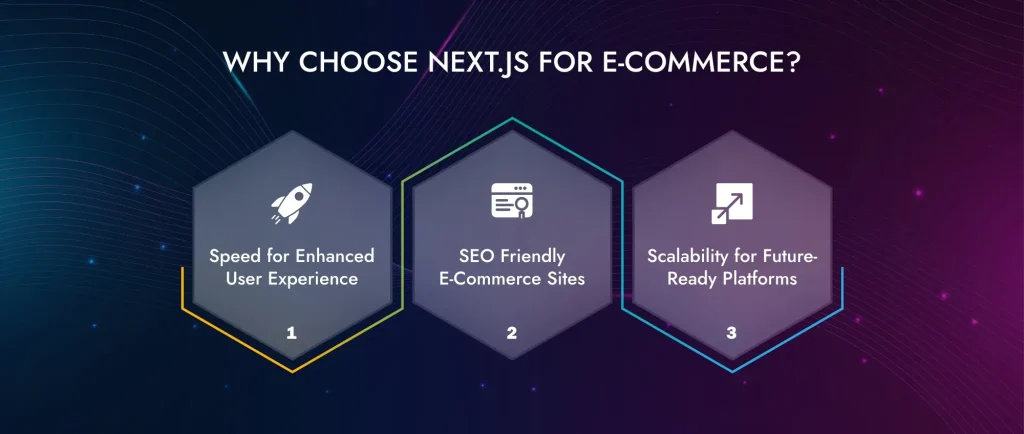
Why Choose Next.js for E-Commerce?

When it comes to e-commerce, the right technology stack can make or break a customer’s online experience. We choose Next.js for building e-commerce platforms that meet the demands of both users and search engines, delivering high-speed performance, SEO optimization, and scalability all essential for today’s dynamic digital marketplace.

Why Choose-Next.js for E-commerce

1. Speed for Enhanced User Experience

Next.js excels in delivering lightning-fast page load speeds by leveraging server-side rendering (SSR) and static site generation (SSG). These features allow pages to load instantly, providing a smooth browsing experience that keeps customers engaged and reduces bounce rates. In e-commerce, where even a one-second delay can impact conversions, Next.js ensures your site remains fast and responsive, even during peak traffic.

We build Next.js based e-commerce sites that prioritize performance to meet users’ high expectations. With techniques like code-splitting and image optimization, we create solutions that drive engagement and improve your bottom line.

2. SEO Friendly E-Commerce Sites

One of the critical challenges in e-commerce is standing out in search engine results. Next.js addresses this by supporting SSR and SSG, both of which enhance your site’s crawlability and indexing by search engines. Pages generated with SSR are readily available for search engine bots, allowing for faster indexing and higher rankings.

Additionally, Next.js provides advanced capabilities like dynamic rendering and metadata control, ensuring your site can rank for competitive e-commerce keywords. We understand that SEO is a long-term investment. With Next.js, our team crafts e-commerce solutions that help boost your organic search visibility, drive targeted traffic, and ensure that your products reach the right audience.

3. Scalability for Future-Ready Platforms

As your business grows, your platform must scale. Next.js is inherently scalable, making it an ideal choice for brands looking to expand their online presence. Its modular architecture and API routes enable seamless integrations with other platforms and headless CMS, allowing you to add new features and functionalities as your business needs evolve.

This scalability ensures that your e-commerce platform can handle increasing volumes of visitors and transactions without compromising performance. Our expert Next.js team designs e-commerce solutions that are built to scale with your business. Whether you’re launching new product lines, expanding to new markets, or adding personalized shopping experiences, our Next.js platforms adapt to your growth journey.

Transform Your Online Store with Next.js E-Commerce Solutions

Discover how Next.js can make your e-commerce site fast, SEO-friendly, and scalable.

How Next.js Stands Out Among Other Frameworks

While other frameworks like React or Vue.js are popular for front-end development, Next.js goes beyond by combining the flexibility of React with built-in SSR and SSG capabilities, making it more SEO-friendly and performance-oriented for e-commerce. Unlike traditional single-page applications (SPAs), which can suffer from slower initial loading times and SEO limitations, Next.js offers the best of both worlds: the speed and interactivity of SPAs with the SEO benefits of multi-page applications.

We stay on the cutting edge of technology to ensure our clients benefit from the latest advancements. Next.js’s combination of speed, SEO-friendliness, and scalability sets it apart as a powerful solution for e-commerce platforms that aim to perform at the highest level.

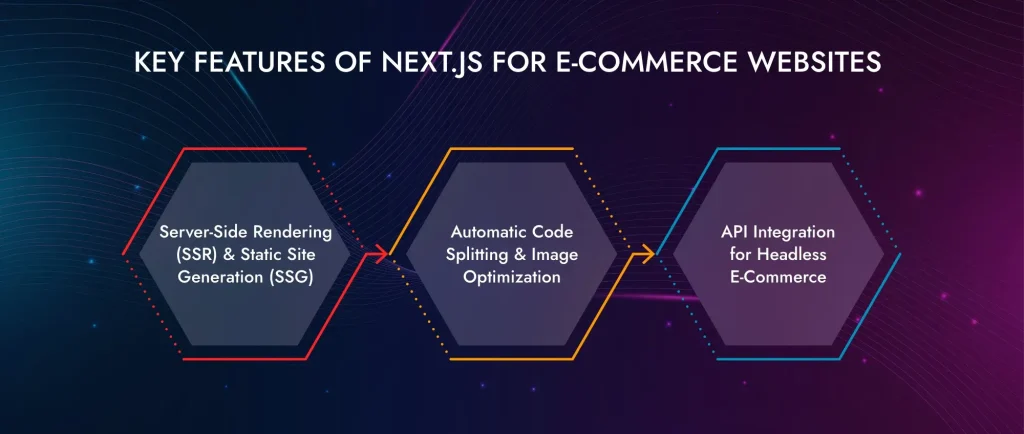
Key Features of Next.js for E-Commerce Websites

Next.js offers several powerful features that significantly improve e-commerce sites, focusing on speed, SEO, and flexibility.

Key Features of Next.js for E-commerce Websites

1. Server-Side Rendering (SSR) and Static Site Generation (SSG)

Next.js provides Server-Side Rendering (SSR) and Static Site Generation (SSG) options, both of which are essential for e-commerce websites aiming for speed and SEO. With SSR, pages are rendered on the server and delivered quickly to users, creating a faster browsing experience. This also makes it easier for search engines to crawl, helping boost your site’s SEO. SSG, on the other hand, generates pages at build time, allowing users to load them instantly. We strategically use SSR and SSG based on page types, ensuring high performance and optimal search engine visibility.

2. Automatic Code Splitting and Image Optimization

To enhance loading times, Next.js uses automatic code splitting, which means only the necessary code for each page is loaded. This reduces the load on users’ browsers and speeds up the site overall, improving the user experience. Image optimization in Next.js is another critical feature that adjusts image sizes dynamically, reducing loading times without sacrificing quality. Together, these features boost SEO rankings and keep customers engaged a priority for us in every e-commerce project.

3. API Integration for Headless E-Commerce

Next.js excels in integrating with headless CMS and third-party tools, which is ideal for building flexible, scalable e-commerce platforms. This means you can seamlessly connect Next.js with a headless CMS like Contentful or Shopify’s API to manage content and product data efficiently. Our experts leverage Next.js’s API routes to create custom solutions customized to your needs, allowing easy expansion and adaptability as your e-commerce business grows.

Build a Next.js E-Commerce Store That Shines

Partner with us to create an online store that attracts more customers and boosts conversions.

How to Create a Scalable E-Commerce Platform with Next.js

Creating a scalable e-commerce platform with Next.js involves leveraging its powerful features and flexible architecture. At ViitorCloud, we focus on implementing a modular design and integrating headless CMS and APIs to ensure rapid deployment and easy maintenance.

Starting with a Next.js e-commerce template provides a strong foundation, especially for projects that require fast deployment without compromising on quality. Templates come pre-built with key features, such as SEO settings, responsive design, and performance optimizations, which can save time and resources.

When choosing a template, look for SEO-friendly setups (like clean URL structures and meta configurations) and scalability features that allow for future growth. We use highly customized templates for faster deployment that provide flexibility and align with our client’s specific e-commerce needs.

With a modular architecture, Next.js allows you to build reusable components that make your platform highly scalable and easier to maintain. Instead of rewriting code for similar features, modularity enables us to develop isolated components for functions like product listings, reviews, and checkout.

This will speed up development and also keep the code organized and simplify updates, allowing you to scale quickly. We emphasize this approach to ensure that your e-commerce platform remains agile and future-ready.

For e-commerce platforms that need flexible content management, integrating headless CMS options like Shopify, WooCommerce, or Contentful with Next.js can be transformative. These CMS solutions provide easy access to your product data and content via APIs, enabling seamless updates without heavy development work.

This setup also allows for a “headless” approach, where the front end and back end are decoupled, giving you more control over design and functionality. Our team builds headless e-commerce solutions that allow clients to add or modify content quickly, ensuring the platform scales smoothly as their business grows.

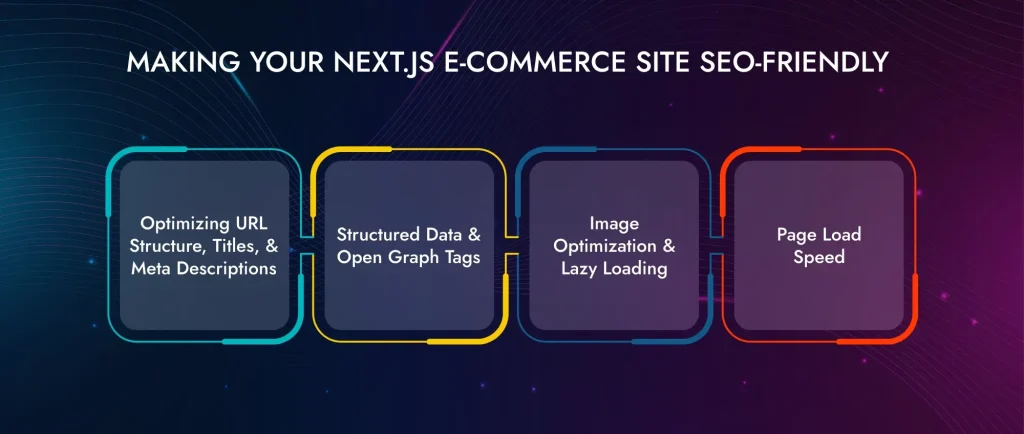
Making Your Next.js E-Commerce Site SEO-Friendly

Optimizing your e-commerce site for search engines is crucial for attracting traffic and driving sales. At ViitorCloud, we utilize Next.js to implement effective SEO strategies that enhance your site’s visibility.

Making your Next.js E-commerce Site SEO Friendly

1. Optimizing URL Structure, Titles, and Meta Descriptions

A well-optimized URL structure, along with relevant titles and meta descriptions, is essential for e-commerce SEO. Next.js allows you to create clean, concise URLs that include keywords, improving both user experience and search engine visibility. Additionally, optimizing titles and meta descriptions with target keywords helps attract clicks from search results. We follow these SEO best practices to ensure each product page is structured to enhance visibility and relevancy in search engines.

2. Structured Data and Open Graph Tags

Adding structured data to your Next.js e-commerce site enables search engines to better understand and display your content in rich results. Product listings, ratings, and pricing information can appear directly in search results, increasing click-through rates. Open Graph tags help control how your pages appear on social media, ensuring consistency across platforms. Our developer integrates these elements to boost search visibility and create a cohesive online presence.

3. Image Optimization and Lazy Loading

Images are critical to e-commerce, but they can also slow down your site if not optimized. Next.js provides tools for image optimization by adjusting sizes based on device type and bandwidth, ensuring fast loading without compromising quality. Lazy loading further enhances speed by only loading images as users scroll down the page. We implement these features to keep your site fast and engaging, improving both user experience and SEO.

4. Page Load Speed

Page speed is a ranking factor for search engines, making it crucial for SEO success. Next.js optimizes load times through features like automatic code splitting and caching, allowing pages to load quickly even under heavy traffic. A fast-loading site not only ranks better but also keeps users engaged, reducing bounce rates. By leveraging these capabilities, we build Next.js e-commerce platforms that perform well in search results and offer a seamless experience to users.

Unlock Next.js Power for Your E-Commerce Success

Leverage Next.js for a seamless, high-performance, and SEO-optimized online shopping experience.

Building a Fast and Engaging User Experience

For e-commerce, speed and user engagement are non-negotiable. At ViitorCloud, we leverage Next.js to deliver exceptional performance and immersive user experiences that drive conversions.

To make your online store exceptionally fast, we integrate advanced Content Delivery Network (CDN) solutions and edge caching. By caching content closer to users, we minimize latency, leading to swift load times, even during peak traffic. Next.js’s compatibility with CDN and edge deployments allows us to ensure consistent performance, giving customers a seamless shopping experience from any location.

With a mobile-first approach, we design e-commerce sites that look and feel right on any device. Next.js supports responsive design by default, allowing us to craft mobile-optimized layouts that adapt seamlessly across screen sizes. This means your store remains accessible and engaging on smartphones and tablets, critical in today’s mobile-centric e-commerce world. Our team ensures that every feature, from browsing products to completing purchases, is fully optimized for mobile, providing an easy and enjoyable experience for every user.

To handle dynamic content without compromising speed, we utilize Next.js’s client-side rendering capabilities. This approach allows us to manage real-time updates such as live product inventories, personalized recommendations, and interactive elements without sacrificing performance.

By combining client-side and server-side rendering, we ensure that your store stays responsive while maintaining the necessary flexibility for tailored engaging customer experiences. We prioritize fast-loading pages that captivate users and drive conversions, leveraging Next.js to build high-performance e-commerce sites that exceed user expectations.

Partner with ViitorCloud to Build Your E-Commerce Store

At ViitorCloud, we’re here to help you build an e-commerce store that’s fast, optimized for search engines, and ready to grow with your business. Using Next.js, we create online stores that load quickly, rank well in search results, and deliver a smooth, engaging experience for every shopper.

Let’s work together to turn your e-commerce vision into reality. With us, you’ll have a reliable partner who understands how to use Next.js to build a store that performs well and meets your business needs. Let’s get in touch with our expert about your e-commerce idea.

Ready for a Next.js E-Commerce Upgrade?

Enhance your e-commerce site with fast, scalable, and user-friendly Next.js solutions.

Bottom Line!

Next.js offers great benefits for e-commerce by combining speed, SEO, and scalability into one powerful tool. It supports server-side rendering, works well with CDNs, and is designed for mobile users. This means your online store can provide a smooth and engaging experience that keeps customers coming back. At ViitorCloud, we use these features to build e-commerce platforms that perform well and adapt to your business needs.

If you’re thinking about using Next.js for your e-commerce project, now is the perfect time to get started. Whether you want to improve site speed, boost SEO, or prepare for future growth, Next.js has everything you need to create a successful online store. Let us help you take advantage of this powerful framework to build a store that stands out in the digital marketplace.


Frequently Asked Questions

ViitorCloud leverages Next.js to build high-speed, scalable e-commerce platforms using server-side rendering and static site generation, ensuring smooth performance as your business grows.

Our Next.js e-commerce solutions leverage server-side rendering and optimized structures to boost search visibility. We enhance SEO with clean URLs, meta descriptions, and structured data to drive targeted organic traffic.

Yes, ViitorCloud integrates headless CMS platforms like Shopify and Contentful, allowing you to easily manage and update content. This setup enhances flexibility, making your site scalable and easy to maintain.

Our Next.js e-commerce solutions focus on fast loading speeds, SEO optimization, and a smooth user experience all essential for reducing bounce rates and increasing conversions, ultimately driving more sales for your business.

How to Choose an AI Services Company

Businesses must strike a balance between innovation and customer satisfaction to achieve sustainable growth. While innovation enhances efficiency and productivity, customer satisfaction drives sales. This is where AI services come into play, bridging the gap between meeting customer expectations and fostering innovation.

AI technologies, such as chatbots and data analytics, not only enhance customer interactions but also facilitate product improvements based on feedback. Furthermore, AI automates manual processes, mitigates cybersecurity risks, and leverages data analytics for informed decision-making.

When seeking to integrate AI into your business, selecting a reliable partner is crucial. Here’s how to choose the right AI development company and the benefits of partnering with an expert in AI development services.

CHECK: AI in Business | Prepare Your Business for the Future

How to Choose the Best AI Services Company

Adopting AI technology is no longer optional; it has become essential for businesses aiming to thrive. Research indicates that 75% of entrepreneurs believe AI opens new opportunities, with 91% of leading companies investing in AI solutions.

To navigate this landscape effectively, consider the following steps:

How to Choose the Best AI Development Company

1. Define Your Project Requirements

Before searching for an AI services provider, clearly define your project needs. Whether you require generative AI services, custom web app development, or market automation, having well-defined requirements will guide you in selecting the right partner.

2. Research Potential Companies

Once you have outlined your project requirements, research companies that specialize in those areas. Visit their websites and seek references from colleagues or industry experts. Compile a list of potential partners that align with your needs.

3. Assess Technical Expertise

Evaluate the technical capabilities of the companies on your list. Look for expertise in relevant AI tools and technologies that match your project requirements. Review their case studies, software development practices, client references, and portfolios to gauge their proficiency.

4. Review Project Management and Communication

Effective project management and communication are vital for successful collaboration. Inquire about the company’s project management processes and how they track progress. Clear communication ensures you stay informed about developments throughout the project lifecycle.

5. Request and Evaluate Proposals

After narrowing down your options, request proposals from your shortlisted companies. A comprehensive proposal should outline timelines, project scope, budget estimates, and other critical details. Compare these proposals to find one that aligns with your requirements and offers transparency.

6. Check Reviews

Investigate client reviews and testimonials to gain insights into each company’s communication style, work ethics, and project management skills. This information will help you make an informed decision.

7. Evaluate the Cost of AI Development Services

Finally, consider the cost of services offered by potential partners. Pricing can vary based on location, technology stack, project size, and complexity. Many companies provide free quotations tailored to your project’s needs, making it easier for you to assess costs.

By following these steps, you can confidently choose the right AI development services partner to integrate AI into your business effectively.

AI Services for Your Business.

Discover how ViitorCloud’s AI Services empower your business with innovative solutions tailored to your goals.

Benefits of Partnering with an AI Development Company

Choosing an experienced AI services partner offers numerous advantages that can significantly impact your business growth:

Benefits of Partnering with an AI Development Company

An established AI development company brings specialized knowledge in advanced technologies such as natural language processing, machine learning, and computer vision. Their experience across various industries equips them to tackle specific challenges effectively.

AI companies streamline development cycles and optimize resource allocation to build effective AI components swiftly. This agility allows businesses to meet market demands promptly.

With continuous learning and optimization techniques like neural networks and deep learning, an AI partner can refine algorithms to improve accuracy in tasks such as predictive analytics and image recognition.

An expert in AI development services can help scale your business by leveraging machine learning algorithms and cloud computing technologies. They tailor solutions to meet your unique business objectives and data resources.

Post-launch support is crucial for ensuring the optimal performance of AI systems. A reliable partner will provide ongoing maintenance services, monitor key performance indicators, address issues promptly, manage data security, and ensure compliance with privacy regulations.

Choose the Right AI Partner with Confidence

Explore ViitorCloud’s expert AI Services designed to drive growth and enhance efficiency.

Accelerate Your Business Growth with ViitorCloud

At ViitorCloud, we understand that leveraging AI solutions is key to accelerating your business growth. Our comprehensive range of customized AI development services is designed to enhance data analysis processes, automate tasks, personalize customer interactions, and optimize operations.

If you’re looking for a trusted partner to elevate your business through innovative AI solutions, look no further than ViitorCloud. Our team of experts excels in project management communication skills tailored to your specific needs.

Contact us today for a consultation and discover how our tailored solutions can transform your business!


Frequently Asked Questions

When choosing an AI company, define your project requirement first, then research potential companies, assess technical expertise, review project management and communication, request and evaluate proposals, check reviews, and evaluate the cost of AI development services.

When you choose an AI service company, consider factors such as the expertise of a person in the industry. Also, check track of successful projects, proficiency in AI technology, communication skills, and costing.

The leading companies in AI services include ViitorCloud, Amazon, Microsoft, Google, OpenAI, and IBM. ViitorCloud is committed to driving innovation and efficiency through its expert AI solutions, making it a key player in the evolving landscape of artificial intelligence.

How Digital Transformation in Customer Experience Makes a Big Impact

Nowadays, businesses are recognizing the power of digital transformation in customer experience (CX), which can enhance the overall customer journey. With time, customer expectations are rising, and organizations must embrace digital transformation to offer personalized, engaging, and overall better digital experiences across various touchpoints. 

This not only enriches the customer experience but also enhances the brand image. With modern technologies, we will see even more options that transform the customer experience. ViitorCloud helps businesses offer engaging and innovative customer experiences. Check out our latest digital experience solution on LinkedIn

Now, let’s discuss how digital technologies can make the digital customer experience better. 

Check: Importance of Digital Experience Monitoring Solutions 

The Significance of Transforming Customer Experience 

So, it goes without saying that customer experience has made a lot of difference in today’s market, where it is hard to attract and retain customers. Forrester’s 2024 US Customer Experience Index states that companies with better customer experience quality see 41% faster revenue growth.  

And digital transformation has completely changed how businesses approach customer experience. With proper utilization of advanced technologies and data analytics, they can make customer interaction better, which leads to loyalty, better business performance, and customer satisfaction. 

A McKinsey study states that a customer experience digital transformation can generate a 20-30% increase in customer satisfaction, a 10-20% improvement in employee satisfaction, and 20-50% economic gains of the cost base addressed in various journeys. Other important statistics show: 

These statistics clearly show the importance of prioritizing customer experience transformation. With the right digital transformation strategies, businesses can understand what customers need, their preferences, and their behaviors. Such data insights allow businesses to create customer experiences that attract new customers, retain existing ones, drive repeat purchases, and eventually increase revenue. 

Transform your customer experience with our innovative digital solutions. Enhance engagement and drive growth today.

Impact of Digital Transformation on Customer Experience 

As stated in the previous section, businesses need to go through digital transformation and embrace various advanced technologies to offer better CX. Here’s how the impact of digital transformation in customer experiences can transform the way companies interact with their customers and shape the future of customer experience: 

1. Personalization and Hyper-Personalization 

Personalization is now considered for customer experiences. With available customer data and insights, businesses can design their offerings, content, and interactions to individual preferences and needs. Redpoint and Harris found that 54% of consumers are willing to share personal data for a superior experience. 

Taking personalization to the next level, hyper-personalization uses advanced data analytics, AI, and real-time data to offer highly contextualized and individualized experiences. This level of personalization not only enriches customer satisfaction but also increases loyalty and repeat business. 

2. Instant Service and Self-Help with AI and ML 

Artificial Intelligence (AI) and Machine Learning (ML) are obviously transforming the way businesses interact with customers. Organizations can automate processes, integrate new systems, and use predictive analytics to forecast customer demand and deliver proactive support with the proper use of AI and ML. 

Chatbots, powered by AI, are a great example here as they provide 24/7 customer support, engage in conversational interactions, and resolve queries without human intervention. According to ChatBotsMagazine, chatbots can trim customer support service by 30%. 

3. Customer Journey Mapping 

Digital transformation in customer experience helps map the customer journey. Customer journey mapping is a powerful tool for visualizing and understanding the multiple touchpoints a customer interacts with on their path to purchase. With this, businesses can identify pain points, optimize experiences at each stage, and create strategies to satisfy customer expectations. 

Customer journey maps allow businesses to analyze actual customer needs, compare the actual experience with benchmarked standards, and analyze the buying funnel as customers move through various stages. Such insight allows businesses to personalize services and create meaningful connections with customers. 

4. Omnichannel Customer Engagement 

Customers expect smooth experiences across multiple channels and devices. Omnichannel customer engagement involves integrating various touchpoints, such as websites, mobile apps, social media, and physical stores, to provide a unified brand experience. 

Salesforce reports that 60% of customer touchpoints now take place online, which shows the importance of digital channels in the customer journey. With an omnichannel approach, businesses can ensure that customers can easily switch between channels while maintaining their preferences, shopping carts, and browsing history. 

5. Voice and Conversational Interfaces 

Voice-activated devices and conversational interfaces are transforming how customers interact with businesses. The convenience and accuracy of voice recognition technology are driving its adoption in customer service and beyond. 

Voice assistants like Amazon’s Alexa, Google Assistant, and Apple’s Siri are being integrated into customer service strategies. This allows customers/users to perform tasks, make inquiries, and receive support through voice commands. Advanced chatbots and voice bots, powered by artificial intelligence capabilities, can understand and respond to complex queries and provide human-like interactions to handle various queries. 

Revolutionize your customer interactions with advanced digital solutions that enhance satisfaction and loyalty.

Customer Experience Technology Examples 

To highlight the practical applications of digital technology in transforming customer experience, here are some examples: 

1. Generative AI and Machine Learning 

In the last few years, AI has become very important to Gen Z and millennial customers for better experience. A Gartner report predicts that by 2025, 80% of customer service and support organizations will be using generative AI in some way or another. Here’s how AI is transforming customer experience: 

Chatbots and Virtual Assistants 

  • 24/7 customer support availability 
  • Instant response to common queries 
  • Reduction in support costs by up to 70% 

Predictive Analytics 

  • Anticipating customer needs 
  • Personalizing recommendations 
  • Preventing customer churn 

2. Omnichannel Experience Technology 

Modern customers expect seamless interactions across all touchpoints. Research shows that 73% of customers prefer businesses that use multiple channels to reach them and offer personalized experiences. Main components include: 

  • Consistent but not irritating messaging across channels 
  • Seamless transition between devices 
  • Integrated customer history 

3. Conversational User Interfaces (CUIs) 

Conversational User Interfaces can completely change how customers interact with businesses. This technology is already showing impressive results, with businesses reporting up to 35% improvement in customer satisfaction scores when using advanced CUIs. 

Benefits for Businesses: 

  • Reduced customer service response times 
  • Improved self-service adoption rates 
  • Customer engagement through natural conversations 
  • Integration with existing customer service platforms 

4. Mobile-First Technologies 

With 54% of global internet traffic coming from mobile devices, according to Statista, mobile optimization is important to make the customer experience better and even to reach them. 

Mobile Experience Enhancement 

  • Responsive design 
  • Fast loading times 
  • Simplified navigation 

5. Augmented and Virtual Reality 

AR and VR are revolutionizing how customers interact with products and services. One of the biggest and most popular examples is the IKEA app. Augmented reality within the IKEA app allows users to see how furniture would look in their house. This impacts customers’ buying decisions and makes their experience even better. 

Virtual Try-Ons 

  • Digital product visualization 
  • Interactive product demonstrations 
  • Immersive shopping experiences 

Drive business growth by transforming customer experiences through innovative digital technologies and insights.

The Future of Customer Experience in the Digital World 

As we are crossing the first half of this decade, the future of customer experience seems even more transformative. New techs like 5G, extended reality (XR), and edge computing will make the impossible possible in terms of customer experiences. 

5G  

5G networks across the world will provide even faster internet connectivity on the go and this will open doors for virtual try-ons and immersive product demos anytime, anywhere. 

XR 

Extended reality, combining virtual reality (VR), augmented reality (AR), and mixed reality (MR), will blur the lines between the physical and digital worlds. Customers will be able to interact with products and services in entirely new ways, and we offer AR, VR, and MR Development Services.

Edge Computing  

This will put data processing even closer to the source and reduce latency. Eventually, it will empower businesses to provide more personalized experiences based on customers’ location, behavior, and preferences. 

Also Read: 10 Ways AI Will Improve Customer Experience in 2024?

Elevate your customer journey with cutting-edge digital transformation strategies for unparalleled engagement.

Final Words 

Hence, we can say that new digital technologies have the power to transform customer experience in many innovative ways. With the right use of digital transformation in customer experience, businesses can build long-term relationships with customers and enhance their experience. 

ViitorCloud can be your trusted partner in this journey. With our expertise in AI, AR/VR, IoT, and other emerging technologies, we can help you offer a better customer experience to improve your brand image and engage customers for more. Contact us and learn how we can help you transform your customer experience and drive business growth. 


Frequently Asked Questions

Digital transformation improves customer experience by using techs like AI and machine learning to offer personalized, seamless interactions across multiple touchpoints. This transformation allows businesses to meet rising customer expectations effectively- meaning increased satisfaction and loyalty.

For customers, digital transformation means more personalized and convenient experiences. It involves businesses using technology to customize interactions and services to individual preferences for a more engaging and efficient customer journey.

Customer experience transformation involves a strategic overhaul of how businesses engage with customers across all touchpoints. It requires reimagining processes, integrating customer feedback, and adopting new technologies according to customer behaviors and expectations.

How to Prepare Your Business for the Future of AI in Business

In the era of rapid technological advancement, AI in business is becoming essential for enhancing operations and overall performance. Companies face challenges such as operational inefficiency and strategic decision-making, compounded by the vast amounts of data generated daily, which can overwhelm traditional analytical methods. AI excels in data analytics, effectively addressing these challenges.

Artificial Intelligence is paving the way for a future where chatbots and virtual assistants manage customer inquiries efficiently. Utilizing natural language processing, AI technology is transforming business operations to improve productivity and efficiency. According to Forbes Advisor, AI is projected to contribute $15.7 trillion to the global economy by 2030, with the Indian AI market expected to reach $3,935.5 million by 2028, reflecting a growth rate of 33.28% from 2023 to 2028.

Understanding the impact of AI in business is crucial for preparing your organization for a future driven by this technology. Establishing ethical policies and optimizing workflows are vital steps for companies aiming to thrive in an AI-enhanced environment.

Understanding the Impact of AI in Business

Artificial Intelligence is revolutionizing various industries by improving productivity, fostering innovation, and enhancing decision-making capabilities. It automates routine tasks, allowing employees to focus on more complex responsibilities, thereby boosting overall productivity. Additionally, AI algorithms analyze data to provide valuable insights into customer behavior, enabling businesses to make informed decisions.

Key benefits of AI in business include:

  • Personalization of messages and product recommendations through chatbots, enhancing customer satisfaction.
  • Predictive analytics that forecast customer behavior and market trends, optimizing inventory management and marketing strategies.
  • Competitive advantages gained through improved market understanding and targeted campaigns.
  • Enhanced security measures against malware, phishing attacks, and spam emails.
  • Streamlined supply chain processes through automation.

These advantages illustrate how AI in business is transforming sectors such as healthcare, finance, and technology.

Unlock Your Potential with AI in Business

Prepare your business for the future of AI in business. Discover how our AI development services can transform your operations and drive innovation.

Our 7-Step Process for Businesses to Prepare for the Future with AI

Integrating AI in business requires careful planning and execution to ensure success. AI also helps organizations to reduce costs, improve efficiency, and gain a competitive edge.

Here’s a seven-step process designed to help organizations prepare for an AI-driven future:

7-Step Process for Businesses to Prepare for the Future with AI

1. Define Your Business Goals

Clearly outline the objectives of integrating AI into your operations. Determine what specific problems you aim to solve with AI and identify metrics for improvement, such as productivity or customer satisfaction.

2. Identify the Right Data Sources

Since AI relies heavily on data for accurate predictions and decisions, identifying both internal (CRM systems, supply chains) and external (social media feeds) data sources is essential. Ensure that all data is accurate, relevant, and up-to-date.

3. Choose the Right Resources for AI Development

With numerous AI tools available, selecting those that align with your business needs is crucial. Consider factors such as cost, user-friendliness, and the expertise of development service providers when choosing technologies like natural language processing or machine learning algorithms.

4. Develop a Strong Data Strategy

A robust data strategy is vital for implementing AI in business effectively. This includes planning for data storage, collection methods, analysis processes, privacy measures, and governance policies.

5. Train and Educate Your Team

Equip your team with the necessary skills and knowledge to work with AI systems. Invest in training programs focused on machine learning and data science to ensure your workforce can leverage these technologies effectively.

6. Start Small and Scale Up

Begin by implementing AI solutions in a specific department before expanding across the organization. This phased approach allows for manageable integration while minimizing disruption.

7. Monitor Performance and Make Adjustments

Continuously assess the performance of your AI systems by analyzing metrics such as speed, accuracy, and efficiency. Gather user feedback regularly to make necessary adjustments that enhance system performance.

This structured approach will facilitate the successful integration of AI in business, leading to significant benefits.

Transform Your Operations with AI Solutions

Prepare your business for the future of AI in business. Partner with us to implement cutting-edge AI solutions that enhance efficiency and decision-making.

How ViitorCloud Helps Businesses Become Future-Ready with AI

The future of AI development in business is set to revolutionize operational efficiency and enhance strategic decision-making through the power of predictive analytics and automation. By harnessing cutting-edge technologies such as computer vision and machine learning, companies can streamline processes and improve decision-making across various industries.

At ViitorCloud, we are dedicated to being your trusted partner in this transformative journey toward implementing AI solutions in business. Our expertise in AI development services allows us to guide organizations in selecting the most suitable tools tailored to their unique requirements. With our support, your business will be equipped to excel in an increasingly competitive landscape shaped by artificial intelligence.

If you’re ready to integrate AI solutions into your operations, we are here to provide expert guidance at every stage. We specialize in delivering innovative AI solutions in business, particularly for the energy sector, ensuring your organization is prepared for the future with state-of-the-art technology.

Choose ViitorCloud as your partner for AI development services, and let us help you achieve your business goals. If you’re looking to utilize AI for success in your organization, feel free to connect with us on LinkedIn!


Frequently Asked Questions

They are implementing AI in the business by identifying areas for automation or insight generation. Additionally, AI tools should be chosen to integrate them into existing systems and continuously optimize the system with data insights. These data insights help in improving operations, customer experiences, and decision-making.

AI business strategy helps businesses to improve customer engagement with chatbots. Additionally, automated tasks of the business processes and optimized operations with data analytics were performed. As a result, it improves productivity and efficiency.

AI-powered future with machine learning advancement, edge computing integration, and increased data availability. Additionally, it will improve transparency with the AI frameworks.

Generative AI in React: Smarter UIs with Vercel AI SDK 3.0

Generative AI in React is revolutionizing web development, delivering productivity gains of up to 50% and speeding up routine tasks by 96% as per our market research. With tools like Vercel AI SDK 3.0, developers can automate repetitive processes, freeing time to focus on building more engaging, dynamic UIs.

This AI-driven approach empowers teams to create responsive web experiences that intelligently adapt to user needs, boosting engagement and raising the bar for modern applications. By leveraging generative AI, developers set a new standard for efficiency and innovation in web development.

What is Generative AI?

Generative AI is a subset of Artificial Intelligence that focuses on creating new content, designs, and solutions based on patterns learned from extensive datasets. Unlike traditional AI, which primarily analyzes and classifies existing data, generative AI can produce original outputs such as text, images, music, and even code. This technology employs machine learning algorithms, particularly deep learning models, to understand complex data patterns and generate creative outputs autonomously.

Significance of Generative AI in Modern Applications

Generative AI holds transformative potential across various industries:

Generative AI In Modern Applications
  1. Content Creation: Tools like ChatGPT and DALL-E exemplify generative AI’s ability to produce high-quality written and visual content rapidly. This capability enhances productivity by automating tasks that previously required significant human effort.
  2. Personalization: Generative AI enables businesses to customize experiences for users by analyzing behavior and preferences. For instance, streaming services like Netflix use generative algorithms to recommend shows based on user history, enhancing engagement.
  3. Research and Development: In fields like healthcare, generative AI accelerates drug discovery by simulating molecular interactions and generating new protein sequences. This capability can lead to faster innovations in pharmaceuticals.
  4. Design Automation: In UI/UX design, generative AI assists designers by creating multiple design variations quickly. It automates repetitive tasks, allowing designers to focus on strategic decision-making and creativity.

How Generative AI Enhances User Interfaces and Experiences

Generative AI significantly improves user interfaces (UI) and user experiences (UX) through several key mechanisms:

  1. Personalized User Experiences: By leveraging user data, generative AI can create customized interfaces that adapt to individual needs. This personalization leads to more intuitive interactions and increased user satisfaction.
  2. Automated Design Processes: Generative AI tools can generate design templates, prototypes, and wireframes based on user behavior analysis. This automation reduces manual work and accelerates design iterations.
  3. Real-Time Data Insights: Generative AI provides designers with actionable insights by analyzing user interaction patterns. This data helps identify pain points in the user experience, enabling quick adjustments for improved usability.
  4. Accessibility Improvements: Generative AI enhances accessibility by adapting content for users with varying abilities. It can create gesture-based controls or modify layouts to ensure a more inclusive experience.
  5. Enhanced Aesthetics: By suggesting design adjustments based on user preferences and trends, generative AI helps refine UI aesthetics. This ensures that designs remain visually appealing while meeting functional requirements.

Elevate Your User Experience with Generative AI

Integrating Vercel AI SDK 3.0 can transform your React apps. Let ViitorCloud bring smarter, intuitive UIs to life with cutting-edge Generative AI solutions.

Introduction to Vercel AI SDK 3.0

The Vercel AI SDK 3.0 is an innovative, open-source toolkit designed to empower developers to create AI-powered user interfaces (UIs) with frameworks like React, Next.js, and Svelte. This SDK stands out due to its robust feature set that simplifies the integration of artificial intelligence into web applications, allowing for the development of dynamic and responsive UIs.

Overview of New Features

The Vercel AI SDK 3.0 introduces several key features that enhance its functionality:

  • Framework Compatibility: It supports multiple frameworks, including React/Next.js, boosting React AI integration, along with Svelte/SvelteKit, with plans for expanding to Vue/Nuxt.
  • Streaming Capabilities: The SDK enables real-time data streaming through hooks such as useChat and useCompletion, allowing developers to build interactive smart UIs and manage text completions effortlessly.
  • Generative AI Features: Developers can dynamically generate UI components based on user interactions, enhancing engagement by tailoring responses in real-time, crucial for building AI in React applications.
  • Integration with Leading AI Providers: The SDK seamlessly connects with popular AI models from OpenAI, Hugging Face, and Anthropic, providing a unified API for generating text and structured objects, ideal for React AI projects.
  • Edge and Serverless Ready: It is designed to work with Vercel’s serverless architecture, allowing applications to scale efficiently while maintaining low latency, making it an optimal solution for AI SDK React implementations.

A Game-Changer for Developers

The Vercel AI SDK is a game-changer for developers building AI-powered UIs due to its ease of use and powerful capabilities. By abstracting complex integrations with various AI models, the SDK allows developers to focus on building engaging smart UIs rather than managing the underlying infrastructure. Its framework-agnostic approach means that developers can utilize familiar tools while harnessing the power of Generative AI.

Moreover, the SDK’s support for real-time streaming and dynamic component generation enables the creation of applications that are not only responsive but also highly interactive. This capability is crucial in today’s digital landscape, where user expectations for seamless interactions are higher than ever. The integration of Vercel AI tools makes it easier for developers to create React UI components that respond intelligently to user inputs.

Vercel AI Tools for Efficient React Integration

We use several tools within the Vercel ecosystem + Cursor AI which complement the Vercel AI SDK for efficient React AI integration:

  • useChat Hook: This hook simplifies the process of managing chat states and responses, allowing developers to implement chat interfaces with minimal code, a vital tool for building smart UIs.
  • useCompletion Hook: It facilitates handling text completions from AI models, automatically updating the React UI as new data arrives, making AI SDK React development more efficient.
  • Chat & Prompt Playground: An interactive platform that allows developers to experiment with different models and parameters in real time, streamlining the development process from concept to deployment using Vercel SDK.

The Vercel AI SDK 3.0 equips developers with the necessary tools to create sophisticated AI-driven applications efficiently. By leveraging its features, developers can build smarter UIs that enhance user engagement and streamline application performance. For more detailed information about getting started with the Vercel AI SDK.

Laverage Generative AI in Your UI

Use the potential of Vercel AI SDK to create responsive, intelligent interfaces. Partner with ViitorCloud to explore innovative AI Development Services tailored to your needs.

Integrating Generative AI in React

Integrating Generative AI into React can transform business applications, enabling real-time personalization, automation, and intelligent user interactions. At ViitorCloud, we specialize in providing AI solutions to enhance user experience and drive business value.

How ViitorCloud Can Help

ViitorCloud Integrating Generative AI In React
  1. Custom AI Solutions: We design customized AI components that integrate seamlessly into your React applications, from chatbots and predictive analytics to dynamic content generation, leveraging tools like the Vercel SDK.
  2. Expert Implementation: Our team leverages advanced tools like the Vercel AI SDK and OpenAI APIs, enabling features such as real-time data streaming, adaptive React UI elements, and multimodal content support.
  3. Scalable AI Architectures: We build scalable, robust AI-driven systems optimized for high performance, ensuring your applications can handle complex data processing and increased user demands with the support of AI SDK React technologies.
  4. End-to-End Deployment: From initial strategy and development to deployment on platforms like Vercel or Netlify, we offer comprehensive support to ensure seamless integration and rapid time-to-market using Vercel AI tools.

Use Cases We Deliver

  • AI-Powered Chatbots: Automate customer interactions with intelligent, context-aware responses using React AI solutions.
  • Predictive Dashboards: Visualize real-time insights for strategic decision-making powered by Generative AI.
  • Smart Content Management: Use Generative AI for automated tagging, content recommendations, and personalization, transforming how users interact with your platform.

Make Smarter UIs a Reality with Vercel AI SDK

Supercharge your React applications with Generative AI—ViitorCloud’s AI experts craft solutions that drive engagement and boost functionality.

Building Smart UIs with AI

Smart UIs refer to user interfaces that leverage artificial intelligence to enhance user interaction, personalization, and overall experience. These interfaces are capable of adapting in real-time to user inputs and preferences, making them more intuitive and engaging.

Role of AI SDK in React

The Vercel AI SDK plays a crucial role in building smart UIs within React applications. By providing a unified API for integrating various AI models, the SDK simplifies the process of creating dynamic and responsive user interfaces.

Key features include:

  • Generative UI Capabilities: The SDK allows for the on-the-fly generation of UI components based on user interactions, enabling a more personalized experience through generative AI.
  • Real-time Data Streaming: Hooks like useChat and useCompletion facilitate real-time updates, allowing applications to respond instantly to user inputs using AI SDK functionalities.
  • Framework-Agnostic Design: The SDK supports multiple frameworks, making it versatile for developers working with React, Next.js, and others.

Benefits of Using AI in React

Integrating AI in React applications offers several benefits for creating dynamic and responsive UIs:

  • Dynamic Personalization: AI algorithms analyze user behavior to tailor content and layouts, enhancing user satisfaction.
  • Conversational Interfaces: The integration of chatbots powered by natural language processing allows users to interact through voice or text, improving accessibility.
  • Predictive User Experience: By anticipating user needs based on historical data, AI can suggest relevant actions or content, creating a seamless experience.
  • Visual and Speech Recognition: Incorporating image and speech recognition capabilities enables users to interact with applications in more intuitive ways.

Key React AI Features for Smarter UIs

  1. useChat Hook: Manages real-time chat interactions, streamlining the integration of conversational interfaces powered by React AI.
  2. useCompletion Hook: Facilitates automatic updates as new content is generated by the AI SDK, ensuring a fluid user experience.
  3. Generative UI Technology: Enables the dynamic creation of UI elements based on user queries, significantly enhancing engagement through Vercel AI tools.
  4. Context-Aware Interfaces: React components can adjust based on user context, improving relevance and usability.

By leveraging these features from the Vercel AI SDK, developers can build smarter UIs that not only meet but exceed user expectations, leading to more engaging and effective web applications.

Revolutionize Your UI with Generative AI

Transform your digital experiences with ViitorCloud’s expertise in Vercel AI SDK integration. Lead in smarter UIs. Let’s innovate together!

How Vercel AI SDK Enables These Use Cases

The Vercel AI SDK simplifies the integration of generative AI into React applications by providing:

  1. Unified API Access: Easily connect to various AI SDK models, such as language models and predictive analytics tools, to implement diverse AI functionalities.
  2. Real-Time Interaction: Features such as useChat and useCompletion allow developers to build responsive applications that update dynamically based on user input.
  3. Generative UI Capabilities: The Vercel SDK enables developers to create smart UIs with AI that adapt based on user interactions, making interfaces more intuitive and personalized.

Why Choose Vercel AI SDK for React?

The Vercel AI SDK is a powerful toolkit tailored specifically for integrating Generative AI capabilities into React applications. It provides a robust foundation for building intelligent, dynamic user interfaces, making it the go-to choice for developers looking to implement React AI integration effectively.

  • Seamless Integration: The Vercel AI SDK is designed to work effortlessly with React UI and Next.js, allowing developers to incorporate AI features into their applications without complex configurations.
  • Real-Time Data Handling: With built-in hooks like useChat and useCompletion, developers can easily implement React AI features that fetch and render streaming responses from AI models, enhancing interactivity.
  • Interoperability: The SDK supports multiple large language models (LLMs), such as OpenAI and Hugging Face, offering flexibility in choosing the best AI SDK for specific business needs.
  • Edge and Serverless Ready: Optimized for deployment on Vercel’s serverless platform, the SDK ensures scalable, high-performance applications.
  • Streaming Capabilities: The Vercel AI SDK allows for real-time streaming of AI-generated content, elevating user experiences through immediate feedback and interaction.
  • Unified API: The Vercel SDK provides access to various LLMs through a single API, simplifying the process of integrating and managing different models.
  • Framework-Agnostic Hooks: While primarily used in React AI integration, the SDK includes hooks compatible with other frameworks like Svelte, enabling AI SDK React developers to implement Smart UIs with AI across multiple platforms.
  • Prompt Playground: Vercel’s interactive playground allows developers to experiment with different prompts and models, accelerating development and enabling quick iterations.

The Vercel AI SDK stands out for its ease of use, robust features, and flexibility, making it an excellent choice for React developers looking to integrate advanced AI capabilities into their applications efficiently.

Experience Next-Level UIs with Generative AI

ViitorCloud’s AI Development Services bring the advanced capabilities of Vercel AI SDK to your projects, enhancing user interaction like never before.

Partner with ViitorCloud

Unlock the power of AI in your applications with ViitorCloud. Our team brings expertise in using advanced AI tools like Vercel AI SDK 3.0 to create smarter, scalable solutions that connect with users and simplify processes. Partnering with us means gaining tailored, AI-driven applications that fit your needs and deliver seamless digital experiences. Connect with us to bring innovative AI solutions to your next project.

Bottom Line

Generative AI is changing how interactive web applications are built—automating complex tasks, personalizing in real-time, and boosting user engagement. With tools like Vercel AI SDK 3.0, adding these features to React apps becomes simple, helping developers build dynamic, intelligent applications.

With our AI development services, we help businesses use these technologies to create scalable, AI-driven solutions that transform digital experiences. Hire an AI developer and unlock the full potential of generative AI for your next project, driving innovation in your applications.


Frequently Asked Questions

Generative AI automates repetitive tasks, delivers personalized user experiences, and enables real-time interactions, leading to enhanced efficiency and improved customer engagement.

We implement stringent security measures and compliance standards (e.g., GDPR, CCPA) to safeguard data, ensuring all AI interactions are secure and aligned with industry regulations.

Absolutely. We design custom AI solutions to specific use cases, ensuring the solutions are aligned with your business goals and technical requirements.

We provide comprehensive support, including performance optimization, updates, and scaling assistance to ensure your AI-driven applications run smoothly and effectively adapt to evolving business needs.